Free MOT History Check UK: How To Check By Registration
Spot hidden faults and mileage fraud with a free mot history check uk. Learn how to check any vehicle's MOT records by registration to buy with confidence.

Free MOT History Check UK: How To Check By Registration
Every used car has a story, and the MOT history is one of the most revealing chapters. A free MOT history check UK drivers can access online shows you past test results, recorded mileage, advisory notices, and failure reasons, all tied to a single registration number. Whether you're about to buy a second-hand car or just want to keep tabs on your own vehicle's record, this data helps you spot potential problems before they cost you money.
At Vehiclepedia, we give you access to MOT history alongside a wider vehicle check that covers tax status, registration details, and more, using official data from sources like the DVLA. It's a practical starting point for anyone who wants to make informed decisions about a vehicle.
This guide walks you through exactly how to check a car's MOT history by registration, what the results mean, and how to use that information to your advantage. We'll also cover common red flags to watch for in MOT records and explain how this check fits into a broader vehicle history review when you're buying used.
What an MOT history check tells you
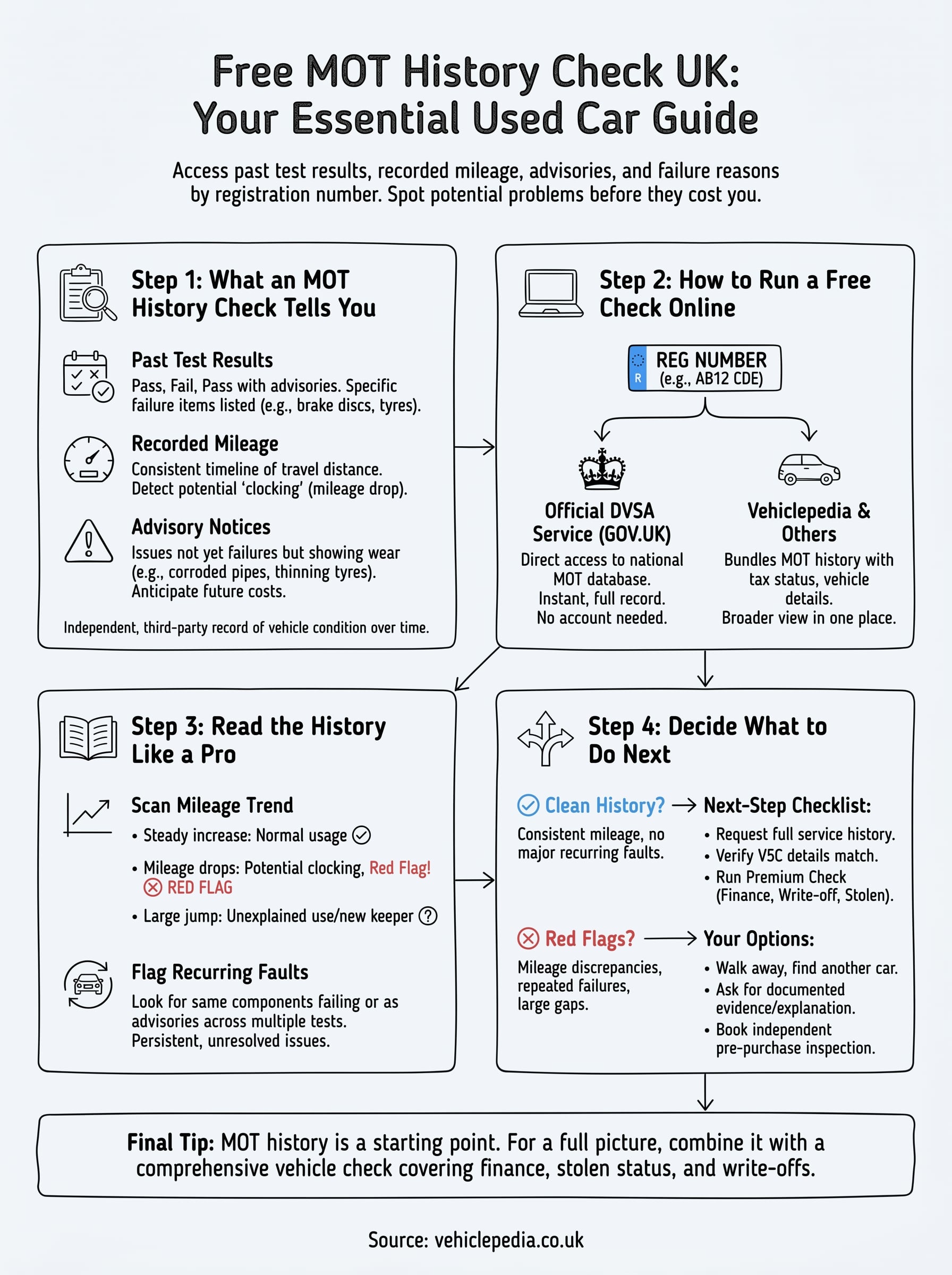
An MOT history check gives you a detailed record of every test a vehicle has gone through since 2005, when the DVSA (Driver and Vehicle Standards Agency) began keeping digital records. You can access this data free by entering the registration number through official channels. A free MOT history check UK buyers rely on covers far more than just a pass or fail verdict; it shows you the full picture of how a car has been maintained and used over time.
The MOT history is one of the few independent, third-party records of a vehicle's condition at regular intervals, making it one of the most reliable documents you can review before buying a used car.
Past test results and failure reasons
Each MOT entry shows you whether the car passed or failed, along with the exact date and the test centre that carried it out. When a vehicle fails, the record lists the specific items that caused the failure, such as brake disc wear, tyre condition, or lighting faults. This level of detail tells you what problems the car has had and whether the previous owner actually addressed them before the next test.
| Result | What it means for you |
|---|---|
| Pass | Vehicle met minimum safety standards on that date |
| Fail | Specific faults listed; check they were fixed before the retest |
| Pass with advisories | Minor issues noted; watch these areas for future deterioration |
Mileage records and advisories
Every MOT entry includes the recorded mileage at the time of testing, which gives you a consistent timeline of how far the car has travelled each year. If the mileage appears to drop between tests, that is a strong indicator of clocking, where the odometer has been tampered with to display a falsely low reading. Alongside mileage, advisory notices flag components that have not yet reached failure level but are showing wear, such as corroded brake pipes or thinning tyres. These advisories help you anticipate upcoming repair costs and build a much clearer picture of the car's real condition before you hand over any money.
Step 1. Gather the details you need
Before you run a free MOT history check UK buyers and owners use every day, you need just one piece of information to get started: the vehicle's UK registration number. That's the number plate, for example "AB12 CDE". In most cases, this is all the check requires, and you can pull up a full test history in seconds.
The registration number
Your registration number is the key that unlocks the entire MOT record. You'll find it on the front and rear number plates of the vehicle, on the V5C logbook (the vehicle registration certificate), on insurance documents, or on any previous MOT certificates. If you're looking at a car for sale, the seller should give you this immediately, and if they hesitate, that itself tells you something worth noting.
Never proceed with a used car purchase without first confirming the registration number matches the details shown on the V5C.
Here's a quick reference for where to locate the registration number:
| Document or source | Where to look |
|---|---|
| Number plates | Front and rear of the vehicle |
| V5C logbook | Top right corner of the document |
| MOT certificate | Listed alongside the vehicle details |
| Insurance documents | Policy schedule or certificate of insurance |
What if you don't have the V5C yet?
You do not need the V5C in hand to run an MOT history check. The registration number alone is sufficient to retrieve the full test record. However, when you eventually buy a vehicle, always request the V5C and cross-check that the reference number on the document matches the plates physically on the car before you commit to anything.
Step 2. Run a free MOT history check online
With your registration number ready, you can run a free MOT history check UK drivers and buyers use in a matter of seconds. There are two main routes worth knowing: the official government service and a vehicle check platform like Vehiclepedia, which bundles MOT history alongside additional vehicle data in a single lookup.
Use the official DVSA service
The DVSA provides a free tool on GOV.UK that gives you direct access to the national MOT database. You do not need to register or pay anything to use it. Follow these steps to retrieve the full record:
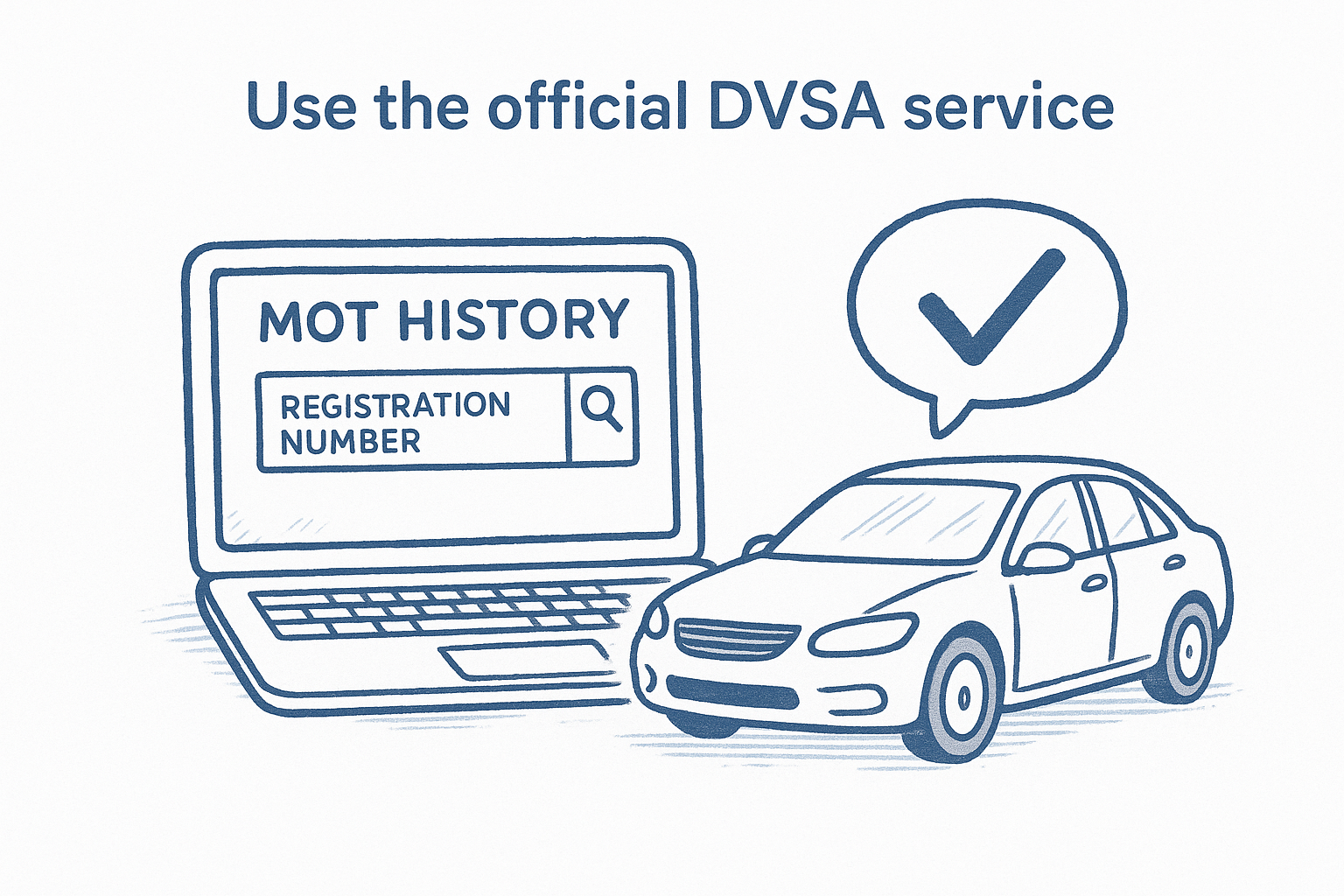
- Go to the MOT history checker on GOV.UK (search "check MOT history" on GOV.UK)
- Enter the full vehicle registration number in the search field
- Click "Search" and the complete MOT record loads immediately
- Review each entry, including the date, result, recorded mileage, and any specific faults or advisories listed
The government database updates after each test, so what you see reflects the most current official record for that vehicle.
Check with Vehiclepedia for more context
Running the check through Vehiclepedia gives you MOT history alongside tax status, registration details, and ownership records in a single report. Rather than visiting multiple sites to piece together the full picture, you get a broader view of the vehicle in one place. Enter the registration number into the search bar on the Vehiclepedia homepage and your results appear straight away, without creating an account or paying anything for the core data.
Step 3. Read the MOT history like a pro
Once your free MOT history check UK results load, you need to read them systematically rather than just glancing at pass or fail labels. The real value sits in the patterns across multiple entries, and knowing what to look for turns raw data into a clear picture of the vehicle's condition.
Look at the mileage trend
Start by scanning the mileage figures recorded at each test from oldest to most recent. A healthy vehicle should show a steady, consistent increase year on year. Use this simple check as your guide:
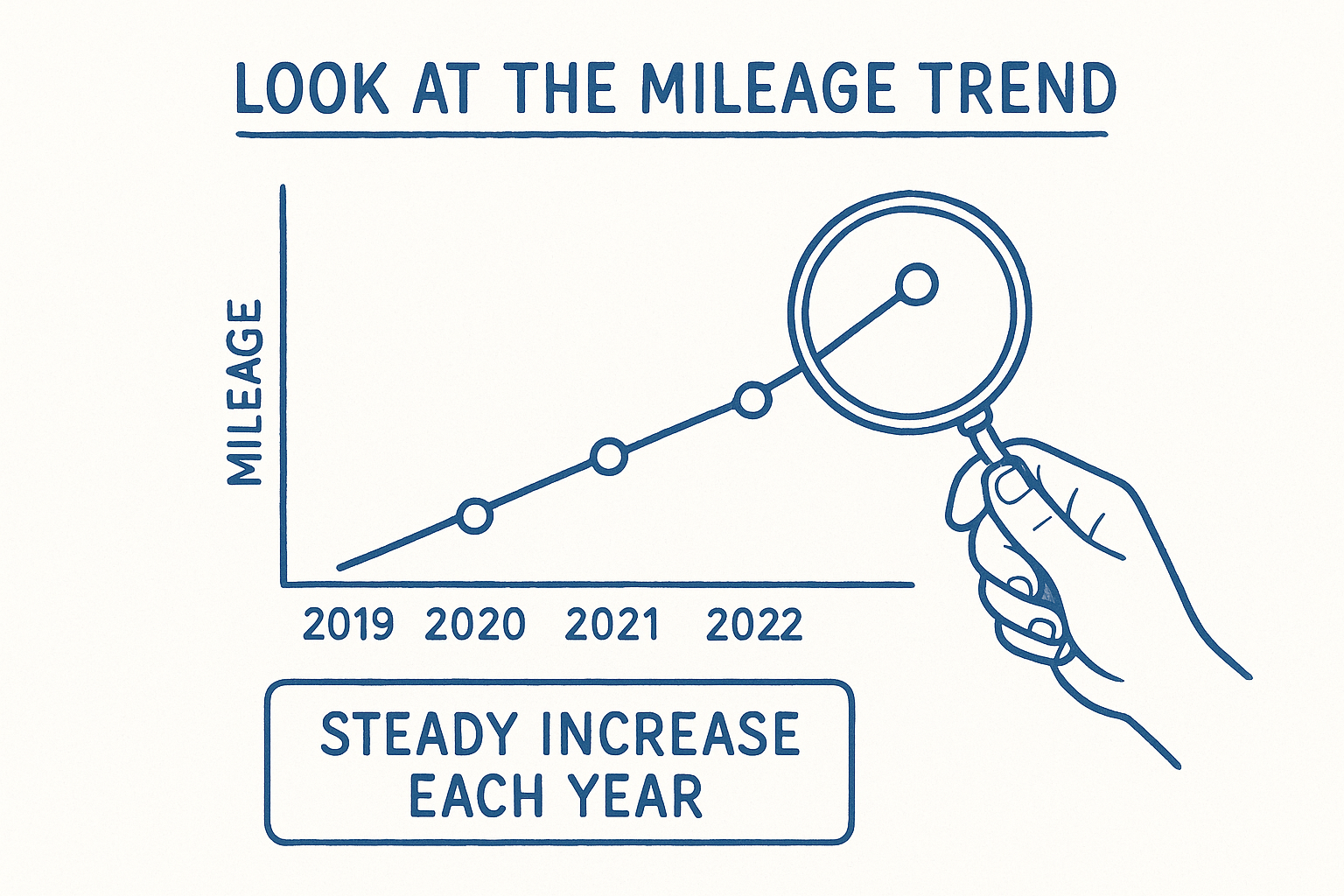
| Mileage pattern | What it suggests |
|---|---|
| Steady increase each year | Normal usage, no immediate concern |
| Mileage drops between tests | Potential clocking; treat as a serious red flag |
| Very low annual mileage consistently | Verify with service history; some cars genuinely cover little ground |
| Large unexplained jump in one year | Could indicate undisclosed heavy use or a new keeper |
If the mileage ever appears lower in a later entry than an earlier one, walk away from the vehicle until you receive a credible explanation supported by documentary evidence.
Flag recurring faults
Look at failure reasons and advisories across every entry, not just the most recent one. If the same component, such as brake discs or suspension components, appears repeatedly as a fault or advisory, that signals a persistent underlying issue the previous owner may not have fully resolved. Note each recurring item by name and ask the seller directly what work was carried out to address it.
Step 4. Decide what to do next
Once you've reviewed the results from your free MOT history check UK lookup, you need to turn that information into a clear decision. The data you've gathered tells you whether the car is worth pursuing further or whether it's time to move on and look elsewhere.
If the MOT history looks clean
A clean record with consistent mileage, no recurring faults, and only minor advisories is a positive signal, but it doesn't end your checks there. Use this as your next-step checklist:
- Request the full service history to confirm the car has been maintained between tests
- Verify the V5C details match the registration and MOT records
- Run a premium vehicle check to confirm there is no outstanding finance, no write-off markers, and no stolen status
A clean MOT history confirms the vehicle met minimum safety standards at each test date, not that it has been perfectly maintained in between.
If you spot red flags
Mileage discrepancies, repeated failures on the same components, or large unexplained gaps between tests are all reasons to pause before committing. Your options at this point are straightforward:
- Walk away and find a vehicle with a cleaner record
- Ask the seller to provide documented evidence of repairs and a credible mileage explanation
- Book an independent pre-purchase inspection with a qualified mechanic before handing over any money
Taking a systematic approach to this decision protects you from buying a vehicle that carries hidden costs or safety risks you didn't knowingly agree to take on.
Quick recap and next step
Running a free MOT history check UK buyers rely on takes less than a minute and gives you access to every recorded test result, mileage entry, failure reason, and advisory notice tied to a vehicle's registration. You now know where to find that data, how to read it systematically, and what to do when the record raises concerns.
The MOT history is a strong starting point, but it doesn't cover outstanding finance, stolen status, or write-off markers. Those risks can cost you significantly if you miss them before buying. To build the full picture, run a complete vehicle check that combines MOT data with the deeper history a basic lookup won't surface.
Take the next step and view a sample premium report to see exactly what a full Vehiclepedia check covers, and make sure no hidden risks slip past you before you commit to a purchase.