How Often Do Cars Fail the MOT? Rates and the 4 Top Causes
How often do cars fail MOT? About 4 in 10. See the failure rates, the 4 biggest causes and the checks that help you pass first time.
How Often Do Cars Fail the MOT? Rates and the 4 Top Causes
If you are asking how often do cars fail MOT tests in the UK, the answer is about 4 in 10 at the first attempt. Published figures run from 28% to 40%, depending on the year and how failures are counted. Lighting is the biggest single cause at 18.9% of failures, followed by suspension, brakes and tyres. Lights are the first check for every driver. Suspension matters most if you drive an older car or use pothole-heavy roads. Brakes and tyres are the checks nobody should skip.
An MOT fail costs you a repair bill, a retest and, if your old certificate has expired, the right to drive the car home. The DVSA says nearly half of the faults it finds could be avoided with simple maintenance, such as replacing bulbs, wipers and tyres. Below, you will find the failure rates side by side, then the four biggest causes ranked. Each comes with what testers fail and the checks you can run yourself.
Vehiclepedia is a UK vehicle history service, and MOT data sits at the centre of what we do. Our MOT history comes directly from the DVSA. You can enter any registration into our free MOT checker to see the full history, status, due date and mileage of a car.
How often cars fail the MOT
Around 37 in every 100 MOT tests end in a fail, and most published figures for first-time tests fall between 36% and 40%. The causes are mostly ordinary wear items, not rare mechanical faults.
The overall failure rate
The best-known numbers come from DVSA testing data. They differ because each covers a different year and counts tests differently, so read them as a range, not a single truth. For planning, assume between 1 in 3 and 4 in 10 cars fail first time.
- 2014/15: around 40% of cars failed at the first attempt.
- 2015/16: over 36% failed first time, equal to almost 7.8 million tests.
- More recent summaries: about 37% of tests end in a fail.
- Some sources quote a 71.8% pass rate, which implies roughly 28% failing. This is the low end of the range and probably reflects a different way of counting.
Plan on roughly 4 in 10 cars failing first time, with nearly half of the faults avoidable.
Share of failures by cause
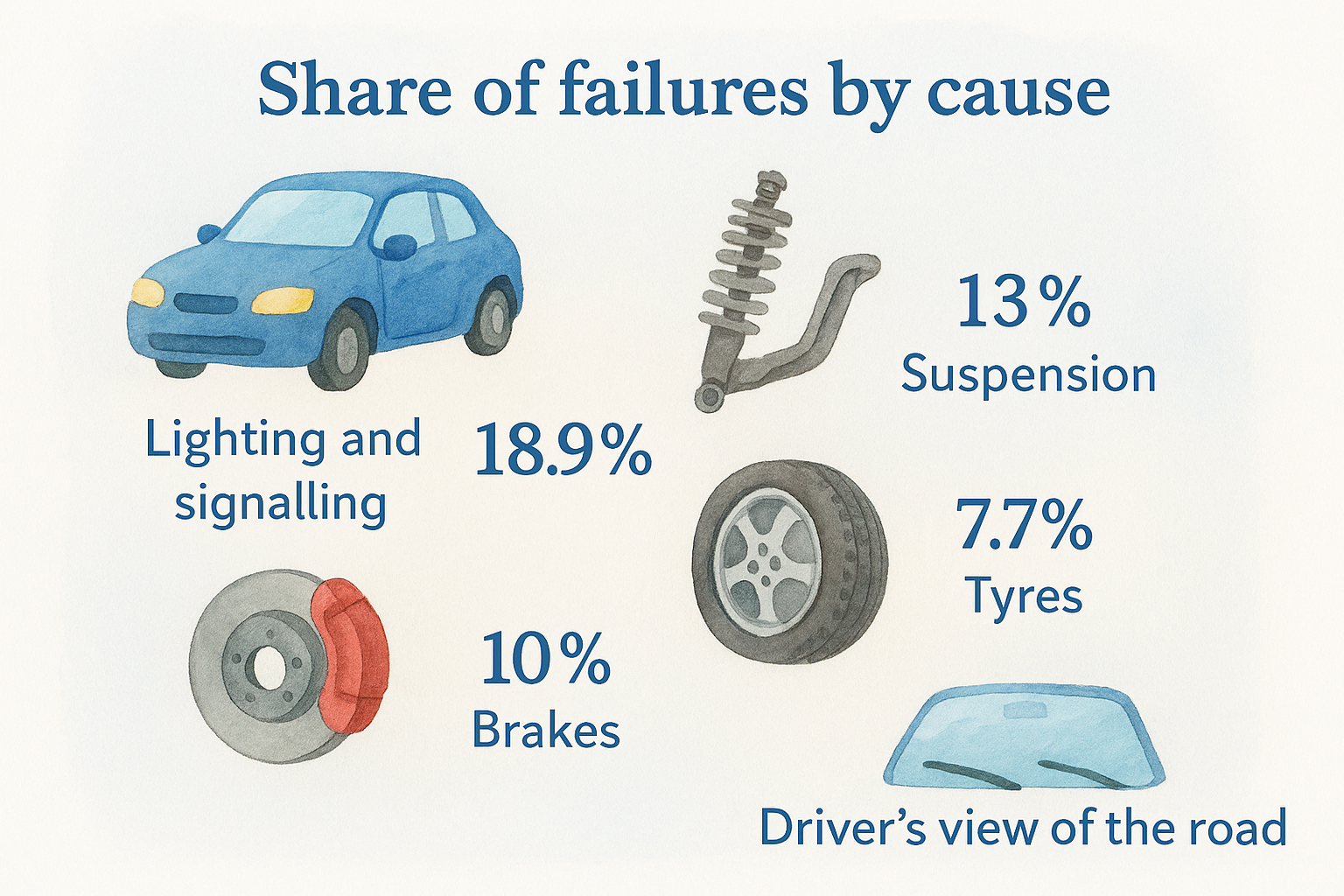
The five biggest categories account for up to about 57% of failures. The table turns each category's share of failures into a rough chance for any single test, using 37% as the overall rate. Treat the last two columns as estimates, because one car can fail for several reasons.
| Cause | Share of failures | Share of all tests | Roughly 1 in |
|---|---|---|---|
| Lighting and signalling | 18.9% | 7.0% | 14 |
| Suspension | 13% | 4.8% | 21 |
| Brakes | 10% | 3.7% | 27 |
| Tyres | 7.7% | 2.8% | 36 |
| Driver's view of the road | 7.2% | 2.7% | 37 |
The fifth category, driver's view of the road, has no item of its own because the fixes are quick. Replace damaged wiper blades, or any more than a year old. Top up the washer fluid and clear stickers, dashcams and air fresheners from the windscreen. Large chips in your line of sight will also fail the car.
What a fail means for you
A car fails when the result lists a dangerous or major fault. Minor faults and advisories still pass, but you should fix them soon. With a dangerous fault you must not drive the car until it is repaired. With a major fault and a still-valid certificate, you can usually drive it away and have the work done elsewhere.
If the old certificate has already expired, you can drive only to a pre-booked test or repair. Driving without a valid MOT can bring a fine of up to £1,000. A retest within 10 working days is usually a partial retest of the failed items only, so ask the garage what it charges.
1. Lighting and signalling faults
Lighting and signalling is the most common MOT fail, behind 18.9% of failures. That is roughly 1 test in 14 failing on a lamp alone, and most of those are bulbs you can swap in minutes.
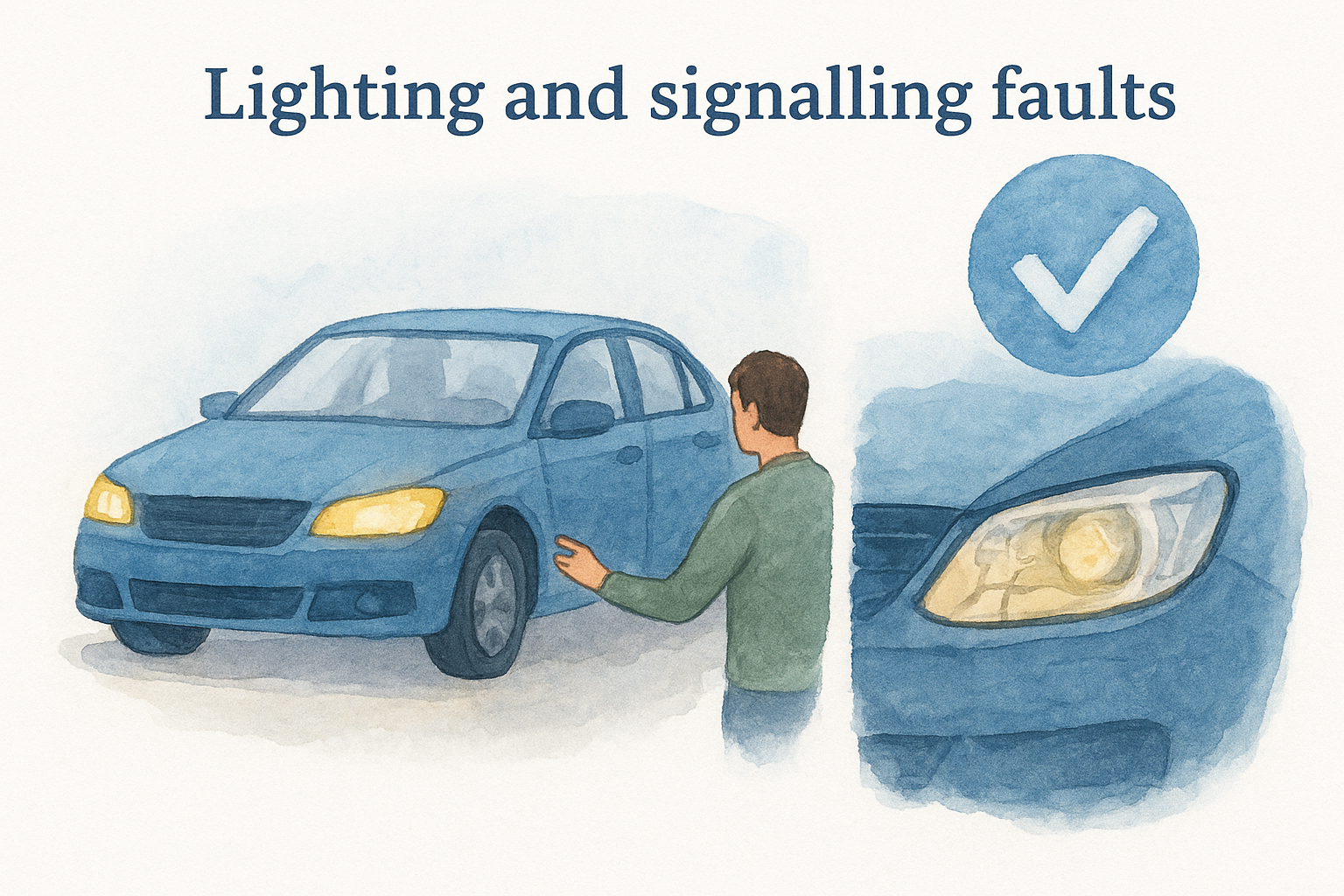
A single dead bulb is the most likely thing to fail an otherwise sound car.
What testers fail
Testers check every exterior lamp for operation, condition and colour, so the fault list is longer than "a bulb has gone". Cracked or misted lenses and loose bulbs count as well.
- Blown brake, side or fog lights
- A dead number plate lamp, which drivers often forget
- Indicators that do not flash
- Mismatched bulb colours or damaged lenses
How to check it before the test
Do this the day before. It takes five minutes and covers the most common fail in one go.
- Switch on dipped beam, main beam, side lights and hazards, then walk around the car.
- Ask a helper to stand behind the car while you press the brake pedal.
- Tap each bulb lightly to check it is secure, and confirm the colours match.
- Polish or clean any misty lenses.
Replacement bulbs are cheap, and your car handbook shows how to fit them.
2. Suspension faults
Suspension causes 13% of MOT failures, around 1 test in 21. It is the fault drivers most often miss because it builds up slowly. Potholes make it worse, since one hard hit can damage a spring or shock absorber.
Suspension faults hide in plain sight, so listen to the car as much as you look at it.
What testers fail
Testers inspect springs, shock absorbers and the joints and bushes that hold the wheels in place. Leaking shock absorbers and snapped springs are the classic fails, and neither is easy to spot by eye.
The early warning is usually sound. Clunks over bumps or when cornering mean something is worn, and a car that sits lower or higher at one corner is already telling you.
How to check it before the test
If you are buying used, run the registration through our free MOT check first. The full MOT history shows how the car did in earlier tests, so you can see whether it has failed before. Then check the basics yourself.
- Drive a bumpy road you know and listen for clunks, especially in corners.
- Park on level ground and check the car sits level, with no low or high corner.
- Push down hard on each corner and let go. The car should rise and settle without bouncing repeatedly.
3. Brake faults
Brakes account for 10% of MOT failures, about 1 test in 27. They deserve the most urgency, because a braking defect is a safety fault and not a cosmetic one.
Brake faults warn you first, so act on the noise before the test finds it.
What testers fail
Testers assess how well the brakes work and how worn the parts are. Worn pads and discs and a handbrake that will not hold are the usual culprits.
- Pads or discs worn past their limits
- A handbrake that will not hold on a slope
- The car pulling to one side under braking
- Low brake fluid
How to check it before the test
Most brake problems announce themselves, so use your ears and a quiet road. Squealing or grinding means the pads are running low, and either noise is worth a garage visit before the test.
- Brake firmly on a quiet, straight road and check the car stops in a line.
- Park on a hill and apply the handbrake. It should hold the car.
- Check the fluid reservoir sits between the minimum and maximum markings.
- Look through the wheel spokes at the disc surface and the pad thickness.
4. Tyre faults
Tyres cause 7.7% of failures, about 1 test in 36. The legal minimum tread is 1.6mm across the central three quarters of the tyre, and the same limit applies on the road as in the test bay.
A tyre that fails the 20p test will fail the MOT and is illegal to drive on.
What testers fail
Testers check tread depth, condition and fitment. Tread below 1.6mm is the main cause, but cuts, lumps and bulges fail too. Driving on illegal tyres can bring a fine of up to £2,500 and three penalty points per tyre.
- Tread below the legal minimum
- Cuts, bulges or other damage
- Mismatched sizes across an axle
- Incorrect pressures
How to check it before the test
The 20p coin test is the quickest way to gauge tread. It takes a minute per tyre.
- Put a 20p coin into the main grooves. If you can see the coin's outer band, the tread is too low.
- Feel the inside edges for uneven wear, which points to alignment or inflation problems.
- Look over the sidewalls for lumps, cuts and bulges.
- Set pressures to the handbook figures and check the sizes match across each axle.
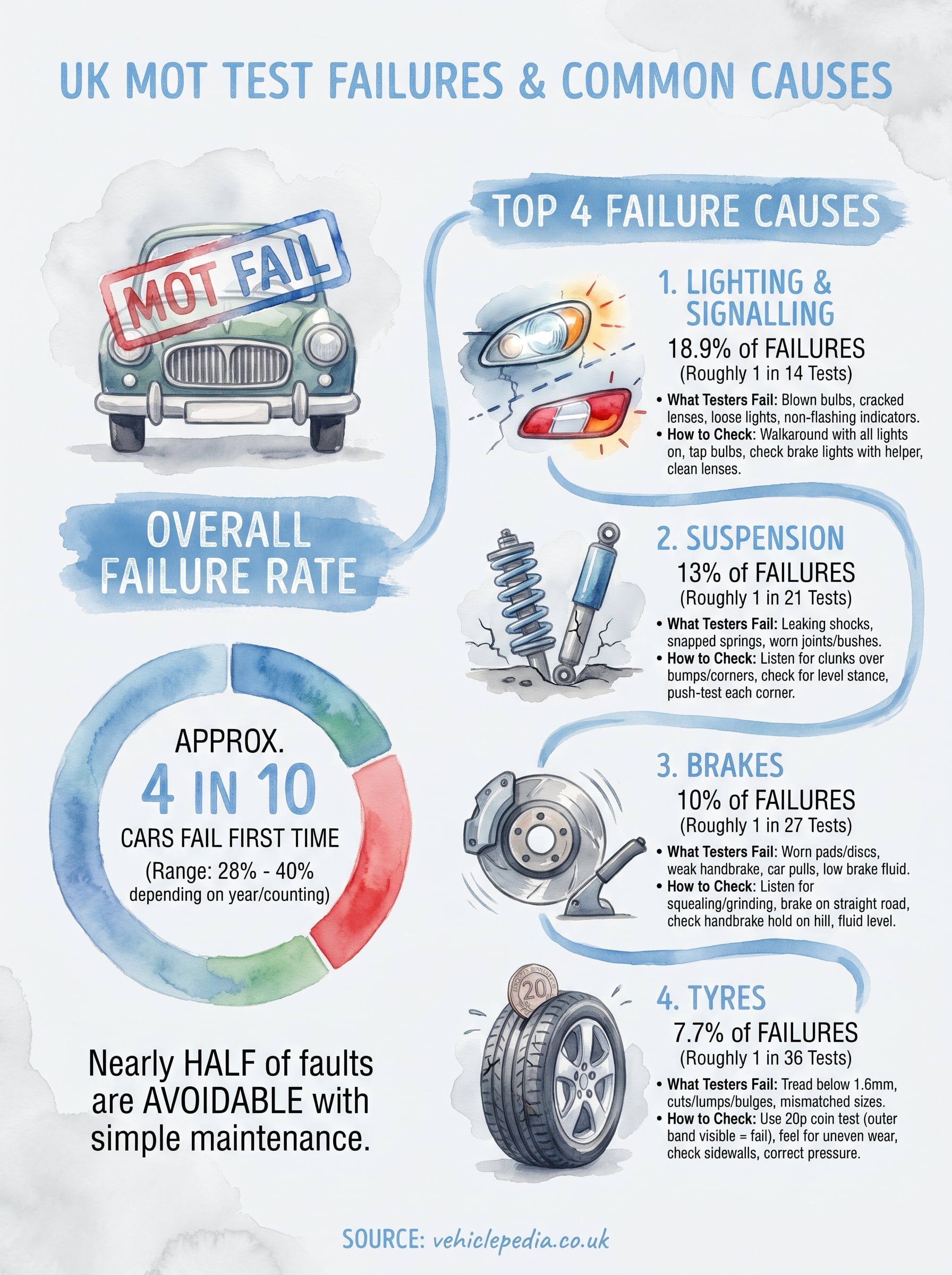
Pass first time by checking the basics
About 4 in 10 cars fail the MOT at the first attempt, and the leading causes are lights, suspension, brakes and tyres. Most of the fails come from wear you can find with a coin, a helper and ten minutes on the driveway. Fix the cheap items before the test, and treat any brake or suspension noise as a reason to book a garage visit early.
If you are weighing up a used car, the same logic applies. A car's past MOT results tell you how it has been looked after. Take a look at our sample vehicle history report to see what a full vehicle history check contains before you buy.