How To Check MOT History Online Using A Registration Plate
Run a free mot car check history by reg plate on Vehiclepedia, spot clocking, decode advisories and verify tax before you buy.
How To Check MOT History Online Using A Registration Plate
Every used car has a story, and the MOT history is one of its most revealing chapters. Knowing how to check MOT history gives you direct access to a vehicle's past test results, including passes, failures, advisory notices, and recorded mileage at each test. Whether you're buying a used car or just keeping tabs on one you already own, this information helps you spot potential problems before they cost you money.
An MOT history check can reveal patterns of recurring faults, confirm whether the mileage adds up, and show you exactly when the current certificate expires. The good news? You can do it all online in under a minute using nothing more than a registration plate. At Vehiclepedia, we pull this data from official UK sources including the DVLA, so you get accurate, up-to-date results with every lookup.
This guide walks you through the process step by step, from running your first check to understanding what the results mean and what to look out for. We'll also cover what you can access for free and when it's worth going further with a premium vehicle history check.
What you can learn from an MOT history check
An MOT history check gives you a detailed record of every test the vehicle has undergone since 2005, when MOT records started being held digitally. Each entry shows the date, result, mileage, and any reasons for failure or advisory notices. Understanding what this data means is the first step in knowing how to check MOT history effectively.
Pass and fail records
When a vehicle fails its MOT, the tester logs specific failure reasons, categorised as either "dangerous" or "major" defects. These entries stay permanently on the record, so you can see what was wrong and whether the issue was fixed before the next test. A pattern of repeated failures on the same item, such as brakes or steering, suggests the previous owner patched problems just enough to scrape through rather than fixing them properly.
A vehicle that fails for the same reason across multiple tests is a clear warning sign worth investigating before you part with any money.
Look carefully at the gap between a failure and the retest. A retest completed on the same day or the next day can indicate a rushed repair rather than a thorough one, worth questioning when you speak to the seller.
Mileage consistency
Each MOT record includes the odometer reading at the time of the test. Reviewing these figures across several years lets you check the mileage follows a logical progression. If the recorded mileage drops between tests, that's a strong indicator the odometer has been tampered with, a practice known as clocking, and there are other ways to spot a clocked car too.
A typical UK driver covers roughly 7,000 to 10,000 miles a year, though this varies with motorway commuting versus short local trips.
Advisory notices
Advisories are items the tester flags as worth monitoring but not serious enough to fail the car. They don't block a pass, but they highlight parts that are wearing out and may well fail at the next test. Common examples include worn tyres, corroded brake pipes, and deteriorating rubber seals.
Reviewing advisories from the last two or three tests tells you what maintenance is coming and gives you grounds to negotiate on price.
Step 1. Run a free MOT history check online
The quickest way to learn how to check MOT history is to use a free MOT history lookup by reg. You only need one piece of information: the vehicle's registration plate. The whole process takes under a minute, and the results come directly from official DVLA records with no account or payment required.
How to run the check
Follow these steps to retrieve a vehicle's full MOT record:
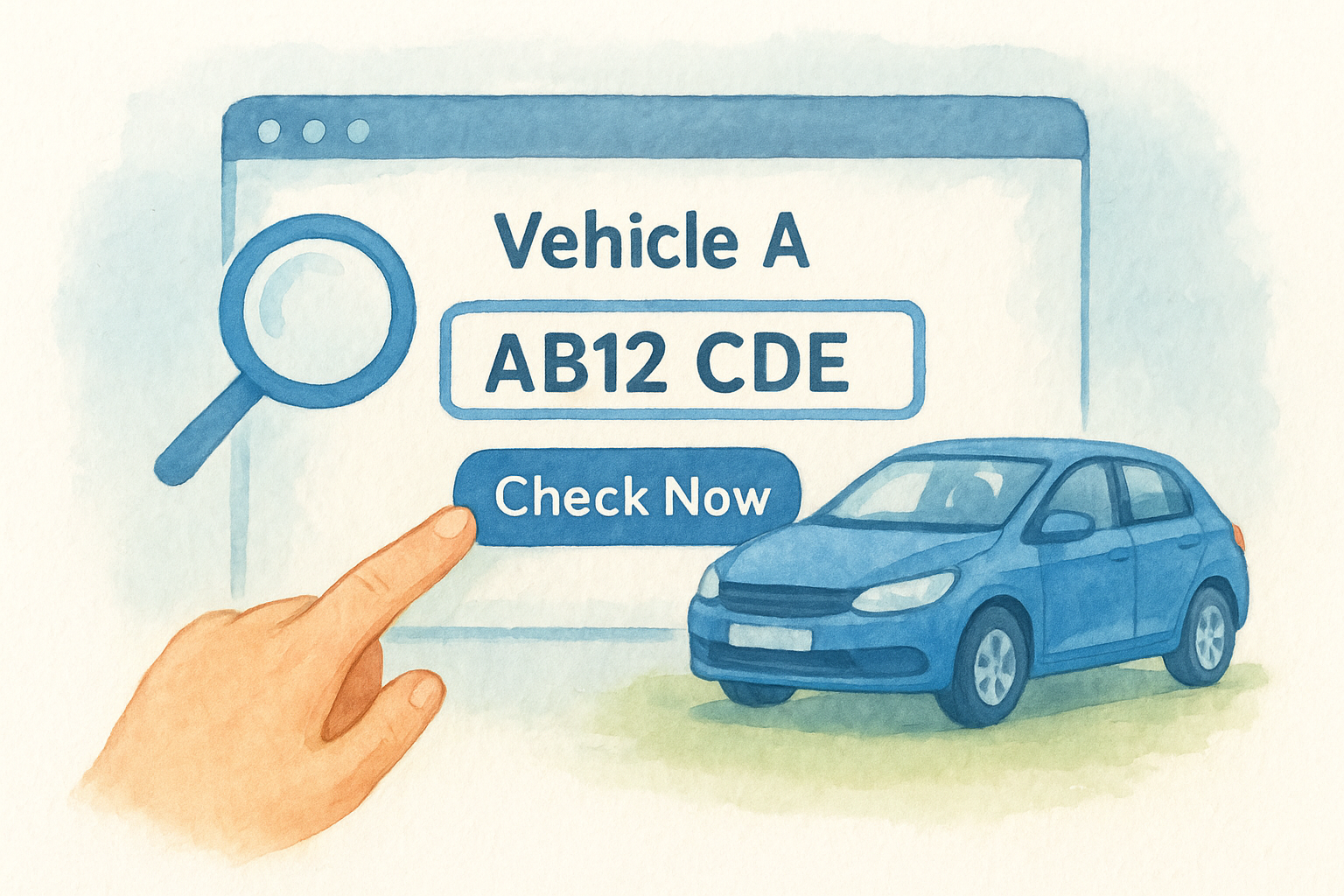
- Visit the Vehiclepedia free car check page at vehiclepedia.co.uk
- Type the vehicle registration plate into the search field, for example: AB12 CDE
- Click "Check Now" to run the lookup
- Review the MOT history section, which lists every recorded test result, date, and mileage entry
You do not need to create an account or pay anything to access the core MOT history results.
What information comes back
Your results will include the test date and outcome for every MOT on record, the odometer reading logged at each test, any failure reasons, and any advisory notices raised. You also get the current MOT expiry date, which tells you at a glance how long the certificate has left to run, the same figure you would get from a dedicated MOT due date check. This is useful whether you are buying a car or simply keeping track of a vehicle you already own.
Before you search, confirm you have the registration plate written down accurately. Incorrect characters return no results, so double-check the plate against the V5C logbook or a clear photo of the number plate if reviewing the car remotely.
Step 2. Interpret mileage, advisories and failures
Once your results load, read them critically rather than just scanning for a green pass. Knowing how to check MOT history is only useful if you understand what the data is telling you, so work through each section methodically.
Reading the mileage progression
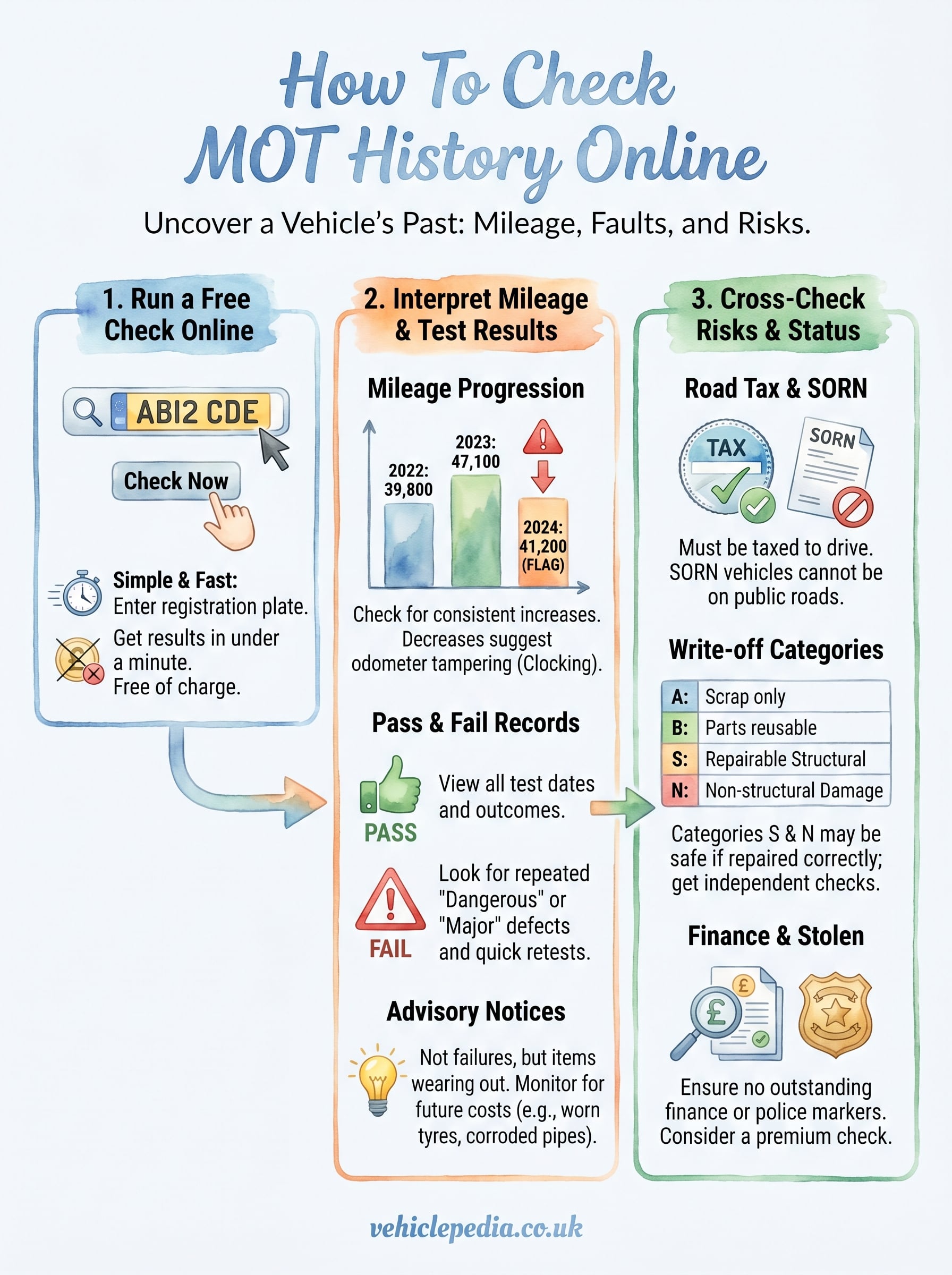
Pull out every mileage figure from oldest to newest and check each one is higher than the previous entry, or let a mileage verification check do the comparison for you. Any drop between tests is a red flag for clocking. Use the table below as a template:
| Test date | Mileage recorded | Difference |
|---|---|---|
| 2021-05 | 32,400 | - |
| 2022-05 | 39,800 | +7,400 |
| 2023-05 | 47,100 | +7,300 |
| 2024-05 | 41,200 | -5,900 (flag this) |
Any mileage that decreases between consecutive tests is a strong indicator of odometer tampering and should be raised directly with the seller.
Weighing up advisories and failures
Advisories carry no immediate weight on a pass result, but two or three identical advisories across consecutive tests suggest the owner has repeatedly ignored the same issue. Pay particular attention to advisories on brakes, tyres, and suspension, since these affect safety and cost the most to fix.
Failures deserve closer scrutiny. Check whether a failure was immediately followed by a same-day retest, which can indicate a rushed repair, and the underlying fault may have returned since.
Step 3. Cross-check tax, insurance and write-off risks
An MOT check is a strong starting point, but it does not tell you everything. Once you know how to check MOT history and have reviewed the results, your next move is to verify the vehicle's tax status and check for more serious flags like write-off markers or outstanding finance. These checks take only a few extra minutes and can save you from an expensive mistake.
Road tax and SORN status
Every vehicle on UK roads must carry valid road tax. A car declared SORN (Statutory Off Road Notification) is legally prohibited from being driven on public roads, which means if the seller is asking you to drive it away, they are already breaking the law. Check the current tax status and expiry date as part of a combined tax and MOT lookup on Vehiclepedia alongside the MOT results. This tax and SORN data comes from the DVLA's Vehicle Enquiry Service, the same system that powers GOV.UK's own vehicle tax checker, so you're seeing the same official record whichever site you use.
Write-off categories explained
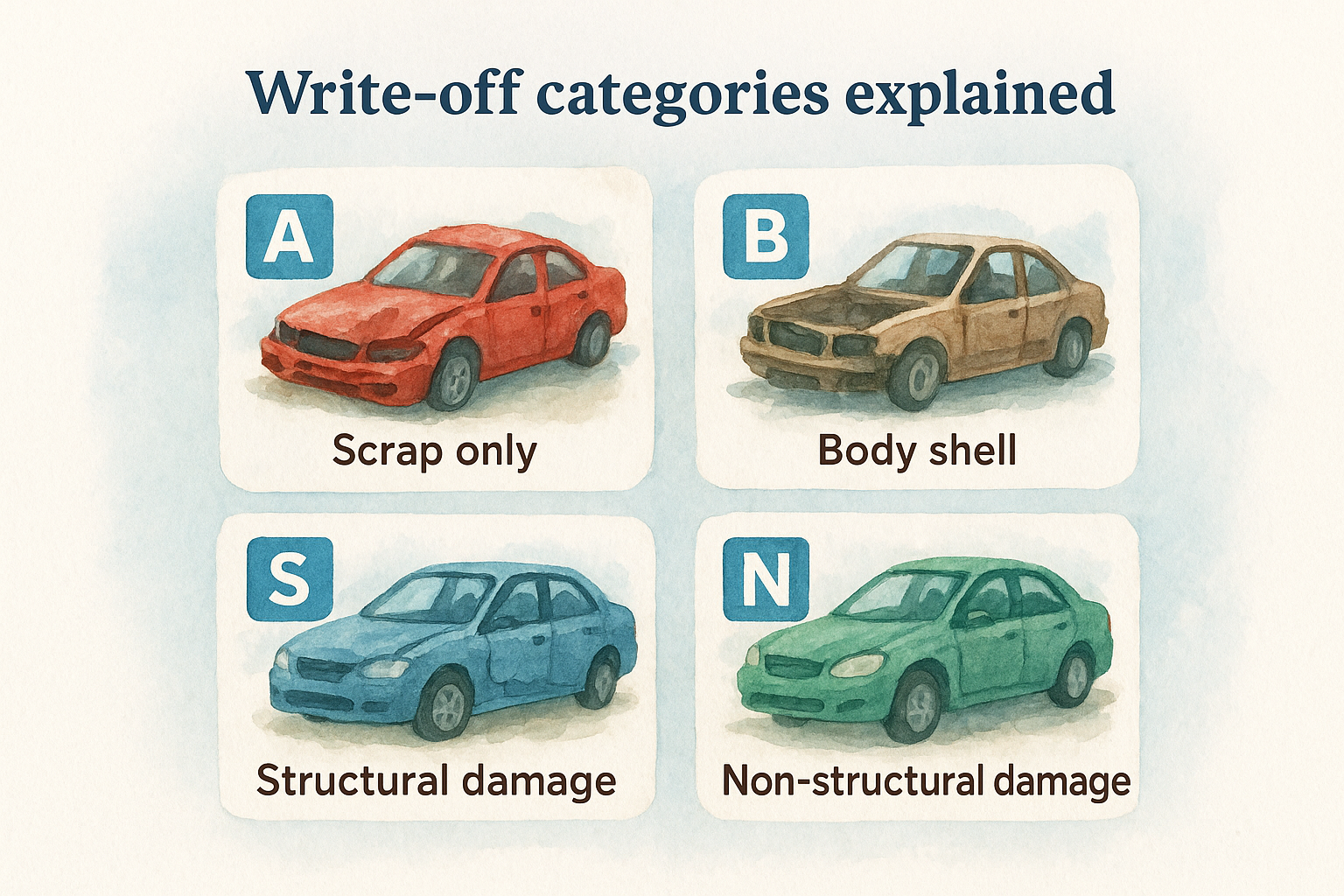
Insurance write-offs fall into four categories in the UK, and not all of them mean the car is unsafe, so it pays to know how to spot a written-off car by reg. Use the table below to understand what each category means before you decide whether to walk away:
| Category | What it means | Safe to drive? |
|---|---|---|
| A | Scrap only, must be crushed | No |
| B | Body shell must be scrapped, parts reusable | No |
| S | Structural damage, repairable | Only if repaired correctly |
| N | Non-structural damage | Usually yes, verify repairs |
A Category S or N write-off is not automatically a deal-breaker, but you should always get independent mechanical confirmation that repairs were completed to a proper standard before purchase.
Finance and stolen vehicle checks
A car with outstanding finance legally belongs to the finance company, not the person selling it. If you buy it without checking, you could lose both the car and your money. Running a premium check through Vehiclepedia covers both the finance database and the UK Police stolen vehicle register, giving you a complete picture before you commit.
Common questions and edge cases
Even when you follow the steps above, you may hit a result that looks unexpected. Here are the most common scenarios and what they mean for you as a buyer.
What if the vehicle has no MOT records?
If the lookup returns no MOT history at all, there are two likely explanations. The vehicle may be brand new and not yet reached its third year, when the first MOT becomes due. Alternatively, it may have been registered before 2005, when MOT records started being held digitally, so earlier tests don't appear in the database.
If the car is several years old and still shows no records, treat this as a red flag and ask the seller for physical MOT certificates before proceeding.
Can I check MOT history for vans and motorbikes?
Yes. The same registration plate lookup works for vans, motorbikes, and motorhomes, using the same format, so you can apply the same approach to reading mileage progressions and failure patterns. Note that some vehicles are exempt from MOT testing, including certain agricultural vehicles and those built before 1960, so a blank result here isn't automatically suspicious, and you can confirm historic vehicle MOT exemption status separately.
What does "MOT expired" mean on the results?
An expired MOT means the vehicle's current certificate has lapsed and the car cannot legally be driven on public roads. If you are viewing a car with an expired MOT, factor the cost of a fresh test and any repairs into your offer.
Wrap up and check another vehicle
You now have everything you need to run a thorough check on any vehicle in the UK. Knowing how to check MOT history is the foundation, but the steps here take you further: reading mileage progressions, weighing up advisories and failures, and cross-checking tax status, write-off markers, and finance risks before you hand over any money.
The core results cost you nothing, and a few minutes of due diligence now can save you thousands later. If the record raises questions you can't answer alone, a premium check adds the stolen vehicle register and outstanding finance database to the picture.
Ready to start? Run your first lookup now and get instant results from official UK sources, or see what a premium report includes before you buy.