Free Vehicle History Report UK: What You Can Check By Reg
Run a free vehicle history report UK by reg to spot MOT gaps, tax issues and mileage red flags before you buy—see what it misses too.
Free Vehicle History Report UK: What You Can Check By Reg
Buying a used car without checking its background is a gamble most people can't afford. A free vehicle history report uk search by registration number pulls together MOT results, tax status, mileage records and DVLA data in seconds, and it costs you nothing to run before you hand over a deposit or arrange a viewing.
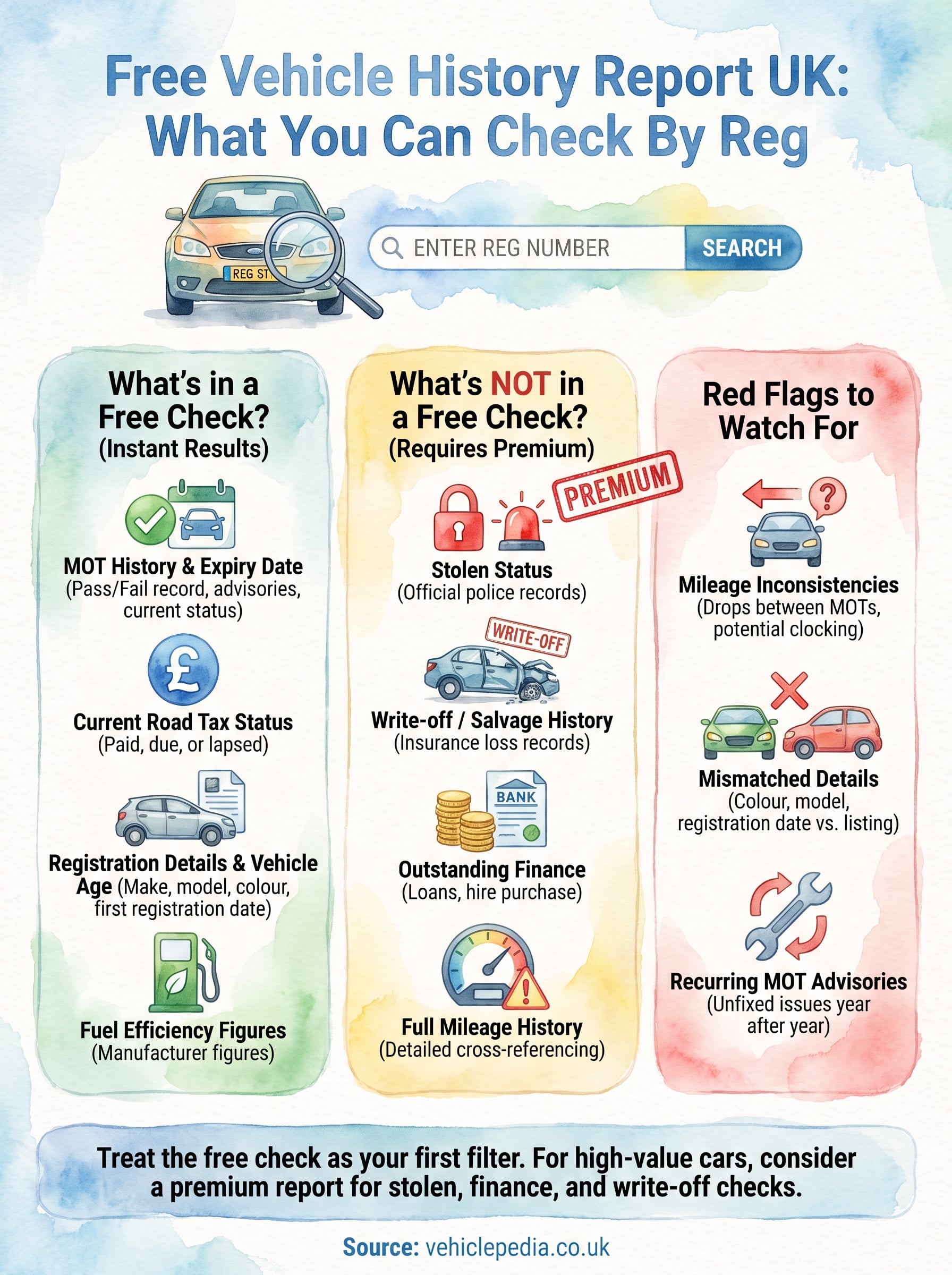
So what does a free check actually show you? Enter a reg plate and you'll get the MOT history and expiry date, current road tax status, registration details, vehicle age, and even fuel efficiency figures pulled straight from official sources like the DVLA. It won't confirm whether a car is stolen, written off, or still under finance, that level of detail sits behind premium reports, but it gives you enough to spot obvious red flags fast.
This article walks through exactly what each free field means, how to read the results properly, and where the limits of a free lookup start, so you know when it's worth paying for a fuller report before you buy or sell.
Why a free vehicle history check matters
Used car fraud costs UK buyers hundreds of millions of pounds every year, and most victims never see it coming until something breaks or the DVLA sends a letter about unpaid tax. A five-minute reg check before you view a car can save you from months of legal hassle and repair bills you never budgeted for.
The money you stand to lose
Odometer fraud alone affects roughly one in sixteen vehicles on UK roads, according to industry estimates cited by gov.uk consumer guidance. Buy a car with 40,000 miles knocked off the clock and you're not just overpaying, you're also buying a vehicle that's due for expensive wear-related repairs far sooner than the listing suggests. Add in unpaid road tax, an expired MOT, or a mismatched registration, and a seemingly good deal turns into a costly mistake within weeks.
A free check costs nothing and takes minutes, a bad used car purchase can cost thousands and take months to sort out.
Problems a quick check commonly reveals
Before you even speak to a seller, a registration lookup can flag issues that would otherwise only surface after you've paid:
- MOT failures or advisories the seller didn't mention
- Road tax that's lapsed, meaning you can't drive it home legally
- A mileage history that doesn't match the odometer reading
- Multiple registration changes, which can hint at cloning
- Inconsistent vehicle details versus what's advertised
Each of these is a reason to walk away or renegotiate, and you learn them for free before you've committed a penny.
Why sellers rarely volunteer this information
Genuine sellers usually don't mind you running a check, they've got nothing to hide. Sellers who get defensive or rush you toward a quick cash deal are often the ones you need to check hardest. Running a DVLA-backed history check puts you in control of the conversation rather than relying on someone else's word, and it means you're negotiating from facts rather than guesswork. That shift in leverage alone is worth the two minutes it takes to run a reg plate through a checker before you agree to view a car in person.
How to run a free vehicle history check by reg
Running a free vehicle history report uk check takes less time than reading the car listing itself. You need two things: the registration plate and a couple of minutes. There's no need to create an account or hand over payment details for the basic information, so treat it as a routine step before every viewing, not an optional extra.
Getting the reg number right
First, grab the exact registration plate, either from the listing photos or by asking the seller directly. Typos are the most common reason a check comes back empty or shows the wrong vehicle, so double-check letters like O and 0, or I and 1, before you submit anything.
Running the check step by step
Once you've got the plate confirmed, the process itself is quick:
- Head to a free vehicle checker such as Vehiclepedia
- Type the registration number into the search box exactly as it appears on the plate
- Submit the search and wait a few seconds for results to load
- Review the MOT, tax, and vehicle details that appear on screen
- Compare every field against what the seller has told you
If the reg check contradicts the seller's story anywhere, that's your cue to ask harder questions before you go any further.
Do this before you arrange a viewing, not after you've already driven an hour to see the car. It costs you nothing and it's the fastest way to filter out cars that aren't worth your time.
What your free report includes and what it misses
A free vehicle history report uk search gives you a solid starting point, but it's not the full picture. Knowing exactly where the line sits stops you from assuming you're covered when you're not.
What's actually in the free report
Run a reg through a free checker and you'll typically see:
| Field | What it tells you |
|---|---|
| MOT history and expiry | Pass/fail record, advisories, and when the current MOT runs out |
| Road tax status | Whether tax is paid, due, or lapsed |
| Registration details | Make, model, colour, and first registration date |
| Vehicle age | How long the car's been on UK roads |
| Fuel efficiency | Manufacturer figures for the exact model |
That's enough to catch an expired MOT or a seller fudging the car's age, both common tricks in private sales.
The gaps that matter most
What a free check won't tell you is whether the car's been stolen, written off, or still has outstanding finance attached to it. It also won't confirm mileage history in enough detail to catch every case of clocking, since that data sits behind premium checks that cross-reference MOT readings against insurance and finance registers.
Free data tells you what the car is, premium data tells you what happened to it.
If a car's high value, has changed hands more than once, or the seller seems evasive, that gap is exactly where a paid report earns its cost, particularly for the stolen and finance checks a free lookup simply can't reach.
Red flags to watch for in your results
Once your free vehicle history report uk search loads, don't just skim it, read every line against what the seller told you. Most red flags aren't dramatic, they're small inconsistencies that hint at a bigger problem underneath.

Mismatches between listing and record
Check that the colour, model, and first registration date on screen match the advert and the car in front of you. A colour change on record that the seller never mentioned isn't automatically dodgy, but paired with a vague answer about the car's past, it's worth pressing on. Same goes for a registration date that's years earlier than the seller claims, that gap usually means something.
Signs that point to bigger problems
Watch for these specific warning signs in your results:
- MOT advisories that repeat year after year without ever being fixed
- A tax status showing SORN when the seller says it's been driven daily
- Mileage figures that drop between MOT records, a classic sign of clocking
- Gaps of a year or more with no MOT history at all
- Multiple keeper changes in a short space of time
One red flag might be nothing, three together mean you should walk away or demand a premium check before you pay.
Any of these on their own deserves a follow-up question. Stack two or three together and you're looking at a car that needs a full premium history check, not just a free one, before any money changes hands.
Making sense of what you've found
A free vehicle history report uk search gives you the facts you need to walk into a viewing prepared, not guessing. You've seen what it covers, MOT status, tax, registration details, and where it stops short, stolen markers, write-offs, and finance. That gap isn't a flaw, it's just the line between free and premium data, and now you know exactly where it sits.
Treat the free check as your first filter, not your last step. If anything in your results raises a question, or the car's value and history warrant closer scrutiny, don't gamble on hope. A premium report closes those gaps with stolen, finance, and write-off checks a free lookup can't reach.
Curious what that deeper report actually looks like before you pay? Have a look at our sample report and see exactly what you'd be checking.