How Much Is My Car Worth In The UK? Free Valuation Guide
Find out how much is my car worth uk with our guide. Compare trade-in vs private sales, use valuation tools, and learn how history affects your car's price.
How Much Is My Car Worth In The UK? Free Valuation Guide
Whether you're selling privately, trading in at a dealer, or just curious, the question "how much is my car worth UK" comes up more often than you'd think. The answer depends on several factors, age, mileage, condition, service history, and even the time of year you choose to sell. Getting it wrong means either leaving money on the table or pricing yourself out of the market entirely.
The good news is you don't need to guess. Several free tools and methods can give you a reliable estimate within minutes, and knowing your car's full history plays a bigger role in its value than most people realise. That's where a service like Vehiclepedia comes in, our free vehicle history checks pull data straight from official UK sources like the DVLA, helping you (and potential buyers) understand exactly what a car has been through.
This guide walks you through how to value your car accurately, which free valuation tools are worth using, and what steps you can take to get the best possible price. We'll also cover the key factors that affect your car's worth and how to back up your asking price with solid data.
What a UK car valuation actually means
A car valuation in the UK is not a single fixed number. It is an estimated market value based on what buyers are currently willing to pay for a vehicle in a specific condition, at a specific time, and in a specific location. When you ask "how much is my car worth UK," you are really asking for a range, not an exact figure, and that range shifts depending on how and where you decide to sell.
Trade-in value vs private sale value
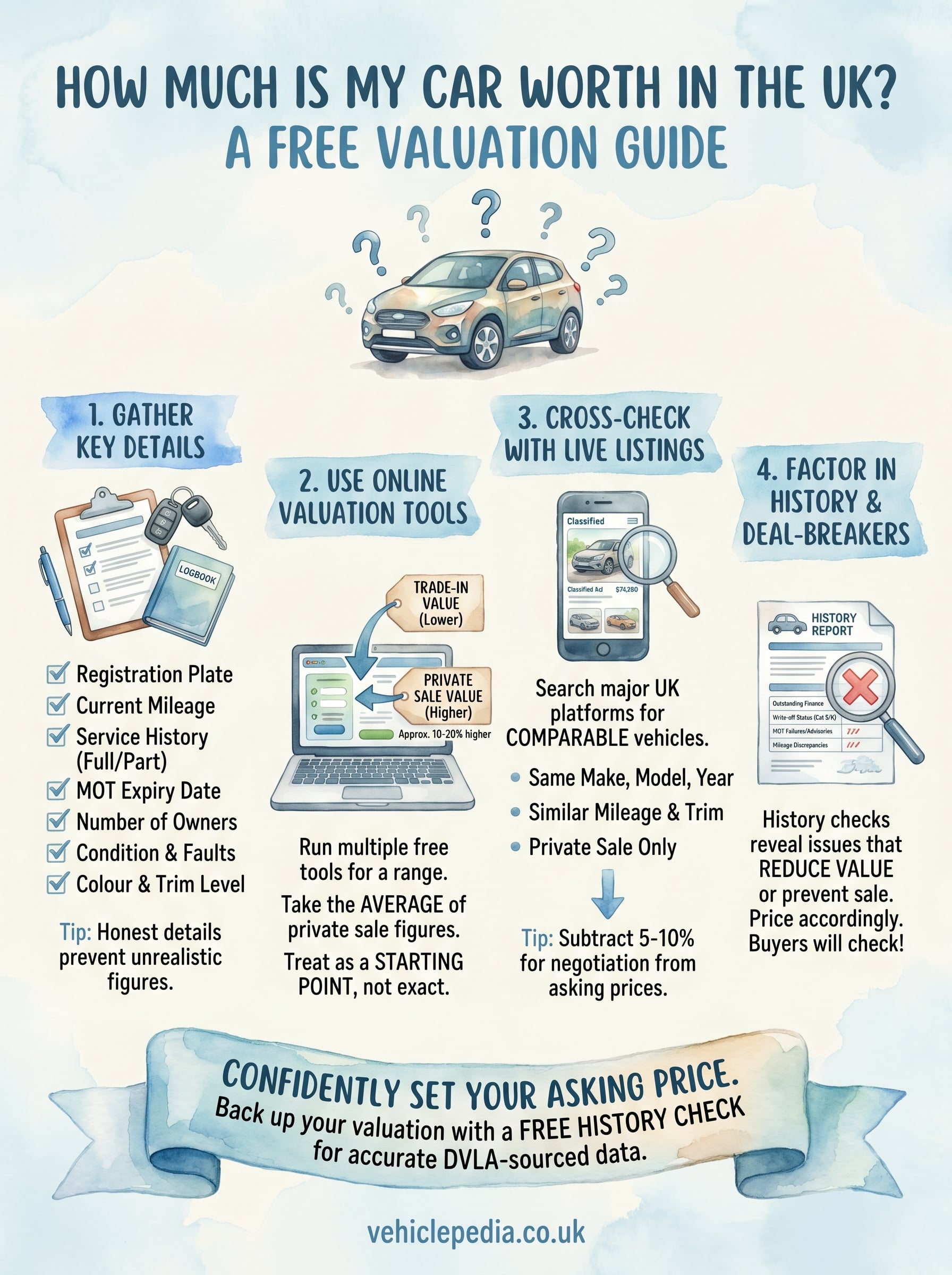
These two figures are almost always different, and understanding why matters. Trade-in value (also called part-exchange value) is what a dealer offers when you swap your car as part of buying another from them. Dealers need to resell at a profit, so they buy below market rate. Private sale value is what you can realistically achieve by selling directly to another person, which is typically 10-20% higher than a trade-in offer.
Selling privately almost always puts more money in your pocket, but it takes more time and effort than handing the keys over at a dealership.
What "market value" actually reflects
Market value is driven by live supply and demand. A popular model with low running costs holds its value better than a less sought-after vehicle. Factors like colour, trim level, and regional demand also move the price. A diesel estate, for example, may sell faster in a rural area than in a city centre.
Your car's documented history plays a role too. A full service history, no outstanding finance, and a clean MOT record all support a higher asking price, while gaps or red flags push it down.
Why valuations differ between tools
No two valuation tools pull from identical data. Some base their figures on recent auction results, while others use dealer listing prices or private sale data. This is why you will often see a spread of several hundred to a few thousand pounds between tools for the same car. Treat any single valuation as a starting point, not a definitive answer, and cross-check at least two or three sources before settling on a price.
Step 1. Gather the details that affect price
Before you search "how much is my car worth UK" in any tool, you need the right information ready. Valuation tools are only as accurate as the data you put into them, so spending five minutes pulling together the key details upfront prevents you from getting a figure that does not reflect your car's actual condition or history.
The details you need before you start
Most valuation tools ask for your registration plate and current mileage at a minimum. Beyond those two, the details below will sharpen your estimate and prepare you for buyer questions later.
| Detail | Why it matters |
|---|---|
| Registration number | Confirms make, model, age, and engine size |
| Current mileage | Lower mileage typically means a higher value |
| Number of previous owners | Fewer owners usually signals more consistent care |
| Service history | A full documented history supports a higher asking price |
| MOT expiry date | A long MOT remaining gives buyers confidence |
| Known faults or damage | Honest assessment avoids wasted time negotiating |
| Colour and trim level | Certain specs and colours hold value better than others |
A car with complete service records can be worth several hundred pounds more than an identical model with no paperwork at all.
Pulling this together before you start means your valuation reflects reality, not a best-case scenario you will struggle to justify when a buyer shows up.
Step 2. Use free online valuation tools
With your details ready, you can now get an instant estimate of what your car is worth. Several free valuation tools operate in the UK market, and most work the same way: enter your registration plate and mileage, and the tool returns a price range within seconds. Running this search is the fastest practical answer to "how much is my car worth UK."
How to read a valuation result
Valuation tools typically return three separate figures: a trade-in price, a private sale price, and sometimes a dealer forecourt price. The trade-in figure is almost always the lowest because dealers build their profit margin into it. Focus on the private sale figure if you plan to sell directly to another person, as that reflects what a buyer would reasonably pay through a marketplace like Facebook or AutoTrader.
Never rely on a single tool. Run at least two valuations and take the midpoint as your working estimate.
What to do with conflicting results
If two tools return figures that are several hundred pounds apart, do not panic. Different tools weight auction data, dealer listings, and private sales differently, so variation is normal. When results diverge, average the figures and use that number as your baseline before moving on to cross-checking with live listings in the next step.
Step 3. Cross-check with live listings
Online valuation tools give you a theoretical price range, but live listings show you what real buyers are actually paying right now. Searching active car adverts for vehicles that match yours, same make, model, year, mileage, and condition, answers "how much is my car worth UK" with real market evidence rather than estimated data.
How to search live listings effectively
Search for your car on the major UK classified platforms and filter results tightly. You want listings that are as close to your specification as possible, not just the same model but the same trim level, colour, and mileage bracket. Aim to find at least five to ten comparable listings before drawing any conclusions.
Use these filters each time you search:
- Make, model, and year of manufacture
- Engine size and fuel type
- Mileage within 10,000 miles of your own
- Trim level or specification where available
- Private sale listings only, to exclude dealer markup
What to look for when comparing
Once you have your comparable listings, note the asking price range across all of them, then subtract around 5-10% to account for negotiation. Buyers almost always expect to haggle below the listed price, so the real transaction value sits slightly under what you see advertised.
The midpoint of comparable live listings is the most reliable reality check you can run before setting your asking price.
Step 4. Factor in history and deal-breakers
Live listings and valuation tools give you a market average, but your car's specific history can push its price above or below that figure. When buyers ask "how much is my car worth UK" after viewing your advert, they are often checking whether the documented history matches the asking price. If it does not, they will either walk away or negotiate hard.
What history issues reduce value
Certain history markers cut directly into what buyers will pay. Each one below gives buyers a reason to offer less or pull out entirely, so knowing them upfront helps you price honestly from the start.
- Outstanding finance: The car legally belongs to the lender until the debt is cleared. Buyers cannot safely purchase a car with finance still attached.
- Written-off status: A Category S or N write-off reduces value significantly, even after repairs.
- MOT failures or advisories: A pattern of recurring faults signals poor maintenance.
- Mileage discrepancies: Any gap between recorded and claimed mileage raises immediate red flags.
Running a full vehicle history check before you list your car means you already know what buyers will find, and you can price accordingly.
The deal-breakers buyers check first
Most informed buyers will run their own vehicle history check before committing. Verifying your car's status through a service like Vehiclepedia gives you accurate DVLA-sourced data on MOT history, ownership records, and any outstanding finance, so nothing surfaces mid-negotiation that undermines your asking price.
Next steps
You now have a clear, repeatable process for answering "how much is my car worth UK" with confidence. Start by gathering your registration number and mileage, run at least two free valuation tools, cross-check those figures against live listings, and then audit your car's history for anything that could shift the price. Each step builds on the last, so skipping one leaves gaps that buyers will notice before you do.
Before you set a final asking price, run a vehicle history check to confirm exactly what a buyer will see when they do their own research. Knowing your car's MOT record, ownership history, and finance status upfront puts you in a stronger negotiating position and prevents surprises mid-sale. You can view a sample Vehiclepedia report to see what a full check covers, then decide whether a premium report makes sense for your situation.