What Is My Car Worth UK: How To Value It Fast Online
What is my car worth uk? Learn how to value your vehicle fast online, compare trade vs private prices, and adjust for condition to get the best price today.

What Is My Car Worth UK: How To Value It Fast Online
Whether you're selling privately, trading in at a dealership, or just curious, the question "what is my car worth UK" comes up more often than you'd think. The problem is, most people guess, and guessing usually means leaving money on the table or pricing so high the car never shifts.
The good news: you don't need to guess. Several free online tools let you get a realistic valuation in minutes, typically using nothing more than your registration number and current mileage. But not all valuations are equal, and understanding what drives your car's worth gives you a real edge in negotiations.
This guide walks you through exactly how to value your car online, which tools to use, and what factors affect the final figure. We'll also show you how a free vehicle check from Vehiclepedia can help you present a clean history to buyers, because a car with verified MOT, tax, and ownership records is always worth more than one shrouded in mystery.
What a UK car valuation actually means
A car valuation is not a fixed price. It's an estimate of what your car is likely to sell for in a specific market at a specific moment. When you search "what is my car worth UK," you'll often see three different figures come back from valuation tools, and they're not interchangeable. Each number reflects a different type of transaction, which means using the wrong one as your target price can cost you hundreds of pounds.
The figure that matters most depends entirely on what you plan to do next: sell privately, trade in, or part-exchange.
Trade, private, and part-exchange: three different numbers
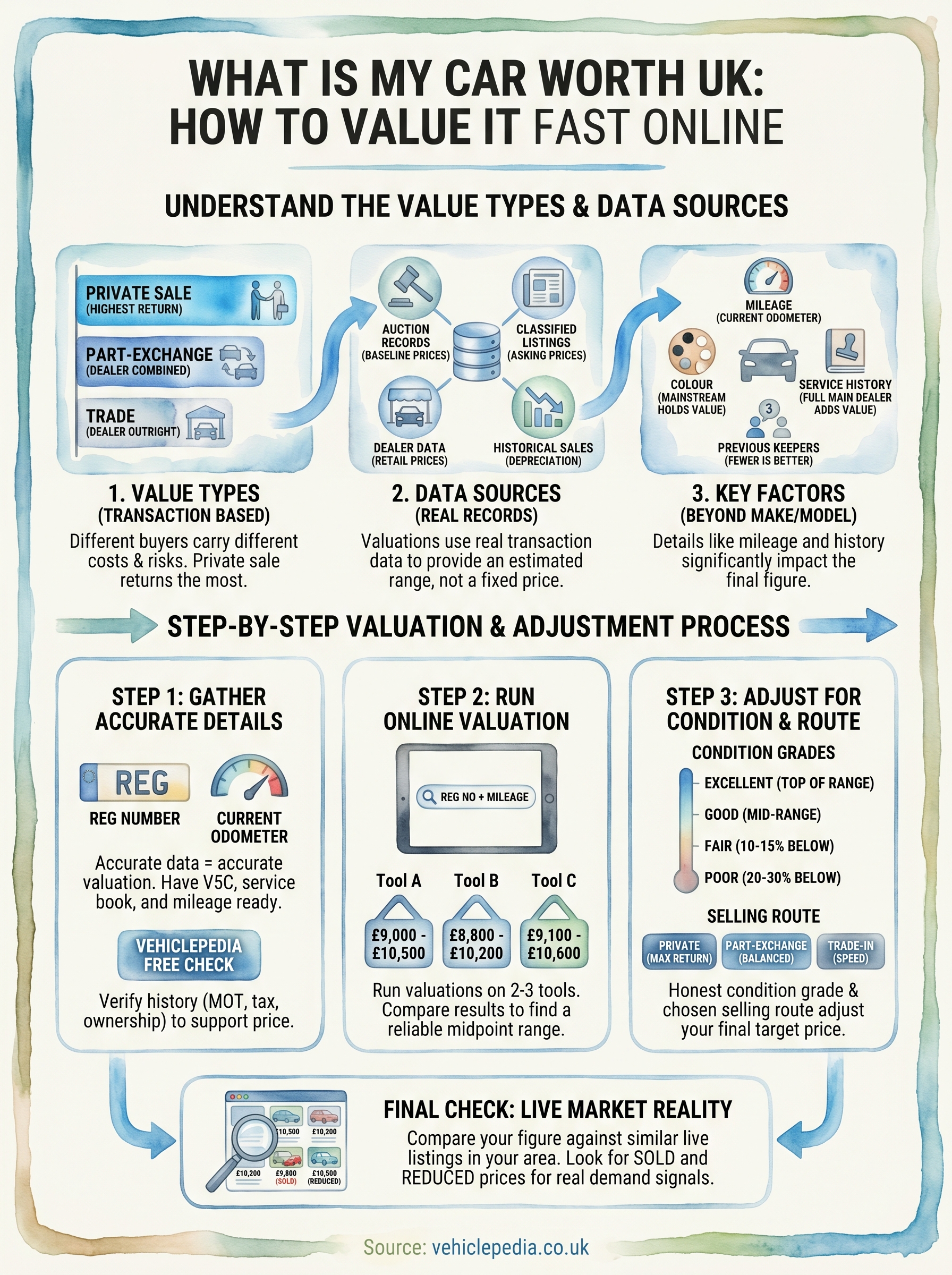
These three values exist because buyers carry different cost structures and risk tolerances. Trade value is what a dealer pays you outright. It's the lowest of the three because the dealer needs room to recondition the car, market it, and cover warranty obligations before making any profit. Private sale value is the highest figure because you're selling directly to the next owner, cutting out the middleman entirely.
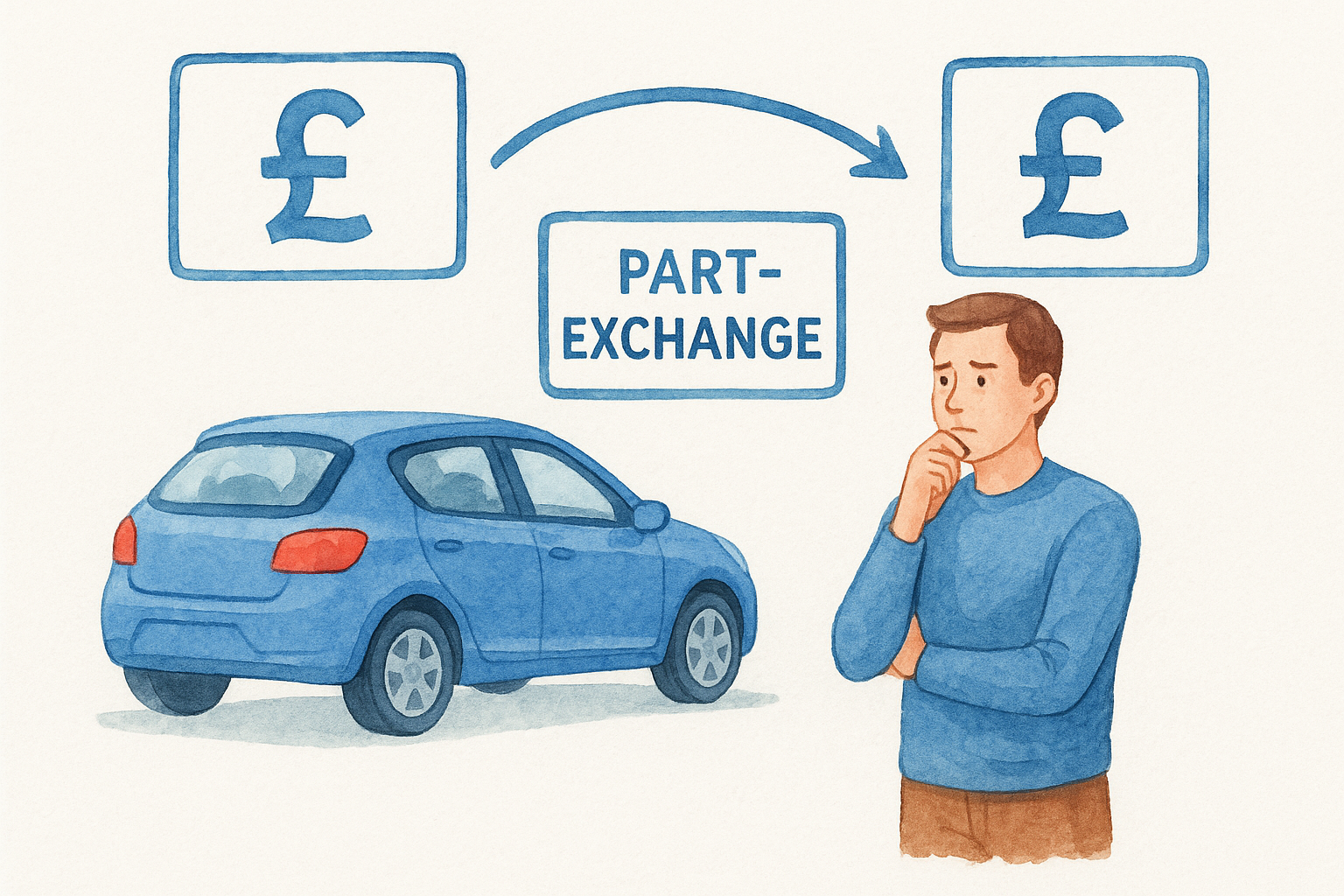
Part-exchange sits somewhere in between. When a dealer offers you a part-exchange deal, they combine a trade purchase (your car) with a retail sale (their car) into one transaction. The convenience comes at a cost, and many sellers underestimate how significant that cost is. It's not unusual for a part-exchange offer to land 10 to 15% below the equivalent private sale value on the same vehicle.
What UK valuations are actually based on
Valuation tools pull data from real transaction records, auction results, and live classified listings. They factor in your car's make, model, year, trim level, mileage, and colour to produce an output range rather than a single figure. No two cars sell under identical conditions, which is why a range is more accurate than one number.
Here's what each data source tells valuers:
| Data source | What it reveals |
|---|---|
| Auction records | Baseline trade floor prices |
| Classified listings | Current private asking prices |
| Dealer forecourt data | Retail prices after preparation |
| Historical sales | Depreciation trends by model |
Reading a valuation range correctly gives you a negotiating anchor. If a tool returns £8,500 to £10,200, the lower end reflects likely trade offers and the upper end reflects optimistic private sale conditions. Your realistic private sale target sits toward the middle of that range, with room built in for negotiation.
Why the same car can be worth different amounts
Two cars that look identical on paper can fetch different prices based on service history, the number of previous keepers, and verifiable MOT records. A car with a full main dealer service history and clean MOT records commands more than the same model with incomplete paperwork, even if the mechanicals are in the same condition.
Colour also plays a measurable role in resale value. Mainstream colours like white, black, and silver hold their value better because they attract a wider pool of buyers. A bright or unusual colour may be harder to shift at full market price regardless of how well the car has been maintained.
Step 1. Gather the details that change value
Before you run any online valuation, pull together the right information first. Entering inaccurate data produces an inaccurate figure, and an inaccurate figure leads directly to a wrong asking price. The five minutes you spend on this step saves significant confusion later when buyers start asking questions.
Your registration number and mileage
Your registration plate pre-fills most core details automatically in any valuation tool. When you enter it, the tool typically returns the make, model, trim level, engine size, and fuel type. What it does not return is your current odometer reading, so check it before you start. Mileage is one of the biggest drivers of used car value in the UK.
A car covering around 10,000 miles per year is considered average in the UK; anything significantly above or below that benchmark shifts the valuation meaningfully.
Have these details ready before you begin:
- Registration number (from your V5C or the car itself)
- Current odometer reading in miles
- Trim level or specification (for example, SE, Sport, or GT Line)
- Engine size and fuel type if not pre-filled
- Colour
Service history and previous keepers
Many people asking "what is my car worth UK" overlook the impact of service history on their valuation. A full service history with dated stamps from a recognised garage or main dealer adds a measurable premium over a car with no evidence of regular maintenance. Pull out your physical service book, count the stamps, and note the date and mileage of the last service.
Previous keeper count also matters to buyers. A car with two or three keepers over ten years reads very differently to one with six owners in five years, even at identical mileage. You can confirm your previous keeper numbers instantly with a free check on Vehiclepedia using your registration plate, which gives you exactly the same data a buyer will see before making an offer.
Step 2. Get instant values from online tools
With your details ready, running an online valuation takes under two minutes. Most UK valuation tools follow the same basic structure: you enter your registration number, confirm the pre-filled vehicle details, input your mileage, and receive an estimated value range within seconds. The critical step most people skip is running more than one valuation and comparing results, because no single tool has a monopoly on accuracy.
How to run your valuation step by step
UK valuation platforms use a consistent format, so knowing the sequence in advance saves you time. Here is the exact order of steps most tools follow:
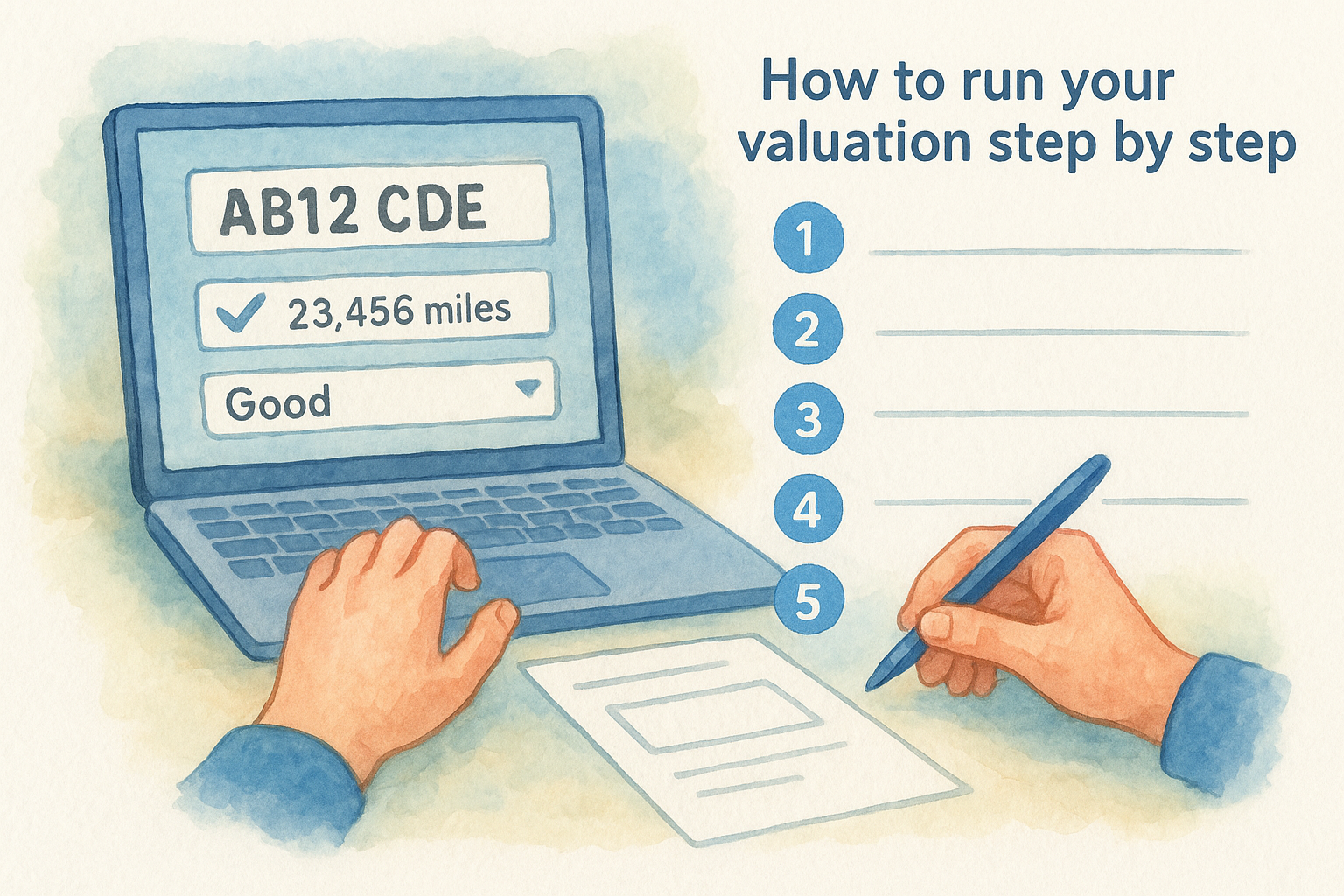
- Enter your registration number into the search field
- Confirm the make, model, trim level, and fuel type that auto-populate from DVLA records
- Type in your current odometer reading in miles
- Select the condition category that best reflects your car (typically excellent, good, fair, or poor)
- Enter your postcode, as regional demand can shift the output slightly
- Review the trade value, private sale value, and part-exchange figure as three separate numbers
Running the same valuation on two or three different tools gives you a reliable midpoint that is more useful than any single figure on its own.
What the output actually tells you
When you ask "what is my car worth UK" through an online tool, the result you see is a reference range, not a guaranteed sale price. The lower bound of that range reflects what a trade buyer is likely to offer. The upper bound reflects optimistic private sale conditions in a competitive market.
Check how recently each tool refreshed its underlying data. Some platforms update valuations daily using live classified listings and recent auction results; others rely on data that may be several weeks old. A tool working from stale data can overestimate your car's value by a meaningful margin, particularly for models that are currently depreciating quickly. If a valuation looks noticeably higher than comparable cars listed in classifieds right now, treat that figure with caution.
Step 3. Adjust for condition and selling route
Online tools return a baseline figure for an average, reasonably maintained example of your car. That number needs adjusting before you treat it as your actual asking price. Where your car sits on the condition scale and which selling route you choose both have a direct and significant effect on the realistic figure you should be working toward.
How condition grades shift your figure
Most UK valuation platforms use four condition tiers: excellent, good, fair, and poor. Choosing the wrong tier is one of the most common mistakes sellers make, and it almost always skews optimistically. Before you select a grade, walk around the car slowly and note kerbed alloys, paint chips, scuffs, worn seats, or any warning lights. Each visible issue a buyer can point to becomes a negotiating tool that knocks down your asking price regardless of what your valuation said.
Overstating your car's condition during the valuation produces a number that buyers will quickly reject once they see the car in person.
Here is what each tier typically reflects and how it affects your figure:
| Condition | What it reflects | Typical impact on value |
|---|---|---|
| Excellent | No visible wear, full service history, clean bodywork | Top of the valuation range |
| Good | Light surface marks, complete history, standard wear | Mid-range |
| Fair | Visible scratches or dents, partial history | 10-15% below good |
| Poor | Significant damage, incomplete or missing records | 20-30% below good |
Picking the right selling route
Your chosen selling route determines which valuation number becomes your working target. Private sale returns the highest figure because you sell directly to the next owner, but it takes more time and requires you to handle viewings and negotiations yourself. Part-exchange is convenient and typically lands 10 to 15% below an equivalent private sale figure on the same car. A straight trade-in to a dealer is the fastest option and the lowest return of the three.
Use this simple framework when asking "what is my car worth UK" for a specific purpose:
- Maximum return: private sale, price toward the upper-mid point of your valuation range
- Balanced approach: part-exchange, use the mid-range figure as your benchmark
- Speed over price: dealer trade-in, accept the lower bound and move quickly
Step 4. Sanity-check with the live market
Online valuations give you a solid starting point, but they don't always reflect what buyers in your area are actually paying right now. The final check before you set your asking price is to compare your valuation against live listings for the same make, model, trim, year, and similar mileage. This takes roughly five minutes and can save you from pricing too high or, just as costly, too low.
How to search live listings accurately
Search used car classified sites for your exact vehicle using every filter available. Enter your make, model, fuel type, and trim level, then narrow the mileage range to within 10,000 miles of your own odometer reading. Look at how many comparable cars are currently listed and at what price points. If you find ten similar examples and nine of them sit below your valuation tool's mid-range figure, that is a direct signal to adjust your asking price downward before you go live.
The number of days a car sits unsold in a listing tells you more about correct pricing than any single valuation tool.
Spot-check asking prices against actual demand
Listings show asking prices, not confirmed sale prices, so treat them with a degree of caution. A car priced at £9,500 that has been sitting for 60 days is not worth £9,500 in the current market. When you ask "what is my car worth UK" for your own vehicle, look specifically for recently listed cars that are already marked as sold or have had price reductions applied, as those give you the clearest signal of where real buyer demand actually sits.
Use this checklist before you finalise your asking price:
- Find at least five comparable listings using identical trim, fuel type, and year
- Note the mileage range across those listings and compare it to your car
- Flag any listings that have been reduced or are marked as sold
- Adjust your target price to sit within the realistic range of active, well-matched listings
- Confirm your car's history details are accurate using a free Vehiclepedia check, since buyers will run one before making an offer
Next steps
You now have a clear, repeatable process for answering "what is my car worth UK" with confidence. Gather your registration number and mileage, run valuations across two or three tools, match your condition grade honestly, and cross-reference your figure against live classified listings before you commit to an asking price. Each step removes guesswork and gives you a defensible number when buyers start negotiating.
One thing every serious buyer will do before making an offer is run a vehicle history check on your car. Getting ahead of that step yourself means no surprises surface during the sale and no last-minute price reductions. A clean, verified history record actively supports your asking price rather than undermining it. Before you list your car anywhere, run a free vehicle history check on Vehiclepedia using your registration plate. You can also view a sample premium report to see exactly what buyers will find.