What Is Euro NCAP? Car Safety Ratings Explained
What is Euro NCAP? Learn how star ratings work, how to check a model's score, and why pairing it with a Vehiclepedia history check matters.
What Is Euro NCAP? Car Safety Ratings Explained
You've probably seen a car advert boasting a five-star safety rating, or spotted a mysterious score on a used car listing and wondered what it actually means. What is Euro NCAP and why does it matter when you're choosing a car? It's the European New Car Assessment Programme, an independent body that crash tests new vehicles and publishes safety ratings the whole industry pays attention to.
In short, Euro NCAP puts cars through a battery of standardised crash tests, covering everything from frontal impacts to pedestrian protection and how well safety assist tech actually works. The result is a star rating out of five that tells you how a specific model performs when things go wrong, not just what the manufacturer claims in a brochure.
Below, we'll break down how the testing actually works, what each star rating represents, and how the criteria have changed over the years as cars have gained more tech. If you're checking a used car's history on Vehiclepedia before buying, knowing its Euro NCAP score adds another layer of confidence to that decision.
Why Euro NCAP ratings matter when buying a used car
When you're buying used, you don't get a warranty against bad design. The car has already been built, crashed by nobody hopefully, and driven for years by someone else. A Euro NCAP rating gives you an independent, tested answer to a question a seller's word never quite settles: how will this specific model protect the people inside it if something goes wrong? For anyone comparing two similar used cars at similar prices, that single data point can matter more than mileage or service history.
Ratings aren't fixed for life
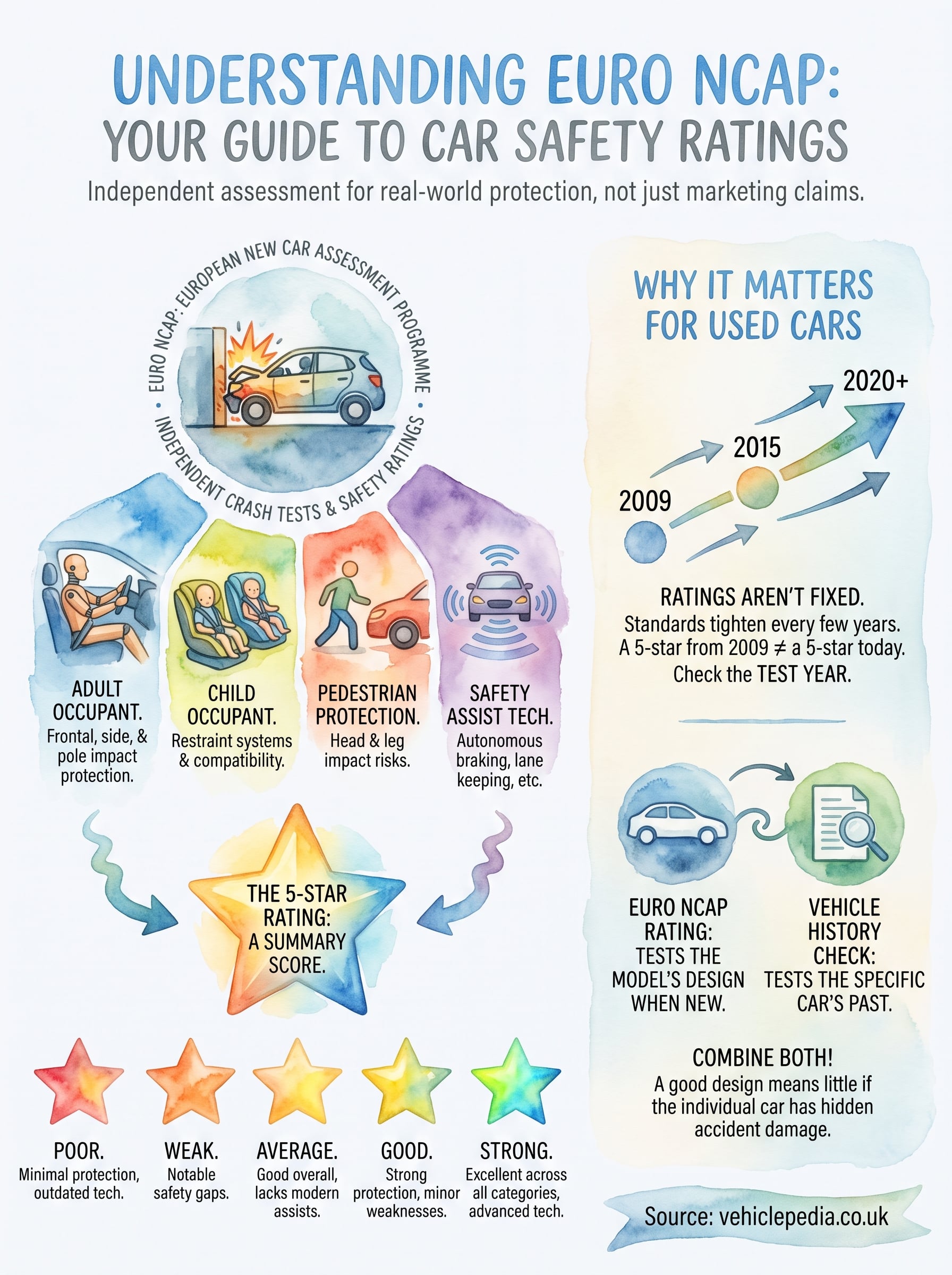
Here's the part most buyers miss: a five-star rating from 2009 doesn't mean the same thing as a five-star rating from 2024. Euro NCAP tightens its testing protocols every few years, adding new requirements for pedestrian protection, autonomous emergency braking, and child safety as technology improves. A car that scored top marks a decade ago might only manage three or four stars under today's stricter benchmarks.
A five-star rating only tells you a car was safe by the standards of the year it was tested, not by today's.
| Test period | Typical focus |
|---|---|
| Pre-2009 | Basic occupant protection, limited pedestrian testing |
| 2009-2015 | Introduction of pedestrian and child protection scoring |
| 2016-2019 | Safety assist tech, including autonomous braking |
| 2020 onwards | Driver monitoring, advanced crash avoidance systems |
The real-world risks a rating reveals
Underneath the star count sit four separate scores covering adult occupant, child occupant, pedestrian, and safety assist performance. Checking these breakdowns, not just the headline star rating, shows you exactly where a car excels or falls short. A model might carry four stars overall but score poorly on pedestrian protection, which matters if you're regularly driving in built-up areas or near schools.
Insurance, resale value and peace of mind
Lenders, insurers, and future buyers all pay attention to safety credentials, whether they realise it or not. Cars with stronger Euro NCAP performance often attract lower insurance premiums and hold their value better at resale, because they're seen as lower risk across the board. Ultimately, though, the biggest reason to check comes down to something simpler than money: knowing the car you're about to drive your family in has actually been crash tested and proven to protect them, not just assumed to.
How to check a car's Euro NCAP rating
Finding a car's Euro NCAP score takes a few minutes, and you don't need any special access to do it. The official Euro NCAP website lists every tested model going back years, searchable by make, model, and year, with full breakdowns of the four category scores rather than just the headline star rating. Since manufacturers submit their own vehicles for testing, and Euro NCAP occasionally buys cars anonymously to verify claims, the results published there are as close to independent as you'll get in the industry.
Searching for a specific model
Getting to the right result is straightforward if you follow a clear sequence:
- Go to the Euro NCAP ratings search and select the manufacturer
- Choose the exact model and, where relevant, the body style, since a hatchback and estate version of the same car sometimes score differently
- Match the test year to the version you're actually looking at, not just the current model name
- Open the full report to see the adult, child, pedestrian, and safety assist breakdowns, not just the star total
Always check the test year against the exact car you're viewing, because the same model name can hide very different safety scores across generations.
When a car isn't listed
Older or low-volume models sometimes never went through Euro NCAP testing at all, particularly imports, older vans, and niche kit cars. Rather than assuming the worst, cross-check with the manufacturer's own safety documentation or independent motoring reviews from the period, which often reference informal crash performance even where no formal Euro NCAP score exists. This is exactly the kind of gap a full history check helps fill, since it can confirm the model, age, and specification you're actually dealing with before you go hunting for safety data elsewhere.
How Euro NCAP crash tests actually work
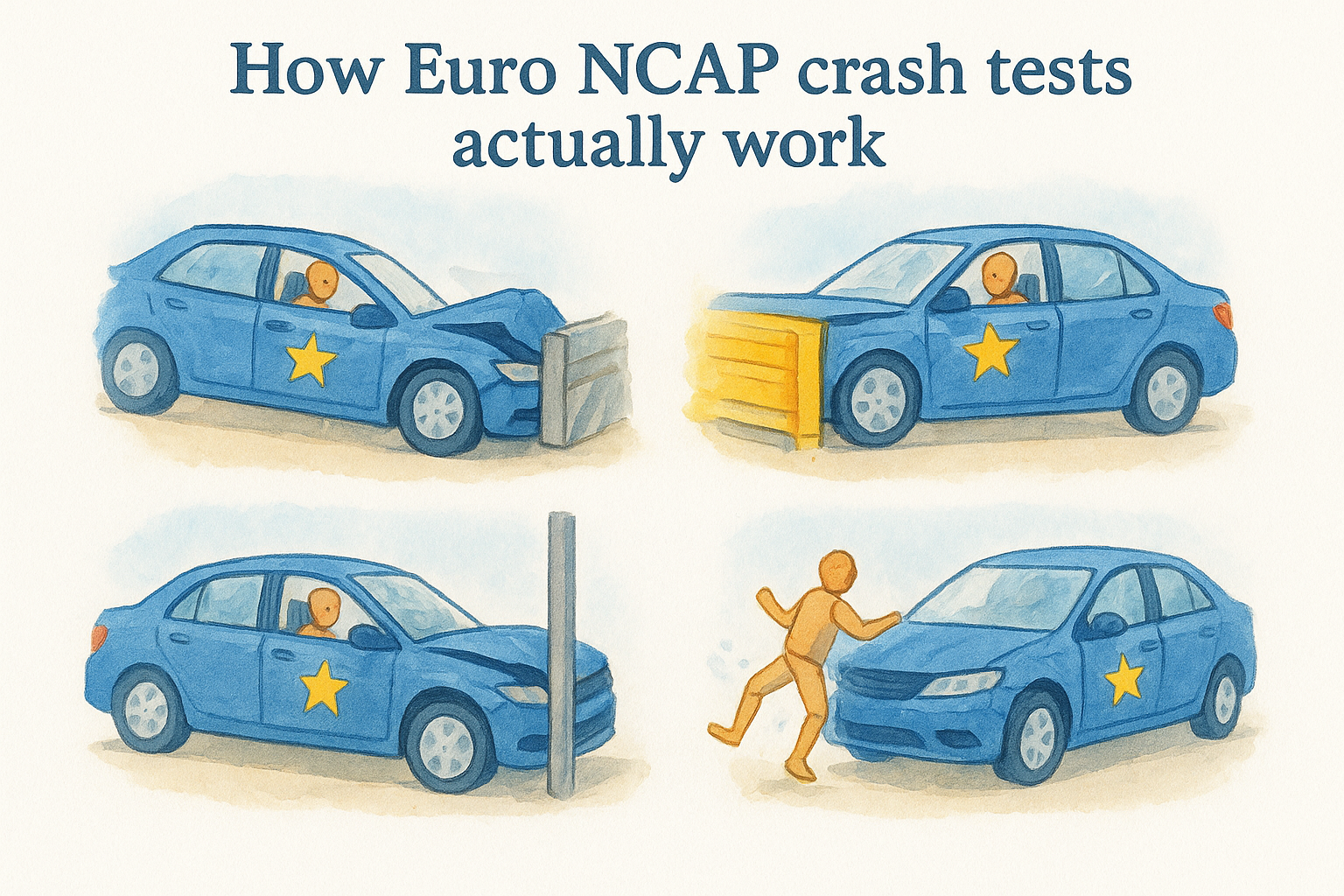
Behind every star rating sits a genuinely destructive process. Euro NCAP buys or sources test vehicles, then subjects them to a fixed sequence of physical crash tests designed to mimic real accidents rather than idealised lab conditions. Engineers measure exactly what happens to crash test dummies fitted with sensors throughout the cabin, recording forces on the head, neck, chest, and legs during each impact.
The physical crash tests
Four main tests form the core of the assessment, each targeting a different type of real-world collision:
- Frontal offset test: the car strikes a deformable barrier at an angle, replicating a head-on crash where only part of the front end absorbs the impact
- Side impact test: a moving barrier strikes the driver's door, simulating a T-bone collision at a junction
- Pole test: the car is driven sideways into a narrow pole, testing how well the structure protects against a tree or lamppost strike
- Pedestrian protection test: dummy legs and head forms are fired at the bonnet and bumper to assess injury risk to people outside the vehicle
No single crash test tells the whole story, which is why Euro NCAP combines four separate collision scenarios before awarding a rating.
Beyond the crash: assist tech and virtual testing
Modern assessments go further than metal-on-metal impacts. Euro NCAP also runs safety assist evaluations, checking whether autonomous emergency braking actually stops the car in time, whether lane-keeping systems intervene correctly, and whether seatbelt reminders work across all seats. Increasingly, computer simulations supplement physical crashes too, letting engineers model additional scenarios without building extra prototypes. Together, this mix of destructive testing and digital modelling is what makes the final safety rating credible rather than a marketing figure dreamed up by a manufacturer.
What the star ratings mean, from zero to five
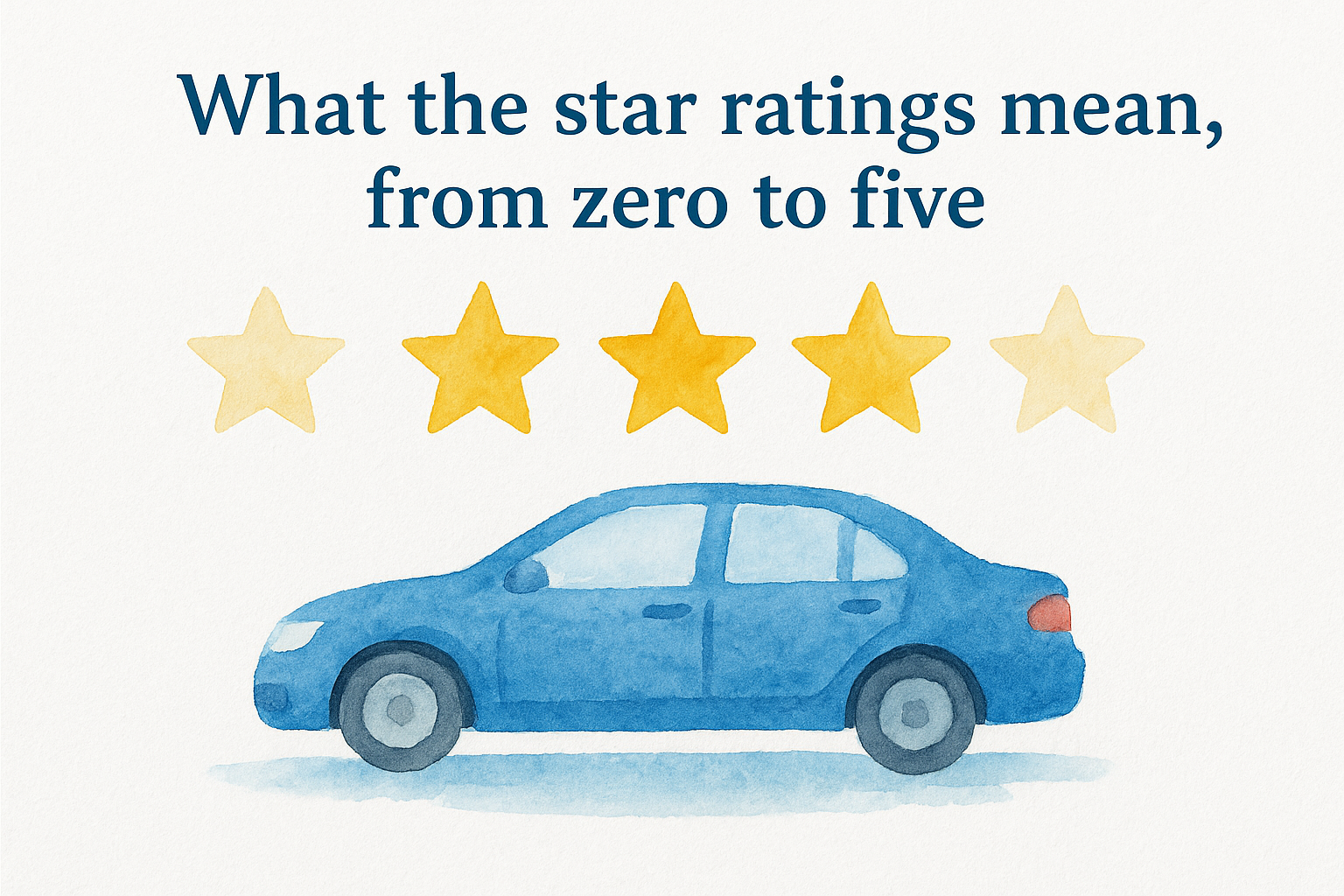
A Euro NCAP star rating is a single number, but it hides four separate scores rolled into one summary. Five stars means a car performed strongly across adult occupant, child occupant, pedestrian, and safety assist categories, not that it aced one test and coasted on the rest. Manufacturers chase five stars for marketing reasons, but the gap between four and five stars in real terms is usually smaller than the gap between two and three, where genuine structural weaknesses start showing up.
What each star level actually means
Here's a rough guide to how the ratings translate into everyday risk:
| Star rating | What it generally indicates |
|---|---|
| 5 stars | Strong protection across all categories, including advanced safety assist tech |
| 4 stars | Good overall protection, with minor weaknesses in one category |
| 3 stars | Average protection, often lacking modern assist features |
| 2 stars | Below-average protection, notable gaps in occupant or pedestrian safety |
| 0-1 stars | Poor structural protection, minimal or outdated safety tech |
Spotting a two-star or lower rating on a used car listing should prompt questions, not automatic rejection, since older budget models were simply never built to modern standards.
Why zero and one-star ratings still exist
Context matters more than the number alone. Some low-scoring vehicles are city cars or vans designed decades ago, tested once, and never updated, while others are recent budget imports built to lower regional standards before entering the UK market. Testing methods also evolve constantly, so a car built for an older protocol can score lower purely because it was never assessed against pedestrian or assist criteria that didn't exist yet.
A low star rating isn't always about a bad car, sometimes it just reflects an outdated test or a market never designed around Euro NCAP standards.
Reading the full breakdown, rather than the headline figure, tells you which of these situations you're actually looking at.
Using Euro NCAP alongside a full vehicle history check
A star rating tells you how a model performs in a lab, but it says nothing about the specific car sitting on a driveway with a for-sale sign in the window. That's where a vehicle history check earns its place alongside your safety research. Euro NCAP confirms the design was tested and rated; a history check confirms the actual vehicle in front of you hasn't been in a serious accident, written off, or quietly repaired without proper documentation.
Why one without the other leaves gaps
Knowing a model scored five stars means little if the exact car has a hidden crash history that compromised its structure. Combining both checks gives you a fuller picture:
- Euro NCAP tells you how the design performs when new
- A history check tells you if this particular car has been written off, stolen, or has outstanding finance
- MOT and mileage records reveal whether wear and tear match the car's age
- Ownership history shows how many hands it's passed through, which can hint at underlying issues
A five-star design means little if the individual car has already been written off and rebuilt.
Running both checks before you commit
Before agreeing a price, run the registration through a car history check on Vehiclepedia to pull MOT records, road tax status, and ownership details straight from official DVLA data, then cross-reference the model against its Euro NCAP score separately. Vehiclepedia's free check covers the essentials, while the premium report adds finance, write-off, and stolen vehicle checks for anyone who wants full legal protection before handing over money. Used together, safety ratings and history data answer two different questions: how well was this car built, and has that build actually held up.
Making a safer choice on your next car
Knowing what Euro NCAP is turns a vague marketing badge into something you can actually use when comparing cars. Stars tell you how a design performs under controlled crashes, and category breakdowns tell you where its real strengths and weaknesses sit. Neither of those things, though, tells you what's actually happened to the specific car you're about to buy.
That's the gap a history check fills. Pairing a Euro NCAP score with verified MOT, mileage, and write-off data gives you a genuinely informed view before you hand over any money, rather than a hopeful guess based on a brochure rating and a seller's assurances.
Before you commit to a used car, run its registration through Vehiclepedia and see exactly what a proper report covers by checking our sample report, so you know precisely what you're getting before you buy.