How to Check a Car's Service History in the UK
Learn how to car check service history using MOT records, service books and Vehiclepedia reports to spot forged records before you buy.
How to Check a Car's Service History in the UK
A missing service history is one of the biggest red flags when buying a used car, yet plenty of buyers still skip checking it properly. If a seller can't produce stamps, receipts or digital records, you're taking a gamble on how well that engine has actually been looked after. Running a car check service history search before you hand over any money can save you from inheriting someone else's neglected maintenance problem.
So how do you actually verify a car's service record in the UK? The honest answer is that no single check gives you the full picture. You need to combine the physical service book, dealer and garage records, MOT history, and where possible a manufacturer's digital service record. Knowing how check car service history works across these sources means you can cross-reference claims rather than just trusting a seller's word.
This guide walks through each method step by step, from reading a paper service book properly to using MOT history data and registration lookups to spot gaps or inconsistencies. By the end, you'll know exactly what to ask for, what counts as solid proof, and which warning signs mean you should walk away from a deal.
What counts as a car's service history
A genuine service history is a paper trail (or digital trail) showing that a car has had its scheduled maintenance done, roughly on time, by someone qualified to do it. That means oil changes, filter swaps, brake checks, timing belt replacements and the dozens of smaller jobs manufacturers specify at set mileage or time intervals. Full service history means every scheduled service has been carried out and recorded, usually by a franchised dealer or an approved garage network. Partial service history means some services happened but there are gaps, missed intervals, or a mix of DIY and professional work with patchy documentation.
The main types of service records
You'll typically come across one or more of these when checking a used car:
- Paper service book: a small booklet with stamps, dates, mileage and a garage signature for each visit.
- Digital service record (DSR): used increasingly by manufacturers like BMW, Mercedes-Benz and Volkswagen instead of a physical book.
- Invoices and receipts: itemised bills from garages showing parts and labour for specific work.
- Manufacturer or dealer database entries: internal records a franchised dealer can pull up using the VIN.
- MOT history data: not a service record itself, but useful for spotting mileage inconsistencies and recurring mechanical issues.
A car's service history is only as trustworthy as the paperwork backing it up, not the seller's word.
Why full history matters more than age or mileage
Two cars with identical mileage can have wildly different mechanical condition depending on how consistently they were serviced. A car check service history review tells you whether the previous owner treated maintenance as a priority or an afterthought. Missed intervals on timing belts or cambelts, for example, can lead to catastrophic engine failure, a repair bill that can easily exceed the car's resale value.
This matters just as much for financial reasons as mechanical ones. Cars with a documented full service history typically hold their value better and sell faster, because buyers and dealers alike treat verified history as proof of care rather than a claim. When you're working out how check car service history stacks up against a seller's asking price, remember that a genuine full history can justify a higher price, while unexplained gaps are a legitimate reason to negotiate down or ask hard questions before you commit to anything.
Step 1. Check the service book and paperwork
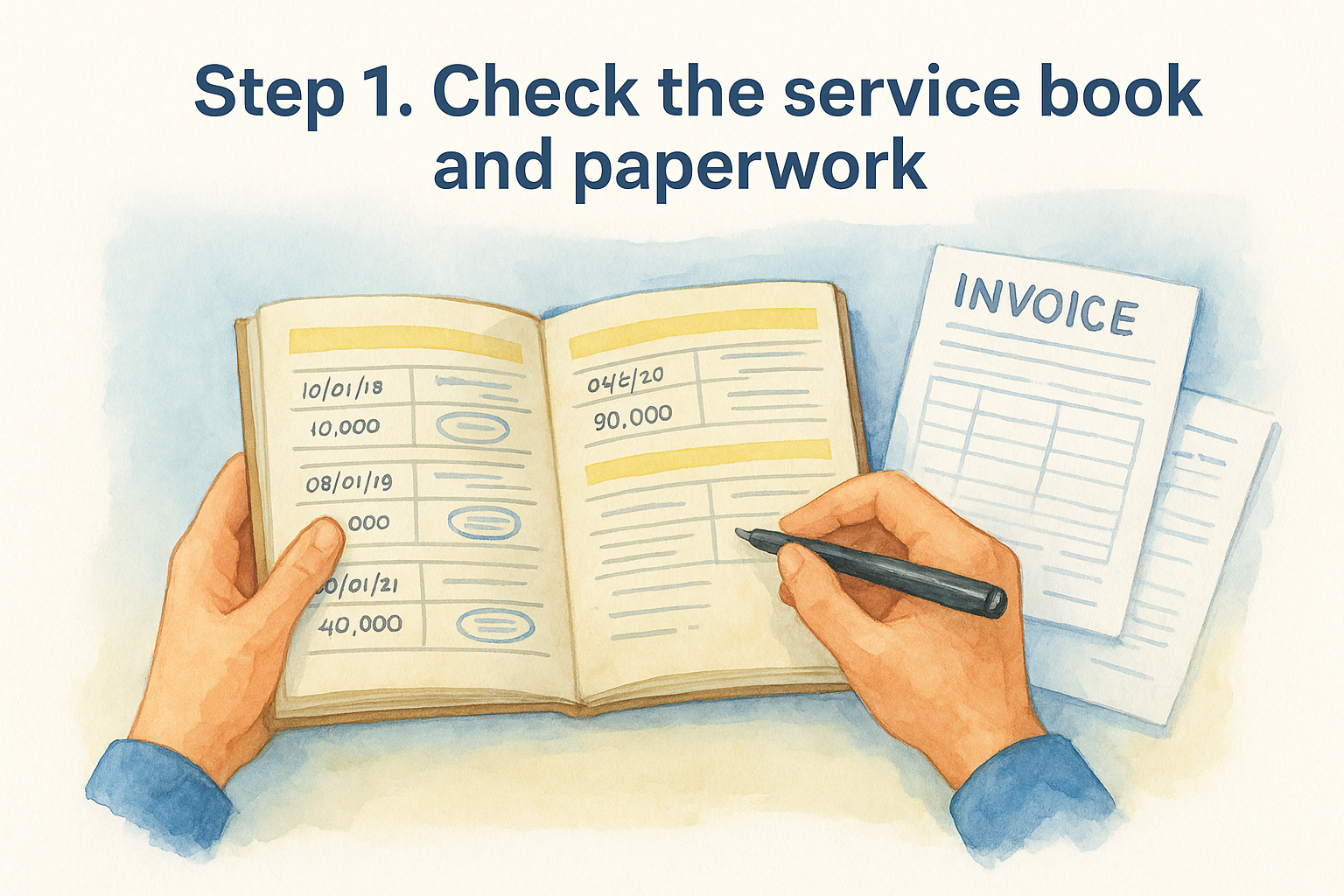
Start with what's in front of you. Ask the seller for the service book and every invoice they can find before you even look at the car properly. A genuine record should show consistent stamps or entries at roughly the intervals the manufacturer specifies, usually every 12 months or 10,000 to 12,000 miles depending on the model.
What to look for on each page
Don't just flick through and count stamps. Check the detail on each entry:
- Matching mileage progression: figures should climb steadily entry to entry, with no jumps backwards or suspiciously round numbers.
- Garage details: a real stamp, name, address and phone number, not just a signature.
- Dates that make sense: gaps of two or three years between services are a warning sign, not a rounding error.
- Work descriptions: vague notes like "serviced" tell you less than itemised invoices listing parts and labour.
If the paperwork doesn't match the mileage on the clock, walk away or dig much deeper before you buy.
Spotting a forged or incomplete book
Handwriting that changes style within the same garage's entries, stamps that look photocopied, or a book that's suspiciously pristine for a ten-year-old car are all signs worth questioning. Genuinely check whether the garage named still exists; a quick search or phone call can confirm a stamp is real rather than invented. Invoices are harder to fake convincingly than stamps, so ask for them specifically even if the book looks complete, because a car check service history built only on stamps without supporting invoices is weaker evidence than one backed by both.
Step 2. Run a free MOT history check
Once you've checked the physical paperwork, cross-reference it against the free MOT history check on GOV.UK. Every MOT test since 2005 gets logged centrally, and the advisory notes and mileage readings recorded at each test give you an independent record that a seller can't easily fake. This is one of the few checks that costs nothing and takes under a minute.
How to run the check
Head to the official GOV.UK MOT history service, enter the registration plate, and review the results:
- Mileage at each test: should rise steadily year on year, matching the service book entries.
- Advisory notes: recurring warnings about the same fault (worn brake pads, corroded brake pipes) suggest deferred maintenance rather than proper servicing.
- Test dates and gaps: a missed MOT year, or one squeezed in right before a sale, can hint at a car that's been off the road or hastily patched up.
Mileage recorded at MOT time doesn't lie, even when a service book does.
Why this step catches what the service book misses
Sellers sometimes present a tidy service book while the MOT record tells a different story. Comparing the two is central to any serious car check service history process, because discrepancies between them are far more revealing than either document alone. Advisories that repeat year after year, for instance, often mean a fault was flagged but never fixed, even if the service book shows a stamp for that same period. Treat any mismatch between MOT mileage and service book mileage as a reason to ask the seller for a direct explanation before you go any further.
Step 3. Get a full vehicle history report
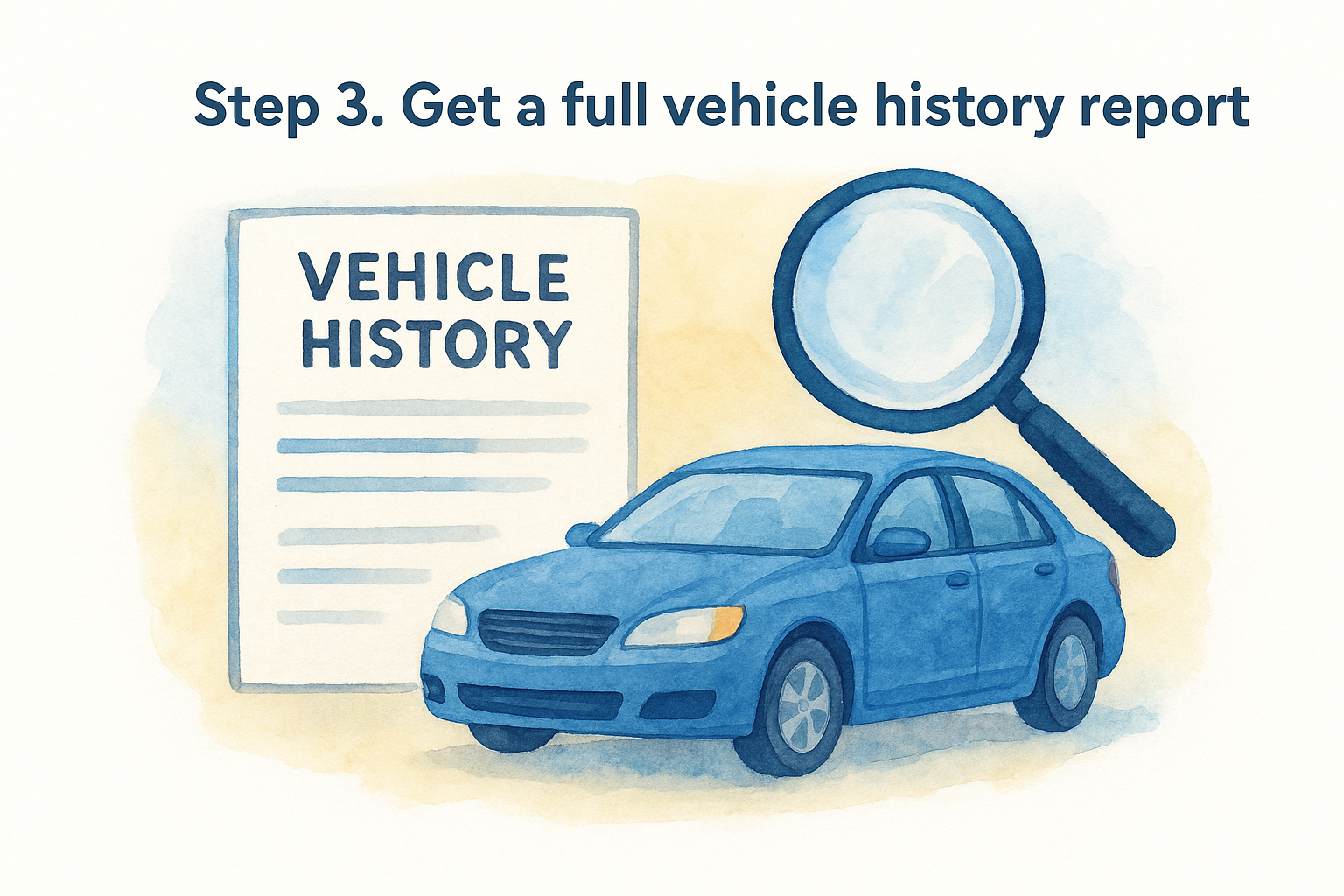
Paperwork and MOT records only tell you what a seller or garage chose to document. A vehicle history report pulls from official databases to reveal what they might not mention: outstanding finance, insurance write-off status, stolen markers, plate changes, and mileage discrepancies flagged across multiple sources. Running a registration lookup on Vehiclepedia gives you this wider context alongside the MOT and tax data you've already checked, so you're not relying on a single document to make a purchase decision.
What a full report adds beyond MOT and paperwork
A proper history report cross-checks data that a service book simply can't show you:
- Mileage anomaly flags: comparing readings logged at MOT tests, previous sales and finance agreements to catch clocking.
- Write-off and insurance category: whether the car was ever declared a total loss and, if so, under which category.
- Outstanding finance: confirms whether there's still a loan secured against the vehicle that could leave you liable.
- Stolen vehicle markers: checked against police records, not just seller assurances.
- Import, export and colour change history: useful context for verifying the car's full story matches what you've been told.
A service book tells you what was done to the car; a full history report tells you what happened to the car.
Reading the report against what you already know
Once you've got the report, line it up against the service book and MOT data you gathered earlier. A car check service history process works best when every source agrees. If the report's mileage figures match the MOT and service book entries, that's strong confirmation. If they don't, you've got a genuine problem to raise with the seller, not a technicality to ignore.
Step 4. Confirm details with a dealer or mechanic
Once you've gathered the service book, MOT history and a full vehicle history report, the last step is human verification. Documents can be forged or misread, but a franchised dealer with access to the manufacturer's database, or an independent mechanic who inspects the car directly, can confirm whether the paperwork matches reality. This step catches the small number of cases where everything on paper looks fine but something still doesn't add up.
Calling the dealer network
Most franchised dealers can look up a digital service record using the VIN, even if the car was serviced at a different branch or a different franchise entirely. Ring the manufacturer's dealer network with the registration and VIN ready, and ask them to confirm the last recorded service date, mileage, and which jobs were carried out.
A dealer's own database is harder to fake than a stamp in a book, so use it whenever the car's history matters.
Booking an independent inspection
If the car's out of manufacturer warranty or the dealer network can't help, book an independent mechanic for a pre-purchase inspection. A good mechanic will:
- Check for recent work: fresh oil, new filters or recently replaced parts that match what the paperwork claims.
- Spot deferred maintenance: worn components that should have been replaced under a genuine full service history.
- Confirm timing belt or chain condition: critical on higher-mileage cars where this job is often skipped or faked.
This final car check service history step turns a paper-based investigation into a physical one, and it's worth the £50 to £100 it typically costs before you commit to a purchase running into thousands.
Buying with confidence
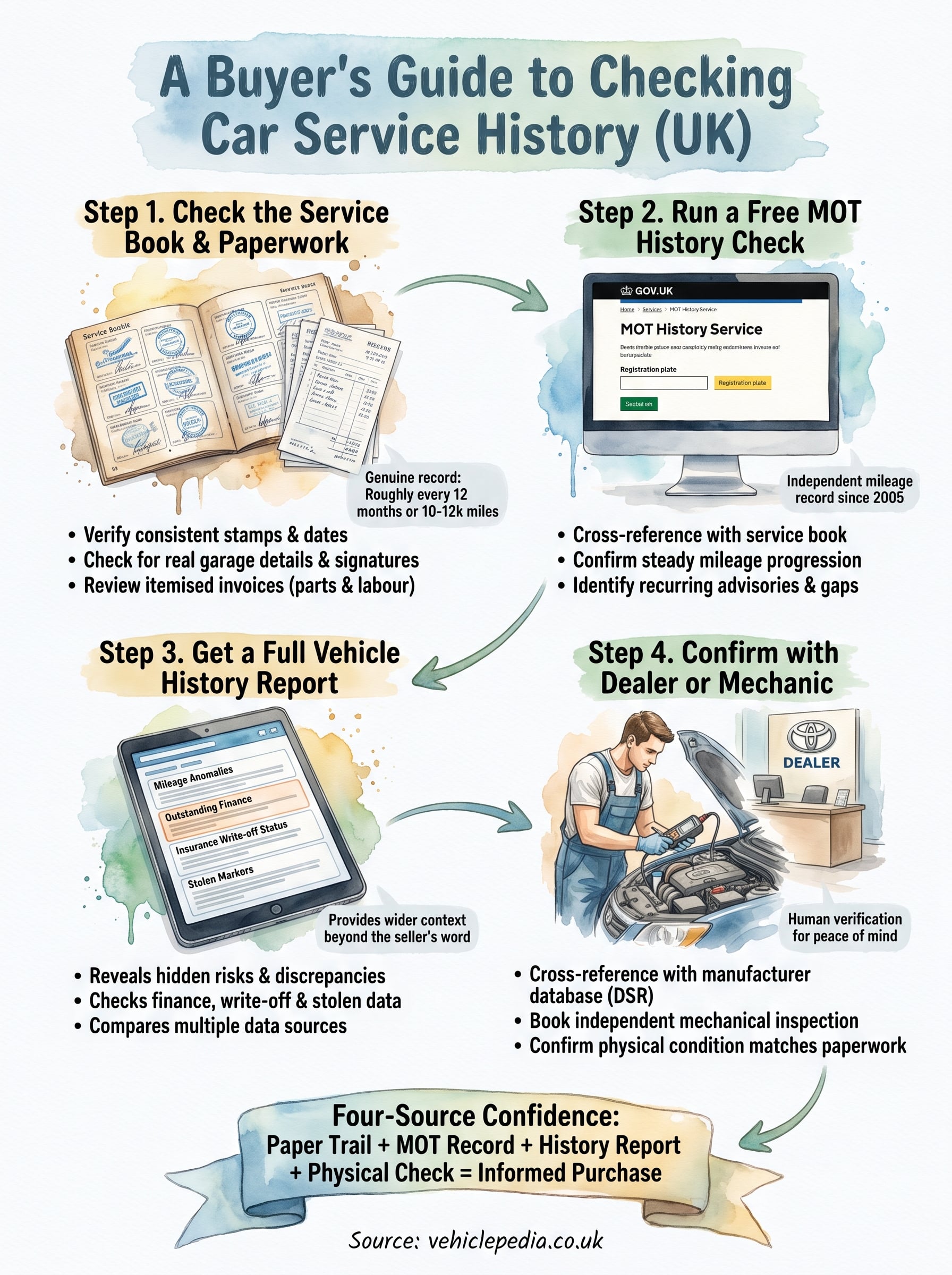
Checking a car's service history properly means layering four sources rather than trusting one. The service book gives you a paper trail, the MOT record gives you an independent mileage check, a full history report exposes finance and write-off risks, and a dealer or mechanic confirms the physical reality behind the documents. Skip any one of these and you're leaving a gap a dishonest seller could exploit.
Getting this right doesn't take long, and it costs far less than discovering a hidden problem after you've paid. Before you view any car, run the registration through a proper vehicle history check and see exactly what turns up. You can preview what a full report looks like on our sample report page, so you know precisely what you're getting before you commit to buying one. That's how you buy with confidence instead of hope.