Car Depreciation After Accident: How Much and How to Claim
Car depreciation after accident explained: typical loss of 5% to 20%, how to work out your figure, and how to claim it from the at-fault insurer.

Car Depreciation After Accident: How Much and How to Claim
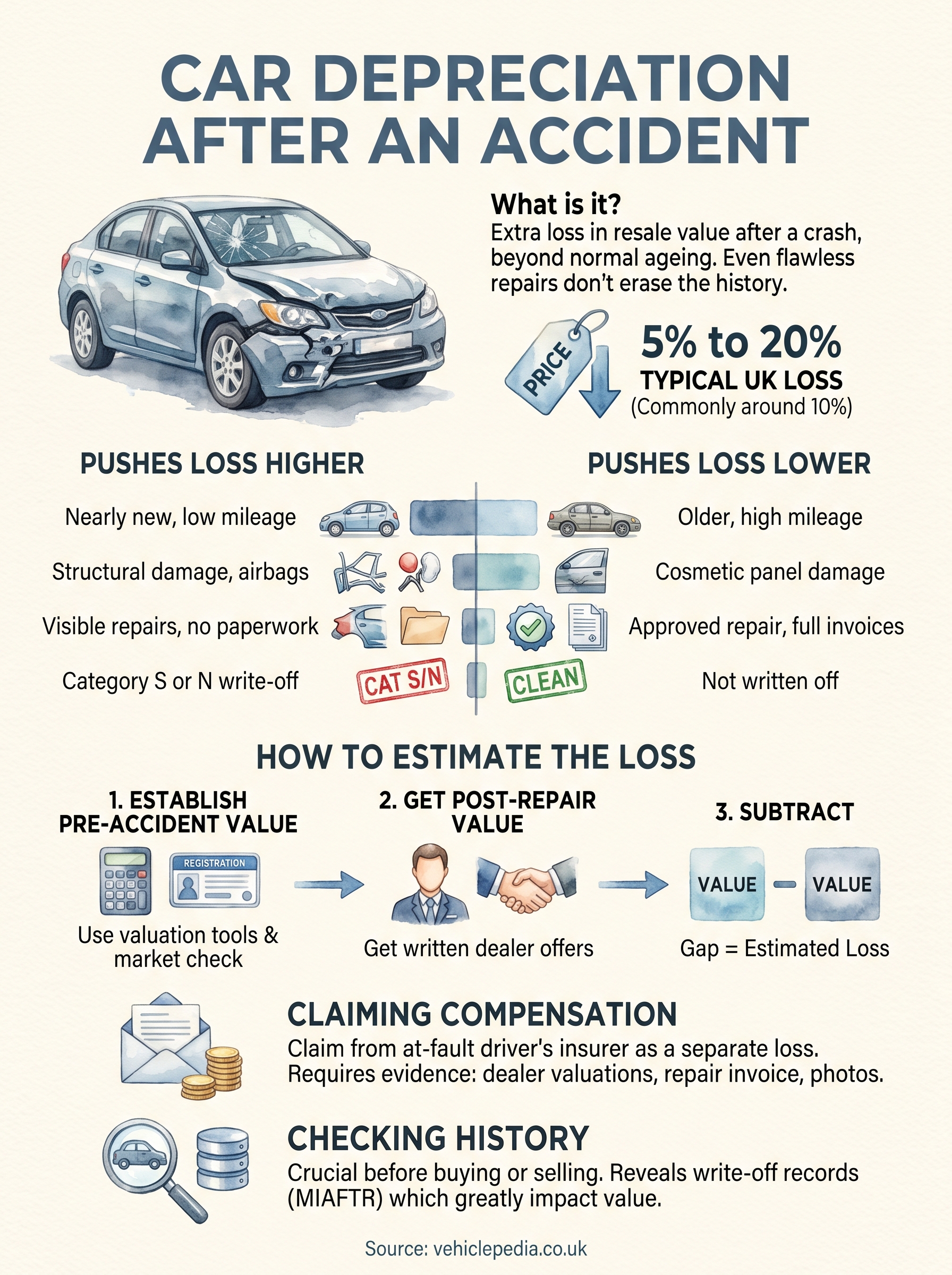
Car depreciation after accident is the extra loss in resale value a car suffers because it has been in a crash, on top of normal ageing. It happens even when the repair is flawless. In the UK the loss is commonly put at 5% to 20% of the car's pre-accident value. Lawyers and insurers often call it diminished value or diminution in value. If another driver caused the crash, you can claim it from their insurer.
Most people only meet the term when an insurer pays for the repair and nothing else. The repair bill and the loss in value are two separate things. The second only gets paid if you ask for it and can show the figure.
This guide shows why the loss happens and what drives its size. It then walks through a method for putting a pound figure on your own car, how a claim works in the UK, and when it is not worth making. We run a UK vehicle history check service, so we also cover how write-off records affect the price of a repaired car, whether you are buying or selling.
Why car depreciation after an accident matters
It matters because the loss lands on you at the moment you sell, part-exchange or settle finance, and nobody compensates you unless you raise it. The size of the loss is also larger than most owners expect.
How accident loss differs from normal depreciation
Every car loses value as it ages. A new car can lose a fifth or more of its price in the first year, and mileage keeps taking its share after that. Accident depreciation is a second, separate loss that sits on top of the first. A two-year-old car with a repaired crash in its past is worth less than an identical two-year-old car with a clean record.
Buyers and dealers price in risk. They cannot see what happened behind the panels, so they assume the worst and lower their offer to cover the unknown. That discount is the loss you are trying to measure.
An accident takes value off a car that ageing has already taken value from, and the two losses add up.
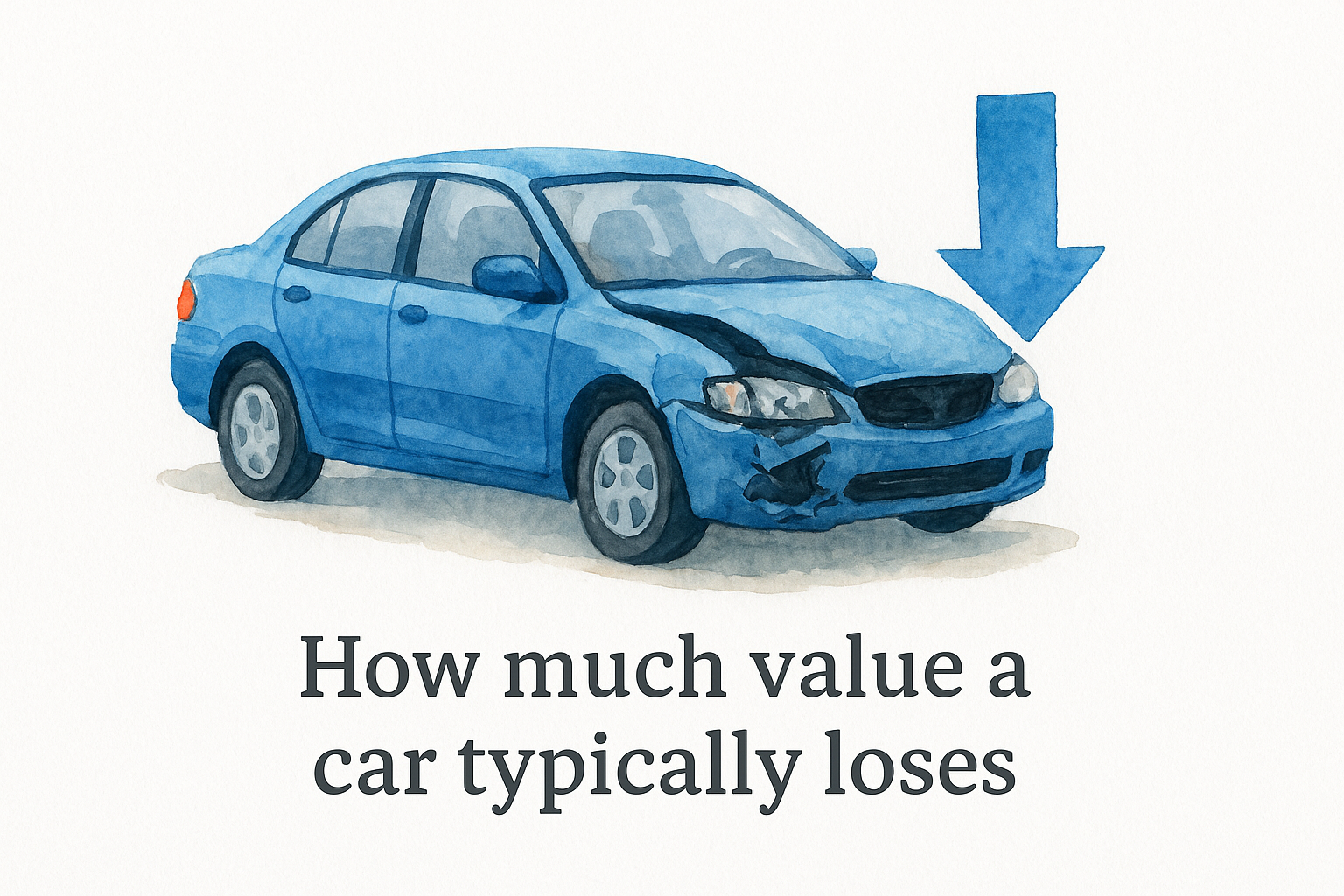
How much value a car typically loses
Nobody publishes a fixed rate, because the loss depends on the car and the crash. The figure most often quoted by the motor trade is 5% to 20%, and around 10% is a common working figure for a moderately damaged car that was repaired well. On an £18,000 car that range runs from £900 to £3,600.
| Factor | Pushes the loss higher | Pushes the loss lower |
|---|---|---|
| Age and mileage | Nearly new, low mileage | Older, high mileage |
| Damage | Structural damage, airbags deployed | Cosmetic panel damage |
| Repair quality | Visible respray, poor panel gaps, no paperwork | Approved repairer, full invoices |
| Insurance record | Written off, Category S or N | Not written off |
Why a perfect repair does not remove the loss
A flawless repair restores how the car looks and drives. It does not restore the car's history. If the insurer treated the car as a write-off, the record sits in the MIAFTR insurance database, and any buyer running a history check will see it. Since 2017 repairable write-offs are Category S (structural) or Category N (non-structural), and both leave a lasting mark on the price.
If the accident was not a write-off, there may be no database record at all. Even so, experienced dealers spot repainted panels and uneven gaps within minutes, and they discount accordingly.
How to estimate your car's loss in value
You estimate the loss by comparing what the car was worth before the crash with what a buyer would pay for it now, and subtracting one from the other. There is no official UK formula, so the strength of your figure depends on the evidence behind both numbers.
Working out your figure step by step
Follow these steps in order:
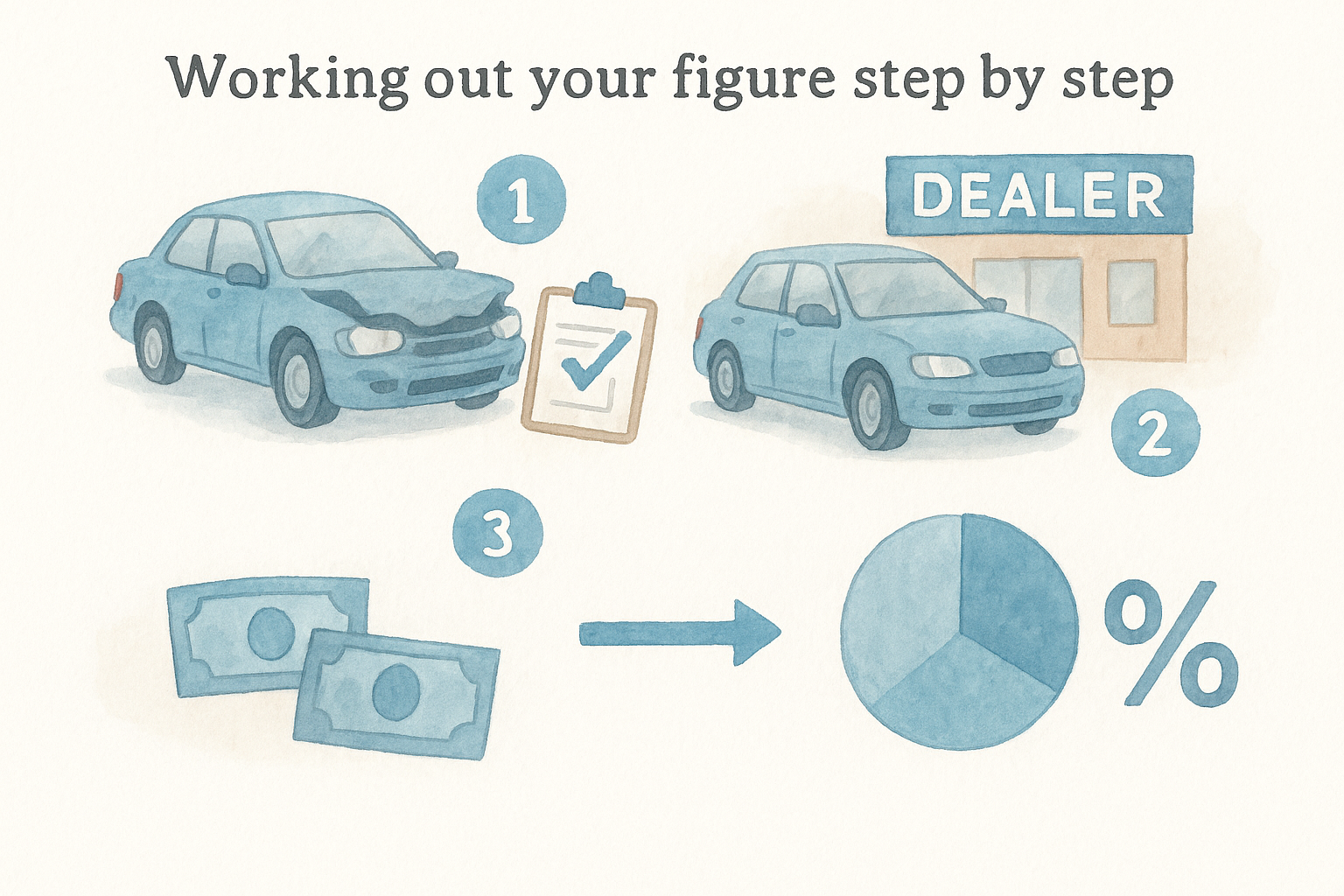
- Establish the pre-accident value. Use a valuation based on your registration, mileage and condition. Our car valuation check finds a valuation from the registration number. Cross-check it against three similar cars currently advertised.
- Get the post-repair value. Ask two or three dealers, or an independent motor trade valuer, for a written figure for the car in its repaired state. Tell each one about the accident.
- Subtract. The gap between the two values is your estimated loss.
- Sanity-check the percentage. If the gap is far outside 5% to 20%, find out why before you rely on it.
Here is a worked example. Your car was worth £18,000 before the crash. Three dealers offer £16,200, £16,400 and £16,000 for it after a good repair. The average is £16,200, so the loss is £1,800, or 10%. That is the figure you would put to the insurer.
The only figure an insurer will take seriously is one built from the car's value before the crash and written offers for it afterwards.
Why the US 17c formula does not apply here
Many top search results push the "17c" formula. It caps the loss at 10% of the car's value, then applies multipliers for damage and mileage. It comes from a US court case and is used by US insurers. No UK court or insurer is bound by it, and quoting it in a UK claim will not carry weight.
You can use it as a rough sanity check, but your own dealer valuations are stronger evidence. They reflect the actual market for your car rather than a fixed cap.
How to claim compensation for diminished value
You claim diminished value from the at-fault driver's insurer, as part of the compensation that puts you back in the position you were in before the crash. It is a separate head of loss from the repair bill, so it needs its own figure and its own evidence. The steps below follow the general approach in England and Wales, and the rules differ in Scotland and Northern Ireland.
Who you can claim from and how
If the accident was not your fault, write to the other driver's insurer with your valuation evidence and a clear figure. Your own insurer may arrange the repair, but it will not normally pay for the loss in value. Read the wording of any settlement before you sign. A full and final settlement can close the whole claim, including the part you have not yet raised.
If the insurer refuses or offers far too little, you can instruct a solicitor, and some take these claims on a no-win-no-fee basis. You can also bring a court claim yourself. Most diminution claims fall within the small claims track, which in England and Wales covers claims up to £10,000, and you can start one through GOV.UK. Recoverable legal costs are limited on that track.
Evidence that supports your figure
Insurers rarely pay a number just because you state it. Gather these items first:
- Written post-repair valuations from two or three dealers or an independent valuer
- Your pre-accident valuation and the comparable adverts behind it
- The repair invoice, plus photographs of the damage before and after
- The insurer's write-off category, if the car was classed as a Category S or N
- Service history and MOT history showing the car's condition before the crash
If you have already sold the car, you can still claim. The sale receipt then serves as proof of what the car fetched, although it is harder to show the sale price reflected the accident.
A claim built on dated, written valuations is hard to wave away, while one built on "my car feels worth less" is easy to refuse.
When a claim is unlikely to succeed
A claim will struggle in several situations, and it is better to know them before you spend time:
- You caused the accident. There is no at-fault party to claim from, and your own comprehensive policy does not cover diminished value.
- The car was a total loss. The insurer pays the pre-accident market value instead, so there is no repaired car to devalue.
- The car is old or cheap. The loss may be too small to justify the effort.
- The repair was thorough and well documented. The insurer can argue the car's value was restored, and you would need dealer evidence to counter that.
How to check a car's accident history before you buy or sell
A history check shows whether a car has a recorded write-off, which is the biggest single trigger for accident depreciation. Run one before you buy, and again before you sell, so you know what the next buyer will see.
If you are buying, a repaired car should be cheaper than a clean equivalent. Our free check covers MOT history, which can reveal repeated advisories or odd mileage, and the premium check at £6 adds the write-off check, finance check and police check. The service history check is also free. Premium reports carry a data guarantee of up to £30,000 for non-trade users.
If you are selling, run the same check on your own car. A salvage record shows the date of the salvage auction and the category of write-off. Being upfront about a repair, backed by invoices, usually costs less than a buyer discovering it halfway through a sale. It also gives you a number to compare against dealer offers, and a car valuation check helps you set the asking price.
Whether you buy or sell, check the write-off record first, because it decides how far the price should fall.
Putting a figure on the loss
A repaired car is worth less than a clean one, typically by 5% to 20%, and the gap is real money when you sell. You can estimate it by comparing the pre-accident value with written dealer offers for the repaired car. If someone else caused the crash, you can claim the difference from their insurer, backed by valuations, invoices and photographs.
Before you negotiate or buy a repaired car, check what the record already shows. You can see exactly what a premium report covers in our sample report, including the write-off check that tells you whether a car has been through this process.