Car Depreciation: What It Is and How It Works
Find out what is car depreciation, how to calculate it, key factors affecting value, and tips to slow it, plus how a Vehiclepedia check helps.

Car Depreciation: What It Is and How It Works
Every car loses value the moment you drive it off the forecourt, but most buyers never stop to work out how much or why. Car depreciation is the drop in a vehicle's value over time, and it's usually the single biggest cost of car ownership, bigger than fuel, insurance, or servicing combined. If you've ever wondered why a two-year-old car sells for thousands less than its original price, depreciation is the answer.
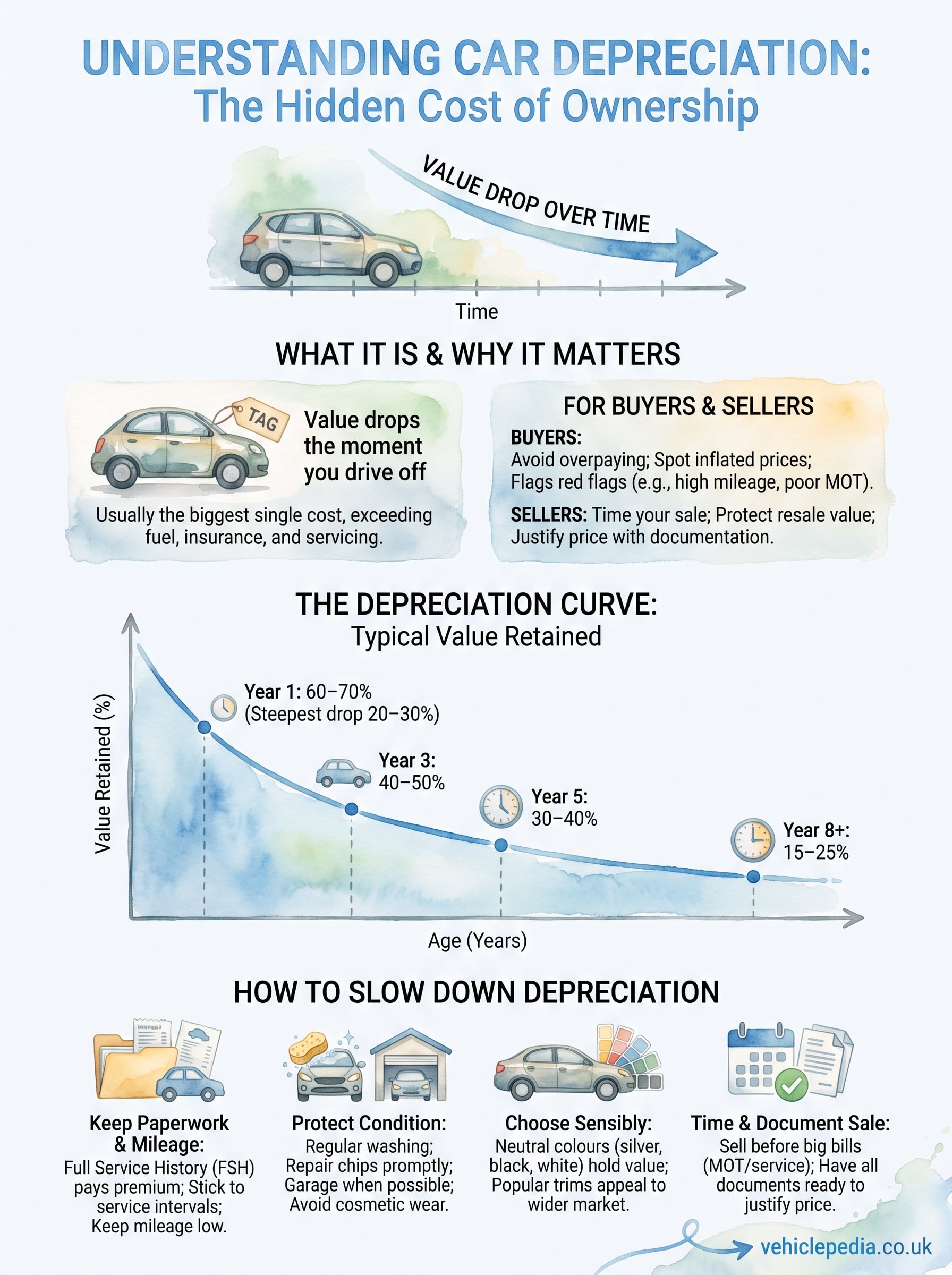
In simple terms, a car depreciates because it becomes older, more used, and less desirable compared with newer models on the market. New cars depreciate fastest, often losing 20 to 30% of their value in the first year alone. After that, the rate slows, but it never stops completely until the car reaches banger territory. Factors like mileage, condition, brand reputation, and even paint colour all play a part in how steep that curve looks.
This article breaks down exactly what causes depreciation, how it's calculated, and which cars with the lowest depreciation in the UK hold their value better than others. Understanding this before you buy, whether new or used, helps you avoid overpaying and gives you a clearer picture of what a vehicle is genuinely worth today.
Why car depreciation matters when buying or selling
Getting your head around car depreciation isn't just an academic exercise. It shapes almost every financial decision you make around a vehicle, from how much deposit you need for a finance deal to whether you're better off leasing than buying outright. Ignore it, and you risk signing up for a car that costs you far more than the sticker price ever suggested.
A car's depreciation curve tells you more about its true cost than the price tag ever will.
For buyers
Understanding depreciation protects you from overpaying for a used car that's already lost most of its value in the first couple of years. Knowing the typical curve for a specific make and model lets you spot a fair asking price versus one that's inflated. It also flags red flags in a vehicle's history, since cars with a poor MOT record, high mileage, or a hidden write-off marker depreciate faster and become harder to sell on later. Knowing how a history check works before you commit helps, because it gives you the MOT history, mileage record, and any write-off or finance markers that directly affect resale value, so you're not caught out months down the line.
For sellers
Sellers need this knowledge just as much as buyers do. If you're planning to sell privately or part-exchange, timing your sale around the depreciation curve can add hundreds or even thousands of pounds to what you get back. A car sold just before its next MOT or service interval, for instance, often fetches less than one sold with fresh paperwork and a clean bill of health. Pricing your car too high because you're unaware of how fast it's actually depreciated only means it sits on the market longer, which itself accelerates the value drop further.
The financial ripple effect
High depreciation also affects insurance payouts, loan balances, and part-exchange values in ways many owners don't anticipate. If your car's market value falls faster than you're paying off a finance agreement, you can end up in negative equity, owing more than the car is worth. Insurers use depreciated value, not what you paid, to settle claims after write-offs, which is why gap insurance exists as a separate product. Recognising these knock-on effects early means you can plan your next purchase, your finance term, and your insurance cover around realistic numbers rather than optimistic ones.
How to calculate your car's depreciation
Working out car depreciation doesn't require a finance degree, just a bit of maths and the right starting figures. Most owners use one of two approaches: the straight-line method or the percentage method, both of which give you a rough but useful estimate of what your car is worth today compared with what you paid for it. Either way, to work out your car's current value you'll need the original purchase price, the car's current age, and an estimate of its expected lifespan or resale value.
Knowing your car's depreciation rate turns a guess about value into a number you can actually rely on.
The straight-line method
This approach spreads the total expected loss evenly across the car's useful life, which makes it simple but not always accurate for the steep early drop most vehicles experience. Subtract the estimated resale value from the purchase price, then divide by the number of years you expect to own it. A £20,000 car expected to be worth £4,000 after eight years loses roughly £2,000 a year under this model, though real-world depreciation rarely stays this consistent year on year.
The percentage method
Percentage-based calculations reflect reality more closely, since depreciation rates are highest in year one and taper off afterwards. Here's a typical pattern used by valuation guides:
| Age of car | Typical value retained |
|---|---|
| Year 1 | 60–70% |
| Year 3 | 40–50% |
| Year 5 | 30–40% |
| Year 8+ | 15–25% |
Running your registration through a free car valuation check gives you the age, mileage, and history data needed to plug into either formula, so your estimate is grounded in facts rather than assumptions.
What affects how fast a car loses value
Several factors combine to decide how steep any car's depreciation curve turns out to be, and no two vehicles lose value at exactly the same rate. Brand reputation plays a huge role here: makes known for reliability, like Toyota or Honda, tend to hold their value far better than brands with a history of costly repairs. Mileage matters just as much, since a car with 60,000 miles at three years old will always be worth less than an identical model with half that mileage, regardless of condition otherwise, which is why a vehicle mileage check is worth running.
The fastest-depreciating cars are usually the ones nobody wants to inherit the running costs of.
Condition, colour, and market demand
Beyond the obvious mechanical factors, cosmetic condition and even paint colour influence resale value more than most owners expect. Neutral colours like silver, black, and white hold value better because they appeal to a wider pool of buyers, while unusual colours narrow your market and speed up value loss. Demand shifts also matter: fuel type is a growing factor, with diesel values softening in many segments as buyers move toward hybrids and electric vehicles.
History and documentation
Gaps in service history, previous accident damage, or an unclear ownership trail all accelerate how fast a car loses value on the used market. Insurers and buyers alike treat a full main dealer service history as a mark of trust, and its absence knocks thousands off resale price on higher-value cars. Xenon-clear documentation, paired with a clean MOT record and no hidden write-off markers, which you can confirm by spotting a written-off car by reg, keeps a car's depreciation closer to the average curve rather than falling off it entirely.
How to slow down your car's depreciation
Nobody can stop car depreciation entirely, but you can control how steep the curve looks over the years you own the vehicle. Small, consistent habits protect resale value far more than any single big decision, and they cost far less than the value you'd otherwise lose chasing a quick fix later.
A well-documented, well-maintained car depreciates on its own terms, not the market's.
Keep the paperwork and the mileage in check
Full service history is one of the cheapest ways to protect resale value, since buyers and dealers pay a premium for a car with every stamp in the book, and a car service history check confirms what's actually recorded. Sticking to manufacturer-recommended service intervals, keeping receipts, and avoiding unnecessary long journeys all help keep your mileage lower than the average for the car's age, which slows the depreciation curve noticeably over time.
Protect the bodywork and choose sensibly
Regular washing, prompt repair of stone chips, and garaging where possible protect against the cosmetic wear that knocks value off older cars fastest. If you're buying new, choosing a popular colour and a well-specified trim, rather than an unusual paint job or a stripped-back base model, gives you a wider pool of future buyers and a stronger resale price when the time comes to sell.
Time your sale and keep records ready
Selling before a big MOT or major service bill often nets more than waiting until the car needs expensive work doing first. Keeping a folder, physical or digital, with your MOT certificates, service receipts, and ownership documents ready to hand over speeds up the sale and justifies a higher asking price when a buyer starts comparing offers.
Making sense of your car's value
At its core, car depreciation is simply the price you pay for using a car rather than owning a static asset. It's steepest in the first year, slows with age, and depends heavily on mileage, condition, brand, and documentation. Understanding the curve helps you buy smarter, sell at the right moment, and avoid the financial traps that catch out owners who never bothered to check the numbers.
Before you make your next move, whether that's buying, selling, or part-exchanging, get the full picture on any car's history and condition first. A clean history report backs up a fair price and protects you from inheriting someone else's depreciation problem. Curious what one of our premium reports actually looks like? View a sample premium report before you decide, and see exactly how much clearer your next purchase decision could be.