Car Write-Off Categories Explained: Cat A, B, S and N
Car write off categories explained: Cat A, B, S and N decoded, plus how to check history, spot risks and negotiate a fair discount.
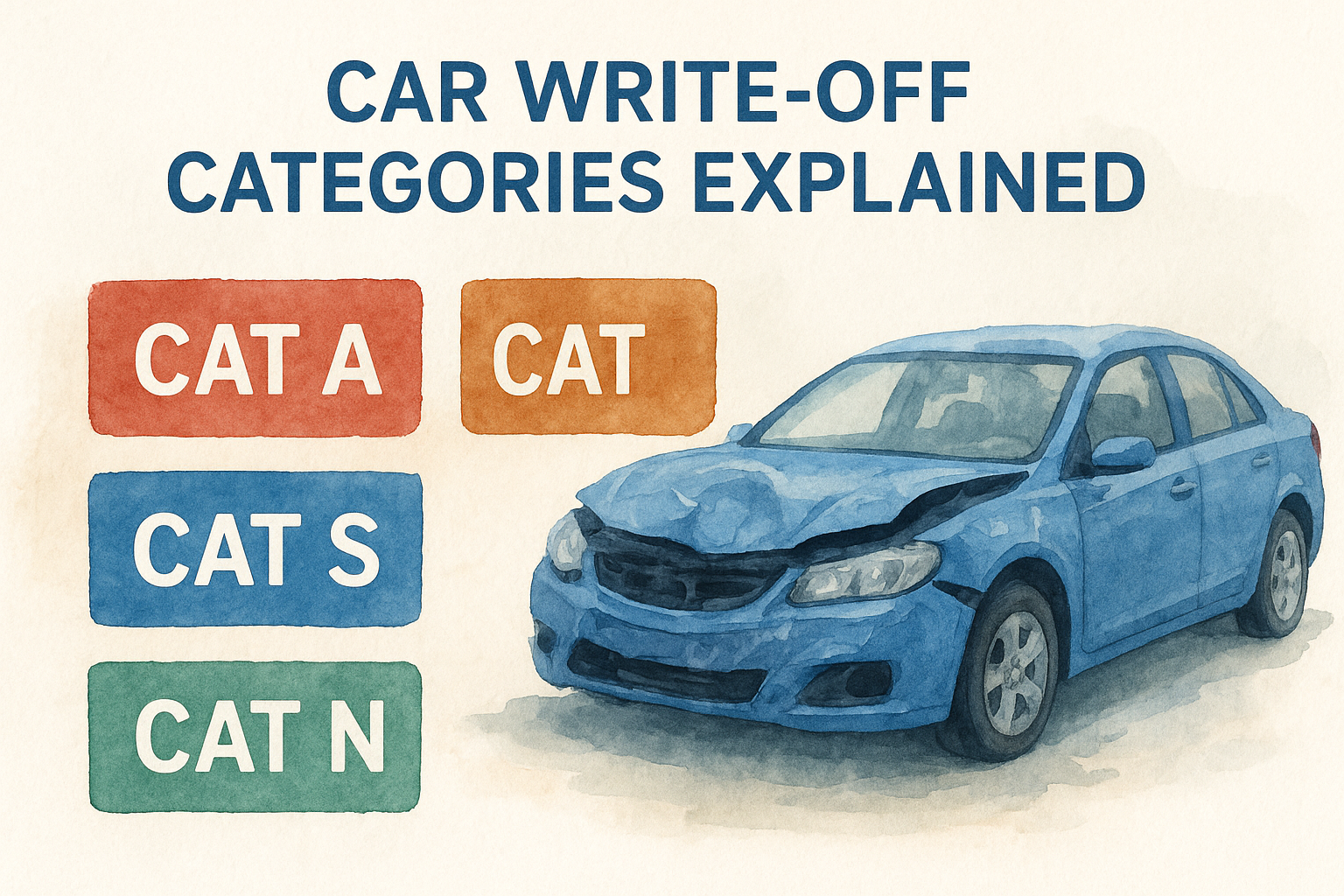
Car Write-Off Categories Explained: Cat A, B, S and N
If you've spotted a cheap car online and noticed the phrase "Cat N" or "Cat S" in the listing, you're right to pause. Car write off categories explained properly can save you from buying a vehicle that's dangerous, hard to insure, or worth far less than the asking price suggests. Insurers use these labels every day, but most private sellers either don't understand them or don't mention them at all.
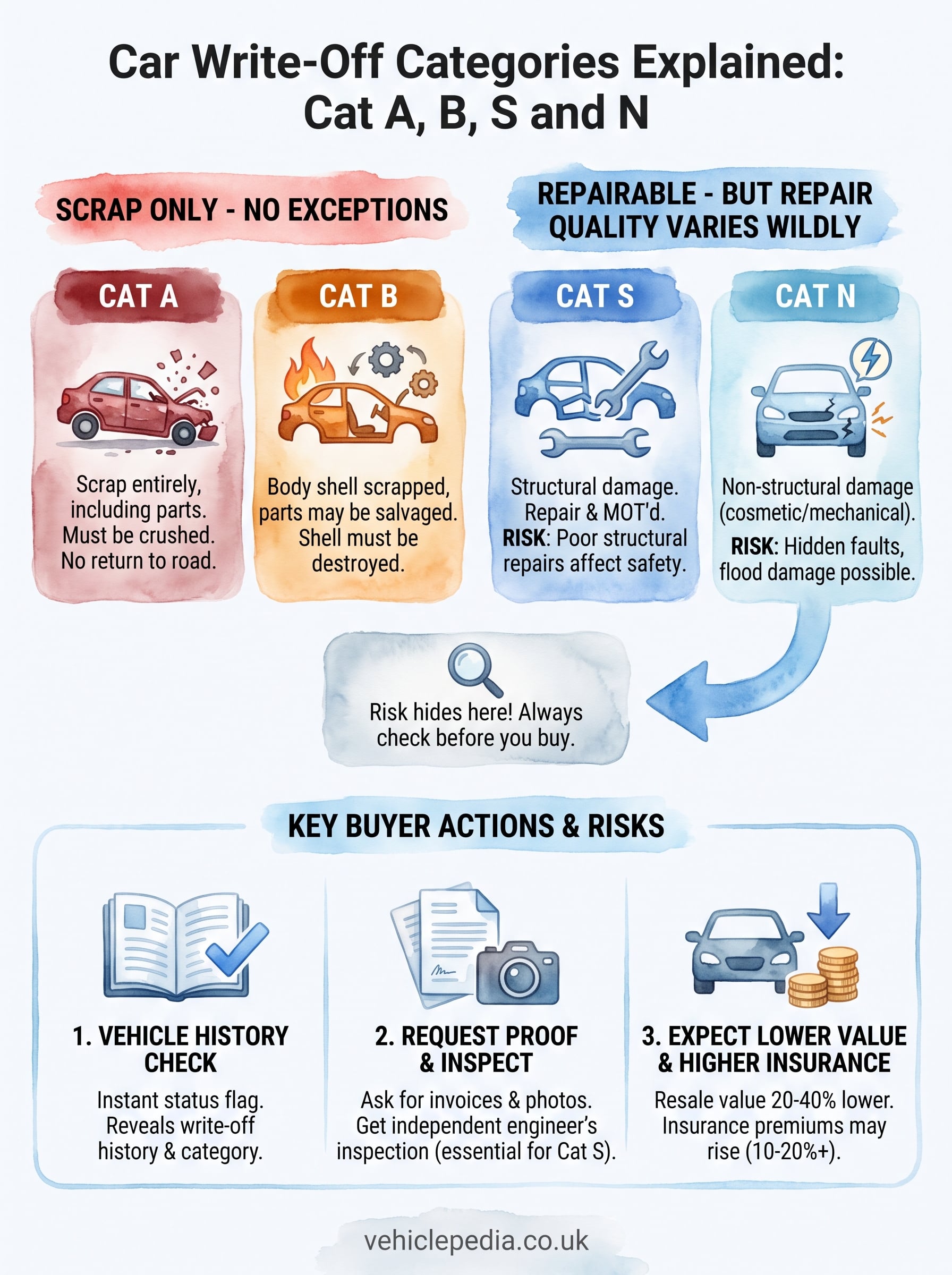
There are four categories you'll come across: Cat A, Cat B, Cat S and Cat N. Each one tells you something different about how badly a car was damaged and whether it was ever safe to put back on the road. Cat A and Cat B mean scrap only, no exceptions. Cat S and Cat N cars can legally return to the road, but repair quality varies wildly and that gap is exactly where risk hides for buyers.
In this article, we'll break down what each category actually means, how it affects a car's safety, insurance and resale value, and what questions to ask before you hand over any money. We'll also show you how a quick vehicle history check flags a car's write-off status instantly, so you're never guessing.
Why the write-off category matters when buying a car
Every write-off category tells you a different story about what happened to a car and what an insurer decided about its future. Get this wrong and you could end up driving something that's structurally unsound, uninsurable at a fair price, or worth thousands less than you paid. Understanding the four categories is the single most useful thing you can do before viewing any used car that's had an accident in its past.
What each category actually means
Insurers assess damaged vehicles against strict criteria and assign one of four categories based on the extent of damage and whether repair is viable. Cat A and Cat B are permanent write-offs, meaning the vehicle must never return to the road. Cat S and Cat N allow repair and reuse, but the label still follows the car forever on its logbook history.
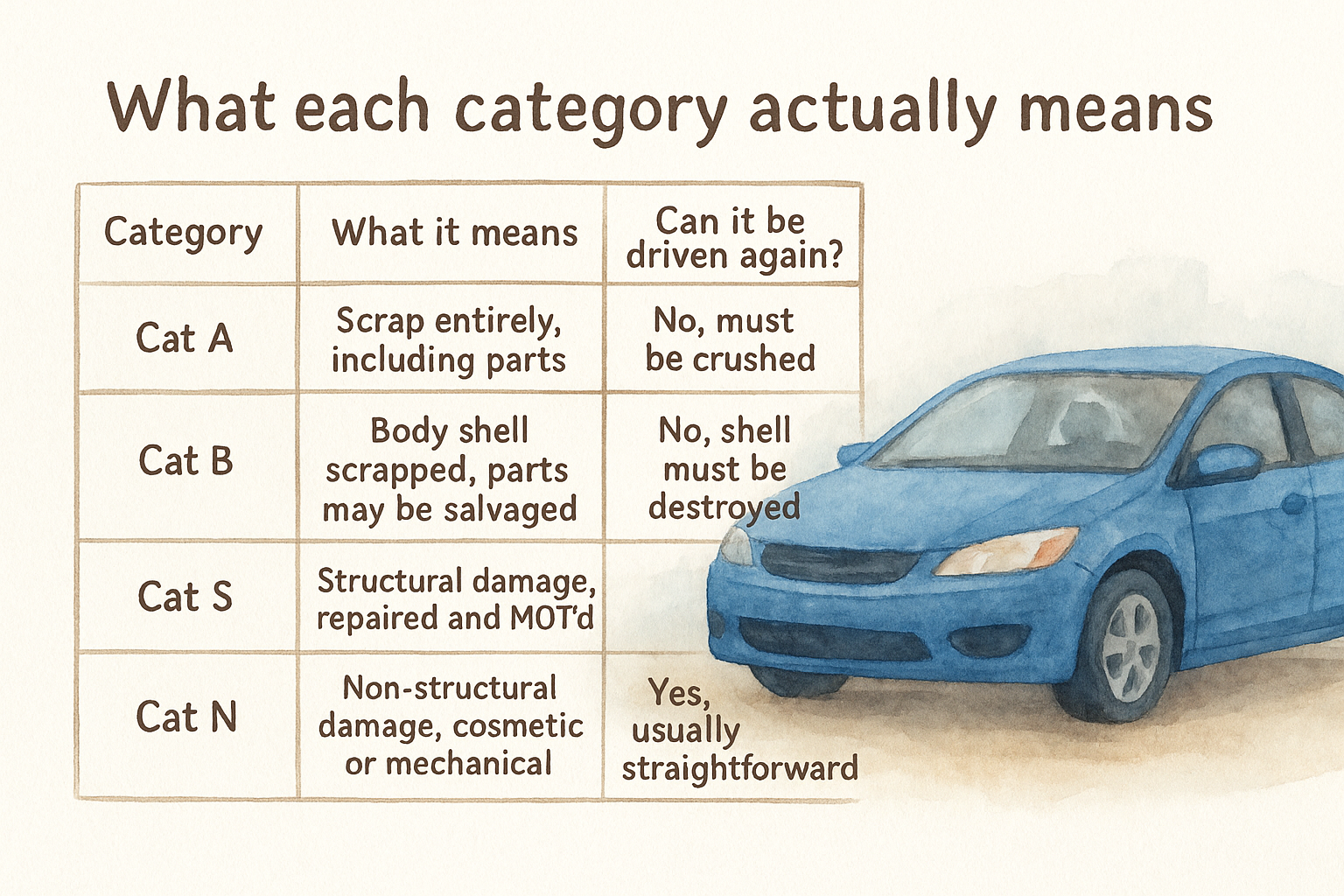
| Category | What it means | Can it be driven again? |
|---|---|---|
| Cat A | Scrap entirely, including parts | No, must be crushed |
| Cat B | Body shell scrapped, parts may be salvaged | No, shell must be destroyed |
| Cat S | Structural damage, repaired and MOT'd | Yes, if properly repaired |
| Cat N | Non-structural damage, cosmetic or mechanical | Yes, usually straightforward |
The safety risk behind the label
A Cat S marking means the insurer identified damage to the car's structural frame, chassis, suspension or steering. That's serious stuff. Even after a repair, a poorly welded chassis or misaligned subframe can affect how the car handles in an emergency stop or a side impact. Cat N sounds safer because it excludes structural damage, but a car with severe electrical faults, airbag deployment, or flood damage can still carry a Cat N label and be just as risky to own if the repair was botched.
A write-off category doesn't tell you how well the car was repaired, only how badly it was damaged in the first place.
That distinction matters more than most buyers realise. Two Cat S cars with identical damage descriptions can have wildly different outcomes depending on who did the repair work and what parts they used. One might be repaired by a qualified bodyshop with genuine parts and a full geometry check. The other might have been patched together in a garage with no paper trail at all.
Why this affects your negotiating power
Sellers rarely volunteer a car's write-off history because it immediately weakens their bargaining position. Once you know a vehicle carries a Cat S or Cat N marking, you have every right to ask for repair invoices, before-and-after photos, and an independent inspection before agreeing on a price. Knowing the category upfront also gives you a realistic starting point for negotiation, since write-off cars typically sell for 20 to 30% less than an equivalent undamaged model.
Why lenders and insurers care too
Finance companies and insurers treat write-off history as a red flag regardless of how well a car drives today. Some insurers refuse cover altogether for Cat S vehicles, while others load the premium significantly. If you're planning to buy on finance, some lenders will decline an application outright once they see the vehicle's history, which is another reason to check before you commit rather than after you've signed paperwork.
How to check a car's write-off history before you buy
Finding out whether a car has a write-off marking takes minutes, not hours, if you know where to look. A vehicle history check pulls data straight from official UK registers and flags any Cat A, B, S or N marking instantly, along with mileage discrepancies, outstanding finance and stolen vehicle alerts. Skipping this step before a viewing is one of the most common mistakes used car buyers make.
Start with the registration plate
Gathering the registration plate is the first thing you need before anything else. From there, a proper check should confirm:
- Whether the car has ever been marked as a write-off, and which category
- The date the write-off was recorded
- MOT history, including any advisories tied to the damage
- Mileage consistency across MOT records
- Outstanding finance or a police stolen marker
What official sources tell you
Government records confirm basic vehicle details such as MOT status and tax band, but they won't always show write-off history on their own. The DVLA's own vehicle enquiry service, for example, focuses on tax and MOT status rather than insurance claims history, so relying on it alone leaves gaps.
Never buy a used car based on a seller's word alone, official records exist precisely because sellers can't always be trusted to disclose the full history.
That's why a dedicated history check that cross-references insurance databases alongside DVLA data gives you a far more complete picture than any single government tool can offer on its own.
Documents to request from the seller
Requesting paperwork directly from the seller adds another layer of confidence once you've run a digital check. Ask for:
- The original insurance write-off notification letter
- Repair invoices showing parts and labour used
- Before-and-after photos of the damage and repair
- An engineer's report or independent inspection, if one exists
Combining a digital history check with physical paperwork closes almost every gap a seller might try to leave open, and it puts you in a far stronger position to judge whether the car in front of you is genuinely safe to buy.
What to weigh up before buying a Cat S or Cat N car
Buying a Cat S or Cat N car isn't automatically a bad decision, but it does mean doing more homework than you would for a car with a clean history. The repair quality matters more than the category itself, so your job is to work out whether the specific car in front of you was fixed properly or just made to look presentable for a quick sale.
Questions to ask before you view the car
Phoning ahead saves you a wasted trip and gives the seller a chance to reveal how much they actually know about the car's past. Ask:
- Who carried out the repair, and are they a registered bodyshop?
- Can you see the original insurance write-off letter?
- Is there a full set of repair invoices and parts receipts?
- Was the car inspected by an engineer after the repair, and is that report available?
- Has the car had an MOT since the repair, and does the mileage line up?
Getting an independent inspection
Spending £150 to £200 on an independent engineer's inspection before you buy is money well spent on any Cat S vehicle. A qualified inspector checks chassis alignment, weld quality, and whether structural repairs meet manufacturer standards, things you simply can't judge from a test drive. Cat N cars carry less structural risk, but it's still worth having someone check for hidden electrical faults or water damage, particularly if the write-off reason involved flooding.
Skipping an independent inspection on a Cat S car is the single most expensive shortcut a buyer can take.
Weighing the price against the risk
Comparing the asking price against a similar undamaged model tells you whether the discount actually reflects the risk you're taking on. If a Cat S car is only 10% cheaper than a clean equivalent, that's not enough of a buffer given the uncertainty around repair quality. Look for a discount closer to 25 to 30%, and factor in the cost of an inspection, potential future repairs, and the harder time you'll have selling it on. If the numbers don't add up once you've priced in that risk, walking away is usually the right call, no matter how tidy the car looks in person.
How a write-off affects insurance costs and resale value
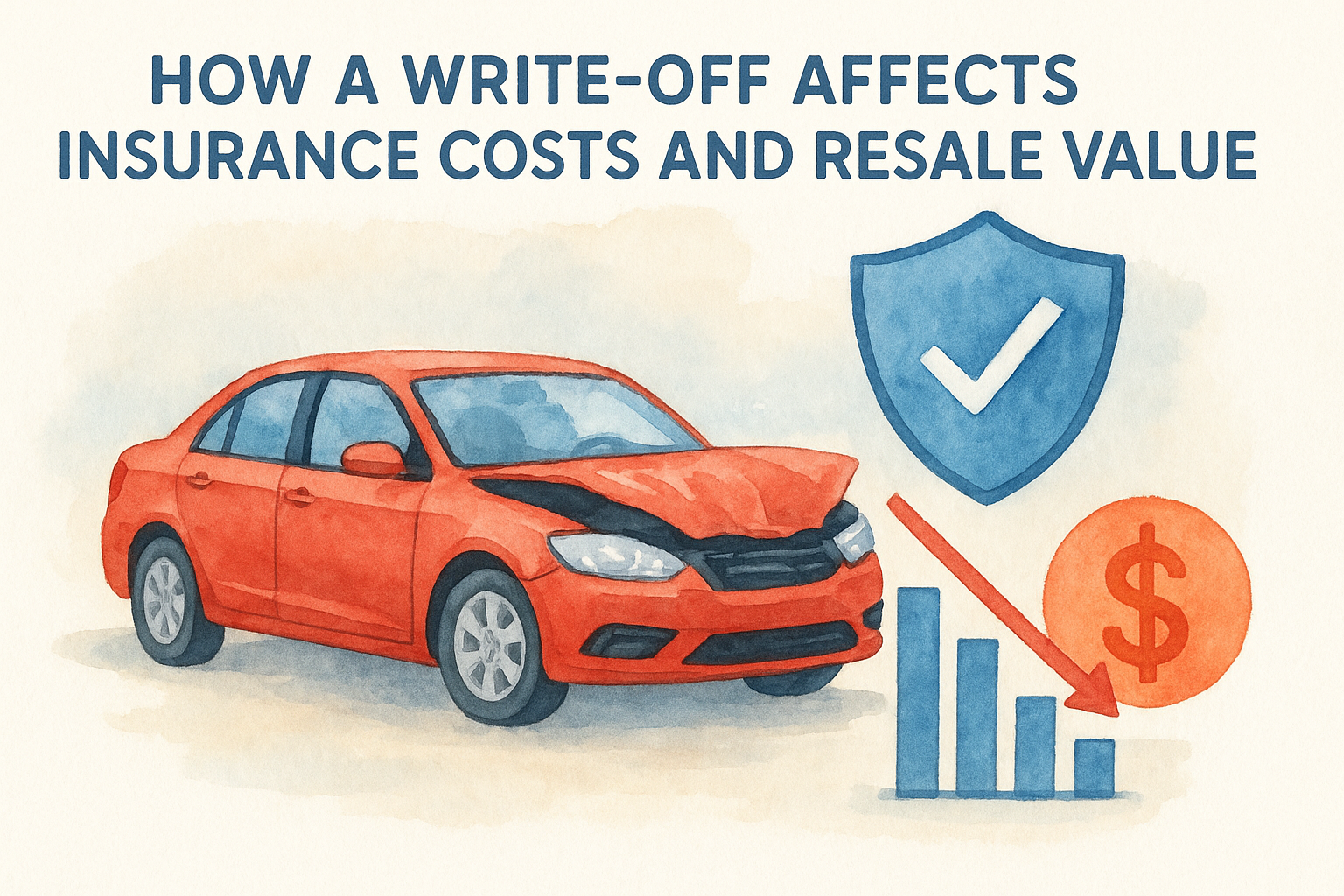
Carrying a write-off marking changes the maths on a car for as long as you own it, not just at the point of sale. Insurance premiums tend to rise once an insurer sees a Cat S or Cat N history, and resale value takes a permanent hit that no amount of polishing or valeting will fix. Both costs are worth totting up before you fall in love with a bargain price.
Why premiums go up
Insurers price risk, and a written-off history signals exactly that, regardless of how well the repair turned out. Some insurers add a loading of 10 to 20% on a Cat S vehicle compared with an identical clean car, while others decline to quote at all. Cat N cars usually fare a little better since the damage wasn't structural, but you'll still find fewer insurers willing to compete for your business, which pushes the average premium higher than it needs to be.
The resale value gap
Selling a write-off car later means accepting a lower price than the market average, no matter how good the repair was. Buyers who know what Cat S or Cat N means will factor that history into their offer, and many won't consider one at all. Expect resale values to sit 20 to 40% below a clean equivalent, with Cat S typically losing more ground than Cat N because of the structural stigma attached to it.
| Category | Typical premium impact | Typical resale impact |
|---|---|---|
| Cat S | 10 to 20% higher | 25 to 40% lower |
| Cat N | 5 to 15% higher | 15 to 30% lower |
A write-off marking follows the car's logbook forever, and so does the discount buyers expect to pay for it.
Factoring this into your budget
Budgeting for these ongoing costs matters as much as the initial purchase price. If you're buying a Cat S or Cat N car specifically because it's cheaper upfront, work out whether the insurance loading and resale hit still leave you better off over three or four years of ownership. Sometimes the numbers work in your favour. Often they don't, and a clean-history car turns out cheaper overall once you add everything up.
Getting the full picture before you commit
Knowing your Cat A, B, S and N definitions is only half the job. The real protection comes from checking the specific car in front of you before any money changes hands, because a label on paper tells you nothing about how well that particular repair was carried out. Scrap categories are a hard no, but Cat S and Cat N cars deserve proper scrutiny rather than blanket rejection or blind trust.
Run the registration, request the paperwork, and get an independent inspection if the structural history warrants it. Weigh the discount against the ongoing insurance and resale costs we've covered, and only proceed once the numbers genuinely stack up in your favour.
Before you view anything, see exactly what a full history check reveals by browsing our sample report, so you know precisely what you're paying for and what red flags to expect.