How to Do a Car Recall Check by Registration
Learn how to run a car recall check by registration using GOV.UK's free tool, spot open recalls, and book a free manufacturer repair.
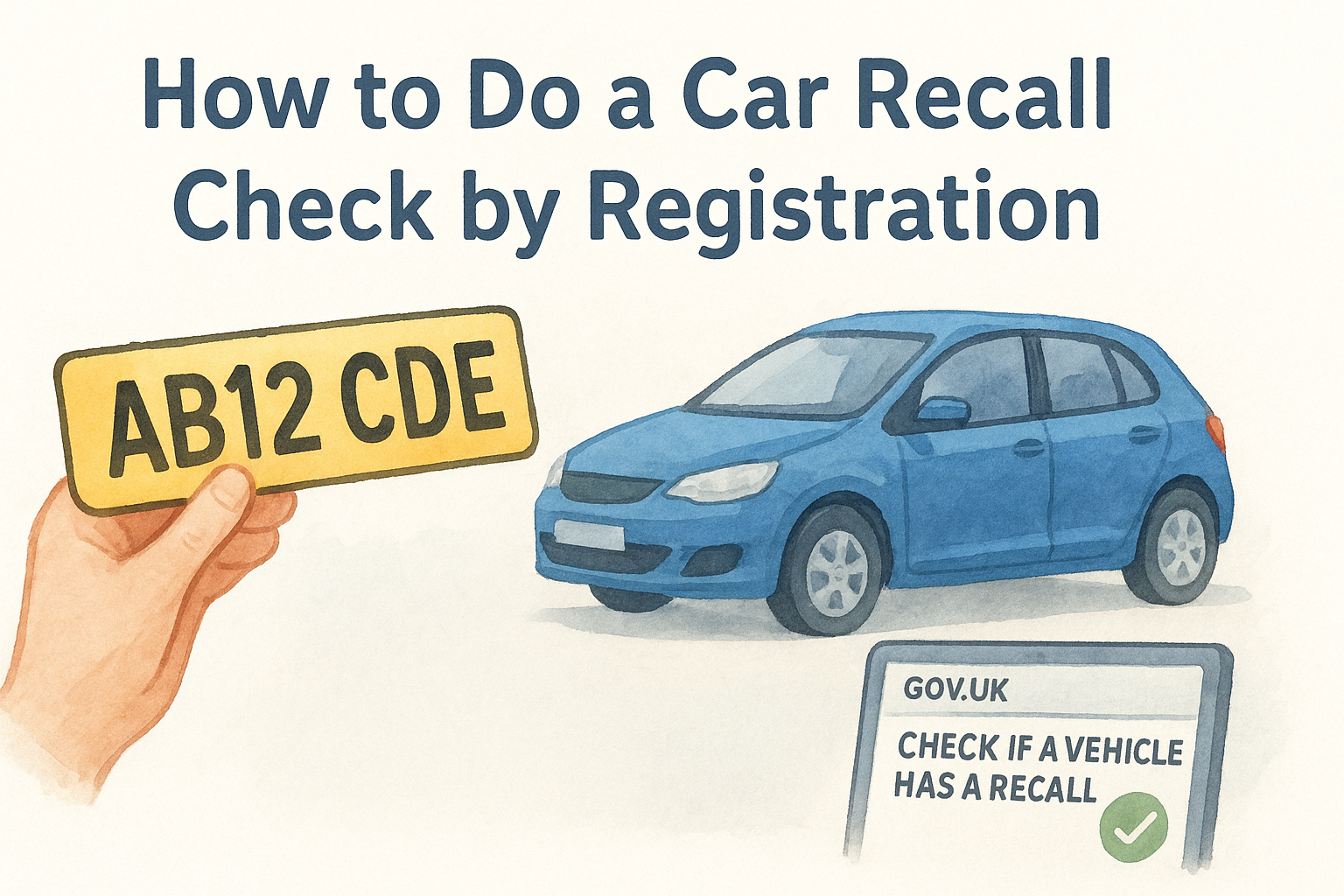
How to Do a Car Recall Check by Registration
Every year, thousands of cars on UK roads carry unresolved safety recalls, faulty airbags, brake issues, steering faults, that owners simply don't know about. A car recall check by registration takes seconds and tells you exactly what you need to know, whether you're buying a used car or just making sure your own vehicle is safe to drive.
If you're wondering how to run a car recall check by registration free, the process is straightforward: enter the number plate into an official database and it cross-references the vehicle against manufacturer recall notices. You don't need the logbook, the VIN, or any paperwork, just the registration plate and a couple of minutes. The results tell you whether there's an open recall, what the fault is, and whether it's been fixed.
In this guide, we'll walk you through exactly how to run a car recall check by registration gov uk style, using trusted official sources rather than guesswork. We'll cover where to check, what the results actually mean, and what to do if your car does have an outstanding recall. By the end, you'll know precisely how to confirm your vehicle's safety status before you drive it another mile, or before you hand over money for someone else's.
Why you should check your car for recalls
Recalls exist because manufacturers found something wrong after the car left the factory, not before. Faulty components like airbag inflators, brake pipes, or steering couplings can pass every safety test at the point of sale, including the car safety ratings explained by Euro NCAP, and still fail years later. You won't spot most of these problems by looking under the bonnet or taking the car for a test drive. A car recall check by registration is the only reliable way to know if your specific vehicle is affected, because recalls apply to batches of cars built with a particular part, not entire model ranges.
A car can look perfectly fine and still be sitting on a safety recall you've never heard about.
The risk to buyers and owners alike
Buying a used car without running a free check before you buy means you could be inheriting someone else's unresolved problem. Sellers don't always know their car has an open recall, and even fewer disclose it. Owners who've had their car for years can be just as unaware, especially if they bought it privately or missed a recall letter that went to a previous keeper's address.
Recalls are free, but only if you act on them
Garages carry out recall repairs at no cost to you, regardless of the car's age or mileage. That's the whole point of a recall: the manufacturer picks up the bill. The catch is that nothing happens automatically. If a letter gets lost in the post, or you're not the registered keeper the DVLA has on file, you could be driving around with a known fault and no idea it needs fixing. Checking your registration takes the guesswork out completely.
Common recall issues worth knowing about
| Recall type | Typical fault |
|---|---|
| Airbags | Faulty inflator, risk of shrapnel on deployment |
| Brakes | Corroded pipes, reduced stopping power |
| Steering | Loose or worn coupling |
| Fuel system | Leaks, fire risk |
| Seatbelts | Incorrect tensioner fitting |
Step 1. Find your vehicle registration number
Before you can run any check, you need the number plate in front of you, either on the car itself or on a document like the V5C logbook, insurance certificate, or MOT certificate. It sounds obvious, but plenty of people mistype a character or confuse an O for a zero, which throws off the whole search. Take a photo or write it down carefully, matching the exact spacing and characters shown on the plate.
Getting this right matters more than people expect.
A single mistyped character can send you searching against the wrong vehicle entirely.
Double-check your registration plate against these sources if you're unsure:
- The physical number plate on the front or rear of the car
- The V5C registration certificate (logbook)
- A recent MOT certificate or invoice
- Your car insurance documents
- The DVLA's vehicle enquiry service, if you only have a VIN
Once you've confirmed the exact plate, you're ready to run a free car recall check on it. This step takes seconds, but it's the foundation for an accurate car recall check by registration, so don't rush past it.
Step 2. Run a free recall check using GOV.UK
Head to the official Check if a vehicle has a recall tool on GOV.UK. This is the government's own database, pulling directly from manufacturer recall submissions, so it's the most reliable starting point for a car recall check by registration free of charge. Enter your registration plate exactly as it appears, then submit the search.
Within seconds, the tool tells you whether your vehicle has an open safety recall. There's no account to create, no personal details to hand over beyond the plate itself, and no cost involved at any point.
The GOV.UK recall checker gives you a definitive answer in less time than it takes to make a cup of tea.
If you'd rather run a broader check alongside recall status, what a history check actually shows covers MOT history, tax status, and other useful details in the same search.
Here's the quick process:
- Go to the GOV.UK vehicle recall page
- Type in your registration number
- Click search
- Read the result screen carefully
Keep the result open, you'll need it for the next step.
Step 3. Understand your recall results
Once the GOV.UK tool returns a result, you'll see one of two outcomes: no recalls found, or details of an open recall that needs attention. Neither result is complicated, but it's worth knowing exactly what you're looking at before you decide what to do next.
No recalls found
Getting a clean result means there's no outstanding manufacturer recall linked to your registration at the time of checking. It doesn't mean the car has never had a fault, only that any previous recall has already been resolved, or the vehicle was never affected. Keep in mind that new recalls get issued regularly, so a clean check today isn't a guarantee for next year.
An open recall on your record
Seeing an active recall listed means the manufacturer has identified a safety defect affecting your specific vehicle. The result usually includes the fault type, such as airbags or brakes, and a brief description of the risk involved.
An open recall isn't a warning to worry about later, it's a fault the manufacturer has already confirmed needs fixing.
Here's what a typical result includes:
- The affected component or system
- A short description of the safety risk
- Confirmation of whether a fix is available
That last point determines your next move.
Step 4. Act on an outstanding recall
Finding an active recall doesn't mean panic, it means picking up the phone. Contact your **main dealer** for the manufacturer listed in your result, or use the contact details GOV.UK provides alongside the recall notice. Explain that you've found an open recall through a registration check and ask them to book the **free repair**.Garages prioritise recall work because manufacturers cover the cost entirely, including parts and labour. You shouldn't be charged a penny, and if a dealer tries to bill you for a listed recall repair, that's worth querying directly with the manufacturer's customer service team.
A recall repair costs you nothing except the time it takes to book the appointment.
Before your visit, gather a few details to make the booking quicker:
- Your registration number and VIN
- The recall reference number from your GOV.UK result
- Your preferred appointment dates
- Confirmation of which dealer network covers your make
Schedule the fix as soon as you can. Safety recalls exist because something has already gone wrong for other drivers, and driving on with a known fault isn't worth the risk, however small it seems.
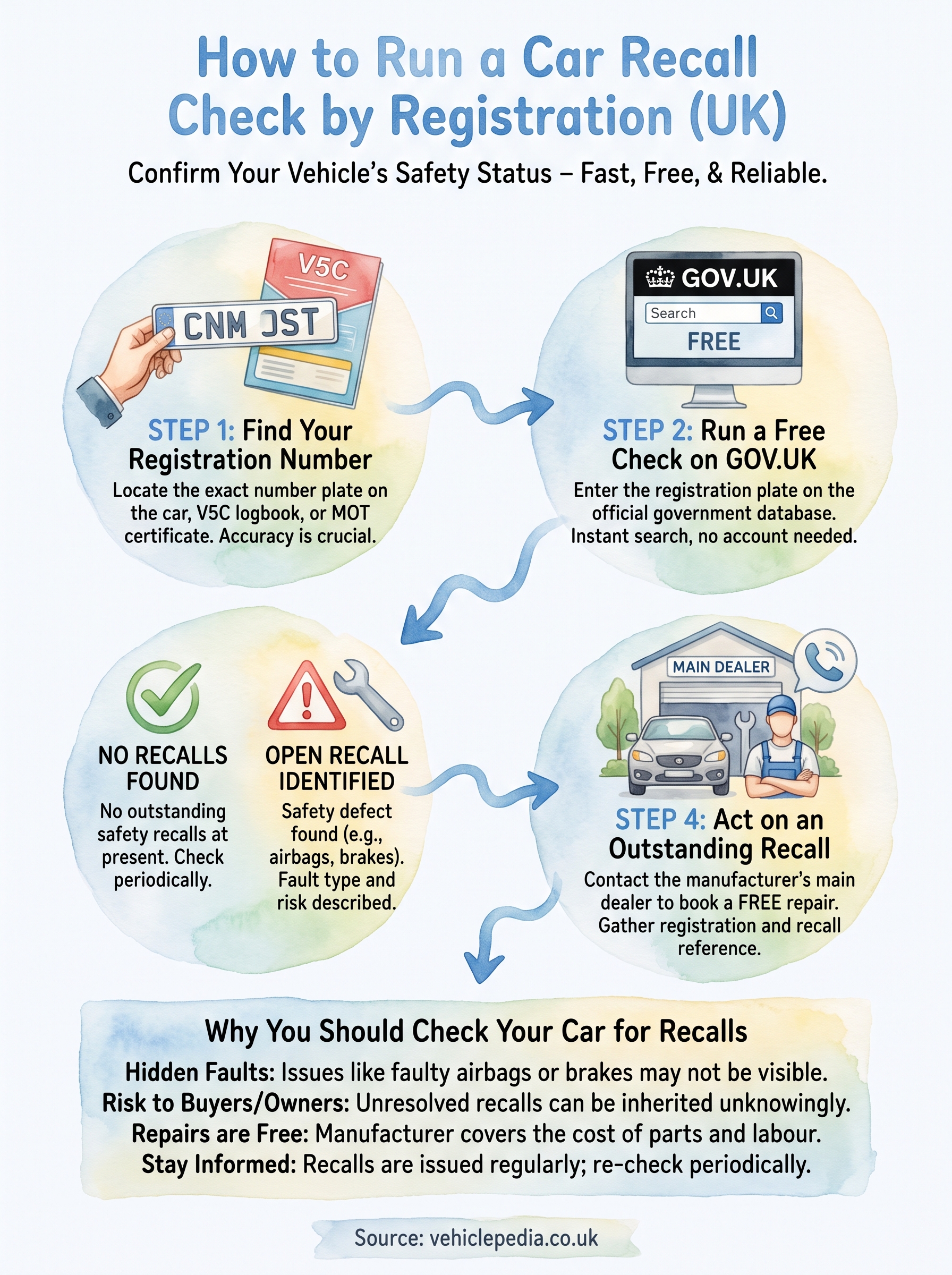
Staying on top of future recalls
Running a car recall check by registration isn't a one-off task you tick off and forget. Manufacturers issue new recalls all the time, often years after a car first hit the road, so a clean result today doesn't guarantee a clean result next spring. Make it a habit to check again whenever you buy a used car, after any long trip abroad, or simply once a year when you run a free MOT status and history check.
Think of it as part of routine ownership, not an emergency measure. Vehicles change hands, addresses change, and recall letters go astray more often than you'd expect. Two minutes on GOV.UK closes that gap completely.
Beyond recalls, a full history check gives you the wider picture: mileage, ownership, and outstanding finance included. If you want more detail before deciding what level of report suits you, see what each report level includes and costs and pick the check that matches your needs.