Check Mileage on GOV.UK: Free Mileage History in 4 Steps
Want to check mileage gov records for free? Enter the reg, read each MOT reading and spot rollback with this four-step guide and worked example.
Check Mileage on GOV.UK: Free Mileage History in 4 Steps
The quickest way to check mileage on GOV.UK is to open the free MOT history service, enter the car's registration number and read the mileage recorded at every MOT test. It costs nothing, needs no account and takes under a minute. Put the readings in date order and any rollback, gap or odd jump becomes easy to see.
The problem is that a dashboard figure proves nothing on its own. Odometers can be altered, and sellers rarely volunteer a history that hurts the asking price. The official record is much harder to fake, because each reading is entered by an MOT tester and stored against the plate. Yet many buyers glance at pass or fail and skip the numbers, which is where the useful information sits.
This guide walks you through the check in four steps: get the plate, run the search, read the mileage trail, then back it up with a second source. You will also see what the government service covers, where it stops, and how a free Vehiclepedia check adds mileage warnings on top of the official data.
What the GOV.UK mileage check shows
The GOV.UK service shows the results of past MOT tests for a vehicle, including the mileage recorded at each one. It is the official free car mileage check, so treat it as the baseline for any other check you run.
What you get for free
Enter a plate and the GOV.UK MOT history service returns the following:
- Whether each test was a pass or a fail
- The mileage recorded when the vehicle was tested
- When the next MOT is due
- For tests in England, Scotland or Wales: the parts that failed, any minor problems, and downloadable copies of current and previous MOT certificates
To see where each test was done, you also need the 11-digit number from the vehicle's log book (V5C). The history may also flag a safety recall, depending on the manufacturer.
The GOV.UK check gives you one mileage reading per MOT test, and those readings are the official trail you compare against the dashboard.
How far back the records go
The records do not stretch back indefinitely, and the cut-off depends on the vehicle and where it was tested.
| Vehicle | Where tested | Results available from |
|---|---|---|
| Cars, motorcycles and vans | England, Scotland, Wales | 2005 |
| HGVs, trailers, buses and coaches | England, Scotland, Wales | 2018 |
| Any vehicle | Northern Ireland | 2017 |
In Northern Ireland you cannot download certificates from this service. Also remember that a car in Great Britain needs its first MOT at three years old. A newer car will show no mileage at all, which is normal and not a warning sign.
Step 1. Get the registration number
You need only the vehicle's number plate to start. Get it before you travel to view the car, so you can run the check in advance.
Find the plate
Ask the seller for the registration when you first make contact, or copy it from the advert photos. Then compare it with the plate on the car and with the V5C when you see it. A plate that differs from the paperwork is a reason to walk away or at least ask hard questions.
Open the official service
Go to the GOV.UK MOT history page and press Start now, which takes you to the service at check-mot.service.gov.uk. Use only that route. The official check is free, so any page asking for payment before showing MOT mileage is not the government service.
Run the check before you see the car, so the mileage history shapes your questions instead of arriving after you have fallen for the car.
Step 2. Enter the plate and open the results
Type the registration into the box and submit it. The service returns the vehicle's test record, with the most recent test first. This is the free car mileage check, with no sign-up.
Confirm it is the right car
Compare the vehicle details shown with the car in the advert, such as make and colour. If they do not match, either the plate was copied wrongly or the car is not what it claims to be. Both are worth resolving before you go any further.
Read each test entry
Open every test, not only the latest. Each entry gives you the date, the result and the recorded mileage. Scroll for the failure reasons and minor problems too. Repeated advisories for the same part can show whether an owner fixed things or let them slide.
Open every past test, because the story is in the sequence of entries and not in the latest pass.
Step 3. Read the mileage trail
A mileage trail is plausible when readings rise steadily from test to test. A typical private car covers roughly 7,000 to 8,000 miles a year, so use that as a rough yardstick, not a rule.
Line up the readings
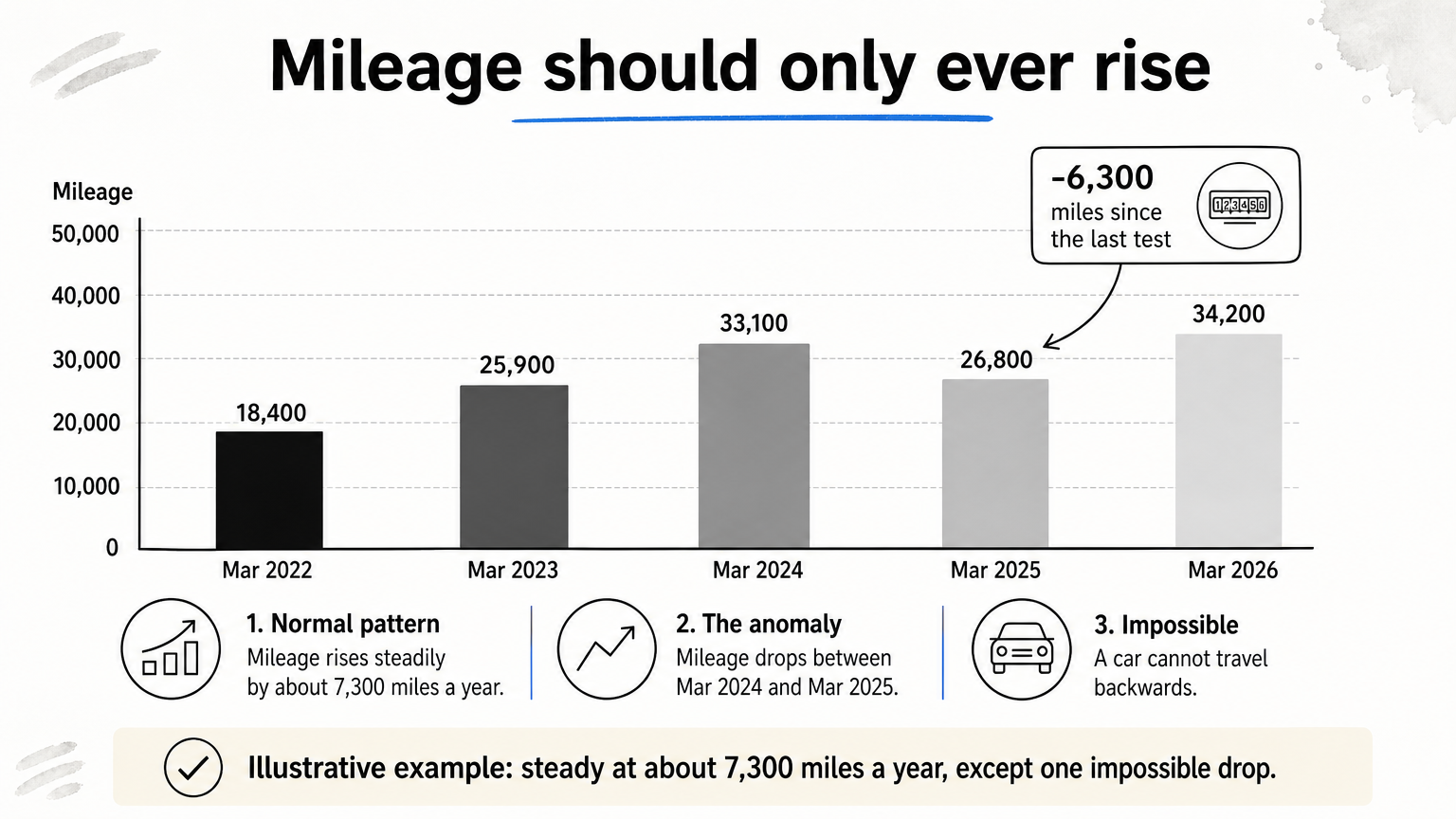
Copy each date and mileage into a simple table and work out the change between tests. Here is an illustrative example:
| Test date | Mileage | Change since last test |
|---|---|---|
| Mar 2022 | 18,400 | n/a |
| Mar 2023 | 25,900 | +7,500 |
| Mar 2024 | 33,100 | +7,200 |
| Mar 2025 | 26,800 | -6,300 |
| Mar 2026 | 34,200 | +7,400 |
The pattern is steady at about 7,300 miles a year, except for one impossible drop in 2025. The mileage cannot go down, so either a tester mistyped a figure or the odometer was altered.
Spot the red flags
Look for these patterns:
- A lower reading than an earlier test
- A big jump that does not fit how the car was used
- Missing years with no MOT entry
- Readings that barely change for several years
- Imported cars, where a kilometre reading may have been entered as miles
A single odd entry is not proof of fraud, since testers do make typing errors. Ask the seller to explain it and to produce invoices or old adverts that show the true figure.
A mileage that falls between two tests is the clearest red flag in the whole record, and the seller should be able to explain it.
Step 4. Back it up with a second source
The GOV.UK record only captures the odometer on test days. Use it as your starting point, then verify the story with other evidence.
What the MOT record cannot tell you
It shows nothing between tests, so a rollback just before an MOT can slip through. It tells you nothing about cars under three years old. It also relies on the figure the tester entered. Treat a clean MOT mileage history as a good sign, not a guarantee.
Cross-check before you commit
Start with paperwork. Ask for service invoices and the stamped service book, then compare the dates and mileages with the MOT readings. Next, run the plate through Vehiclepedia's free check, which shows MOT history alongside instant warnings for mileage trends, sudden drops and DVLA discrepancies. Vehiclepedia's service history check lists the date and mileage of every recorded service for covered brands.
For a deeper look, the Genuine Mileage Check compares recorded mileage against official records, using sources that include the DVLA and MOT history, to detect odometer discrepancies and mileage fraud. Vehiclepedia's mileage checks draw on industry sources as well as the MOT database.
Agreement between MOT readings, service records and the dashboard is what makes a mileage believable.
Check first, then decide
The GOV.UK service gives you a free, official mileage reading for every MOT test. Get the plate, run the search, line up the readings and look for drops, jumps and gaps. Then confirm the figures against service records and a second data source, because the MOT shows the odometer only on test days.
If the mileage story holds up, you can carry on with confidence. If it does not, you have saved yourself an expensive mistake. To see what a full check adds beyond mileage, look at a sample premium report before you buy.