DPF Check by Reg: Find Out Free Using GOV.UK in 4 Steps
DPF check by reg free gov uk: what GOV.UK shows, how to work out if a diesel has a DPF from its plate, and how to confirm it.
DPF Check by Reg: Find Out Free Using GOV.UK in 4 Steps
A free DPF check by reg on GOV.UK does not exist as a single tool, because no official lookup states "DPF fitted" for a number plate. You can still get a dependable answer for free. Look up the registration on GOV.UK to see the fuel type, year and Euro status, use those to work out whether the car should have a filter, then confirm it with the MOT history and a physical check.
The problem is that a missing or blocked diesel particulate filter is an expensive surprise. Removing one is almost always illegal, and a car that left the factory with a filter but has none now fails its MOT. Sellers do not always mention it, and online forums mostly guess. Government pages explain the rules well, but none of them tells you how to apply those rules to the plate in front of you.
This guide gives you that method in four steps, shows what each GOV.UK page does and does not reveal, and explains what to do if the filter turns out to be missing. Vehiclepedia is a UK vehicle history service, and we point out where its free check can back up the official records.
Why GOV.UK cannot confirm a DPF for you
GOV.UK has no reg lookup that reports whether a DPF is fitted. What it does give you are the facts that let you work it out, plus the MOT rules that make the filter a legal requirement.
What a DPF is and why the rules matter
A diesel particulate filter traps solid soot particles from the exhaust and lets the gases escape. The car cleans the filter itself through regeneration, which burns the soot at very high temperature and leaves only a tiny residue. Government guidance says removal is almost always illegal, because the filter cuts air pollution and its health effects.
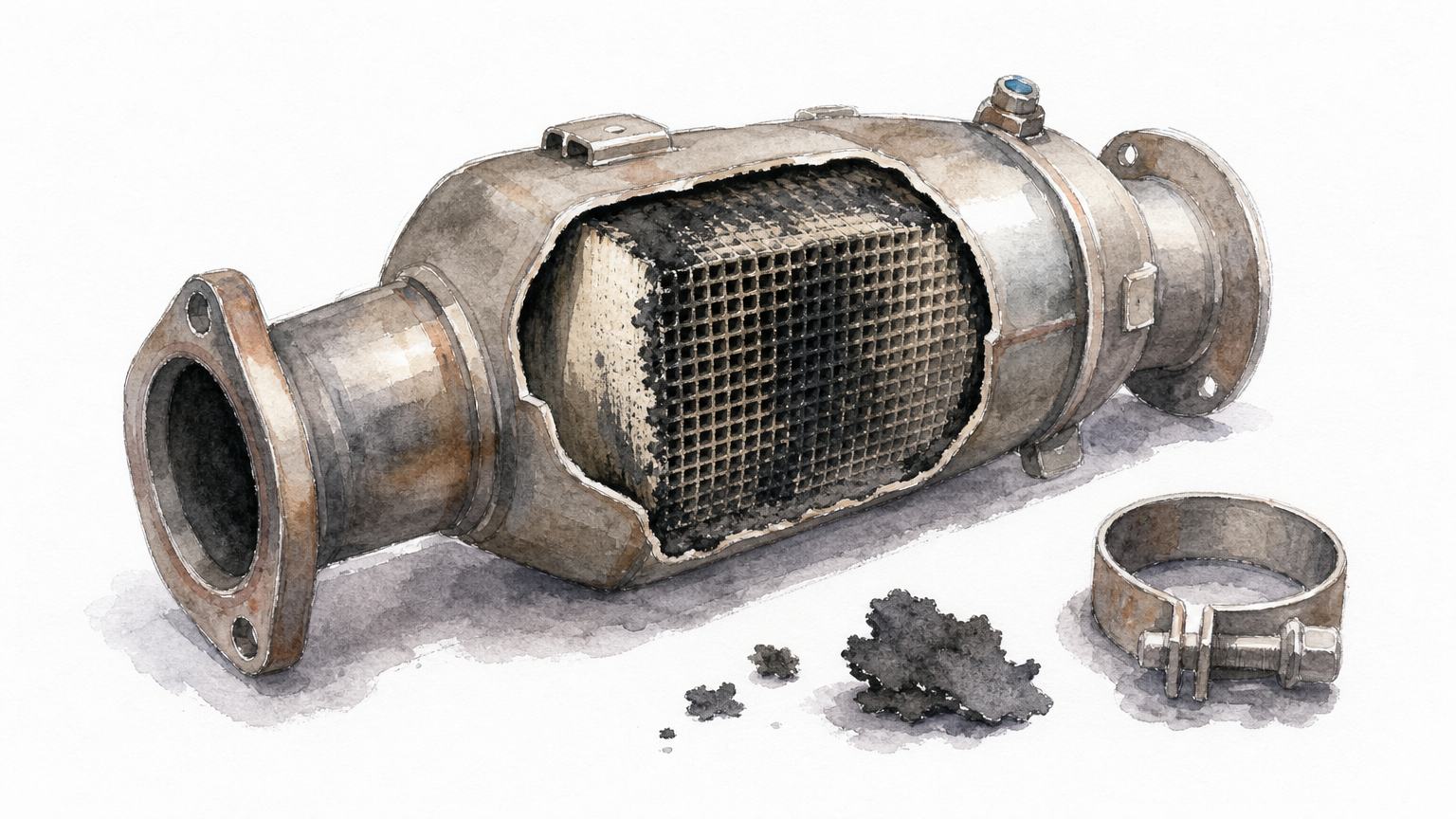
The MOT enforces this. Since February 2014, testers have had to check for a DPF on diesel vehicles, and a car that was built with one but has none now fails. A car can still pass the visible smoke test with the filter removed, which is why the presence check exists.
A car built with a DPF fails its MOT without one, so check before you buy, not after.
What the free official services show
No official lookup has a "DPF fitted" field, so the method is to infer first and verify second. This table shows what each free source contributes.
| Free source | What it shows | How it helps with a DPF |
|---|---|---|
| GOV.UK vehicle enquiry | Tax and MOT status, make, fuel type, year, engine size, CO2, Euro status where recorded | Tells you whether the car should have a filter |
| GOV.UK MOT history | Past tests, failure reasons, advisories, mileage | Shows whether a filter problem was ever recorded |
| V5C registration document | The Euro level of the vehicle | Confirms the emissions standard on paper |
Step 1. Look up the reg on GOV.UK
Start with the free vehicle enquiry service on GOV.UK. You need only the registration, no account is required, and it takes under a minute.
Run the vehicle enquiry
Follow these steps and write down what you see:
- Open the vehicle enquiry service and enter the registration.
- Confirm the make and colour match the car you are looking at.
- Note the fuel type, year of manufacture and date of first registration.
- Record the engine size, the CO2 figure and the Euro status if the page shows one.
Fuel type and registration date tell you more about a DPF than anything else on the page.
Cross-check the same plate
Run the plate through a second free source before you rely on the first. The Vehiclepedia free check returns make, model, age, engine size, CO2 emissions and MOT history from DVLA and DVSA records in one lookup. It does not report a DPF either, but it gives you a second set of figures to compare.
A mismatch is worth questioning. If the make, colour or engine size differs from the car on the forecourt, ask why before you go any further. An engine swap or a cloned plate can change the whole DPF picture.
Step 2. Work out if the car should have a DPF
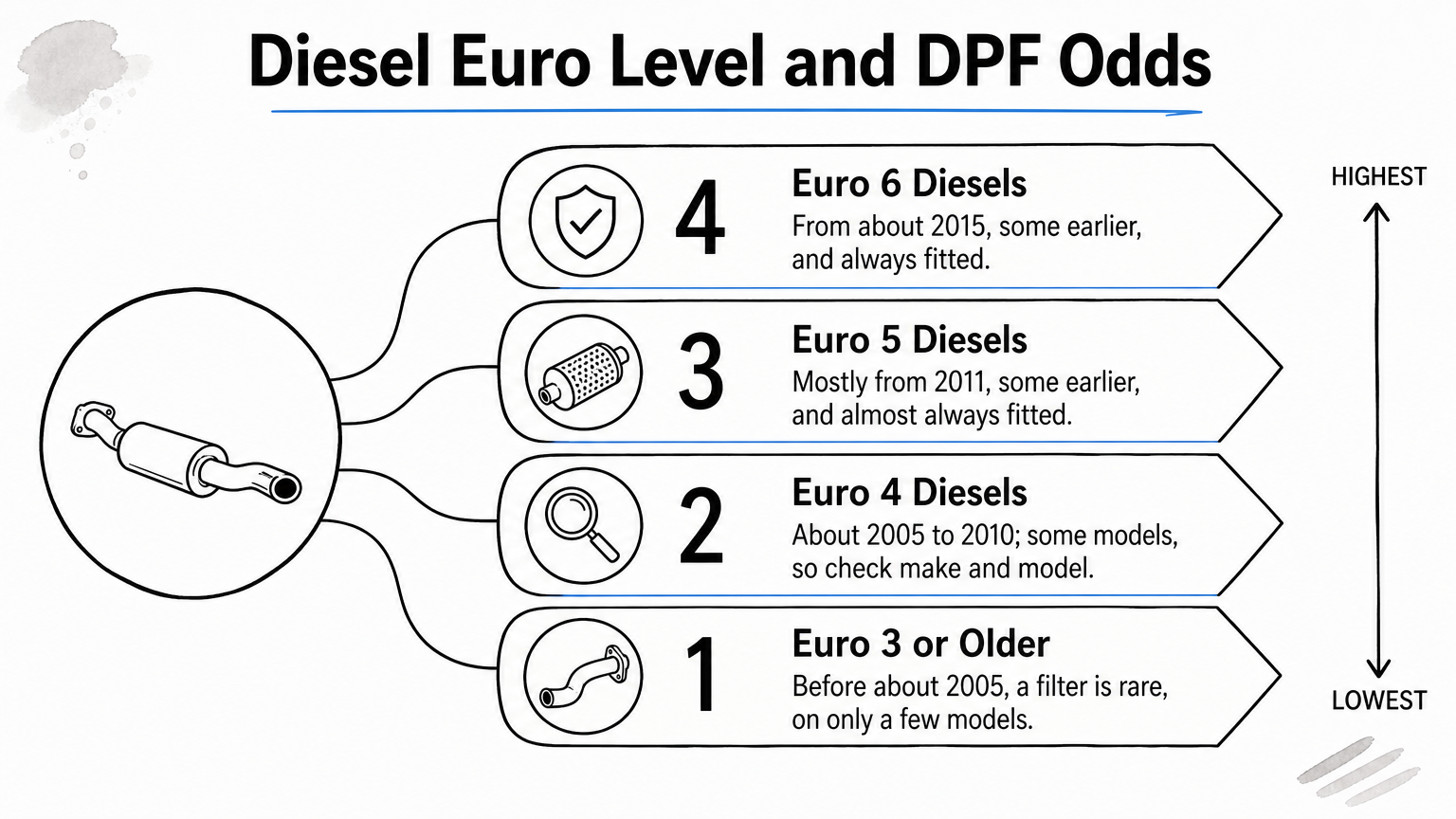
Match the fuel type and Euro status from Step 1 to the table below. For diesel cars, Euro 5 and Euro 6 almost always mean a DPF, and that is the core of the method.
Match the Euro status to a DPF
GOV.UK guidance says Euro 5 applies to vehicles registered on or after 1 January 2011, though some Euro 5 cars were registered earlier. The dates below are approximate, so go by the Euro level where you can find it.
| Car type | Typical registration | DPF fitted? |
|---|---|---|
| Diesel, Euro 3 or older | Before about 2005 | Rare, only a few models |
| Diesel, Euro 4 | About 2005 to 2010 | Some models, so check the make and model |
| Diesel, Euro 5 | Mostly from 2011, some earlier | Almost always |
| Diesel, Euro 6 | From about 2015, some earlier | Always |
| Petrol | Any | Usually no, though some newer direct-injection petrols have a particulate filter |
You can find the Euro level on the V5C registration document. A diesel that a ULEZ checker shows as compliant also meets Euro 6, so it will have a filter.
If a diesel is Euro 5 or Euro 6, treat a missing DPF as a serious fault, not a quirk.
Two worked examples
Take a diesel first registered in 2013 with a 2.0 litre engine. It is Euro 5, so it should have a DPF. If anything suggests otherwise, treat it as a red flag.
Now take a diesel first registered in 2007. It is probably Euro 4, which means the answer depends on the exact model. Ask a main dealer for that make, quoting the VIN, whether your variant left the factory with a filter. Do not guess from forum posts.
Step 3. Read the MOT history for DPF clues
The free GOV.UK MOT history service lets you search by registration and read every recorded test. It cannot show the filter itself, but it shows whether a tester ever had a problem with it.
What to look for in each test
Open each test record and scan the failure reasons and advisories. Look for:
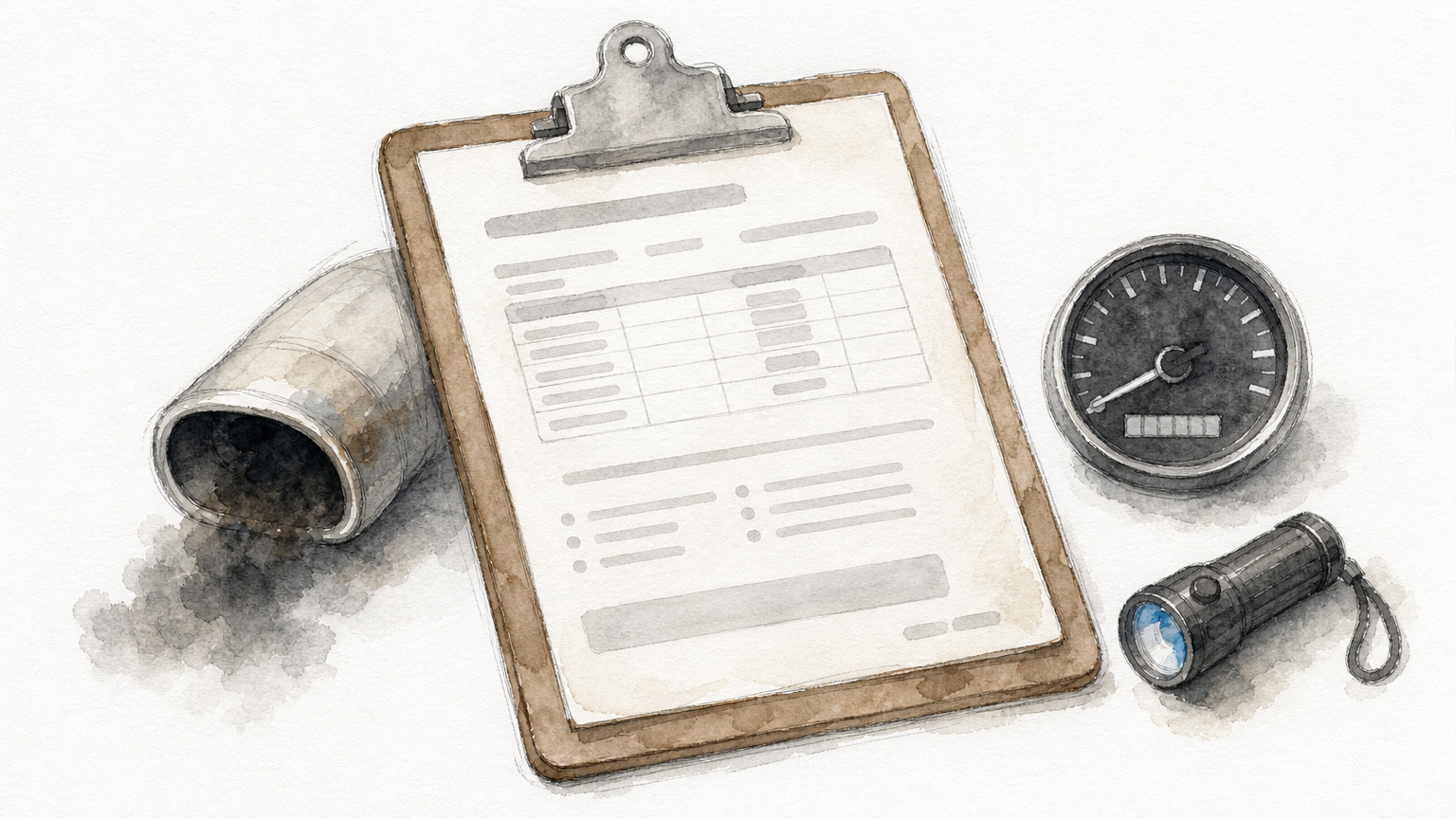
- Any mention of the diesel particulate filter, especially "missing" or "tampered".
- Exhaust or emissions advisories, and any note about smoke.
- A fail followed by a pass days later, which suggests a repair.
- Mileage that climbs steadily, since short urban trips are what clog filters.
The Vehiclepedia free MOT check shows the same history with comments and advisories, if you prefer to read it there.
What a pass tells you
A pass on a diesel built with a DPF since 2014 means the tester checked that the filter was present at that test. That is useful evidence, but it is not a guarantee about today. The filter could have been removed since, and a tester cannot always tell whether the inside has been gutted.
An MOT pass proves the filter existed on test day, not that it still works.
Step 4. Confirm the filter on the car
Paper checks tell you what the car should have. This step confirms what it does have, and it is the only way to be sure.
Check documents and the car itself
Ask the seller for the V5C, the handbook and any invoices that mention the filter. Then check these on the car:
- Watch the dashboard at start-up. Most cars show a DPF warning light, which should go out after a moment. A lit light while driving means a problem.
- Look underneath, ideally on a ramp. The filter sits in the exhaust line behind the engine. A hollow-sounding canister, a cut section or fresh welds are warning signs.
- Ask an independent garage to inspect it. This usually takes only a few minutes.
If the car has an aftermarket DPF and is Euro 5 or above, the part must be type-approved. It should carry a permanent mark showing the "e11" approval, the manufacturer name and the part number.
What to do if it is missing
Walk away unless the price reflects a reinstatement you have costed. Without the filter, the car cannot legally be used on the road and will fail the MOT. Supplying or fitting a non-compliant part can be a criminal offence, with a fine of up to £5,000. You can report sellers of unsafe or illegal parts through GOV.UK.
A diesel with no DPF is not a bargain, it is a failed MOT waiting to happen.
What to do next
There is no one-click DPF check by reg, but the four steps above give you a reliable answer. Look up the plate on GOV.UK, work out from the fuel type and Euro status whether the car should have a filter, read the MOT history for any recorded problems, and confirm the part on the car.
Before you hand over money, also check that the car is not stolen, written off or on finance. Those records sit outside GOV.UK's free tools. You can see exactly what a full history report covers in the Vehiclepedia sample report before you decide whether you need one.