History Check on a Car: What It Shows and How to Run One
Run a history check on car finance, theft, write-offs and mileage before you buy—see what Vehiclepedia's free and premium reports reveal.
History Check on a Car: What It Shows and How to Run One
Buying a used car without checking its background is a gamble. A history check on car records can tell you in seconds whether the vehicle you're eyeing has been stolen, written off, or still has finance owing on it, details a seller will rarely volunteer. All you need is the registration number and a few minutes.
A proper check pulls data straight from official sources like the DVLA, police registers, and insurance databases, then lays out the car's MOT history, mileage record, ownership changes, and any write-off or finance flags in one report. That's the direct answer to what most buyers are searching for: a way to confirm a car is exactly what the advert claims before any money changes hands.
This article walks through exactly what a history check shows, the difference between free and premium reports, and how to run one properly so you don't miss a red flag. You'll also see which checks matter most depending on the car's age and price, so you're not paying for data you don't need.
Why a car history check matters before you buy
Money is the obvious risk, but it's not the only one. Buy a car with outstanding finance and the lender can legally repossess it from your driveway, even though you paid the seller in full and had no idea the debt existed. That's not a technicality; it's how car finance agreements work in the UK, because the vehicle remains security for the loan until it's cleared.
A car with hidden finance or a hidden write-off can cost you the full purchase price twice over.
Stolen vehicles present a similar trap. Criminals often clone number plates or forge logbooks to make a stolen car look legitimate on paper. A police database check flags this in seconds, something you simply cannot spot by looking at a car on a driveway or scrolling through photos in an advert. Without that check, you're relying entirely on the seller's word, which isn't much protection if things go wrong.
Then there's the question of what the car has actually been through. A vehicle marked as written off after a serious accident might have been structurally repaired to a standard that hides real safety issues. Insurers categorise write-offs from Cat A (scrap only) through to Cat N (repairable, no structural damage), and knowing which category applies changes how you should treat that car entirely.
The financial and safety stakes
Mileage discrepancies compound the problem. A car clocked back by 30,000 miles looks like better value on paper, but you're really buying a vehicle closer to the end of its mechanical life, with worn components you haven't budgeted to replace. Cross-checking the mileage history against MOT records catches this almost every time, since MOT testers log mileage at every test.
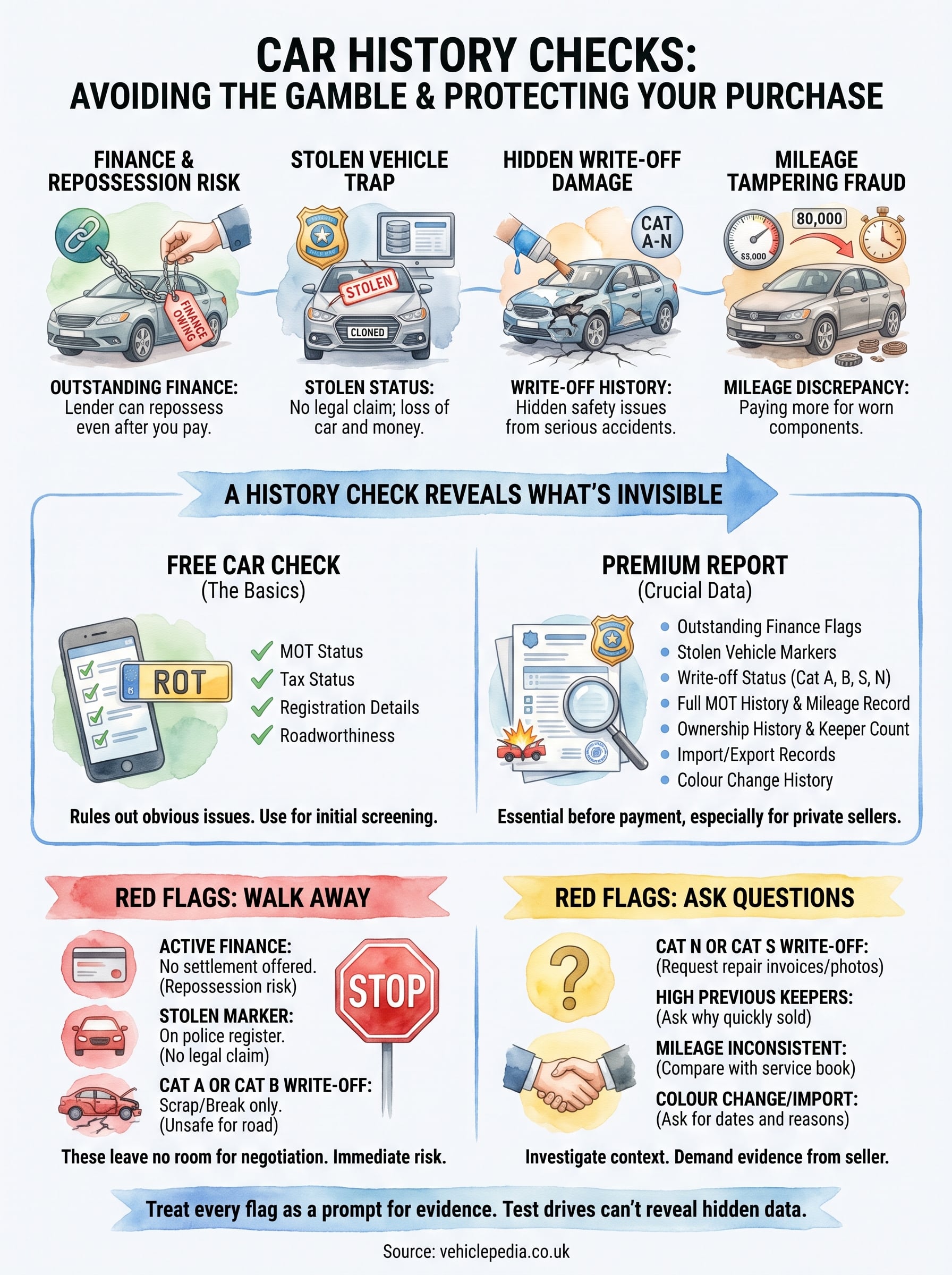
- Outstanding finance: risk of repossession, even from an innocent buyer
- Stolen status: risk of losing the car and the money with no recourse
- Write-off history: risk of hidden structural or safety damage
- Mileage tampering: risk of overpaying for a car with more wear than advertised
Each of these issues is invisible during a test drive. A proper history check on car records turns guesswork into evidence, and that's the difference between an informed purchase and an expensive mistake.
How to run a history check on a car
Running a history check on car records takes less time than filling in a fuel receipt. You need the vehicle's registration number, and ideally its make and model to hand, so you can spot straight away if the details don't match what the seller told you.
Gathering the registration number
Find the plate on the vehicle itself, not just the seller's advert, since cloned plates are exactly the problem you're trying to catch. Photograph it if you're viewing the car in person, then run the check before you hand over any deposit.
Using an online checker
Enter the registration into a tool like Vehiclepedia's free car check, which pulls live data from the DVLA and other official registers. Within seconds you'll see the basics: MOT status, tax status, and registration details.
A registration number and two minutes are all it takes to see whether a car is worth your time.
Deciding whether you need the premium report
The free check tells you if a car is roadworthy and registered correctly, but it won't confirm finance, theft, or write-off status. For that, you need a premium report, especially on cars over £5,000 or anything bought from a private seller rather than a dealer.
- Run the free check first to rule out obvious issues
- Order the premium report before agreeing a price
- Compare the mileage shown against the odometer in person
- Keep a copy of the report as evidence if a dispute arises later
What a full report reveals beyond the basics
Beyond MOT and tax status, a full history check on car records digs into the vehicle's paper trail in ways a quick glance at an advert never could. Ownership history shows how many keepers the car has had and how long each one kept it, which tells you whether it's been a stable family car or shuffled through short-term owners, often a sign of recurring problems.
Import and export records matter more than most buyers realise. A car brought in from Northern Ireland or further afield may have different specifications, warranty terms, or parts availability than a UK-supplied model, and that affects both running costs and resale value later on.
Colour changes and performance data
A colour change flag is a small detail with a big implication. Legitimate reasons exist, a respray after minor damage, or a personal preference, but it's also a known tactic for disguising a car with a murky past. Cross-reference the change date against the ownership timeline to see if it lines up with a plausible story.
A single colour change on its own means little, but paired with other flags it's worth asking hard questions.
Fuel efficiency and performance data round out the picture, giving you real-world figures on fuel consumption and engine output rather than relying on the manufacturer's original brochure claims. Together, these details build a fuller picture of the car's condition, history, and true value, information that goes well beyond what a seller's description or a five-minute test drive can tell you.
Common red flags and what they mean for you
Some results on a history check on car records demand an immediate walk-away, while others just need a follow-up question to the seller. Knowing which is which saves you from either overreacting to a minor issue or ignoring something that should worry you.
Flags that mean walk away
A few results leave no room for negotiation, because the risk to you is legal or financial rather than cosmetic.
- Active finance with no settlement offered: the car can be repossessed regardless of what you paid
- Stolen marker on the police register: you have no legal claim to the vehicle at all
- Cat A or Cat B write-off: the car should never be back on the road
If a report shows outstanding finance or a theft marker, no discount makes the car worth buying.
Flags that need more questions
Other results are worth investigating rather than rejecting outright, since context often explains them.
- Cat N or Cat S write-off: ask for repair invoices and photos of the work
- High number of previous keepers: ask why ownership turned over so quickly
- Mileage inconsistent with MOT history: request the service book and compare figures test by test
- Colour change or import record: ask when and why, then check the dates line up
Treat every flag as a prompt for evidence, not just an explanation. A seller with nothing to hide will happily produce invoices, service records, or paperwork that backs up their story. Hesitation or vague answers at this stage tell you almost as much as the report itself, and they're your cue to either dig deeper or move on to the next car on your list.
Buying with confidence
A history check on car records won't tell you everything about a vehicle, but it tells you the things that matter most: whether it's stolen, still under finance, written off, or clocked. Those four issues cause the most expensive mistakes in used car buying, and they're also the easiest to catch before you commit any money. Test drives and gut feelings can't reveal what's sitting in a police database or a finance ledger.
Run the free check on any car you're seriously considering, then upgrade to a full report before you agree a price or hand over a deposit. It costs far less than the problems it can catch, and a £30,000 data guarantee on premium reports means you're covered if something slips through. If you want to see exactly what's included before you pay, take a look at our sample report and check it against the car in front of you.