Car Registration Check UK: How To Check MOT, Tax & History
Run a reg check on any UK number plate. Learn to verify MOT history, tax and SORN, spot clocking, and uncover finance, write-offs and stolen flags.
Car Registration Check UK: How To Check MOT, Tax & History
Every used car tells a story, but not every seller tells the truth. A car registration check UK lets you pull up a vehicle's official records using nothing more than its number plate. Within seconds, you can confirm MOT status, tax validity, and ownership history straight from DVLA and other trusted databases.
Whether you're buying a used car privately or from a dealer, skipping this step is a gamble. Outstanding finance, write-off markers, and stolen flags can all hide behind a fresh coat of paint. Catching these issues before you hand over money is the entire point of running a check, and it costs less time and effort than most people assume.
This guide walks you through exactly how to check a car's registration in the UK, what each result means, and where free checks end and paid reports begin. At Vehiclepedia, we offer one of the most comprehensive free car checks available, so we'll use our own tools to show you the process step by step.
What a car registration check tells you
A car registration check UK pulls data from several official sources at once. Enter a registration number and you instantly get back the vehicle's make, model, engine size, colour, and year of first registration. These basics let you confirm that the car in front of you physically matches what is on its official record, which is the first verification step you should always take before anything else. Together, these records make up the car's reg history.
If the colour or engine size on the record does not match the car you are looking at, stop the viewing and walk away.
The data that comes back for free
Free checks give you more than most people expect. MOT status and expiry date are available without paying anything, and so is the vehicle's current road tax status and any active SORN declaration. You can also view the full MOT history going back years, which shows every pass, failure, and advisory note ever recorded against the vehicle at each test.
Advisories deserve close attention. A pattern of the same fault appearing at multiple MOT tests signals a recurring problem the seller may not volunteer. Mileage recorded at each MOT test is also stored on the official record, so you can cross-check it against the odometer reading the seller gives you to spot potential clocking.
What paid checks add on top
Paid checks unlock the three data points that carry the highest financial risk: outstanding finance, write-off categories, and stolen vehicle flags. If a car has outstanding finance against it, the finance company still legally owns the vehicle, and you could lose both the car and your money after the purchase completes.
Write-off markers fall into categories ranging from minor structural damage through to vehicles insurers judged too dangerous to return to the road. A premium report shows you exactly which write-off category applies, giving you full visibility of the car's background so you can negotiate, reconsider, or walk away with confidence.
Step 1. Collect the reg and match the basics
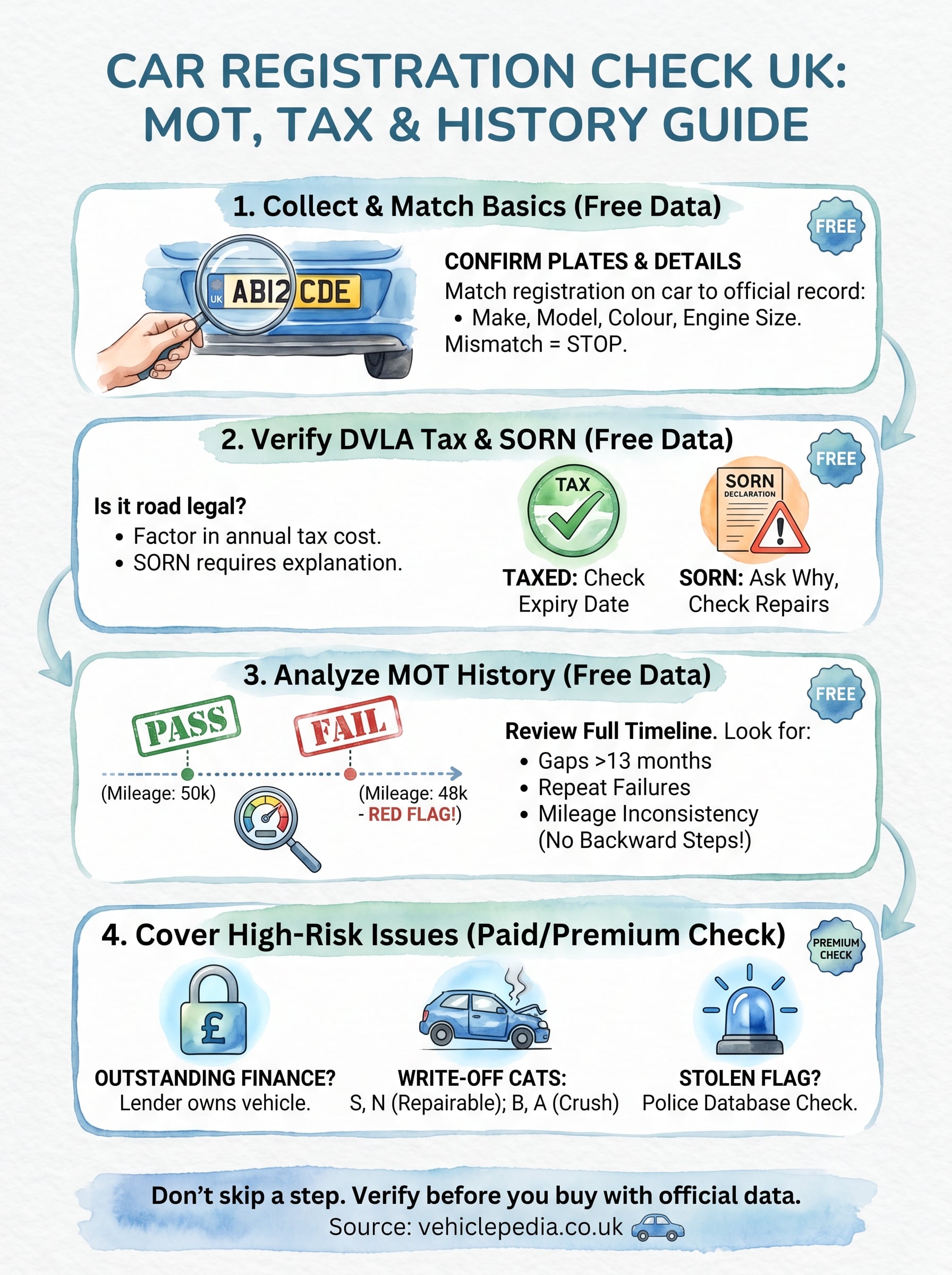
Before you run a car registration check UK, get the correct registration number directly from the physical plates on the car, not from a photo in the listing or a message the seller sends you. In some fraud cases, plates are deliberately swapped onto different vehicles to hide a bad history, so always read both the front and rear plates yourself before entering anything into a check.
Always verify the registration you are about to search matches the plates physically attached to the car.
Confirm the plate format looks right
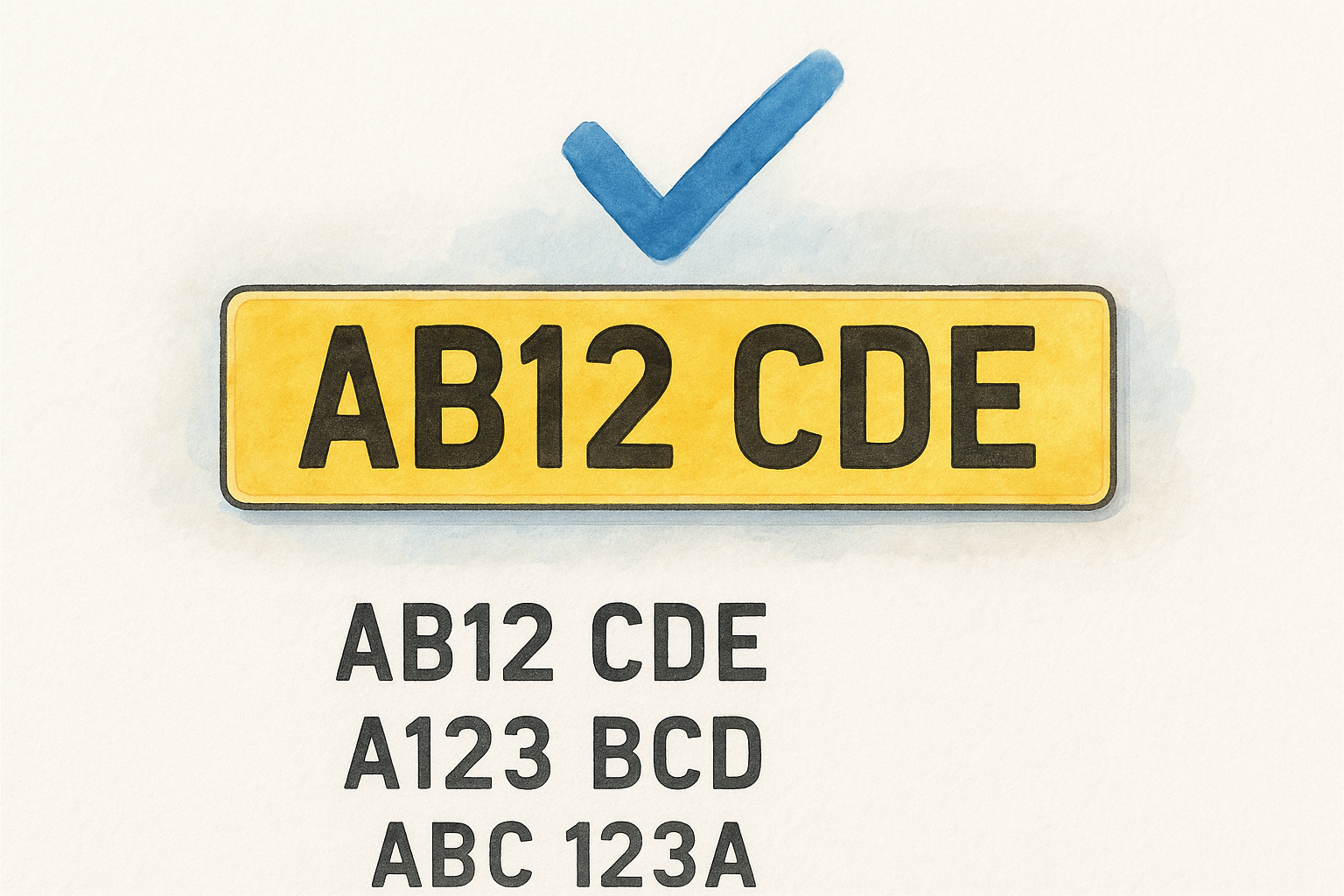
UK number plates follow a standard format that you can recognise at a glance. Any plate that does not match a recognised pattern is worth questioning before you proceed, as it can indicate plates taken from another vehicle. Use the reference below to confirm what you are looking at:
| Era | Format example | Notes |
|---|---|---|
| 2001 onwards | AB12 CDE | Most common format today |
| 1983 to 2001 | A123 BCD | Prefix style plates |
| Pre-1983 | ABC 123A | Suffix style plates |
Match the returned data against the vehicle
Once the check returns results, compare each key field against what you can see on the car in front of you. Go through these points while standing next to the vehicle:
- Make and model: does it match the badges and bodywork?
- Colour: does it match the paintwork, and is there a colour change listed in the history?
- Engine size: does it match what the seller told you?
Any mismatch on these basics is a clear signal to stop and ask questions before going any further.
Step 2. Check DVLA tax, SORN and key details
Once you have confirmed the basics match, run your car registration check UK to pull up the vehicle's current tax and SORN status from the DVLA record. This takes seconds and shows you whether the car is legally taxed to drive on public roads right now. It is the quickest way to check tax status by registration: the record tells you whether the vehicle is taxed, untaxed or declared off the road.
A car showing as SORN cannot legally be driven on a public road, so ask the seller why it was taken off the road before you proceed.
Reading the tax record
The DVLA record shows the tax expiry date and how much the annual rate costs for that vehicle. Check the expiry date against today's date, because a lapse in tax is not automatically the seller's problem to fix once money changes hands. Note down the renewal cost too, as it affects your running expenses from day one.
When reading the tax status, look for these three data points:
- Tax expiry date: confirm it has not already lapsed
- Annual tax rate: factor it into your total ownership costs
- Vehicle class: some classifications carry higher tax bands
Understanding a SORN declaration
SORN stands for Statutory Off Road Notification, which means the registered keeper told the DVLA the vehicle is off public roads and not in use. A SORN declaration is not automatically a red flag, since sellers sometimes SORN a car while it sits on a driveway during a sale period. What matters is why it was SORNed and whether any underlying issue has been fixed since that declaration was made. Ask to see service receipts or repair invoices covering the period it was off the road.
Step 3. Check MOT history and spot red flags
The MOT history section of a car registration check UK gives you a full timeline of every test the vehicle has completed. Each entry shows the test date, pass or fail result, mileage at the time, and any advisories or failure reasons logged by the examiner. Reading this timeline carefully tells you far more about the car's real condition than a seller's description ever will.
To check MOT history, enter the registration number into the checker and open the MOT section. A number plate check for MOT works the same way for any UK car, and the result comes from official DVLA and DVSA records.
How to read the MOT timeline
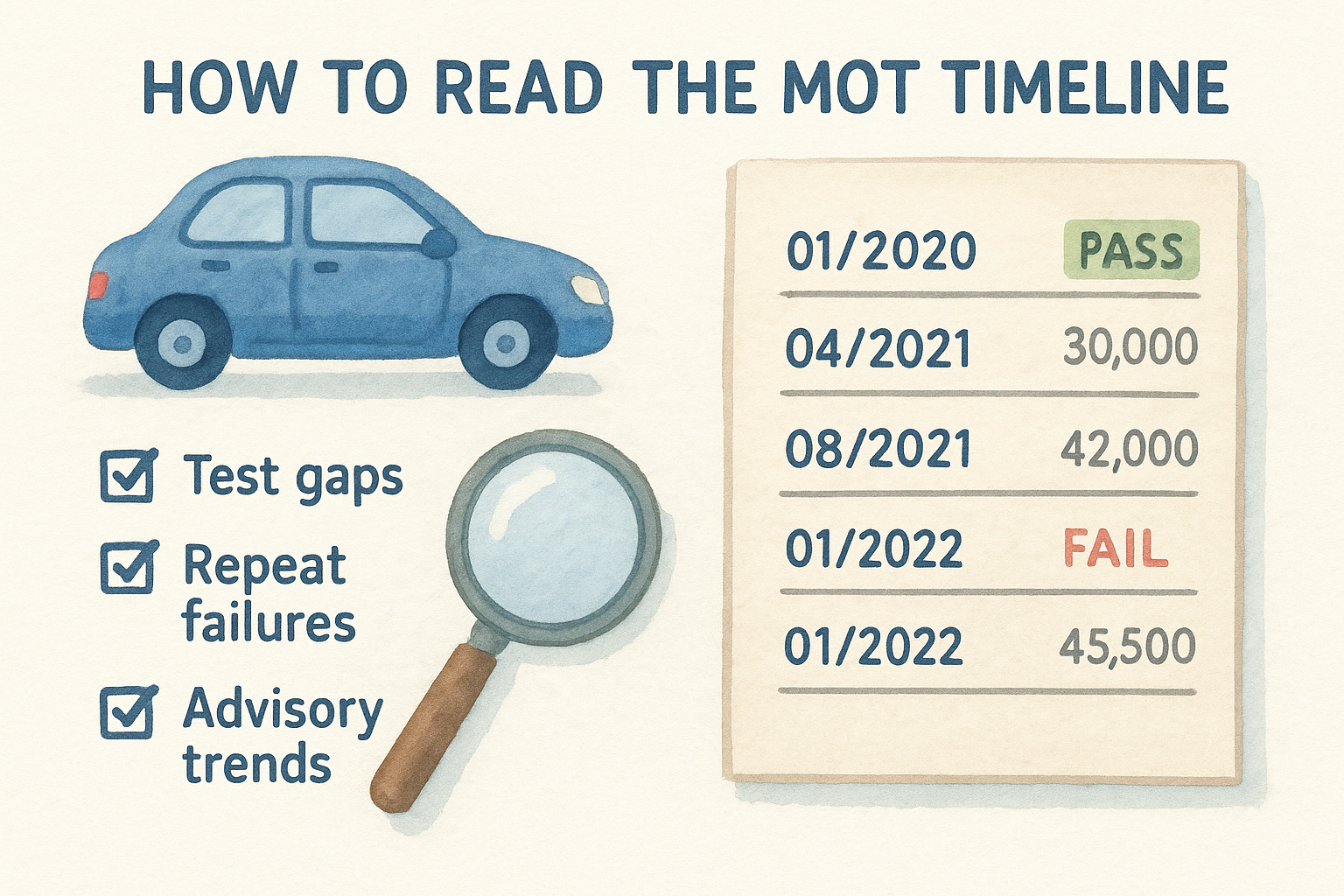
Start by checking how regularly the car has been tested. Gaps of more than 13 months between tests suggest a period where the car was either unroadworthy or unused. Review whether failures were resolved quickly or whether the car needed multiple retests on the same fault, as that signals a persistent problem the seller may not mention voluntarily.
Work through these points as you read each MOT entry:
- Test gaps: any gap over 13 months needs a clear explanation from the seller
- Repeat failures: the same fault appearing twice or more is a mechanical concern
- Advisory trends: advisories that escalate year on year indicate deferred maintenance
Red flags in the mileage record
Mileage recorded at each MOT test gives you a reliable independent odometer trail that is entirely separate from anything the seller tells you. Compare each figure in sequence. Any drop in recorded mileage between consecutive tests is a strong indicator of clocking and should end the viewing immediately.
If the mileage goes backwards at any point in the MOT history, treat it as a serious warning and do not proceed without a fully documented explanation.
Step 4. Cover theft, write-off and finance risks
A car registration check UK can surface the three highest-risk problems in any used car purchase: outstanding finance, write-off markers, and stolen vehicle flags. These checks require a paid report, but the cost is a fraction of what you stand to lose if you buy a car with any of these issues attached to it.
If a car carries outstanding finance, the lender still legally owns it, and you could lose both the vehicle and your money after the purchase completes.
Decoding write-off categories
UK insurers assign write-off categories to vehicles they class as damaged beyond a viable repair cost. The category tells you exactly how serious the damage was, so you can decide whether the car is structurally sound enough to purchase.
| Category | What it means |
|---|---|
| Cat S | Structural damage, can be repaired and returned to road |
| Cat N | Non-structural damage, can be repaired and returned to road |
| Cat B | Body shell must be crushed, parts may be salvaged |
| Cat A | Must be completely destroyed, no parts can be reused |
Checking finance and stolen status
Outstanding finance appears in a premium report and tells you whether any lender holds a legal claim over the vehicle. A stolen vehicle flag comes from the UK Police database and confirms whether the car has been reported missing. Check both before you agree a price, as neither issue is visible during a physical inspection of the car.
Before you commit to the purchase
Running a car registration check UK before you agree to buy takes minutes and costs very little compared to the risks you are covering. The checks in this guide give you verified data from official sources that no seller can contradict, so you walk into any negotiation with the facts already confirmed.
Work through each step in order: match the basics, confirm tax and SORN status, review the full MOT history, then run a paid check for finance, write-off, and stolen flags. Each layer builds on the last, and skipping any one step leaves a gap that could cost you far more than the car itself once the sale is complete.
Start your check today on Vehiclepedia before you view any vehicle in person. View a sample premium report to see exactly what a full paid check covers and decide whether it fits your situation before committing to a purchase.