What To Look For In A Used Car: 15 UK Checks Before Buying
Learn what to look for in a used car with our 15 essential UK checks. Verify MOT history, spot hidden finance, and avoid scams to buy with confidence.
What To Look For In A Used Car: 15 UK Checks Before Buying
Buying a used car can save you thousands compared to buying new, but it also comes with risks. A vehicle might look spotless on the outside while hiding mechanical faults, outstanding finance, or a written-off history underneath. Knowing what to look for in a used car before you hand over your money is the difference between a smart purchase and an expensive mistake.
The good news? Most problems are avoidable if you know where to check. From bodywork and tyres to service records and V5C logbook details, a structured inspection gives you the confidence to walk away from a bad deal, or negotiate a better price on a good one. Pairing a physical inspection with a vehicle history check through Vehiclepedia means you're covering both sides: what you can see with your own eyes and what only official databases like the DVLA and UK Police records can reveal.
This guide breaks down 15 essential checks every UK buyer should carry out before committing to a used car. Whether you're buying privately, from a dealer, or at auction, these steps will help you spot the red flags that sellers hope you'll miss.
1. Run a Vehiclepedia history check
Before you view any car in person, run a history check using the registration plate. It takes a couple of minutes and gives you verified data from official sources before you spend time or fuel travelling to a viewing. Knowing what to look for in a used car starts well before you lay eyes on it, and a registration check is the fastest way to filter out problem vehicles before you get emotionally invested.
What you can confirm for free from the registration
Vehiclepedia's free check pulls data directly from the DVLA and official UK databases, giving you instant access to a car's MOT status, road tax status, and basic registration details. You can confirm the make, model, colour, engine size, and year of manufacture match what the advert shows before you even contact the seller. If the registration returns a different colour or specification to the listing, that is worth querying immediately.
A free check takes under a minute and can rule out obvious mismatches before you waste a journey.
Free checks also reveal the current MOT expiry date and whether the vehicle is taxed, both of which affect your immediate running costs and legal position the moment you take ownership.
What a premium report adds and when it matters
The premium Vehiclepedia report goes further by checking the MIAFTR insurance write-off register and running the registration against the UK Police stolen vehicle database. It also includes a finance check to confirm whether the car has outstanding debt secured against it. If you buy a car with finance attached, the finance company can legally reclaim the vehicle even from a private buyer who had no knowledge of the debt.
For any car you seriously intend to buy, the premium report is worth the cost. Vehiclepedia backs premium reports with a £30,000 data guarantee for non-trade buyers, which gives you legal protection if the data turns out to be inaccurate.
How to use the results to decide, negotiate, or walk away
Run the report before the viewing, not after. If the check reveals a write-off marker, a previous theft report, or outstanding finance, you have a clear reason to cancel the viewing entirely. If the report shows an advisory-heavy MOT history or an unusually high number of previous keepers, you have concrete evidence to negotiate a lower price.
Sellers cannot dispute official database records, so arriving with a saved or printed report puts you in a much stronger negotiating position than a buyer who has done nothing in advance.
2. Verify the car's details with DVLA records
A Vehiclepedia free check pulls official DVLA data that you can cross-reference against the advert before you arrange a viewing. Make, model, fuel type, engine size, colour, and registration year are all retrievable from the registration plate alone, and any one of these fields being wrong in the listing is a reason to question the seller before you spend time travelling to see the car.
What to compare against the advert and the seller's claims
Start by comparing the vehicle's registered colour and specification against the photos and written description in the advert. Then check whether the year of first registration matches what the seller has listed. A common tactic is to advertise a car by its newer model year rather than its actual registration date, which inflates the perceived value and makes the car appear younger than it is.
What mismatches can mean and how to handle them
A colour discrepancy might mean the car has been resprayed following an accident, or the seller has simply used the wrong registration by mistake. A specification mismatch, such as a listed diesel that the DVLA records as petrol, could indicate the seller is describing a different car entirely, which is a serious red flag when you are deciding what to look for in a used car.
If multiple fields do not match, treat it as potential misrepresentation rather than a simple admin error.
When to pause the viewing and ask for proof
If you spot any mismatch between the DVLA data and the advert, contact the seller before visiting. Ask them to explain the discrepancy in writing, whether by message or email, so you have a clear record of their response. A legitimate seller will answer directly and quickly. Vague or defensive replies are a strong signal to cancel the viewing entirely.
3. Check the V5C logbook is genuine and matches the seller
The V5C logbook is the primary ownership document for any UK vehicle, and checking it thoroughly is one of the most important steps in knowing what to look for in a used car. A missing or inconsistent V5C should stop the purchase entirely until the seller provides a satisfactory explanation.
The key V5C fields that must match the car
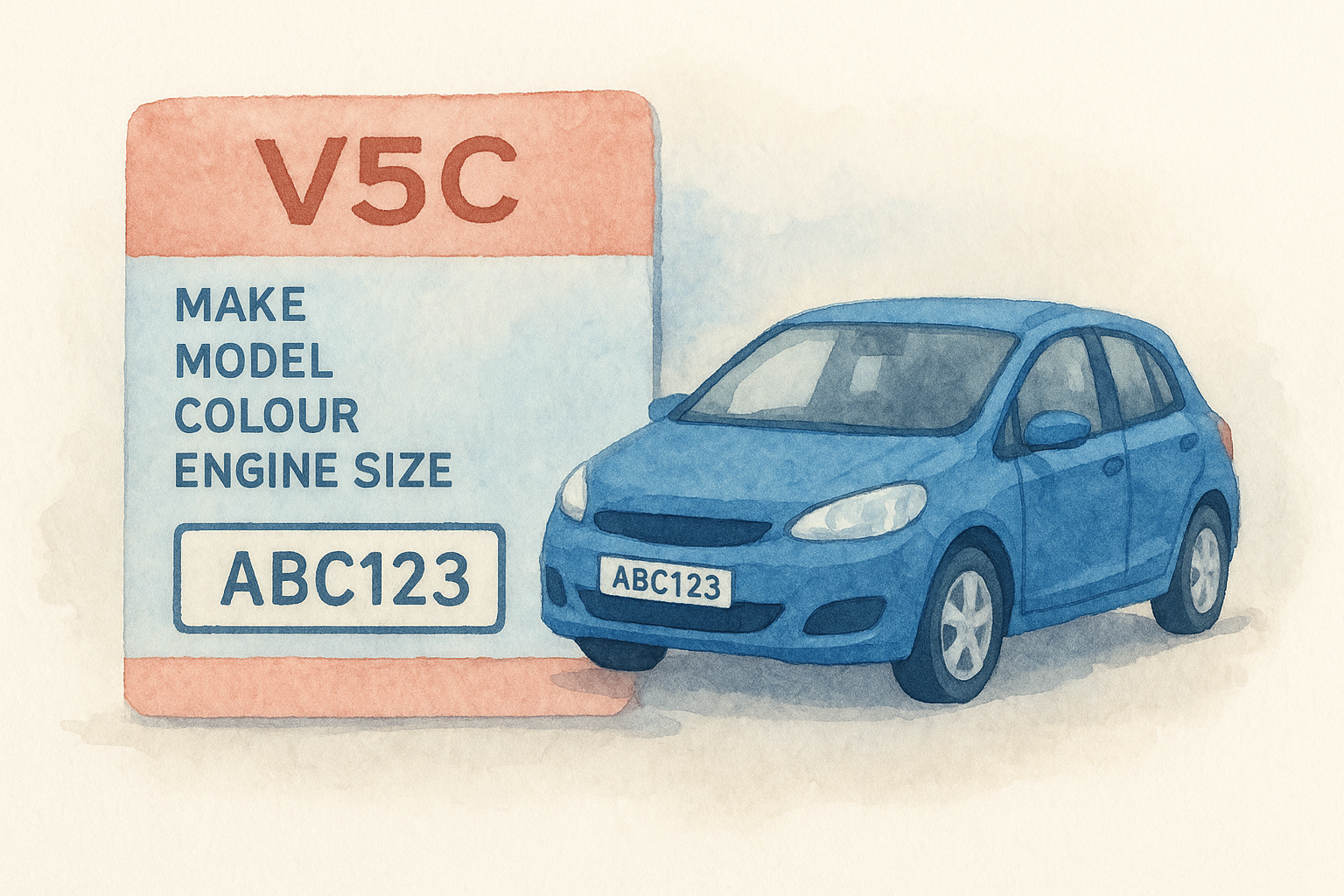
When you receive the V5C, check the make, model, colour, engine size, and VIN against the physical vehicle in front of you. The registration number on the V5C must match the plates on the car. Cross-reference the registered keeper's name and address with the person selling to you, and confirm the V5C carries the correct DVLA watermark and holographic strip on the front cover.
How to spot common V5C red flags
Look at the document's condition and print quality carefully. Genuine V5Cs have a distinct texture, and any document that looks photocopied, laminated, or unusually glossy warrants serious suspicion. Check whether any fields appear altered, such as a different font or ink colour on the keeper section. A V5C that looks pristine on an older vehicle can also be suspicious, as genuine documents accumulate natural wear over time.
You can verify a V5C reference number directly with the DVLA if you have doubts about its authenticity.
What to do if the seller is not the registered keeper
Ask the seller directly and immediately why their name does not appear on the V5C. There are legitimate reasons, such as a recently deceased relative or a company fleet sale, but each requires supporting documentation to back it up. Without a clear explanation and paperwork to match, you risk buying from someone who does not have the legal right to sell.
4. Match the VIN to the V5C and the car
The Vehicle Identification Number is a 17-character code unique to each car, and checking it is one of the most reliable physical steps in knowing what to look for in a used car. Unlike registration plates, the VIN is permanently stamped into the vehicle's structure, so any discrepancy between the car and its documents is a serious flag that demands a clear explanation before you go any further.
Where to find the VIN on the car
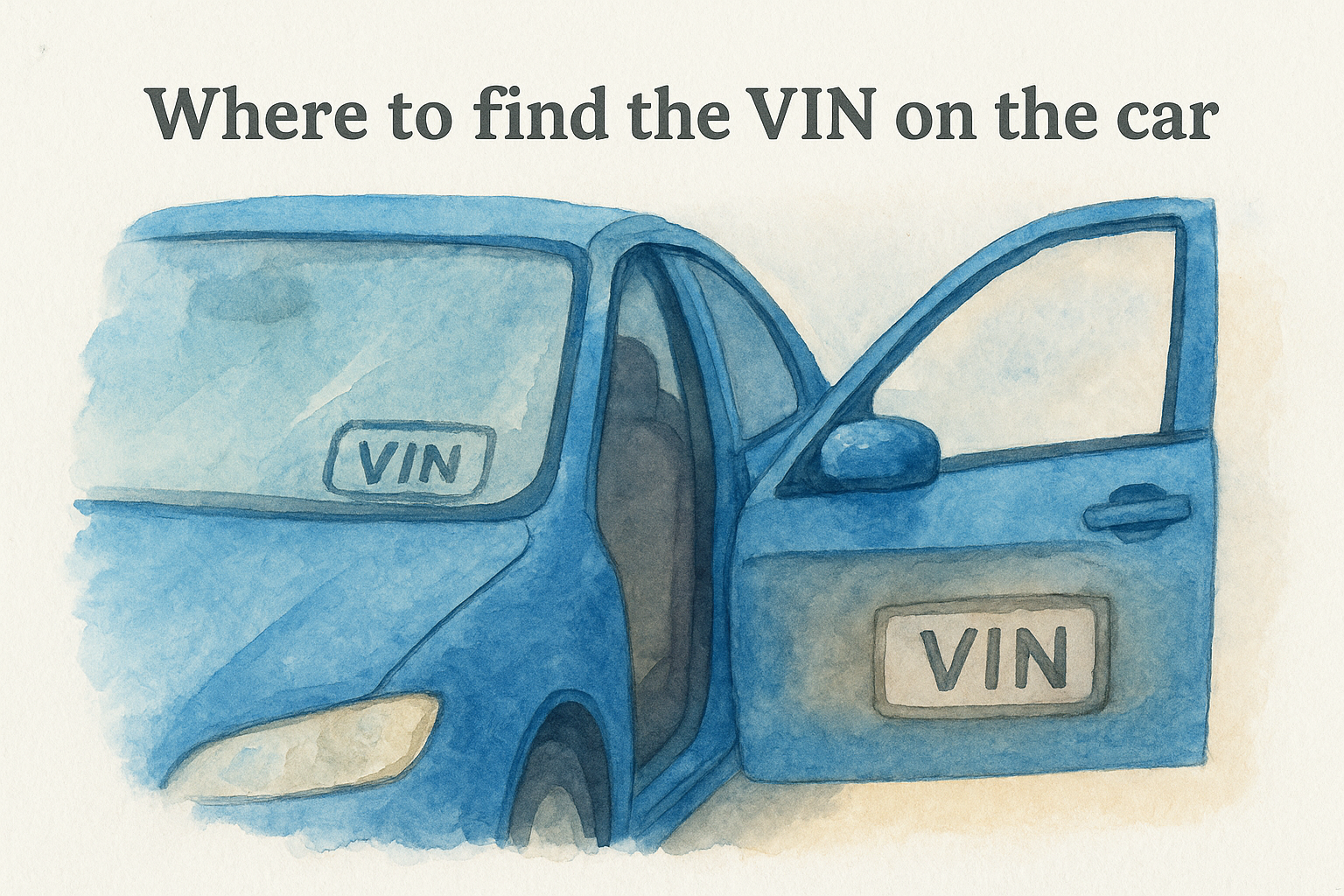
Most UK vehicles display the VIN in at least two places: a plate visible at the base of the windscreen on the driver's side, readable from outside the car, and a second stamp on the chassis or door sill. Check both locations and confirm that each one matches the VIN printed in the V5C exactly, including every digit and letter in sequence.
What a mismatch suggests and why it matters
A VIN that does not match the V5C strongly suggests vehicle cloning, where a criminal takes a stolen car and pairs it with the paperwork of a legitimately registered vehicle of the same make and model. Buying a cloned vehicle means the car can be seized by police regardless of what you paid or how convincing the paperwork appeared at the time.
If the VIN on the car does not match the V5C exactly, walk away before handing over any money.
Extra checks if you suspect cloning
Look closely at the windscreen plate and chassis stamp for scratches, drill marks, or signs that the area around them has been disturbed. A recently replaced plate often looks visibly newer than the bodywork surrounding it. If anything looks wrong, these additional steps can help confirm your suspicion:
- Compare the VIN on the engine block (where accessible) with both the plate and the V5C
- Contact the DVLA directly to verify the number against their official records
- Consider walking away rather than waiting for the seller to produce proof
5. Read the MOT history for patterns, not just the expiry date
The MOT expiry date tells you when the current certificate runs out, but the full MOT history tells you a far more useful story. Access the complete record for free through the DVSA's vehicle enquiry service, and you will see every test result, advisory notice, and failure reason going back years. This is one of the most revealing steps in knowing what to look for in a used car, and most buyers overlook it entirely.
How to interpret advisories and repeat failures
Advisories are items the tester flagged as worth monitoring but not serious enough to fail the car at that point. A single advisory on a single test is usually unremarkable. The problem appears when the same advisory reappears across multiple consecutive tests, which suggests the previous owner consistently ignored an underlying issue rather than fixing it.
Repeat advisories on brakes, suspension, or steering components are a strong signal that the car has been maintained to the bare minimum.
Common MOT warning areas to look for in person
When you visit the car, use the MOT history as a physical checklist. If previous tests flagged brake disc wear, tyre condition, or exhaust emissions, inspect those components directly during your viewing. Corrosion advisories are particularly important on UK cars because road salt accelerates rust, and what starts as a monitored item can become a structural safety failure within a year or two.
When an MOT pass still should not reassure you
A current MOT certificate only confirms the car met the legal minimum standard on the day it was tested. It does not cover items that were not checked, problems that developed after the test, or faults the tester missed. Treat a valid MOT as a starting point, not a guarantee of roadworthiness.
6. Confirm service history and maintenance evidence
Service history is one of the most telling factors in what to look for in a used car, yet sellers frequently inflate its value with vague claims. The phrase "full service history" means different things to different people, so you need to physically examine the paperwork rather than take the advert's word for it.
What "full service history" should actually include
A genuine full service history means stamped entries in the manufacturer's service booklet or printed dealer invoices for every scheduled service interval, covering the car's entire life. Each entry should show the date, mileage, work carried out, and the name of the garage. A booklet with three stamps on a ten-year-old car is not a full history, whatever the seller claims.
A stack of receipts from a single trusted independent garage is often more reliable evidence than a patchy dealership stamp record.
Timing belt or chain, major services, and big-ticket jobs
Beyond routine oil changes, pay specific attention to timing belt replacement records on engines that require them. A snapped timing belt can destroy an engine entirely, and replacement costs run into hundreds of pounds. Ask the seller directly when the timing belt was last changed, and check any invoices confirm both the belt and the water pump were replaced at the same time, as most manufacturers recommend doing both together.
When missing history is acceptable and how to price the risk
Some cars genuinely lose their service records through no fault of the seller, particularly older, high-mileage vehicles or inherited cars. In these cases, factor in the cost of an independent inspection and a full service into your offer price. Missing history is not always a deal-breaker, but it always justifies paying less.
7. Check for outstanding finance before you pay anything
Outstanding finance is one of the most financially damaging traps in what to look for in a used car. Unlike mechanical faults, you cannot spot it by looking at the car. The only way to confirm a vehicle is financially clear is to run a dedicated finance check against official lending records before any money changes hands.
How finance can affect legal ownership of the car
When a car is bought on hire purchase or a similar secured finance agreement, the finance company retains legal ownership until the final payment clears. If the original buyer sells the car before paying it off, they are selling something they do not legally own. You could hand over full payment and still lose the car if the lender traces it.
A private buyer who purchases a car with outstanding hire purchase finance has no legal right to keep it, regardless of what they paid.
Red flags in the advert that hint at finance
Certain patterns in a listing should prompt extra caution. A very low asking price relative to the car's condition, a seller who wants to complete the sale quickly, or an advert that emphasises "urgent sale" are all worth treating with scepticism. Finance holders under pressure to clear debt sometimes sell privately at a loss to raise cash, which puts the buyer at direct risk.
What to do if the check shows finance
If a Vehiclepedia premium report flags outstanding finance on the vehicle, do not proceed with the purchase until the seller provides written confirmation from the lender that the debt has been settled in full. Ask for a settlement letter on headed paper before any payment leaves your account. Walking away is always safer than trusting a verbal assurance.
8. Check the car has not been reported stolen
A stolen vehicle check is a non-negotiable part of what to look for in a used car, yet many buyers skip it entirely because they assume a V5C logbook is proof enough that a car is legitimate. It is not. A stolen car can appear with perfectly matching paperwork if a criminal has gone to the effort of sourcing a matching V5C, which is precisely why a database check against official police records is the only reliable way to confirm the car is clean.
Why stolen checks matter even with a V5C present
A V5C confirms registration history, not ownership. A stolen vehicle can be paired with a genuine V5C from a similar car of the same make, model, and colour. If police trace a stolen car to your driveway, they will seize it regardless of how much you paid or how convincing the paperwork seemed at the time. A Vehiclepedia premium report runs the registration against the UK Police database specifically to catch this.
Buying a stolen car in good faith does not protect you from losing it. The vehicle can be recovered by police at any point after purchase.
Warning signs in the seller's behaviour and paperwork
Pay attention to how the seller behaves during the viewing. Reluctance to let you photograph the VIN, vague answers about where the car came from, or pressure to complete the sale the same day are all patterns worth noting. Similarly, a V5C showing very few keepers on a high-mileage car, or a recently replaced windscreen plate, can indicate the car's identity has been altered.
Safe next steps if anything feels off
If the seller seems evasive or the paperwork raises doubts, run the full premium report before committing anything. Do not hand over a deposit while waiting for answers. Walking away from a viewing costs you nothing; buying a stolen car can cost you the entire purchase price.
9. Check for write-off status and Cat S or Cat N history
Write-off status is a critical part of what to look for in a used car, and it is something you cannot identify from a visual inspection alone. Insurers record write-offs on the MIAFTR database, and only a premium history check like the one Vehiclepedia runs will confirm whether a car carries a marker before you commit to buying it.
What Cat S and Cat N mean in practical terms
Both categories describe vehicles that an insurer wrote off as uneconomical to repair, but they differ in how serious the damage was. A Cat S vehicle sustained structural damage to components like the chassis or crumple zones, and it must pass a formal inspection before returning to the road. A Cat N vehicle suffered non-structural damage, such as cosmetic bodywork or electrical faults, and carries no mandatory re-inspection requirement before being sold again.
A Cat S car that was repaired to a poor standard can fail unpredictably in a future collision, even if it looks fine and drives normally.
What evidence you should ask for if it was written off
If the report confirms a write-off marker, ask the seller for the repair invoice and sign-off documentation showing the work was completed properly. For Cat S vehicles, ask for the independent inspection certificate that confirms the car was assessed as roadworthy before it returned to use. Without this paperwork, you have no way to verify the quality of the repairs.
When to walk away even if the price looks good
A heavily discounted price on a written-off car can seem attractive, but the long-term costs often cancel out the saving. Many insurers charge significantly higher premiums on Cat S and Cat N vehicles, and resale value is substantially lower compared to a clean-history equivalent. If the seller cannot produce repair documentation, walking away is the sensible choice.
10. Sanity-check the mileage and look for clocking clues
Mileage directly affects a used car's price, which makes it a prime target for fraud. Clocking - winding back or resetting an odometer - is illegal in the UK, but it still happens regularly in the private market. Knowing what to look for in a used car means treating the dashboard figure as one data point, not the final word.
How to cross-check mileage against MOT and service records
Every MOT test records the odometer reading at the time of inspection, giving you a timestamped mileage trail stretching back years. Pull the full history through the DVSA and compare each figure in sequence. The numbers should increase steadily and proportionally over time. Any sudden drop or suspicious plateau between tests is a clear sign the odometer has been altered.
If the MOT history shows 18,000 miles one year and 9,000 the next, treat that as a red flag until the seller offers a credible explanation.
Service invoices add further data points. Workshop records typically note the mileage at each visit, so check those figures against the MOT trail for consistency across the car's full life.
Wear-and-tear clues inside the cabin that do not add up
Physical wear gives the game away when the claimed mileage is too low. Heavily worn pedal rubbers, a cracked or shiny steering wheel rim, and a driver's seat bolster ground down to the fabric all suggest far more use than the dashboard shows. Check the gear knob and door grab handles too, as these surfaces wear in direct proportion to actual use.
How mileage issues affect value and insurability
A car sold with a false mileage reading can affect your insurance position if the insurer discovers the discrepancy after a claim. It also distorts the car's true market value, meaning you overpay at purchase and recover less when you eventually sell.
11. Check previous keepers, usage, and import status
The number of previous keepers and how the car was used are key factors in what to look for in a used car. A vehicle that changed hands five times in three years tells a very different story from one with two careful owners across a decade, and the DVLA records accessible through a Vehiclepedia check give you this information before you commit to a viewing.
What keeper changes can reveal and what is normal
Multiple keeper changes in a short period often indicate recurring mechanical problems that each owner tried to pass on rather than fix. A higher number of keepers is not automatically disqualifying, but it does warrant closer questioning. Ask the seller why and when they are selling, and check whether the number of keepers shown on the V5C matches what the official DVLA record shows.
More than four keepers on a car under five years old is worth investigating before you proceed.
Fleet, taxi, hire, and driving school clues to look for
Commercial usage puts significantly higher stress on a vehicle than typical private ownership, even at lower recorded mileages. Look for reinforced seat bases, extra mounting points, or meter brackets inside the cabin that hint at taxi or private hire use. Hire and driving school cars also accumulate clutch and brake wear faster than average, so factor in the likely replacement costs if the history points in that direction.
Extra considerations for imports and parts availability
Grey imports and parallel imports may have been built to different specifications than UK-market cars, meaning certain parts are harder to source and some recall or warranty work may not apply. Check the V5C for a country of origin field and cross-reference the VIN prefix against manufacturer records if the car's origin is unclear.
12. Inspect tyres and wheels for safety and hidden costs
Tyres are one of the most overlooked areas when buyers consider what to look for in a used car, yet they are among the most expensive consumables to replace and the most directly connected to your safety on the road. A full set of quality tyres can cost several hundred pounds, so factoring in their condition is essential before you settle on a price.
Tread depth, tyre age, and matching brands
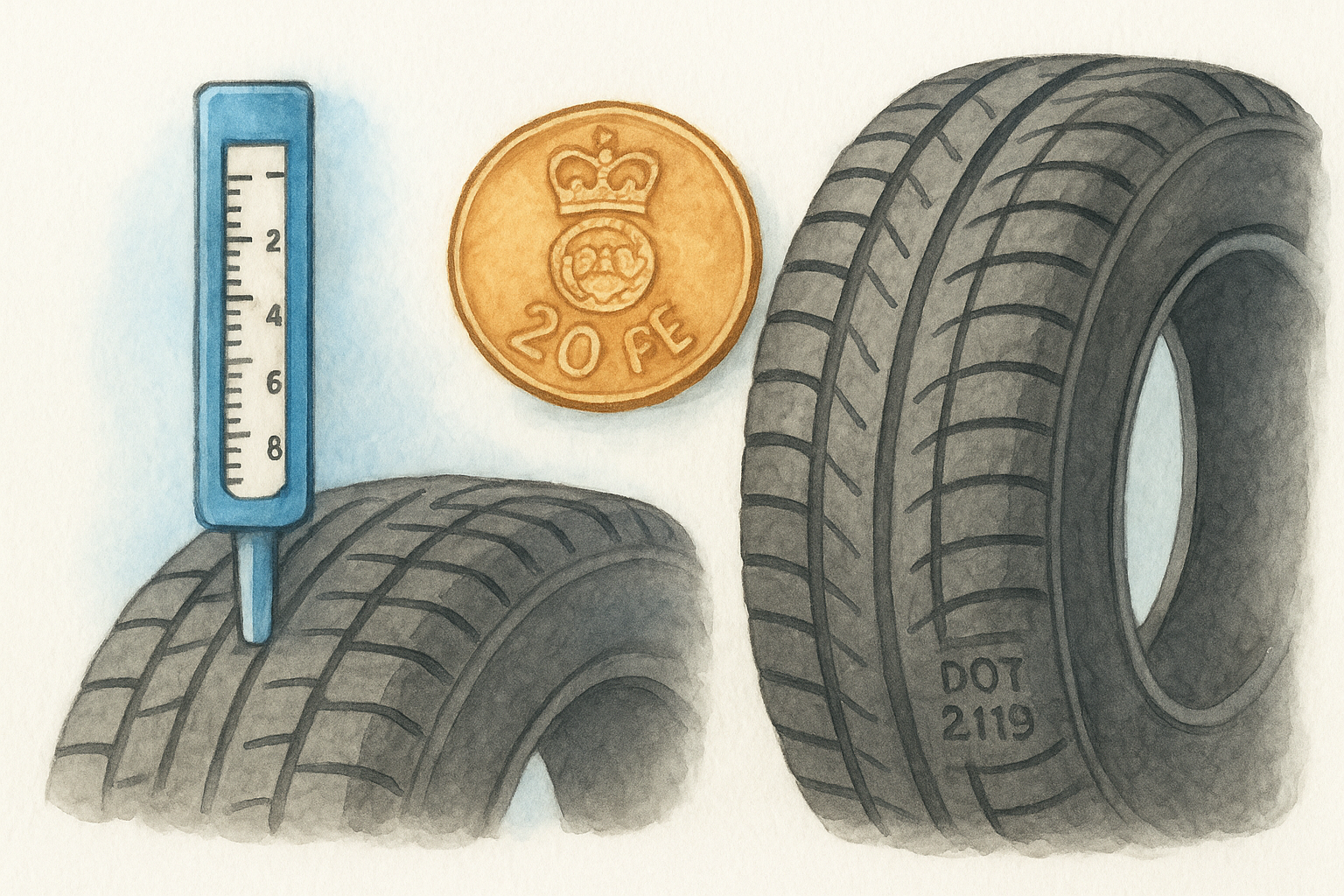
The UK legal minimum tread depth is 1.6mm across the central three-quarters of the tyre, but most tyre manufacturers recommend replacing at 3mm for adequate wet-weather performance. Use a tread depth gauge or the 20p coin test to check each tyre individually. Beyond depth, look at the age markings on the tyre sidewall: a four-digit DOT code shows the week and year of manufacture, and tyres older than five years should be examined closely for cracking regardless of how much tread remains.
Mixing tyre brands across an axle can affect handling, and some insurance policies require matching pairs on each axle.
Uneven wear patterns and what they suggest
Wear concentrated on the inner or outer edge of a tyre points to a wheel alignment problem, which adds cost beyond the tyres themselves. Centre-only wear suggests the tyre has been chronically over-inflated, while wear on both edges indicates persistent under-inflation. Either pattern tells you the previous owner neglected basic maintenance.
Wheel damage, cracks, and alignment warning signs
Run your hand around each alloy wheel rim and check for kerbing damage, visible cracks, or buckles. Cracked alloys are a structural failure risk and are not legally safe for road use. Buckled wheels often cause steering vibration that gets worse at speed, so any wobble during the test drive should send you back to inspect the wheels more closely.
13. Inspect bodywork, panel gaps, and rust in daylight
Always view a car in natural daylight on a dry day. Artificial lighting hides surface imperfections that become obvious outside, and rain on the bodywork masks colour differences between panels that point directly to crash repairs or a respray.
How to spot crash repairs and poor resprays
Crouch at each corner of the car and look along the panel lines from a low angle. Ripples, orange peel texture, or colour mismatches between adjacent panels all point to previous bodywork repairs that may not have been disclosed in the advert.
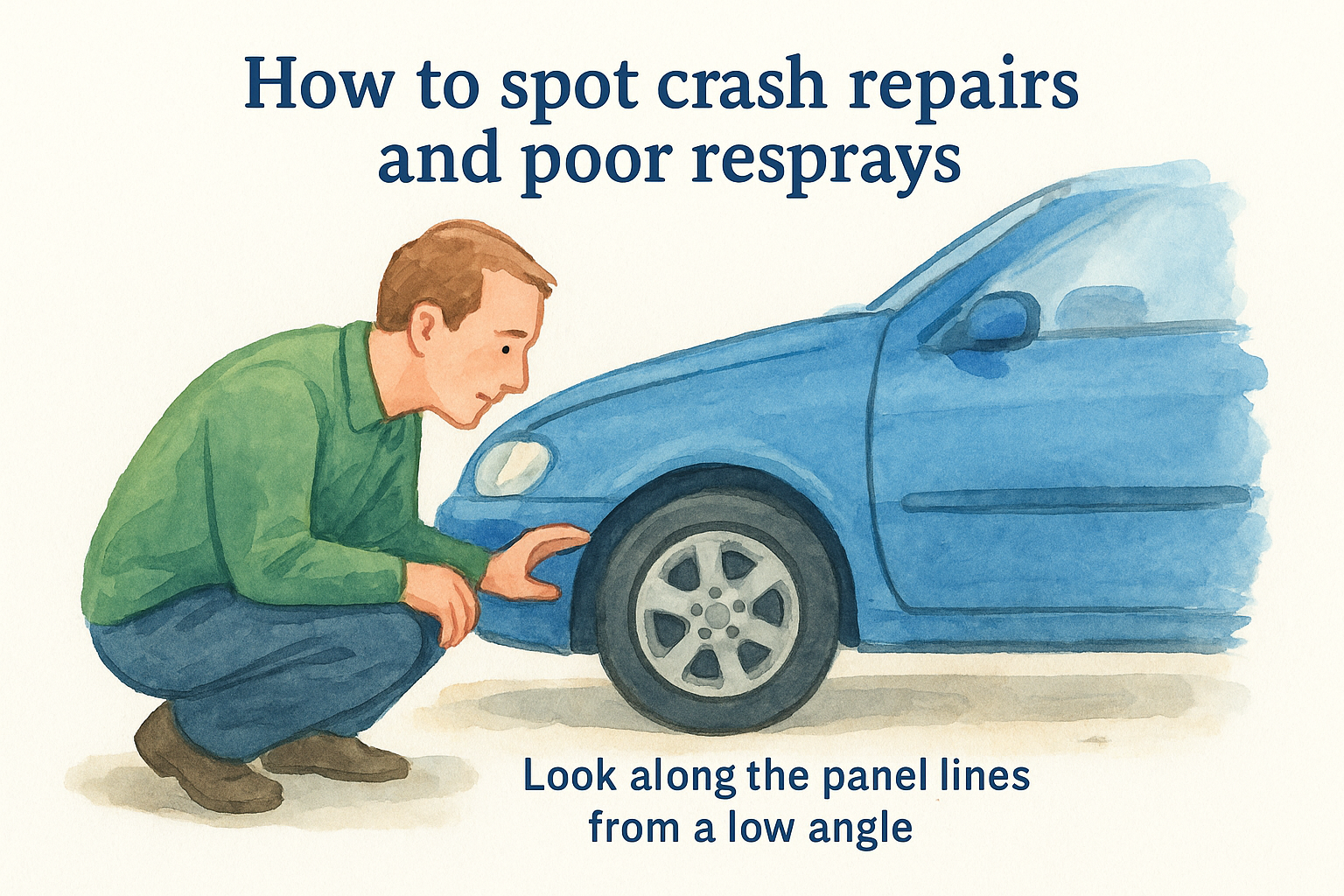
Uneven panel gaps across the front end often indicate a front-impact collision, regardless of how tidy the paintwork looks from a distance.
Check door shuts and boot apertures for overspray on rubber seals, which survives most post-repair cleaning. Any panel sitting higher or lower than its neighbour suggests replacement rather than repair, and understanding this distinction is central to knowing what to look for in a used car.
Where rust hides on common UK cars
Wheel arches, sill edges, and the base of the A-pillars collect road salt and standing water year-round on UK cars. Lift the boot carpet and press firmly on the floor to feel for soft spots caused by hidden corrosion beneath the surface.
Surface rust on a sill can look minor but extend structurally underneath. On older hatchbacks and estates, also check the tailgate lower edge and the channels where the roof meets the rear pillars.
How to estimate repair costs and use them in negotiation
Ask a local bodyshop for a rough quote on any visible rust or paint damage before you commit to the purchase. A realistic repair figure gives you firm grounds to negotiate a price reduction rather than guessing at a number.
Get the estimate in writing if possible. A written quote from a named garage carries far more weight with a seller than a verbal figure you raise during the viewing itself.
14. Check glass, lights, and exterior electrics
Glass and lighting faults are easy to overlook on a busy viewing, but they sit firmly in the category of what to look for in a used car because they affect both legal roadworthiness and your immediate repair bill. Walk around the entire car methodically and test every switch before you move on to the engine bay.
Windscreen chips, lamp moisture, and cracked lenses
Check the windscreen carefully from multiple angles in daylight. Chips in the driver's direct line of vision are an automatic MOT failure, and a full windscreen replacement on some modern cars costs several hundred pounds. Also inspect all lamp units for internal moisture, which appears as fogging or water droplets inside the lens. Condensation inside a headlight unit means the seal has failed and the unit needs replacing.
A chip outside the direct sweep of the wiper can worsen into a crack within weeks, particularly in cold or wet UK weather.
Headlights, indicators, fog lights, and number plate lights
Ask the seller to switch on every light circuit while you walk around the car. Tap each lens and indicator cover gently and check for stress cracks not immediately visible at a glance. Check each of the following in turn:
- Main beams and dipped beams front and rear
- Front and rear fog lights and hazard lights
- Both indicators on all four corners
- Number plate lights at the rear
Why small faults can turn into MOT failures
Even minor lighting faults that look cosmetic can block an MOT certificate. A non-functioning number plate light is a direct MOT failure point, as is a single blown indicator bulb.
Factor the cost of any faults into your offer price rather than assuming you can sort them cheaply later, as some modern LED units are expensive to source and fit.
15. Check the interior, engine bay, and take a proper test drive
This final section of what to look for in a used car covers the steps that tell you whether the vehicle is genuinely fit for daily use. Do not rush through the cabin, bonnet, or test drive because a seller who has prepared the car carefully may have cleaned or masked the areas that normally reveal problems.
Cabin checks for water leaks, smells, and safety features
Press your hand firmly into the floor carpet on both the driver and passenger sides and feel for damp. Water ingress through sunroof seals or door rubbers is a persistent issue on older UK cars, and damp carpets quickly lead to mould, wiring faults, and hidden structural rust beneath the floor. Check the boot floor in the same way.
A musty smell that the seller has masked with air freshener is one of the most consistent signs of a water leak.
Also test every electric window, mirror adjustment, and seat motor to confirm they all move through their full range. Check that seatbelts on every seat lock firmly under a sharp tug.
Under-bonnet checks for fluids, leaks, and warning signs
Open the bonnet with the engine cold and work through every fluid reservoir in sequence. Oil that appears black and gritty indicates the car is well past its service interval. A creamy residue under the oil filler cap points to a head gasket failure, where coolant is mixing into the engine oil. Any evidence of this is a straightforward reason to walk away.
Check underneath for fresh oil stains or coolant deposits on hoses and around the radiator. Any active drip warrants a direct question to the seller before you go further.
Test drive route, what to listen for, and deal-breaker symptoms
Drive the car on both town roads and a faster dual carriageway to put the engine under real load. Listen for knocking at idle, which suggests worn engine bearings, and pay attention to any vibration through the brake pedal, which points to warped discs. A pull to one side under firm braking is a serious safety concern that justifies walking away from the sale entirely.
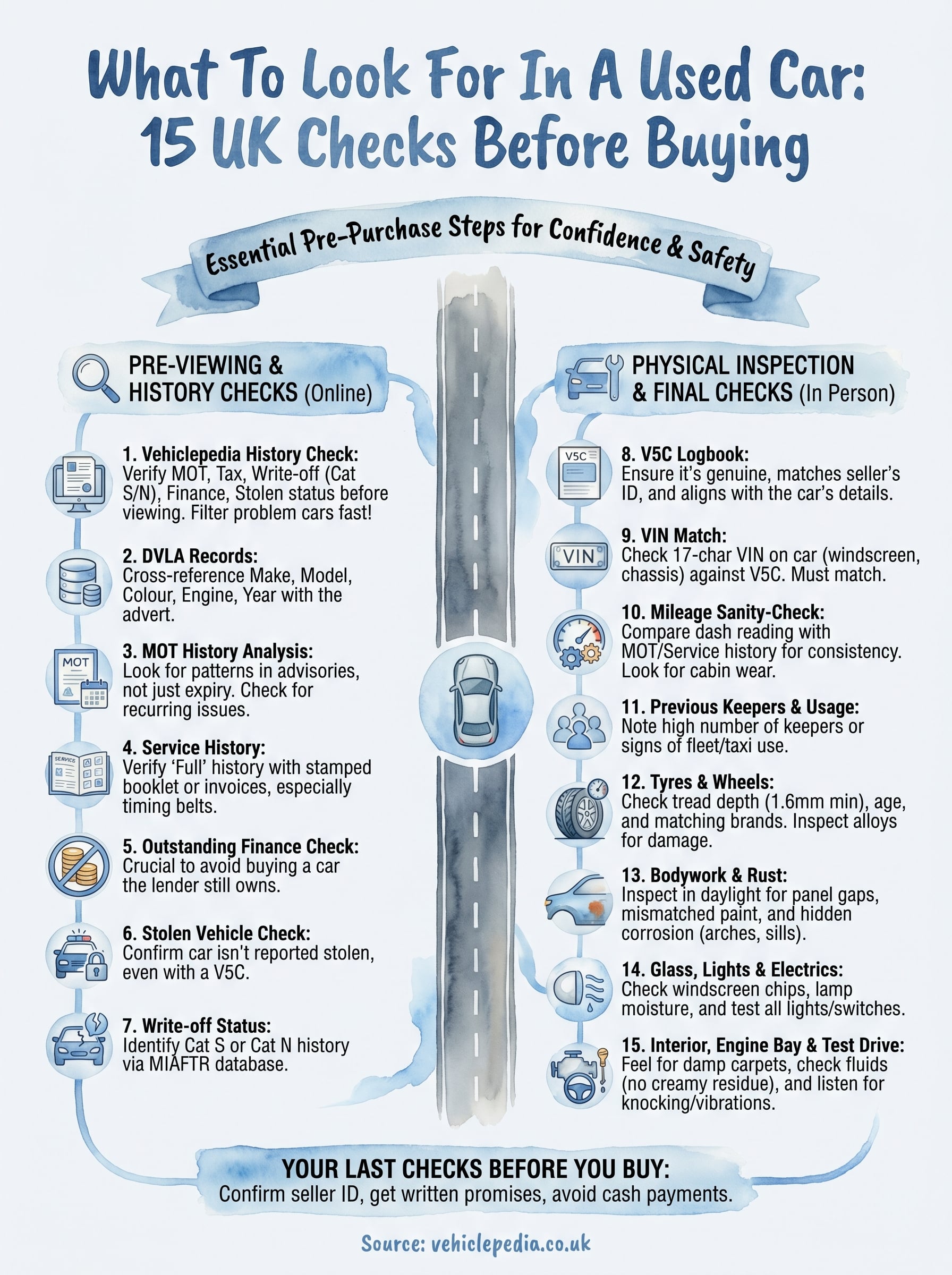
Your last checks before you buy
Working through all 15 steps gives you a complete picture of what to look for in a used car before any money changes hands. The physical inspection, the paperwork trail, and the history check each cover different risks, and skipping any one of them leaves a gap a dishonest seller can exploit.
Before you agree a price, confirm the seller's identity matches the V5C, get any verbal promises about condition in writing, and never pay by cash if you can avoid it. Bank transfer provides a clearer trail if a dispute arises later.
Start with the data before you start with the viewing. A Vehiclepedia report takes minutes and can save you thousands by flagging finance, write-off markers, or theft records before you travel anywhere. View a sample premium report to see exactly what the check covers, or head to the pricing page to get started.