How To Check A Car By Number Plate: MOT, Tax & More UK
Learn how to check a car by number plate to verify MOT history, tax, and mileage. Spot hidden risks like outstanding finance or theft before you buy.

How To Check A Car By Number Plate: MOT, Tax & More UK
Every used car tells a story, but not every seller tells you the full one. Knowing how to check a car by number plate before handing over your money can reveal hidden problems like outstanding finance, previous write-offs, or a dodgy MOT history that the seller conveniently forgot to mention.
A simple registration plate lookup gives you access to a surprising amount of detail: MOT results, tax status, mileage records, specification data, and more. All of it pulled from official UK sources like the DVLA. The best part? Much of this information is completely free to access, so there's no excuse not to check.
In this guide, we'll walk you through exactly how to run these checks step by step, covering everything from free government tools to the more detailed reports available through services like Vehiclepedia. Whether you're buying your first car or your tenth, you'll know exactly what to look for and where to find it.
What you can check from a number plate
A UK registration plate is more than just an identifier. Every plate is linked to a unique record held by the DVLA and other official databases, and knowing how to check a car by number plate gives you a detailed picture of that vehicle's past and present. You can access a surprising amount of this data in minutes, often without spending a penny.
Free checks available from official sources
The UK government provides several free tools that return genuinely useful information. Using the registration number alone, you can pull up a vehicle's MOT history going back to 2005, including pass and fail results, advisory notes, and the recorded mileage at each test. You can also confirm whether a car is currently taxed and road-legal, check its SORN status, and retrieve core specification data like engine size, fuel type, and registered colour.
A car showing large mileage gaps or repeated failures on the same component across multiple MOT tests is worth investigating carefully before you consider buying.
Here is a quick summary of what free checks typically return:
| Check | What you find out |
|---|---|
| MOT history | Pass/fail results, mileage records, advisories |
| Tax status | Whether tax is paid and the expiry date |
| SORN status | Whether the car is declared off road |
| Vehicle specs | Engine size, fuel type, colour, body type |
| Registration details | Age, original registration date |
What premium checks add
Free checks have real limits. They will not tell you whether a car has outstanding finance registered against it, which means a previous owner could still owe money secured on the vehicle. They also will not flag whether a car has been written off by an insurer or reported stolen to the police.
Services like Vehiclepedia cover these gaps with a full premium history report, pulling data from insurance registers, the UK Police Database, and finance records in a single lookup.
Step 1. Confirm the car's identity on DVLA
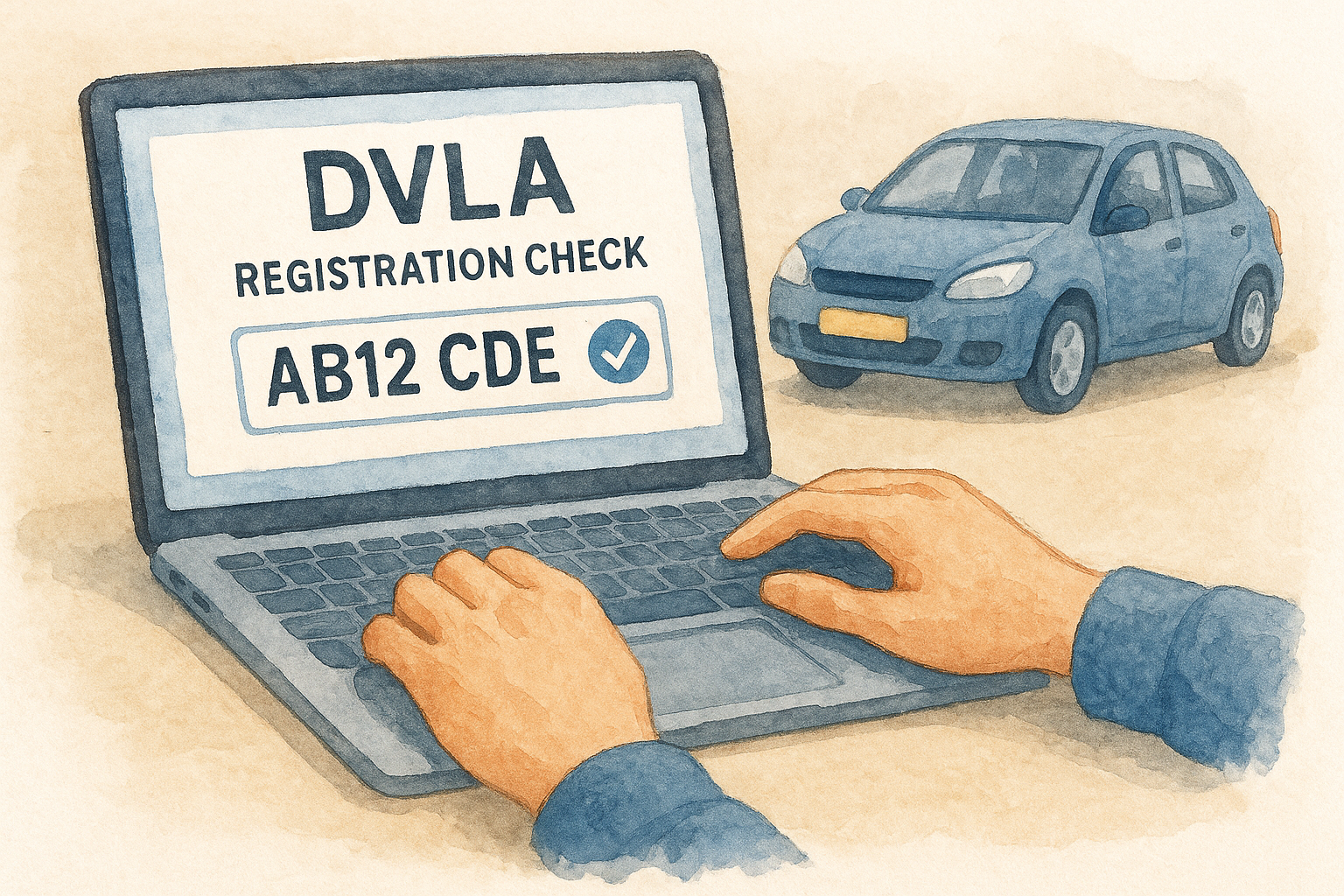
Before anything else, you need to confirm that the car in front of you actually matches what its plate says it is. The DVLA's Vehicle Enquiry Service lets you run a free registration lookup in seconds, returning the official record tied to that plate. This is your first line of defence against a car that has had its plates swapped or its details deliberately altered.
How to run the free DVLA check
Go to the GOV.UK Vehicle Enquiry Service and enter the registration number exactly as it appears on the plate. The result will show you the make, colour, and engine size recorded against that registration, alongside the date of first registration. Once you have those results, cross-reference every single detail against the physical car and the V5C logbook the seller hands you.
If any detail in the DVLA record does not match the car or the V5C, walk away and report it to the police before you hand over any money.
Run through this checklist against the vehicle in front of you:
- Make and model - matches the badges on the car
- Colour - matches the bodywork (colour changes show up in premium reports)
- Engine size - matches the V5C and the sticker under the bonnet
- Date of first registration - confirms the car's genuine age and rules out clocking
Step 2. Check MOT history and spot mileage red flags
The MOT history for any UK vehicle is publicly available through the government's official check service, and it gives you far more detail than a simple pass or fail. Each test record includes the mileage at the time of testing, every failure reason, and any advisory notes flagged by the examiner. This data is free to access and one of the most revealing parts of any number plate lookup.
How to read the MOT records
Visit the official GOV.UK MOT history checker and enter the registration number exactly as it appears on the plate. The results will list every test going back to 2005, with pass and fail outcomes alongside the recorded mileage. Work through each entry chronologically and look for patterns that do not add up.
Red flags to watch for
Not every problem jumps out immediately, so check these specific warning signs before you go any further:
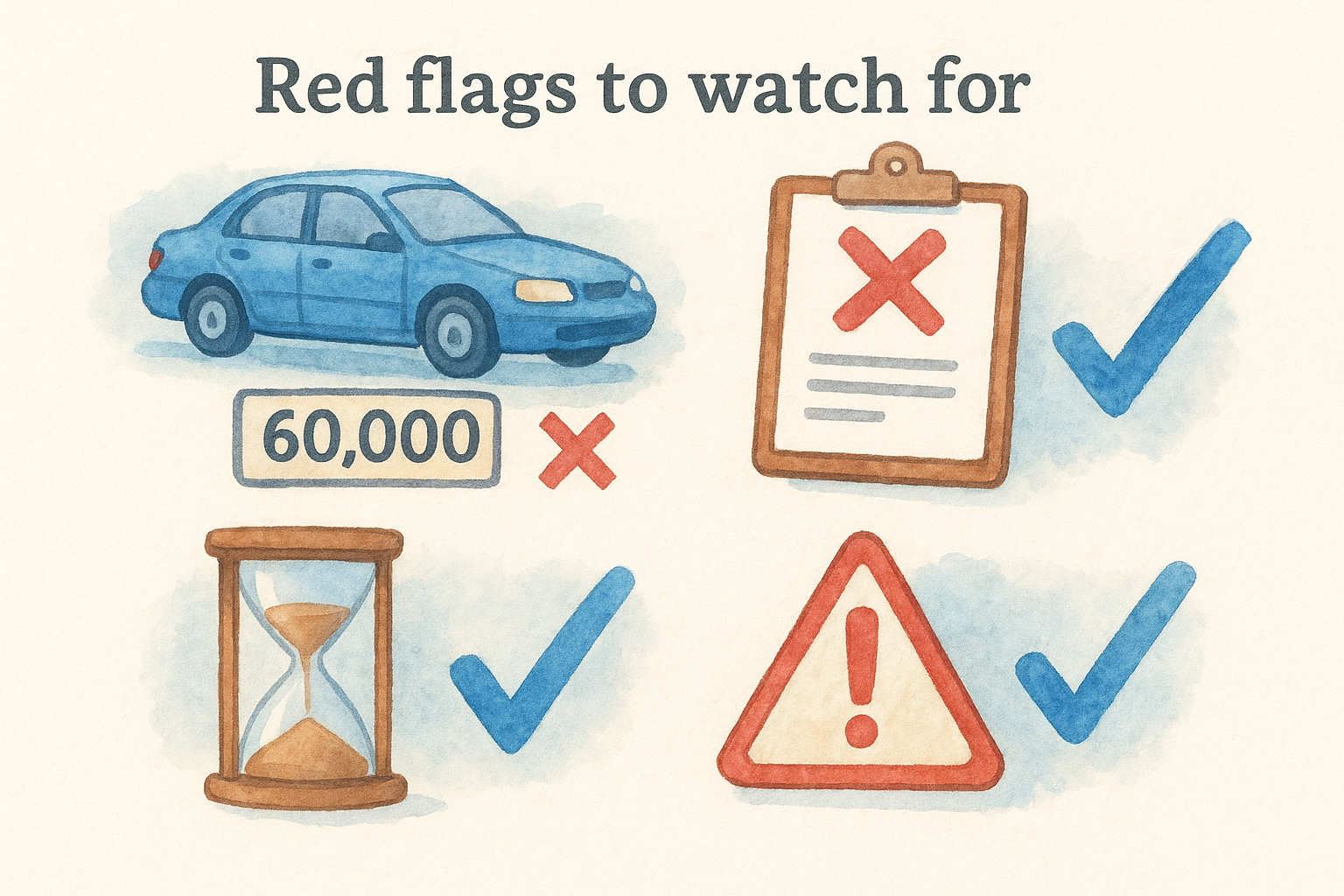
- Mileage that drops between tests - a strong indicator of clocking
- Repeated failures on the same component - suggests a persistent fault the owner has not properly resolved
- Long gaps between tests - the car may have been off the road or driven without a valid MOT
- A cluster of advisories - minor items today can become expensive repairs tomorrow
If the recorded mileage does not match the odometer reading when you inspect the car in person, treat it as a serious warning sign and walk away.
Step 3. Check tax, SORN and road legality
Driving a car without valid road tax is illegal in the UK, and it is the seller's responsibility to keep tax paid while the car remains in their name. When you check a car by number plate through the DVLA Vehicle Enquiry Service, you get the current tax status and expiry date for free, which tells you exactly where things stand before you even view the car in person.
How to check tax status
Visit the GOV.UK Vehicle Enquiry Service and enter the registration number. The result will show whether the car is currently taxed and when the tax expires. Note that road tax no longer transfers between owners since 2014, so the seller receives a refund on any remaining months when the car is sold. You will need to tax it fresh the moment ownership transfers to you.
Never assume a taxed car is automatically road-legal. Check the MOT status alongside the tax record, since both must be valid for the car to be driven legally on a public road.
What SORN means for you as a buyer
A Statutory Off Road Notification (SORN) means the registered keeper has declared the vehicle off the public road. If a car shows a SORN status, the seller cannot legally drive it to you, and you will need to arrange collection on a trailer or flatbed to stay within the law.
Step 4. Run the extra checks that catch expensive problems
Free government tools cover MOT, tax, and basic identity, but they leave three serious risks completely unchecked. When you check a car by number plate through a premium service like Vehiclepedia, you plug those gaps before they cost you serious money.
Check for outstanding finance
Finance is the most common hidden problem in used car sales. If a previous owner took out a hire purchase or personal contract purchase (PCP) agreement and never settled it, the finance company retains a legal interest in the vehicle. Buying that car means you could lose it to the lender even if you paid the seller in full.
Always run a finance check before you transfer any money, since the debt follows the car, not the previous owner.
Check for write-offs and stolen vehicles
A car that has been written off by an insurer may look fine on the surface but carry structural damage that makes it unsafe or uninsurable. A stolen vehicle check runs your registration against the UK Police Database, flagging anything reported as stolen. If a car comes back with either a write-off marker or a stolen flag, report it to the police immediately and do not proceed with the purchase.
| Premium check | Why it matters |
|---|---|
| Finance check | Confirms no outstanding loans secured on the car |
| Write-off check | Identifies insurance category damage |
| Stolen vehicle check | Flags police-reported theft |
Next steps
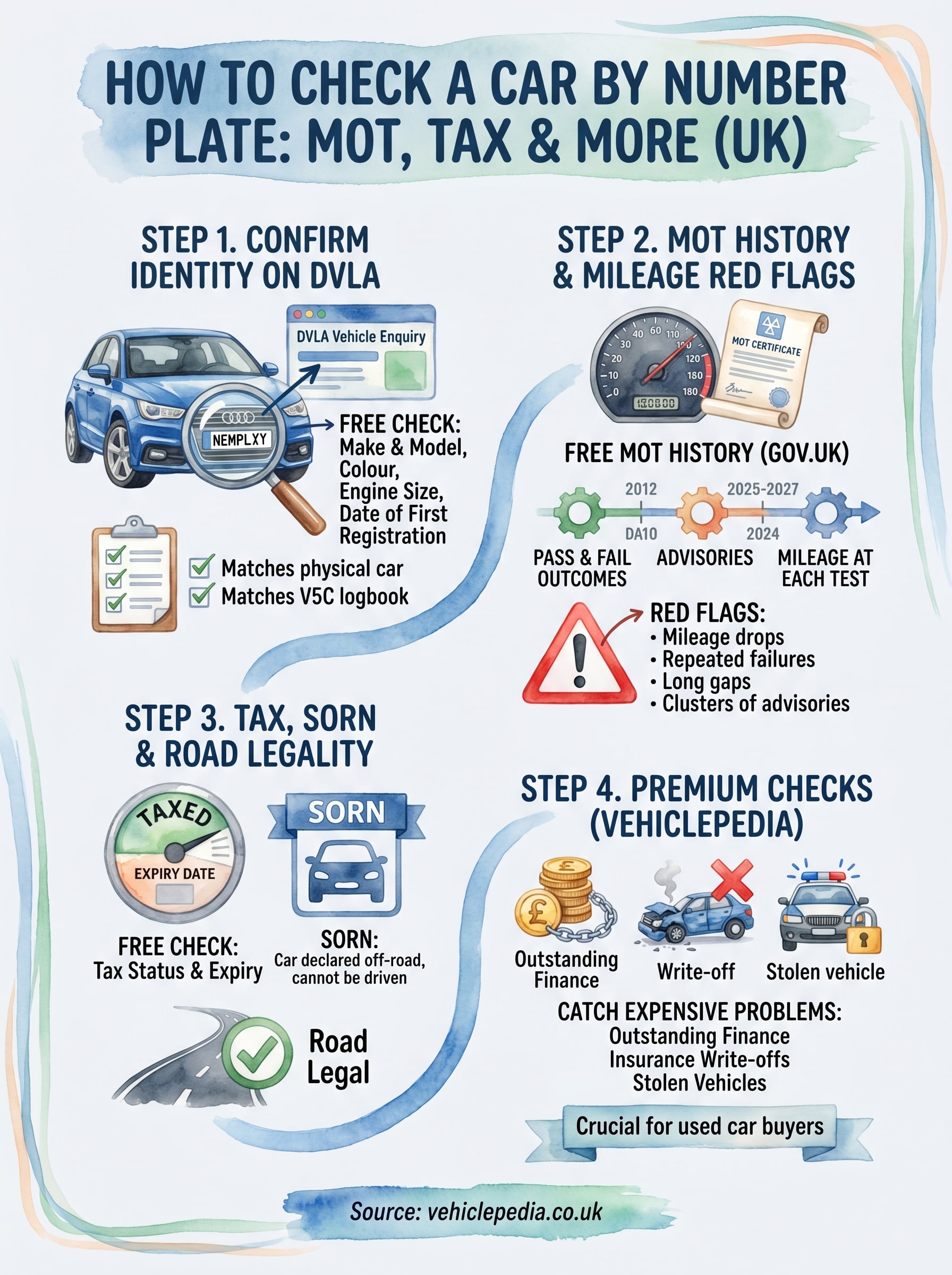
Running through all four steps in this guide gives you a solid picture of any vehicle before you commit to buying. You now know how to confirm a car's identity against DVLA records, read the MOT history for mileage red flags, verify tax and SORN status, and run the premium checks that catch finance, write-offs, and stolen vehicles. Each step costs you nothing more than a few minutes, and any one of them can save you from a very expensive mistake.
Knowing how to check a car by number plate is the single most useful habit you can build as a used car buyer. Free checks handle the basics, but a full report fills the gaps that sellers hope you will miss.
Before you hand over any money, run a free check or view a full premium report on Vehiclepedia to see exactly what data is available on the car you are considering.