Insurance Group Checker by Number Plate: What It Tells You
Use an insurance group checker number plate tool to find your car's group from 1 to 50, see what it means for your premium and why GOV.UK won't show it.
Insurance Group Checker by Number Plate: What It Tells You
An insurance group checker number plate tool takes your registration, identifies the make, model and engine, and returns a group from 1 to 50. Insurers use that group as a starting point when pricing cover. Group 1 is the cheapest to insure and group 50 the most expensive. If your car is very new, you may see a rating from 1 to 99 instead, which works in a similar way.
A group is a risk score for the car, not for you. It reflects how likely a model is to be claimed on and how much those claims cost, based on factors such as performance, repair costs and security. Your age, address and driving history are then layered on top, so two drivers in the same car can still get very different quotes.
This guide covers why the group matters, how to check it from a plate, and how groups and the newer ratings are set. It also explains what to do with the answer when you are choosing a used car. Vehiclepedia is a UK vehicle history check service that lets buyers use a registration to research a car before they commit.
Why your car's insurance group matters
Your insurance group matters because it sets the baseline an insurer works from before it looks at you. A car in a low group is cheaper to insure than a high-group car for the same driver, so the group is worth checking before you buy.
How group changes what you pay
Cars in lower groups tend to be cheap to buy new, cheap to repair and modest in power. Cars in higher groups are powerful or costly to fix. One UK comparison site publishes average annual premiums by group band, and the pattern is clear:
| Insurance group | Average annual premium |
|---|---|
| 1 to 10 | £419.00 |
| 11 to 20 | £481.87 |
| 21 to 30 | £537.54 |
| 31 to 40 | £629.82 |
| 41 to 50 | £772.97 |
These are averages across all drivers, so your own quote will differ. The direction holds, though: groups 1 to 10 cost roughly half as much to insure as groups 41 to 50.
A worked example
Say you are deciding between a group 6 supermini and a group 44 performance saloon. On the averages above, that is £419.00 against £772.97, a gap of £353.97 a year. Over three years of ownership, that adds up to £1,061.91 extra before you have paid for fuel, tax or servicing.
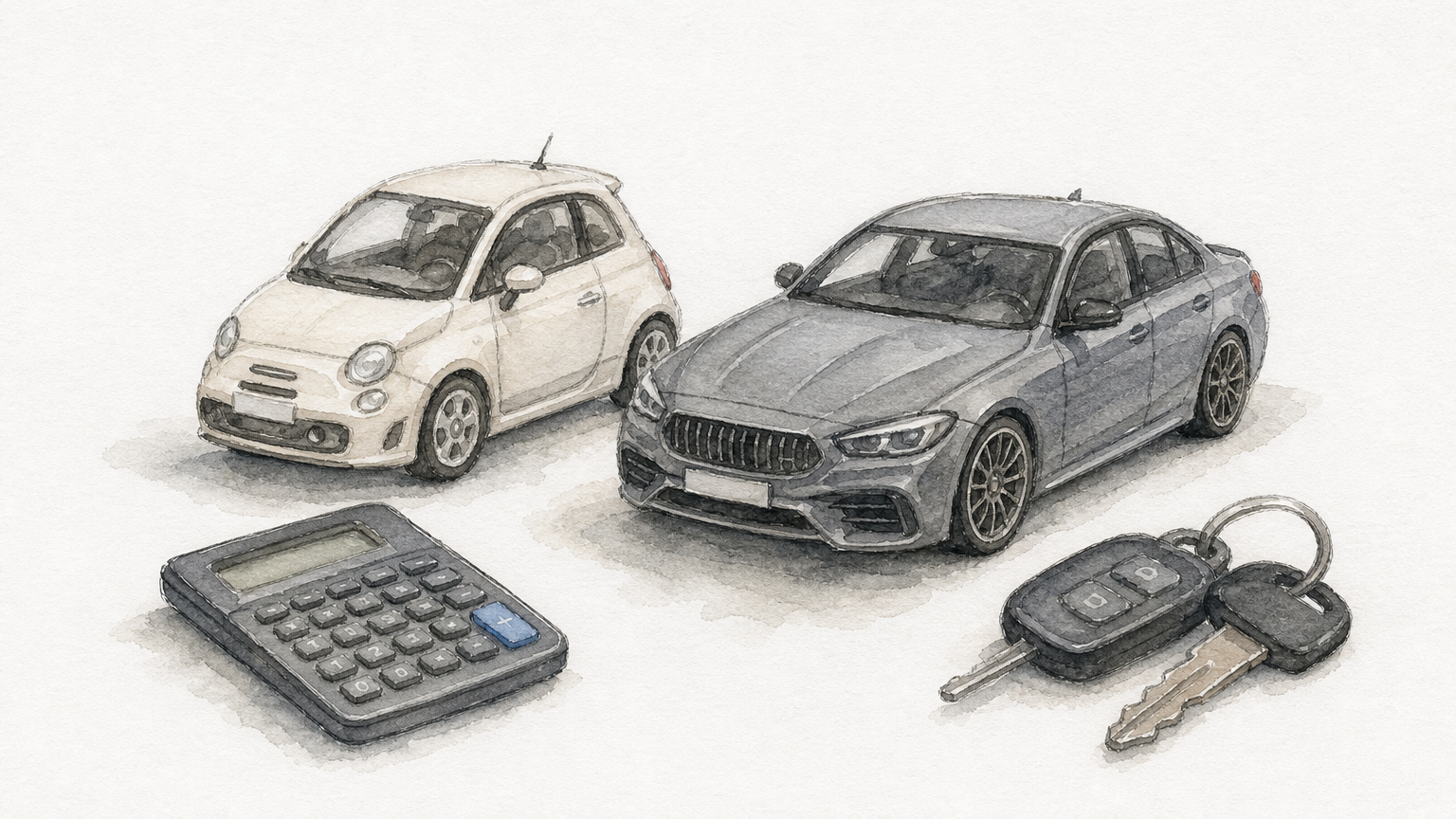
A car's insurance group is the first number an insurer sees, and it can add or save you hundreds of pounds a year.
What the group does not decide
The group is only one input. Insurers also weigh your age, driving history and no-claims bonus, along with these:
- Where you live and where you park the car
- How you use the car and how many miles you drive a year
- The car's security features and any modifications
A young driver in a group 5 car can still pay more than an experienced driver in a group 25 car. Treat the group as a way to compare cars like for like, not as a quote.
How to check your insurance group by number plate
To check your insurance group by number plate, enter your registration into a group checker, confirm that the make and model shown are right, and read off the group. It takes a few seconds, and the same steps work for a car you own or one you are thinking of buying.
Step by step
- Find the registration on the number plate or the V5C logbook.
- Type it into a car insurance group checker run by an insurer or comparison site.
- Check that the make, model, fuel type, engine size and year match your car.
- Read the group, and note any letter "E" after the number.
- If you are buying, compare the group for each trim level you are considering.
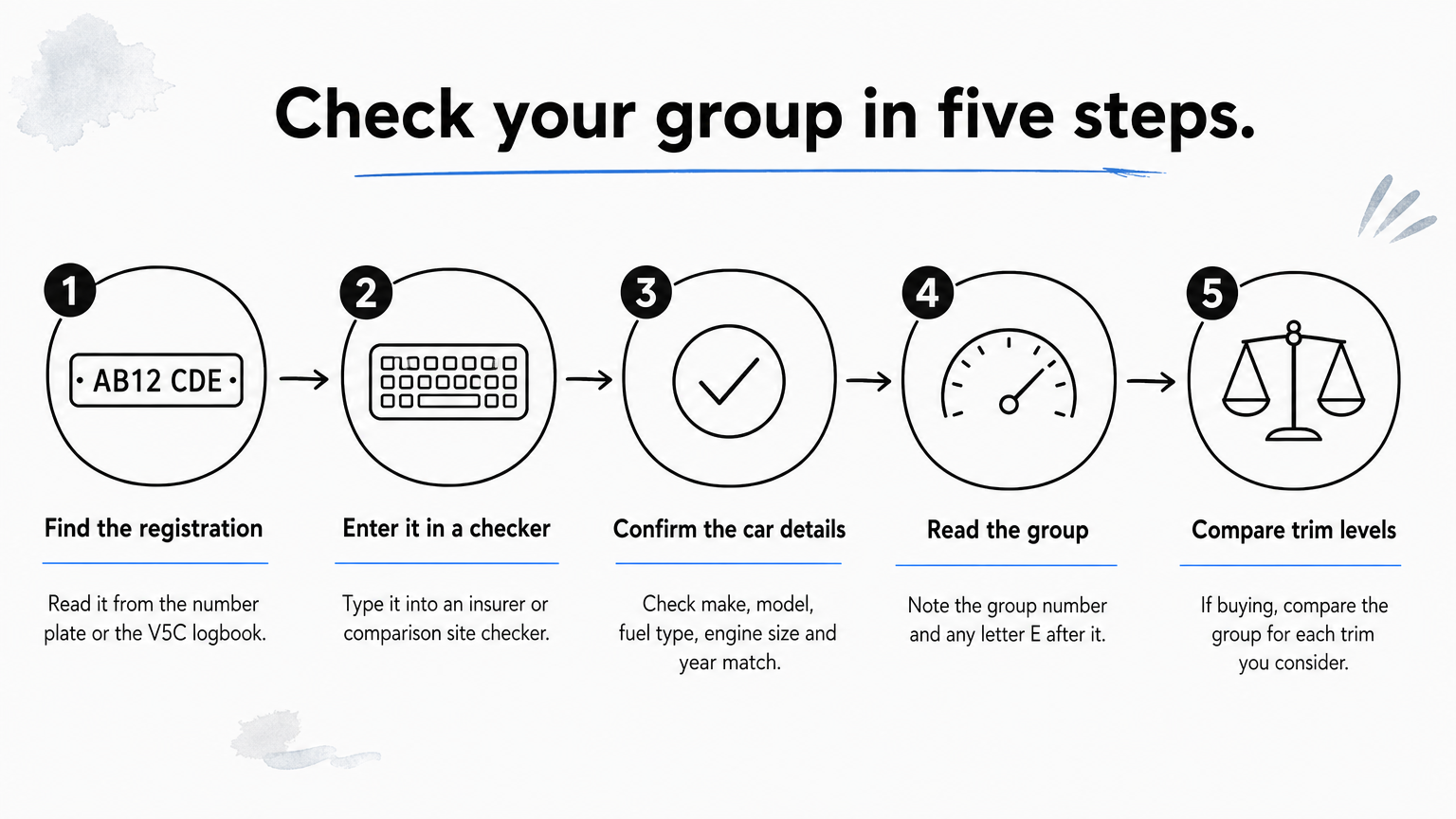
The plate only identifies the car. The group comes from a separate rating database, which is why the checker has to match your registration to a model entry first.
Why GOV.UK will not show it
Many people search for how to check insurance group by reg on GOV.UK. The government's check vehicle information service is useful, but it shows tax status, MOT status and basic vehicle details rather than an insurance group. The DVLA does not hold the group, because it is set by the insurance industry. For the group itself, use an insurer's or comparison site's checker.
Get the right variant
Two versions of the same model can sit in different groups, for example a small-engine and a high-output version. Before you trust a result, confirm the exact engine and power of the car in front of you. Our free check shows model details such as year, body type and performance figures. The Car BHP Check gives the exact BHP from the registration, which helps you pick the right trim in a group checker.
Check the group for the exact variant, because a single trim difference can move a car up or down the scale.
How insurance groups are set and what the numbers mean
Thatcham Research, a not-for-profit automotive risk organisation, gathers the data. The Association of British Insurers (ABI) group rating panel then reviews it and assigns each car a group from 1 to 50.
What is measured
Thatcham and the ABI assess five areas for the newer rating, and the older groups drew on similar ground:
- Performance: acceleration, top speed and list price
- Damageability: likely repair cost, based on design and materials
- Repairability: how hard the car is to fix and what parts cost
- Safety: technology that avoids crashes and protects occupants
- Security: features that deter thieves
This is why a basic city car sits near the bottom and a fast, expensive coupe sits near the top. The system measures repair cost and theft risk as much as raw speed.
What the letter E means
An "E" after the group number stands for "exceeds". It means the car exceeds the security requirement for cars of its type, which lowers its rating. A car that would normally be group 5 but has better security shows as group 4E.
Groups and ratings for newer cars
Cars launched before 1 August 2024 keep their group. Brand new model ranges from that date get a Vehicle Risk Rating (VRR) from 1 to 99, with both numbers shown during a transition period.
| Group (older cars) | VRR (newer cars) | Typical cars | Insurance cost |
|---|---|---|---|
| 1 to 10 | Low end of the scale | Small, low-power cars | Lowest |
| 11 to 30 | Middle of the scale | Medium cars, moderate power | Medium |
| 31 to 50 | High end of the scale | Powerful, high-value cars | Highest |
A group is fixed at launch, while a VRR is based on real-world claims data and updates regularly. Hybrids and electric cars are rated the same way as petrol and diesel ones and appear across all the groups. Some, such as the Volkswagen e-up, sit low, but higher repair costs can still push up their premiums.
Older cars have a fixed group from 1 to 50, while newer ones carry a rating that changes as claims data comes in.
What to do with the result when buying a used car
Use the group to compare your shortlist, then confirm the cost with real quotes. The group tells you what a car costs to insure, not whether it is a good car to buy.
Compare cars before you view them
Run the registration of each car on your shortlist, or the model and trim if you have not found a specific car yet. Small cars such as the Citroën C1, Fiat Panda and Hyundai i10 are typical group 1 examples. If two cars are otherwise equal, the lower group is likely to be cheaper to insure. Always get a quote for your own circumstances, because your age and postcode can outweigh a few groups' difference.
Pair it with a history check
A low group says nothing about a car's past. A vehicle history check covers what the group cannot: MOT history, tax status and import or export records, plus scrapped status and colour changes. Our free check gives you these basics from DVLA data. Premium reports add write-off, stolen and outstanding finance checks, which matter far more than a group if you are about to hand over money. Our data is updated nightly from official sources.
Use the insurance group to judge running costs, and a history check to judge whether the car is safe to buy.
Check the group, then check the car
A number plate is the quickest way to find a car's insurance group. The group, from 1 to 50 or a newer rating up to 99, sets the baseline for your premium, but your own circumstances decide the final price. Check the exact variant, remember that GOV.UK will not show the group, and treat the result as a comparison tool rather than a quote.
Once the group looks right, make sure the car itself is sound. A cheap-to-insure car that is stolen, written off or still on finance is no bargain. You can see what a premium vehicle report covers before you decide whether it is worth it for the car you are considering.