Used Car Buying Guide UK: How to Buy Safely, Step by Step
Follow our used car buying guide UK for budgeting, history checks, inspections and paperwork steps to buy safely and avoid costly mistakes.

Used Car Buying Guide UK: How to Buy Safely, Step by Step
Buying a used car in the UK should feel straightforward, but it rarely does. You're weighing budget against condition, trying to spot dodgy sellers, and hoping the car in front of you isn't hiding a write-off history or outstanding finance. This used car buying guide UK buyers can actually follow walks you through the whole process without the guesswork.
This guide gives you a clear, step-by-step path: how to set a realistic budget once you factor in insurance, tax and running costs, what to check during a physical inspection, which questions to ask the seller, and how to spot red flags before you hand over any money. You'll also learn where a history check fits into the process and why it matters just as much as kicking the tyres.
We'll cover everything from viewing the car and taking it for a test drive to verifying paperwork and negotiating a fair price. By the end, you'll know exactly how to run a DVLA-backed vehicle check, spot signs of accident damage or clocking, and walk away from a purchase with confidence rather than a nagging doubt in the back of your mind.
What to sort out before you start car shopping
Rushing straight to the classifieds is where most bad used car purchases begin. Before you look at a single listing, spend an evening getting your own house in order. Sorting the groundwork first saves you from falling for a car that looks great but doesn't actually fit your life, your budget, or your driving needs. It also means you'll move fast when the right car does appear, which matters because good used cars in the UK rarely sit unsold for long.
Work out what you actually need the car for
Start by being honest about how you'll use the car day to day. A family doing 15,000 motorway miles a year has completely different priorities from someone doing a five-mile urban commute. Write down your non-negotiables before you get distracted by shiny alloys or a nice colour.
- Daily mileage and journey type: motorway commuting favours diesel or hybrid; short urban trips suit a small petrol or EV
- Passengers and cargo: think about car seats, dogs, or regular trips to the tip
- Parking situation: a narrow driveway or tight street parking rules out anything oversized
- Fuel type: check whether you have off-street parking for EV charging, or whether diesel still makes sense for your mileage
Getting this right narrows your search dramatically and stops you wasting weekends viewing cars that were never going to work.
Get your finances and paperwork in order
You can't negotiate confidently or move quickly on a good deal if your finances aren't sorted. Sellers, especially private ones, often favour a buyer who can pay immediately over one who needs a week to arrange a loan. If you're financing the purchase, get an agreement in principle from a lender before you start viewing cars, so you know your real spending limit and can act the same day if needed.
If you're paying cash, make sure the funds are actually accessible. Many banks cap daily transfers, and some sellers won't accept anything but a bank transfer or cash for larger amounts. Sort this out in advance rather than discovering a £2,000 daily limit the moment you're ready to pay.
Sort your budget and finance before you view a single car, not after you've fallen for one.
Decide your must-haves versus nice-to-haves
Separate what you genuinely need from what would just be nice to have. This stops you overpaying for features you don't need, and it stops you walking away from a genuinely good car because it lacks heated seats.
| Category | Example | Flexible? |
|---|---|---|
| Must-have | Full service history | No |
| Must-have | Under a set mileage | No |
| Nice-to-have | Metallic paint | Yes |
| Nice-to-have | Sat nav, parking sensors | Yes |
| Deal-breaker | Outstanding finance | Never acceptable |
Having this written down keeps you objective when you're standing in a driveway looking at a car you already quite like. It's easy to talk yourself into overlooking a red flag when you're emotionally invested, so treat this list as your safety net.
Set a rough timeline
Finally, decide how long you're prepared to spend searching. Give yourself at least two to three weeks if possible. Buyers under time pressure, needing a car for a new job starting Monday, for instance, make worse decisions and skip checks they'd normally do. If you genuinely need a car urgently, budget extra time for a proper inspection and a vehicle history check rather than skipping them to save a day or two. A few pounds and half an hour spent checking a car's background is far cheaper than discovering a problem after you've paid and driven away.
Step 1. Work out your true budget
Most buyers fix on a single number, the amount they're willing to spend on the car itself, then get caught out by everything that comes after. Your true budget has to include insurance, tax, servicing and fuel, not just the price on the windscreen. A £6,000 car with a £1,800 annual insurance premium and poor fuel economy can end up costing more in year one than an £8,000 car that's cheaper to run. Work out the full picture before you fall for anything.
Look beyond the purchase price
Getting insurance quotes before you buy is one of the most skipped steps in used car buying, and one of the most costly to skip. Performance models, modified cars, and anything with a big engine can carry premiums that dwarf the monthly saving you made on the purchase price. Run quotes on your shortlist before you commit to viewing, not after you've agreed a price.
| Ongoing cost | What affects it | Typical impact |
|---|---|---|
| Insurance | Engine size, postcode, driver age, car group | Can vary by £1,000+ a year between similar cars |
| Road tax (VED) | CO2 emissions, registration date, list price | £0 to £600+ per year depending on the vehicle |
| Fuel | Engine efficiency, mileage, fuel type | Diesel often cheaper per mile at high mileage |
| Servicing and parts | Brand, age, dealer network | Premium brands typically cost more to maintain |
A cheap car with expensive running costs isn't actually a cheap car.
Build in a safety margin for repairs and checks
Set aside money you won't touch unless something goes wrong. Used cars, even well-looked-after ones, can throw up an unexpected repair bill in the first few months. A sensible rule is to keep back 10 to 15 percent of your total budget for:
- A vehicle history check to confirm the car isn't written off, stolen, or on outstanding finance
- An independent inspection if you're not confident checking the car yourself
- Minor repairs that turn up shortly after purchase, like tyres or brake pads
- Any shortfall between your trade-in value and what the dealer actually offers
Setting this money aside now stops a small problem turning into a financial headache later.
Factor in financing costs if you're borrowing
Borrowing changes your real budget more than people expect. A loan quoted at a low headline rate can still add hundreds of pounds in interest over the term, and dealer finance isn't always the cheapest option available. Compare your dealer's offer against a bank loan or credit union rate before signing anything, and check the total amount repayable, not just the monthly figure, since a longer term often looks cheaper monthly while costing more overall.
Step 2. Decide where to buy your car
Where you buy shapes almost everything else about the transaction, from your legal protection to how much haggling room you'll have. Franchised dealers, independent garages, private sellers and online marketplaces all operate under different rules, and knowing those differences before you start browsing stops you from assuming protections that simply don't exist with a private sale.
Compare your main buying routes
Dealers selling as a business are bound by the Consumer Rights Act 2015, which means the car must be of satisfactory quality, fit for purpose and as described. Private sellers only have to describe the car honestly, they carry none of that same legal obligation around quality. That single distinction should heavily influence where you shop if you're not confident inspecting a car yourself.
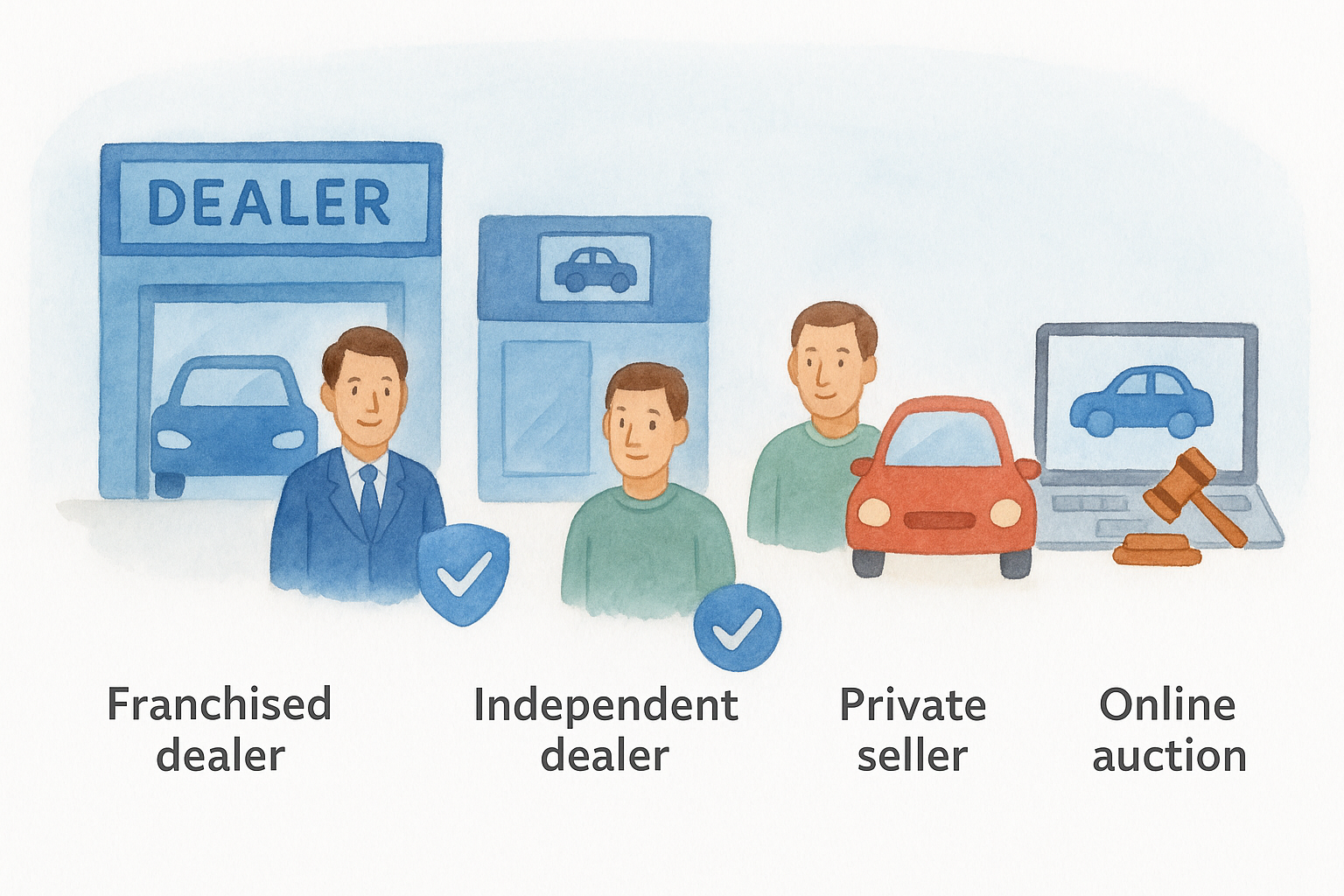
| Buying route | Legal protection | Typical price | Best suited to |
|---|---|---|
| Franchised dealer | Strong, Consumer Rights Act applies | Highest | Buyers wanting warranty and aftercare |
| Independent dealer | Strong, Consumer Rights Act applies | Mid-range | Buyers wanting protection without dealer markup |
| Private seller | Minimal, car must just match description | Lowest | Confident buyers happy to inspect and negotiate |
| Online auction | Varies by platform, often "as seen" | Can be low, but risky | Experienced buyers only |
If you're not confident checking a car yourself, buy from a dealer bound by the Consumer Rights Act, not a private seller.
Weigh up dealers against private sales
Dealers charge more, but that premium often buys you a warranty, some form of aftersales support, and a legal route back if the car turns out to be faulty. Private sellers can save you hundreds or even thousands of pounds, particularly on older cars, but you're accepting that once you hand over the money, you've got very little recourse if something goes wrong. Split the difference by treating a private sale price as the starting point for your history check and inspection budget, since you'll be doing the dealer's due diligence job yourself.
Be extra cautious with online marketplaces and auctions
Auctions and some online marketplaces can offer genuine bargains, but they strip away most of the safety net a dealer forecourt provides. You often can't test drive the car beforehand, and many auction listings are sold explicitly "as seen" with no comeback. Never buy a car you haven't seen in person or had inspected on your behalf, and treat any seller who refuses a viewing or pushes you to pay a deposit before you've checked the vehicle as an immediate red flag. Trading Standards guidance on buying used cars, available through the government's own consumer advice service, is worth a quick read before you commit to any unfamiliar platform.
Step 3. Shortlist cars and check fair value
Once your budget and buying route are settled, start building a shortlist of specific cars rather than browsing endlessly. Aim for five to ten listings that match your must-haves, spread across a couple of buying routes so you've got room to compare. Casting a wide net at this stage means you're not forced into a rushed decision on the first car you view, and it gives you real leverage when it comes to negotiating later.
Pull listings from more than one source
Don't limit yourself to a single classifieds site or dealer forecourt. Check the major online marketplaces, local dealer stock lists, and even dealership websites directly, since some cars never make it onto the big portals. Widening your search this way surfaces cars you'd otherwise miss and gives you a realistic sense of what's actually available at your price point right now, rather than what was available six months ago when you last looked.
Work out what the car is actually worth
Every used car buying guide UK drivers rely on should include a proper pricing check, because sellers routinely price on hope rather than data. Before you get attached to any single listing, compare it against similar cars for sale, matching year, mileage, trim and condition as closely as you can. Look at:
- At least five comparable listings for the same make, model and age
- The mileage band, since a car with 40,000 fewer miles can fairly command a higher price
- Trim level and optional extras, which shift value more than most buyers expect
- How long the car has sat listed, since a stale listing often signals an overpriced car
Never judge a price against one listing. Compare at least five before you decide it's fair.
Flag listings that look too good to be true
A car priced well below every comparable you've found is rarely a hidden gem. It's far more likely to have undisclosed damage, outstanding finance, or a mileage discrepancy the seller is hoping you won't check. Treat any listing that undercuts the market by more than 15 to 20 percent as a warning sign rather than a bargain, and read the description twice for vague phrases like "drives well for its age" or "quick sale needed", which often hint at problems the seller would rather you didn't ask about.
| Price vs market average | Likely explanation |
|---|---|
| Roughly in line | Fairly priced, proceed to inspection |
| 5-15% below | Seller may want a quick sale, ask why |
| 20%+ below | High risk of hidden damage, finance, or fraud |
Once you've narrowed your shortlist to cars priced fairly for their condition, you're ready to dig into their history before you ever pick up the phone to arrange a viewing.
Step 4. Run a full vehicle history check
Before you arrange a single viewing, run a vehicle history check against the registration plate of every car on your shortlist. This is the cheapest, fastest way to eliminate a bad car without ever leaving your sofa, and it catches problems no amount of kicking tyres on a driveway will reveal. A car can look immaculate and still be written off, stolen, or sitting on someone else's finance agreement, and none of that shows up on a test drive.
What a proper check actually reveals
A good registration check pulls together data from the DVLA, insurance registers and police records, giving you a single view of the car's real background rather than the seller's version of events. Look for a check that covers at minimum:
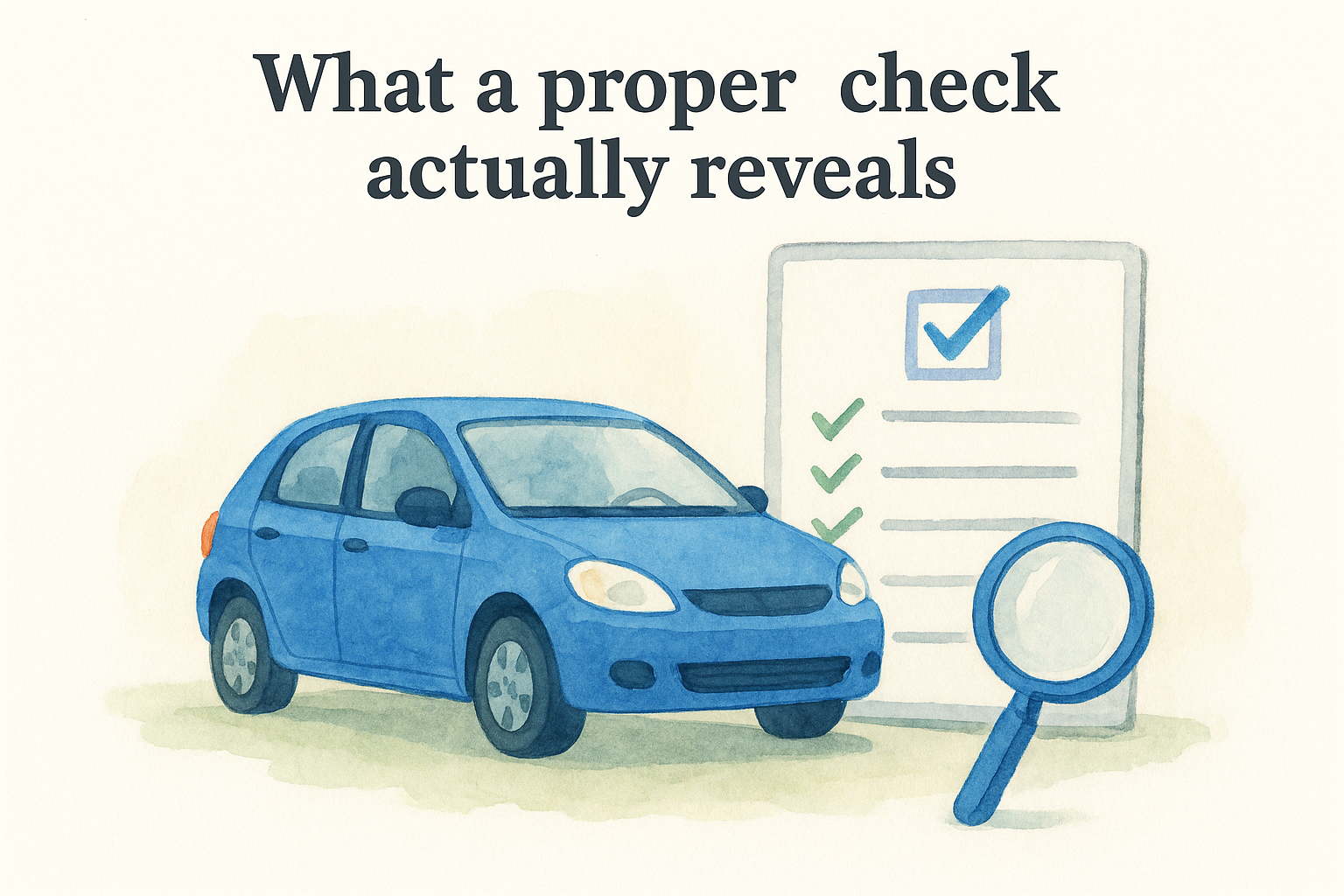
- MOT history, advisories and expiry date
- Outstanding finance on the vehicle
- Write-off or insurance total-loss status
- Stolen vehicle records
- Mileage discrepancies across past MOT tests
- Colour changes and plate changes, which can hint at cloned vehicles
- Import or export status
A five-minute history check catches problems no test drive ever will.
Free checks versus paid reports
A free check using just the registration plate will confirm the basics, tax and MOT status, vehicle age, and whether the car matches the seller's description. For anything you're seriously considering buying, upgrade to a paid history report that covers finance, write-off and stolen status specifically, since these are the checks that carry real financial risk if skipped.
| Check type | What it covers | Cost | When to use it |
|---|---|---|
| Free registration check | Tax, MOT, basic vehicle details | Free | First filter across your shortlist |
| Paid history report | Finance, write-off, stolen, ownership history | Small fixed fee | Any car you're seriously considering |
| Independent inspection | Physical condition, mechanical faults | Higher fee | High-value or older cars |
Cross-check the report against the listing
Once you've got the report, compare it line by line against what the seller told you. If the listing says one owner but the report shows three, or the mileage on the report doesn't match the odometer photo in the advert, ask the seller to explain before you go any further. A seller with nothing to hide will happily talk you through any discrepancy; one who gets defensive or vague is telling you everything you need to know. Treat any mismatch as a reason to walk away rather than a detail to smooth over during negotiation.
Step 5. Inspect and test drive the car
Once a car clears its history check, arrange a viewing during daylight hours and never at night or in heavy rain. Poor lighting hides scratches, filler work and paint mismatches that would be obvious in full sun, and a seller who insists on an evening viewing when daylight slots were available is worth a second thought. Bring someone with you if you can, since a second pair of eyes catches details you'll miss when you're focused on the seller's sales pitch.
Work through a structured inspection checklist
Go through the car methodically rather than wandering around it. A physical inspection doesn't need to be a full mechanical strip-down, but it should cover every panel and system that commonly hides problems.
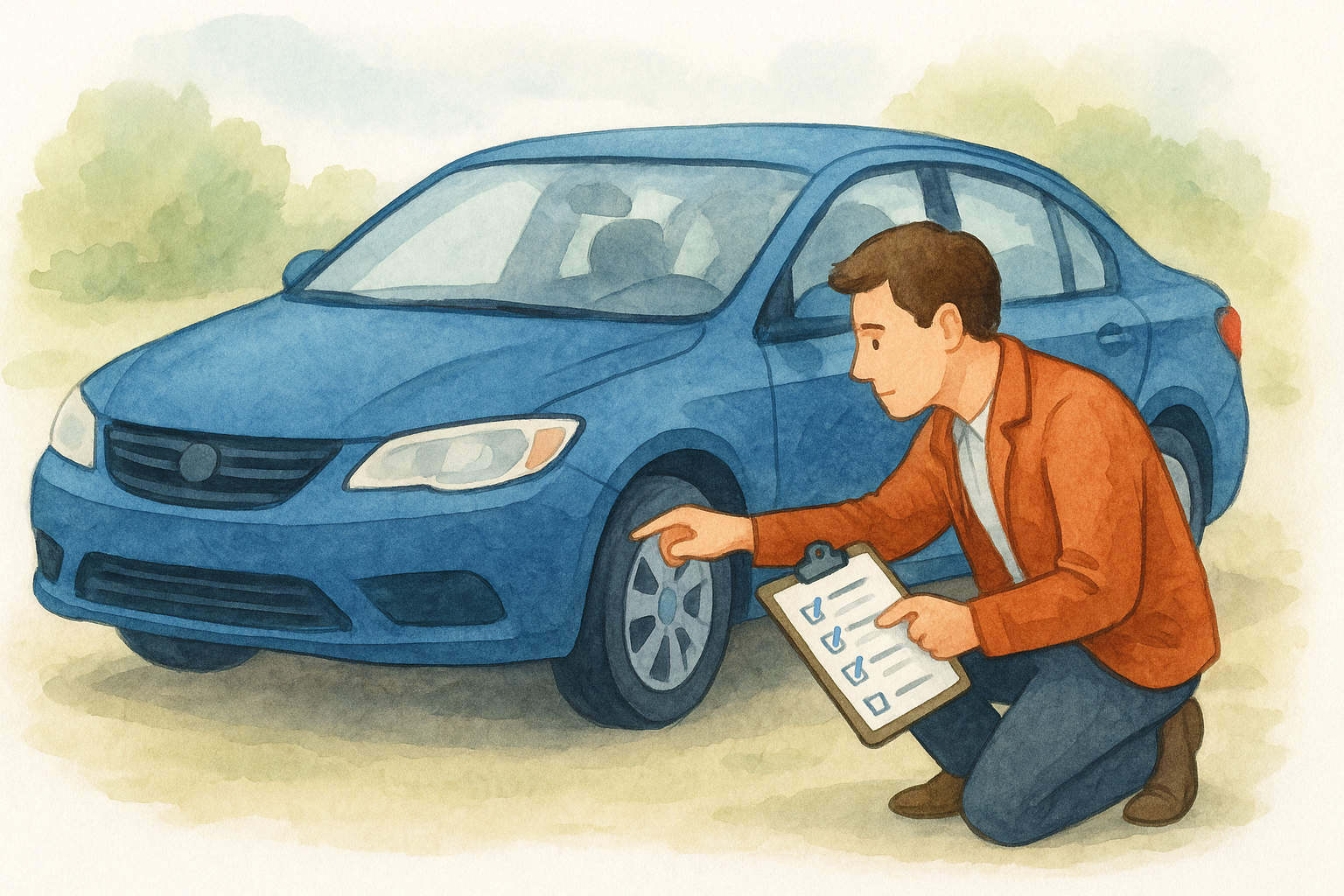
- Check panel gaps and paint colour match across doors, bonnet and boot for signs of accident repair
- Look underneath for rust, oil leaks or fresh underseal hiding older damage
- Check tyre wear is even across all four, since uneven wear points to suspension or alignment faults
- Test every electrical function: windows, aircon, infotainment, all warning lights
- Check the service book stamps match the mileage on the odometer and the history report
- Smell the interior for damp, which often signals a leak the seller hasn't mentioned
A ten-minute inspection with a checklist catches more than an hour of vague poking around.
Test drive on more than one type of road
Insist on a proper test drive rather than a five-minute loop around the block. Push the car through motorway speeds if possible, tight low-speed manoeuvres, and at least one longer stretch where you can listen for noises without the radio on. Cold starts reveal problems that a warmed-up engine hides, so ask to start the car yourself from cold rather than finding it already running when you arrive.
Listen, feel and watch for warning signs
Pay attention to anything that feels off, even if you can't immediately name it. A clutch that bites high, a gearbox that crunches, or brakes that pull to one side are all expensive fixes hiding behind a car that otherwise looks fine.
| Warning sign | Possible cause |
|---|---|
| Smoke from exhaust on startup | Worn engine, head gasket issue |
| Steering wheel vibration | Wheel balance or suspension fault |
| Delayed gear engagement | Clutch or automatic gearbox wear |
| Warning light resets after restart | Seller may be clearing faults before viewings |
If anything on this list shows up, don't rely on the seller's reassurance. Book an independent inspection before you go any further, or walk away and move to the next car on your shortlist.
Step 6. Check the paperwork is legitimate
A car that passes inspection can still fall apart at the paperwork stage, and this is where a surprising number of buyers get caught out. Genuine documents matter just as much as a clean engine bay, because a forged V5C or a mismatched chassis number is often the only visible sign of a car that's stolen, cloned, or being sold by someone who isn't actually the registered keeper. Treat this step as non-negotiable, even if you're buying from someone who seems perfectly trustworthy.
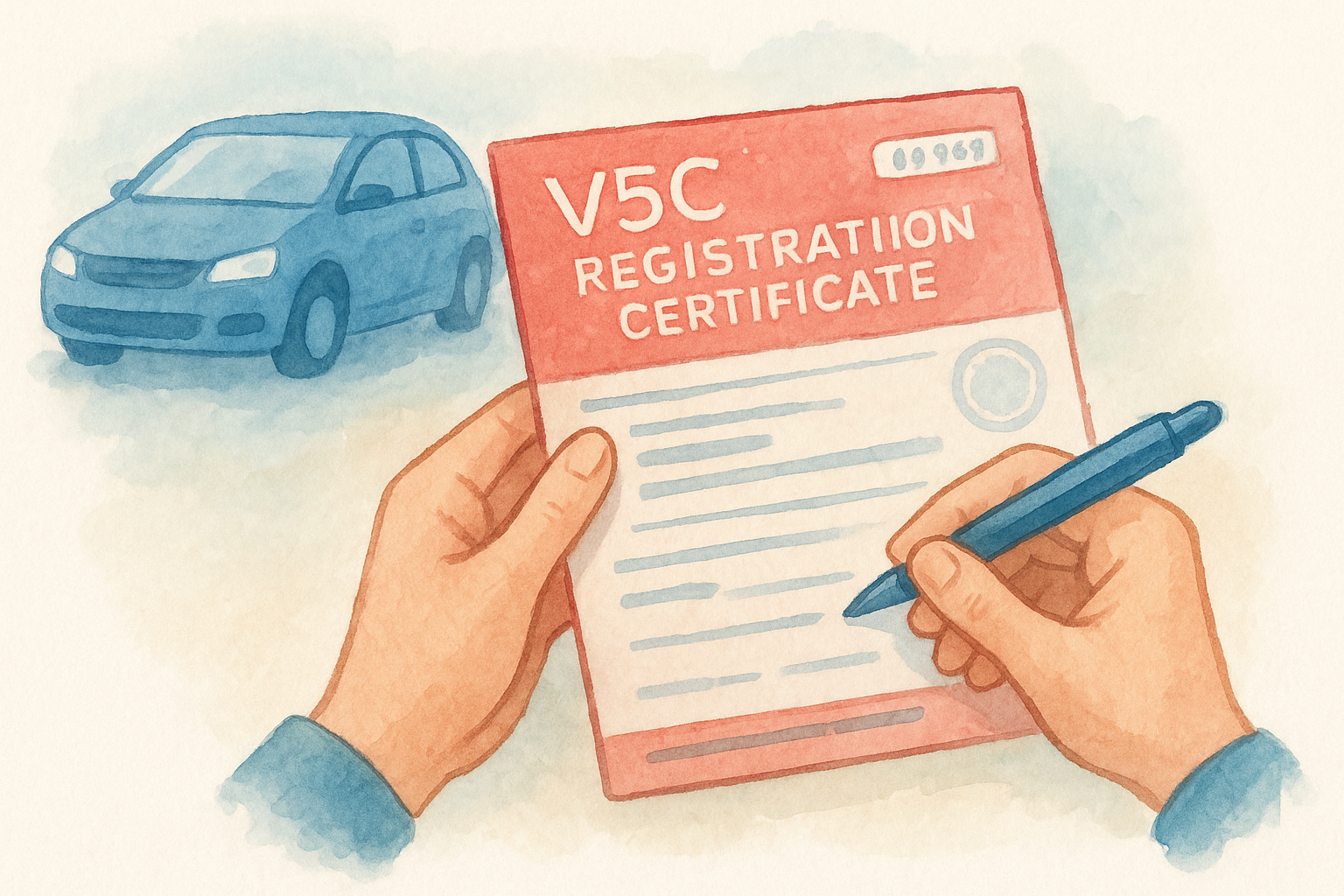
Verify the V5C registration certificate
Check the V5C (logbook) carries the DVLA watermark and a serial number in the top right corner. Genuine documents run their serial numbers sequentially between roughly 08 and 22 as an early filter, and any certificate that looks photocopied, has mismatched fonts, or shows a serial number wildly out of that range needs questioning immediately. Confirm the address on the V5C matches where you're viewing the car, and never buy a car if the seller only has a green new keeper slip with no full logbook to hand over, since this is a common trick used to offload stolen or cloned vehicles quickly.
Match the VIN and plate against the paperwork
Physically check the vehicle identification number stamped on the chassis, usually visible under the bonnet or through the windscreen, against the number printed on the V5C and shown in your vehicle history check. Any mismatch here is a hard stop, not a detail to raise during negotiation.
- VIN under the bonnet matches the V5C exactly
- VIN visible through the windscreen matches both
- Number plate matches the registration on the V5C and MOT certificate
- Engine number matches where stamped and documented
If the VIN doesn't match across the car, the V5C and the history report, walk away immediately.
Check service history and MOT certificates
Ask to see the full service book alongside any loose invoices, and check stamps or receipts line up with the mileage shown on the odometer and in your history report. A service history with gaps isn't automatically a deal-breaker, but a seller who can't produce any paperwork at all for a car claiming "full service history" is telling you something.
| Document | What to check |
|---|---|
| V5C logbook | DVLA watermark, correct serial range, matching address |
| MOT certificates | Mileage progression matches odometer and history check |
| Service book/invoices | Stamps align with claimed service history |
| Finance settlement letter | Required if history check flagged outstanding finance |
If the history check flagged outstanding finance, don't accept a verbal promise that it's been settled. Ask for a written settlement letter from the finance company before you hand over a penny, since you become liable for the debt otherwise, not the seller.
Step 7. Negotiate the price
By the time you've inspected the car and checked its paperwork, you're in a far stronger position than most buyers who walk onto a forecourt and start haggling blind. Negotiating from evidence beats negotiating from instinct every time, because you've got a market comparison, an inspection list and a history report to back up whatever number you land on. Use everything you've gathered so far as leverage rather than saving it for after you've already agreed a price.
Open with evidence, not a gut feeling
Go into the conversation with your comparable listings printed or saved on your phone, along with any faults you found during inspection. Point to specifics rather than a vague "it feels overpriced": a worn tyre needing replacement, a service history with a two-year gap, or three similar cars listed £400 cheaper nearby all give the seller a concrete reason to move on price. Sellers respond far better to specifics than to a buyer who simply says the price feels too high.
Use your findings as leverage
Every flaw you noted during Steps 4 to 6 has a rough cost attached, and you should attach a number to each one before you make an offer.
| Issue found | Typical negotiation impact |
|---|---|
| Tyres near legal minimum | Deduct cost of a full set, roughly £200-£400 |
| MOT advisory not yet urgent | Small deduction, flag for future budgeting |
| Missing service history | 5-10% off asking price |
| Minor cosmetic damage | Cost of repair, or walk-away leverage |
Every fault you found during inspection is a negotiating point, not just a note in your checklist.
Know your walk-away number in advance
Decide your maximum price before you start talking, and stick to it regardless of how the conversation goes. Sellers can sense hesitation, and a buyer who's clearly decided they must have this exact car loses most of their negotiating power immediately. If the seller won't move anywhere close to a fair price backed by your comparables, be ready to walk. There's almost always another car on your shortlist, and sellers who refuse a reasonable offer often come back within a few days once the car hasn't sold.
Get any agreement in writing
Once you've agreed a figure, get it confirmed in a text message or email before you arrange collection or payment. Include the agreed price, any conditions such as a finance settlement letter being provided, and the collection date. This isn't about distrust, it's about avoiding any confusion or last-minute renegotiation once you turn up with the money ready to go.
Step 8. Tax, insure and complete the purchase
Once you've agreed a price, the deal isn't done until you've sorted insurance, tax and the actual handover. Skipping any of these steps, even for a few minutes, can leave you driving illegally or without cover if something goes wrong on the way home. Completing the purchase properly takes twenty minutes and protects you from problems that are far more expensive to fix after the fact than to avoid up front.
Insure the car before you drive it
Arrange your insurance policy before you collect the car, not after. You cannot legally drive the car away, even a few hundred yards, without valid cover in place, and most sellers won't hand over the keys until you can prove it. Have your policy documents ready on your phone or printed, since some sellers will ask to see them before letting you leave the driveway.
Never drive a car home without insurance in place, even for a five-minute journey.
Tax the car and notify the DVLA
Road tax doesn't transfer with the car, so you need to tax it yourself before you drive off, even if the previous owner still had months left on theirs. You'll need the new keeper slip (V5C/2) from the logbook to do this. Work through it in this order:
- Get the green new keeper slip from the seller at handover
- Tax the vehicle immediately using the reference number on that slip, either online or by phone
- Confirm the vehicle shows as taxed before you drive it on public roads
- Keep proof of tax on your phone until it appears on the DVLA record
Refunds on any remaining tax go automatically to the seller once they notify the DVLA of the sale, so don't factor a refund into your negotiation.
Complete the purchase and get a receipt
Handover is where rushed buyers make mistakes, so slow down even if you're keen to get on the road. Pay using a traceable method, bank transfer rather than cash, and confirm the funds have actually cleared before you leave with the keys. Write a simple receipt on the spot covering the registration, price paid, date, and both parties' names and signatures, even for a private sale between people who trust each other.
Gather the full set of items before you drive away: the signed V5C green slip, both sets of keys, the service book, any spare parts like a locking wheel nut, and the finance settlement letter if one was required. Missing any of these later is far harder to chase up once the seller has your money and you've gone your separate ways.
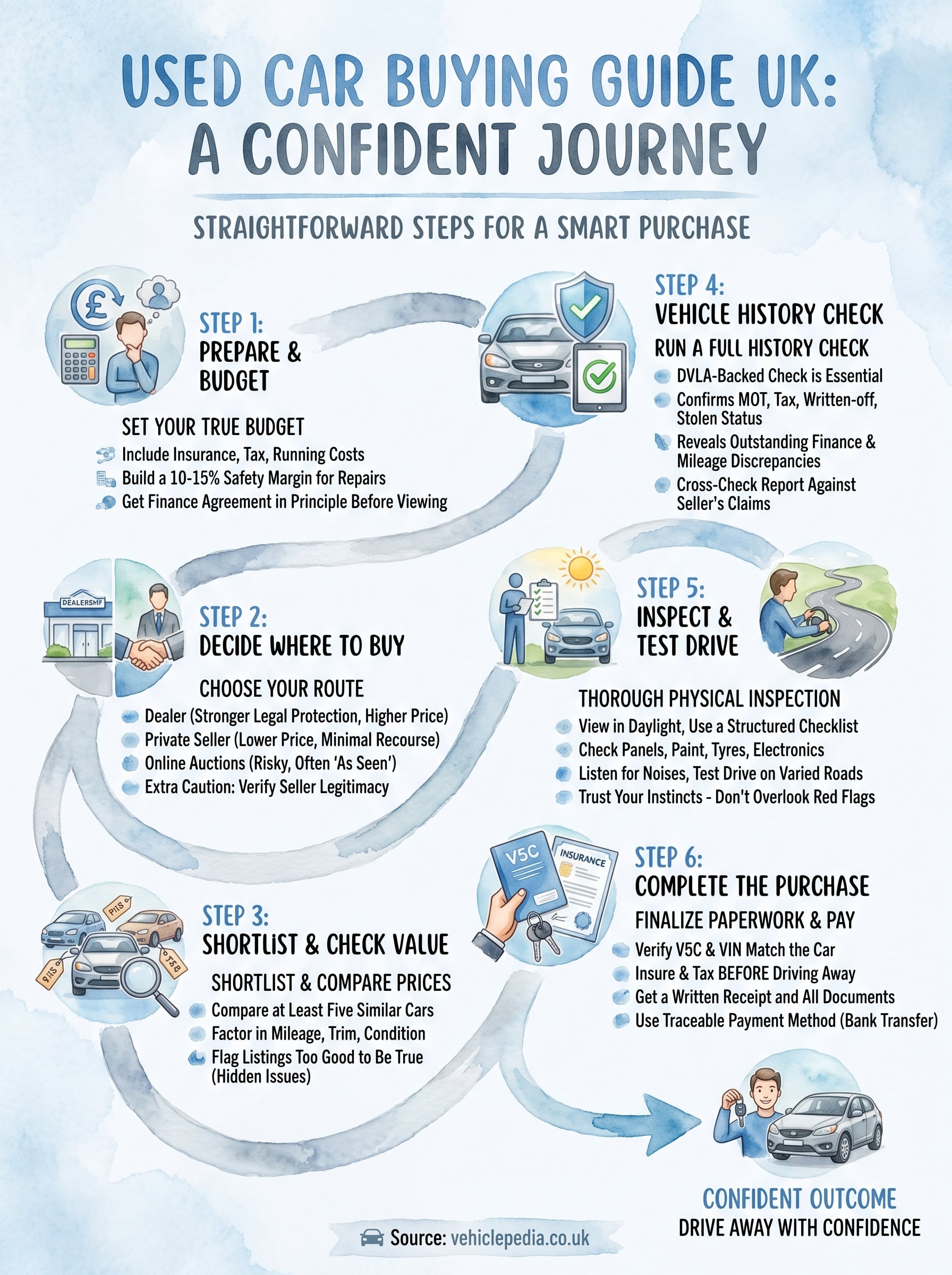
Buying your next car with confidence
Every step in this guide comes back to the same principle: verify before you commit, not after. Following this process turns car buying from a gamble into a series of simple checks, budget first, history second, inspection third, paperwork fourth. Skip any one of them and you're relying on luck rather than evidence.
Getting a proper history check on every car you're serious about isn't optional if you want to avoid inheriting someone else's finance debt or driving away in a written-off car with hidden structural damage. It takes minutes and costs far less than the problems it catches.
Not sure what a full report actually looks like before you pay for one? Have a look at a sample vehicle history report first, so you know exactly what you're getting and can buy your next car knowing the paperwork matches reality.