RAC Used Car Warranty Review: Is It Worth the Money?
Our RAC used car warranty review covers what is included, how claims go, what customers report and when the cover is worth paying for.
RAC Used Car Warranty Review: Is It Worth the Money?
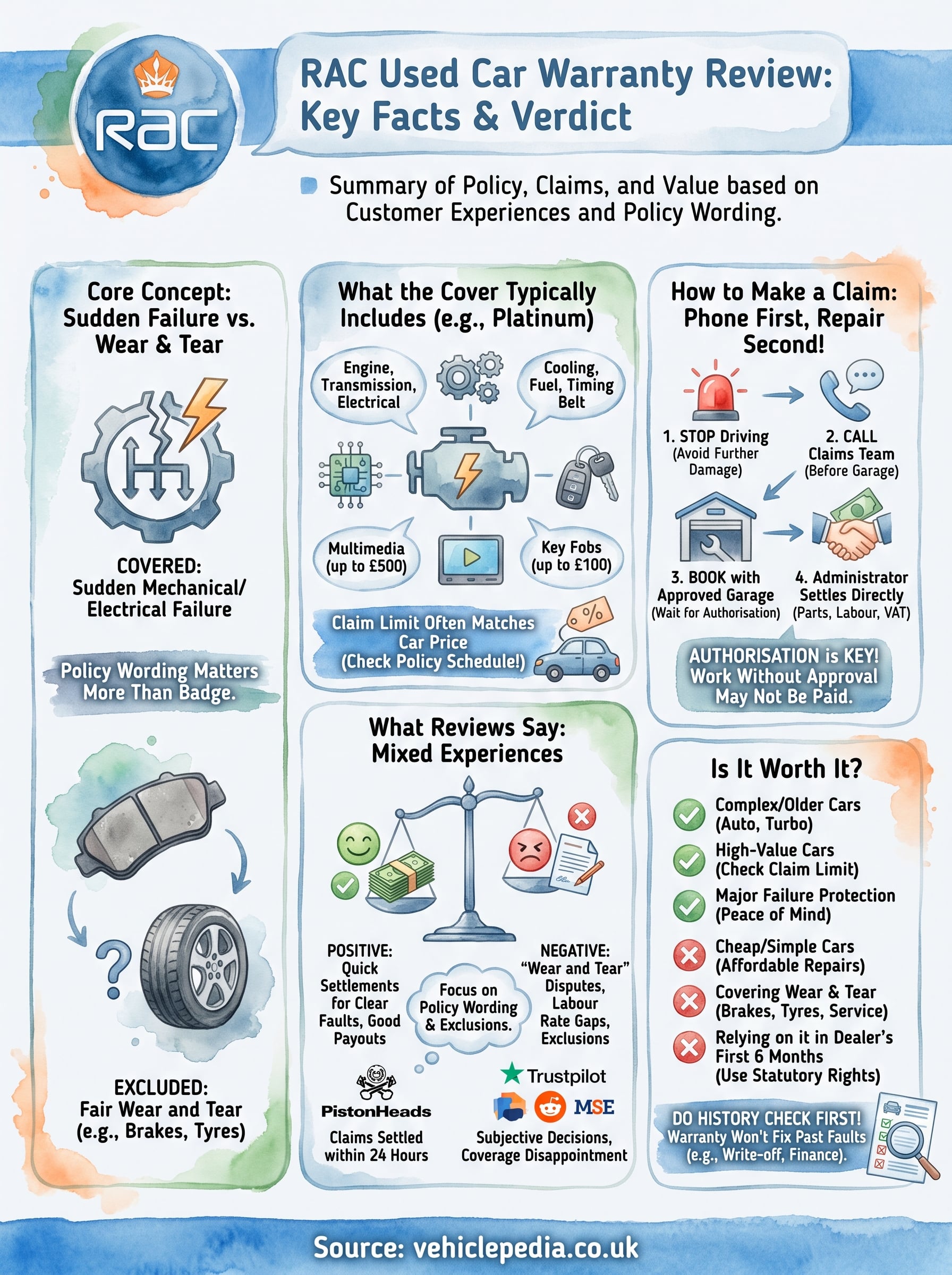
An RAC used car warranty review comes down to this: the policy pays for sudden mechanical or electrical failure on a second-hand car, and customer experiences split between quick, fair settlements and claims declined as "fair wear and tear". The RAC name is usually attached to a policy sold through an approved dealer and handled by a separate administrator. The policy wording therefore matters more than the badge.
This article covers what the cover includes, what customers report, how to make a claim, what it costs and when it is worth buying. Each section builds on the one before, so you finish with a decision rather than a list of opinions.
Vehiclepedia checks used car histories, so we look at this from the buyer's side. A warranty only protects you from future faults. It does nothing about a car's past, such as a write-off record, outstanding finance or a doubtful mileage history, and you need to settle those before you pay for any cover.
Why the RAC name does not tell you what you are buying
"RAC warranty" covers several different products, and the one you get depends on who sells it, which tier you choose and how old the car is. Two buyers can both say they have an RAC warranty and hold very different cover.
Who sells it and who pays
Dealer-sold RAC policies are typically arranged at the point of purchase and administered by a third-party provider. RAC also sells its own direct warranty products, and terms differ between them. Dealers also set their own eligibility. One dealer lists its Platinum policy for cars up to 15 years old and under 150,000 miles at the start of cover. Another dealer's extended policy runs to 80,000 miles and 8 years. Always read the documents issued with your car rather than relying on a figure from elsewhere.
What the cover typically includes
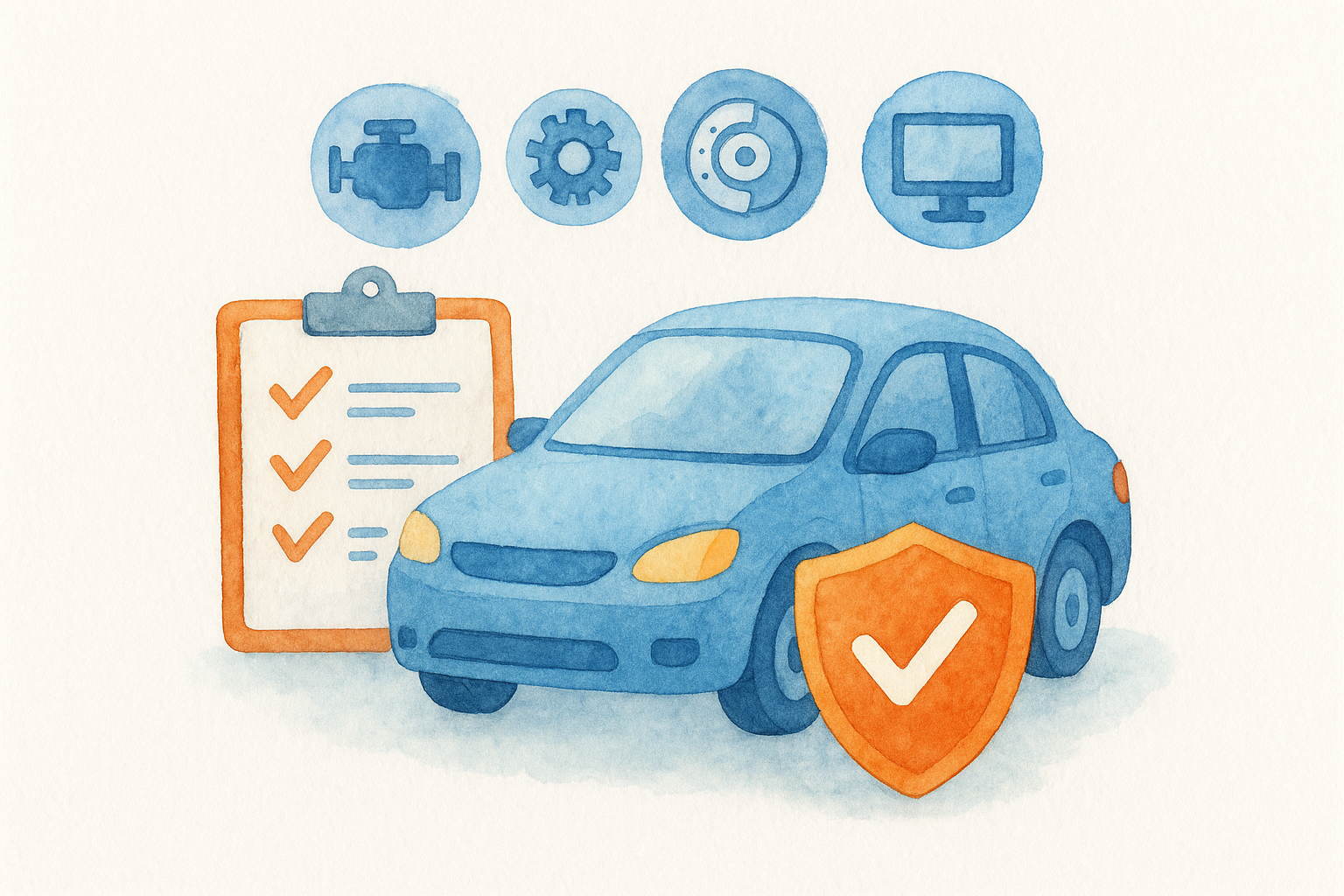
The table below shows what one approved dealer publishes for its Platinum policy. Treat it as an example of a top tier, not a promise for every RAC policy.
| Area | What is listed | Limit or catch |
|---|---|---|
| Engine | Cooling system, ECUs, timing belt, turbo, supercharger, fuel system | Turbo claims exclude foreign object damage |
| Transmission | Manual and automatic gearboxes, clutch, CVT | Failure must be genuine, not wear |
| Driveline | Braking, suspension, steering, drive system, prop shaft | Brake pads are wear items |
| Electrical | Electrical systems | Check named exclusions |
| Multimedia | Touchscreen and in-car entertainment | Up to £500 |
| Key fobs | Remote keys | Up to £100 including VAT per repair |
| Vehicle hire | If a covered repair takes over 8 hours | Up to £50 a day for up to 7 days |
| European cover | Driving abroad | Up to 60 days in any 12 months |
The same dealer states that the overall claim limit matches the price you paid for the car. Many other warranties use a fixed cap whatever the car cost, so this matters most on a pricier car.
What it leaves out
Routine servicing and wear-and-tear parts sit outside standard cover. Many used car warranties also exclude pre-existing faults, aftermarket modifications and damage caused by neglect. Some require a documented service history and approved parts.
The RAC badge describes the seller's partner, not your cover, so the policy schedule is the only source that counts.
What RAC used car warranty reviews say about claims
Reviews of RAC warranties are genuinely mixed: clear-cut failures tend to get paid quickly, and disputes cluster around judgement calls. More than 4,000 Trustpilot reviews of RAC Warranty lean positive overall, yet many reviewers still describe the cover as ambiguous.
Where customers are happy
Satisfied reviewers describe claims settled within 24 hours and payouts they considered fair. A PistonHeads owner who bought a Platinum policy on a high-mileage car and extended it to 12 months reported no problem getting cover in place. These experiences share a pattern. The fault was sudden, obvious and plainly on the covered list, so there was little to argue about.
Where customers are unhappy
The complaints repeat across Trustpilot, Reddit, MoneySavingExpert and owner groups:
- "Fair wear and tear" is cited as the reason for declined claims, which feels subjective when a part simply fails.
- Labour allowances can fall short of the real repair time, and hourly rates can sit below what a local garage charges, leaving you to cover the gap.
- Coverage disappointment comes up often. One Reddit buyer who paid £1,000 for three years called the cover poor after a limp-mode fault, and forum users argue that many used car warranties exclude the expensive parts most likely to fail.
These are individual accounts, not proof of how your claim will go. They do show where to focus your reading of the wording.
Claims succeed when a covered part fails suddenly and fail when someone can argue the part was simply old.
How to make a claim on an RAC warranty
To claim, stop driving the car and contact the claims team before any repair starts. Using the wrong order is the most avoidable way to end up paying for a repair yourself.
The steps
- Stop using the car when a warning light or fault appears. Continuing to drive can give the administrator grounds to refuse.
- Call or email the claims team using the contact details in your policy documents, before you book a garage.
- Book the car in with a garage the administrator accepts. Some policies use a repair network, so ask before choosing your own garage.
- Tell the garage to wait for authorisation. Work that starts before approval can become your cost.
- Let the garage and administrator settle up. On the Platinum policy described above, the administrator pays the garage directly for parts, labour and VAT.
How to protect your claim
Keep every service invoice and follow the service schedule your policy requires. Use parts the policy accepts, because non-approved parts can void a claim. Avoid modifications, and check whether an excess applies. Photograph warning lights and keep the repair estimate, so you have evidence if the labour allowance is disputed.
Phone first, repair second: the authorisation step is what turns a breakdown into a paid claim.
How much an RAC used car warranty costs
There is no single price, because dealers set it by car age, value, mileage and term. Many dealers include an initial period, often three months, in the price of the car. Longer cover is an extra you buy on top.
What drives the price
Terms of 12, 24, 36 or 48 months are common, depending on the seller and tier. One dealer advertises its RAC extended warranty from under 83p a day on a four-year policy, but only for cars up to 80,000 miles and 8 years. Higher mileage and older cars cost more or may not qualify. Ask your dealer for a written quote that shows the term, tier, claim limit and any excess.
A worked break-even example
Say you pay £1,000 for three years, the figure one Reddit buyer reported. That is about £333 a year, or roughly £28 a month. Now suppose a covered gearbox repair costs £1,800, a purely illustrative figure. You come out £800 ahead. With no claims, you have paid £1,000 for peace of mind. For comparison, 83p a day over four years is about £1,210, or around £303 a year.
Compare the price to the worst repair you could face, not to the repair you expect.
Is an RAC used car warranty worth it for you?
It is worth it when a major failure would hurt your finances and the car is complex enough to make one plausible. It is hard to justify on a cheap, simple car you could afford to repair yourself.
When it makes sense
| Your situation | Verdict |
|---|---|
| Older car with an automatic gearbox or turbo | Worth serious consideration |
| Higher-priced car where a flat claim cap would fall short | Check the claim limit, then likely worth it |
| Low-value, mechanically simple car | Often better to save the money |
| Buying from a dealer in the first months | Check your statutory rights first |
| Hoping to cover brakes, tyres or servicing | Not what the policy is for |
Under the Consumer Rights Act 2015, a dealer must supply a car of satisfactory quality. You have a 30-day short-term right to reject, and faults that appear within six months are presumed to have existed at sale. A warranty adds protection beyond that, so do not pay twice for the early months.
Check the car before you rely on any cover
A warranty will not help if the car has a hidden past. Run a history check on the car first. A free check shows MOT history and road tax status, which reveal repeated advisories on worn parts that a policy may refuse. A premium report adds write-off, stolen and outstanding finance checks, which no warranty can fix after you buy.
A warranty covers what breaks next, and a history check tells you what has already gone wrong.
Should you buy one?
A dealer-sold RAC warranty is worth buying when the car is complex or old enough that a big repair would hurt, and when you have read the tier, claim limit, exclusions and service rules. Skip it if you expect it to pay for wear, or if your statutory rights already protect you in the early months.
Do the history work first, then decide on cover. You can see what a Vehiclepedia sample report includes before you commit to a car, so the only surprises left are the ones a warranty exists to cover.