How to Check if a Car Is a Write-Off
Learn how to check if a car is a write off using categories, VIN checks and Vehiclepedia's free and premium reports before you buy.
How to Check if a Car Is a Write-Off
A written-off car can look perfectly normal in a photo and still hide a cracked chassis or flood damage underneath. That's exactly why you need to check if a car is a write off before you hand over any money, not after the deal is done and you're stuck with a vehicle that's dangerous, unroadworthy, or impossible to insure properly.
The good news is that running this check takes minutes, and you don't need to be a mechanic to do it. All you need is the registration plate and access to a vehicle history check that pulls data from official sources like the DVLA and insurance registers. This tells you whether the car carries a write-off marker, and if so, which category it falls under.
In this guide, we'll walk you through exactly how to check if your car is a write off, what the different write-off categories actually mean for safety and resale value, and where to get reliable results without paying for information you can find for free.
What it means when a car has been written off
An insurance write-off is a car that an insurer has decided isn't worth repairing after an accident, flood, fire, or theft recovery. Rather than pay for repairs, the insurer pays out a settlement and the vehicle gets marked with a write-off category that follows it for life, even after it changes hands multiple times. That marker is exactly what you're looking for when you run a check if car insurance write off search on a registration plate.
Britain uses four current categories, set out by the Association of British Insurers, and you'll still come across two older ones on cars registered before 2017, so it helps to know what Cat A, B, S and N mean in practice. Knowing the difference matters because some categories mean the car should never be on the road again, while others describe vehicles that have been properly repaired and are perfectly safe to drive.
| Category | Meaning | Can it be driven again? |
|---|---|---|
| Cat A | Scrap only, crushed for parts | No, must be destroyed |
| Cat B | Body shell must be destroyed, parts can be salvaged | No, shell scrapped |
| Cat S | Structural damage, repairable | Yes, if properly repaired |
| Cat N | Non-structural damage, repairable | Yes, if properly repaired |
| Cat C (pre-2017) | Repair cost exceeded value, repairable | Yes, if properly repaired |
| Cat D (pre-2017) | Repair cost close to value, repairable | Yes, if properly repaired |
A write-off category tells you how badly a car was damaged, not whether it's safe to buy today, so the repair quality matters just as much as the label itself.
Categories S and N replaced the old C and D system in 2017 specifically to highlight structural versus cosmetic damage, which is the detail that actually affects whether a car has been written off in a way that's dangerous long-term. The meaning of a Cat S write off is that the car had damage to the chassis, suspension, or a structural panel, meaning any repair needs proper alignment checks and welding done to manufacturer standard. A Cat N car had damage that didn't touch the structure, so it might just need a new bumper, wing, or interior trim replaced, though it's still worth knowing whether a Cat N car is safe to buy.
Here's the catch: neither category guarantees quality workmanship. Two Cat S cars from different repairers can have wildly different outcomes. One might drive like new, the other might pull to one side on the motorway or fail an MOT within months. That's why checking the category is only step one. You still need to see evidence of the repair, ideally an engineer's report, before you commit to buying.
Step 1. Get the car's registration and basic details
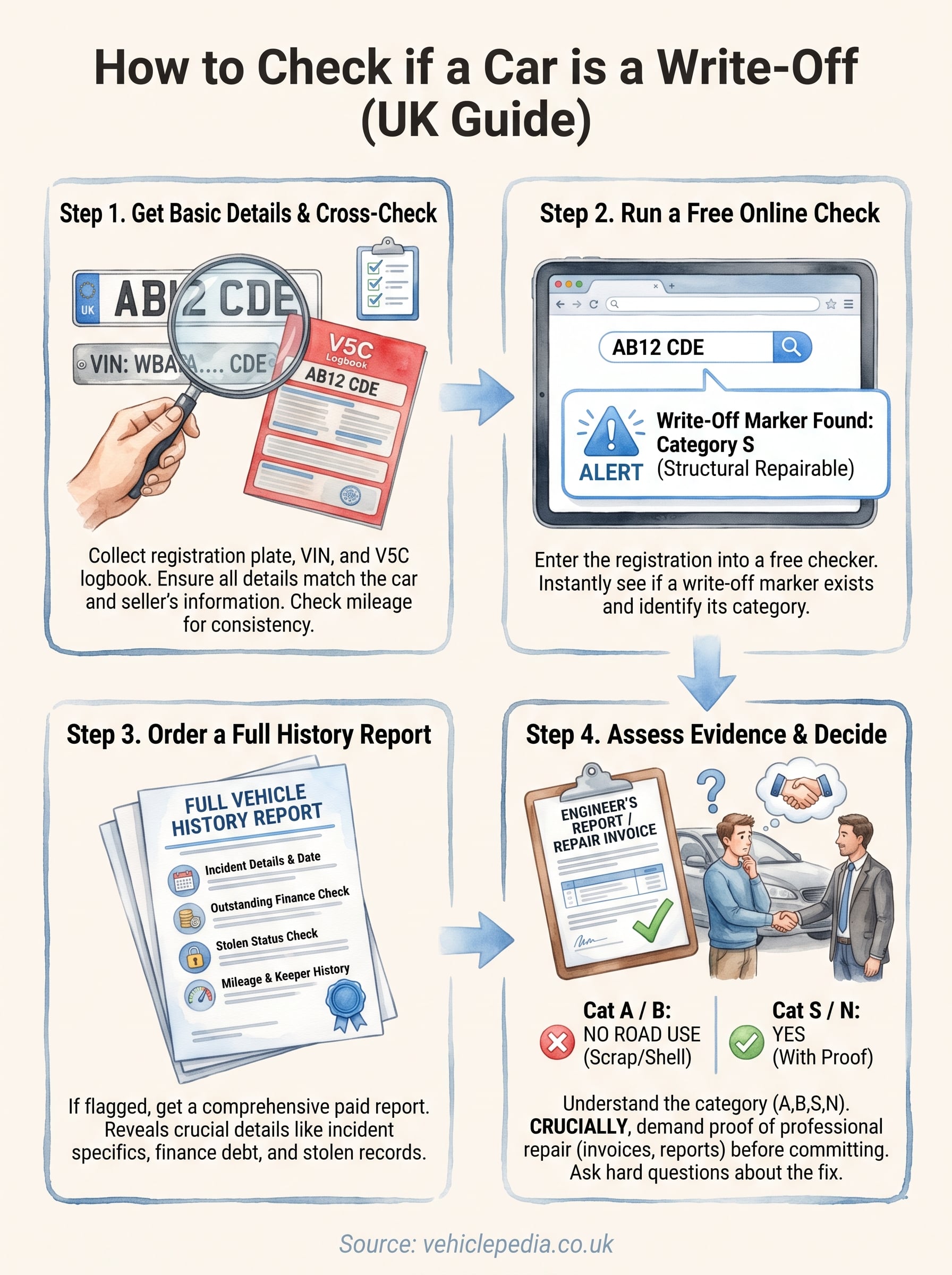
Before you can check if a car is a write off, you need the vehicle's registration number, and ideally a few other details to cross-check against. Ask the seller for the number plate directly, or take a photo of it when you view the car in person. Never rely on a screenshot from an online listing alone, since some sellers crop or blur the plate to stop buyers running checks before making contact.
Gather a few extra details alongside the registration if you can, because they help you spot inconsistencies later. These include the vehicle identification number (VIN), stamped on the chassis plate under the bonnet or visible through the windscreen and easy to confirm with a VIN number lookup, the logbook (V5C) reference, and the mileage shown on the dashboard.
The registration plate alone is enough to start a check, but the VIN is what confirms you're looking at the same car the report describes.
Compare what the seller tells you against what's printed on the V5C document itself, and consider checking the logbook details online too. Discrepancies between the registration on the plate, the VIN on the chassis, and the details on the logbook are a classic sign of cloning, where a written-off or stolen car is given the identity of a legitimate one to hide its history, which is why it pays to run a stolen car check by reg or VIN.
Here's a quick checklist to run through before you move on to the actual check:
- Registration plate matches the V5C exactly
- VIN on the chassis matches the VIN printed on the V5C
- Mileage on the dashboard roughly matches the last recorded MOT mileage
- Seller's name matches the registered keeper on the V5C
Once these basics line up, you're ready to run the registration through a proper history check rather than taking the seller's word for it.
Step 2. Run a free write-off check online
With the registration confirmed, head to a free car write-off check tool and enter the plate. Vehiclepedia's own free check pulls data from the DVLA and other official sources, so you can see the write-off status alongside MOT history, tax status, and basic vehicle details in one place, without creating an account or entering payment details first.
A genuine free check should tell you within seconds whether a car carries a write-off marker, no payment required.
Where to look for the result
Results typically appear within seconds of submitting the plate. Look specifically for a line marked "write-off" or "insurance status" on the results page, since this is where the category, if any, gets flagged. If you're trying to check my car is not a write off before agreeing a price, this is the fastest way to rule it out or confirm your suspicions.
What a free check does and doesn't show
Most free tools will confirm whether a write-off marker exists and which category it falls under, but they usually stop there. They won't show you the date of the incident, the insurer involved, or whether the vehicle has also been reported stolen or still has outstanding finance attached. That's a deliberate limit, since insurers and finance companies charge for access to that deeper data, and free checks are funded to cover only the basics.
Treat this step as your filter, not your final answer. If the free check shows no write-off marker, that's reassuring, but it doesn't rule out stolen status or finance owing. If it does show a marker, you now know enough to either walk away or dig further before making any commitment.
Step 3. Order a full vehicle history report
Once a free check flags a write-off marker, or you simply want the full picture before parting with money, it's time to order a full vehicle history report. This paid report digs into records a free check can't touch, including the date and description of the recorded incident, whether the car has ever been reported stolen, and if there's any outstanding finance still owed on it. Vehiclepedia's premium vehicle check pulls this together in one report, backed by a £30,000 data guarantee for non-trade buyers, so you're not just trusting a single database, and you can see what each report level covers and costs before you order.
A full report doesn't just confirm a write-off, it tells you why, when, and whether the debt or crime history attached to the car could become your problem.
What a full report typically includes
Before you pay for a report, check that it covers the essentials. A worthwhile report should give you:
- Full write-off category and the date it was recorded
- Insurer-reported incident details, where available
- Outstanding finance check against the VIN
- Stolen vehicle status via the police database
- Import, export, and colour change history
- Previous keeper count and plate change history
Reading beyond the write-off flag
Don't stop at the headline result. If you're trying to check if my car is written off as part of a wider due diligence process, the surrounding details matter just as much as the category itself. A car with outstanding finance and a Cat N marker carries different risks to one that's finance-free with the same category, so it's worth knowing how to check a car's finance history as well. Cross-reference the mileage and keeper history in the report against what the seller told you earlier, since gaps here often point to a car that's been quietly moved through several owners to bury its past.
Step 4. Read the write-off category and decide what to do
Once you've got the category in front of you, the real work starts: deciding whether this particular car, with this particular repair history, is worth the risk. Reading the write-off category correctly means matching it against the evidence in the report rather than treating the letter as a simple pass or fail grade. A Cat N car with a full repair invoice and matching photos is a very different proposition to a Cat S car with a single line in the report and no supporting paperwork.
Never buy a written-off car on the category alone, buy it on the evidence that backs up the repair.
Questions to ask before you commit
Work through these, alongside the wider questions to put to a private seller, before you agree a price or hand over a deposit:
- Does the seller have an engineer's report or repair invoice confirming the work done?
- Was the repair carried out by a body shop with insurance-approved standards, or a private garage?
- Does the asking price already reflect the reduced value that comes with a write-off marker?
- Will your insurer accept the car, and at what premium, given the category?
- Is there an MOT history showing consistent passes since the repair, with no recurring structural advisories?
When to walk away
Any mismatch between what the seller claims and what the report shows is a reason to pause. If there's no paperwork for a Cat S repair, if the seller is vague about who carried it out, or if the price doesn't reflect the history, treat that as a warning rather than a negotiating point. Cars that have genuinely been repaired well come with proof, and sellers with nothing to hide are usually happy to provide it before you even ask.
Buying with confidence
Knowing how to check if a car is a write off turns guesswork into a straightforward process: gather the registration, run a free check, order a full report if anything looks off, then weigh the category against the evidence in front of you. Skip any of these steps and you're gambling on a seller's word rather than official records.
Most written-off cars aren't scams. Plenty are honestly repaired and priced fairly to reflect their history. The problem only arises when buyers skip the check and assume a clean-looking car has a clean past. Don't be that buyer.
Before you commit to any used car, run the registration through a check and see exactly what a report contains. You can preview a full example report to see precisely what you'll get, then decide with real evidence rather than a hunch.