AA Used Car Warranty Review: Cover, Claims and Complaints
Our AA used car warranty review covers what it includes, where claims go wrong, your rights and how to decide if it is worth buying for your car.
AA Used Car Warranty Review: Cover, Claims and Complaints
The AA used car warranty review verdict in short: it is a solid safety net for a newer car that is expensive to fix, but it is not the cover-everything promise many buyers expect. Owners who claim for a major component failure often report being paid. Owners who run into exclusions, labour limits or diagnostic costs write the angry reviews. Whether it is worth buying depends on your car, the policy wording and how you handle a claim.
An AA used car warranty is a paid repair plan for mechanical and electrical failures on a used car. You buy it from the AA, or a dealer bundles it with the car. When a covered part fails, the policy pays towards the repair within set limits. It is not accident insurance and it is not a service plan.
This article explains why opinions split, what the cover includes and excludes, what claims look like in practice, how to decide whether it suits you, and how to claim properly. Vehiclepedia does not sell warranties, so there is no commission behind the verdict. We do check vehicle histories for UK buyers, and that matters here because a warranty is only as good as the car under it.
Why the AA used car warranty divides opinion
The AA used car warranty divides opinion because it is a limited repair plan sold under a very familiar brand. Buyers hear "AA" and expect broad, hassle-free cover. When a claim fits the policy wording, owners are pleased. When it does not, they feel misled, and those are the reviews that stand out.
The short verdict
My view is that it is worth considering for a newer car that is costly to repair, provided you read the exclusions before you pay. The published terms cover almost all mechanical and electrical faults, up to the market value of the parts, with no limit on the number of claims. That is a real benefit on a car with complex electronics, a turbocharged engine, or a hybrid or electric drivetrain.
It is a poor fit if you expect wear and tear cover, or payment for finding the fault. Brakes, tyres, batteries and clutches fall outside most warranties of this type, and the AA's terms exclude diagnostic charges. Any star rating you see for the AA used car warranty reflects whether the buyer's expectations matched the wording, far more than it reflects the AA's general quality.
A used car warranty pays for covered failures, not for the car you hoped you had bought.
Why the reviews are so mixed
Three things drive the split between happy and unhappy customers.
- Expectations: "Comprehensive" gets read as "everything". Most policies list covered parts and excluded parts, and the excluded list is where disputes start.
- Labour and time: The policy pays a set labour rate and a time allowance per job. If your garage charges more or needs longer, you pay the gap.
- Policy length and car age: A three-month policy on an old car gives a fault very little time to appear. A multi-year policy on a younger car gives you far more chance of a worthwhile claim.
Some owners report strong outcomes. One owner on a three-year policy described a claim worth roughly three times what the policy cost. Others describe being left with a bill after the labour allowance and diagnostic exclusion were applied. Both can be true of the same product.
Dealer-bundled cover versus a policy you buy
Many dealers include a short AA warranty with the car, then offer to extend it. A bundled policy is the one most people end up reviewing, often without having read it. Owners of older cars with a few months of bundled cover report the harshest experiences, mainly because age-related wear is typically excluded and the short term leaves little room for a covered failure.
A policy you choose and buy yourself is different. You pick the term, you see the eligibility limits for your car, and you can compare it against other warranty providers before paying. Whichever route you take, ask for the full policy document, not the leaflet. The document is what a claims handler works from.
What the AA used car warranty covers and excludes
The AA used car warranty covers almost all mechanical and electrical faults on an eligible car, up to the market value of the parts. It excludes wear items, fluids and diagnostic charges. Plan names and limits change, so confirm the current terms on the AA's own site before you rely on any figure here.
Plans and eligibility
The AA has published two main levels of used car cover. Eligibility is the first filter, because a car outside the age or mileage limit cannot be covered at all.
| Plan | Maximum car age | Maximum mileage | Notes |
|---|---|---|---|
| Protect Essential | Up to 10 years | Under 100,000 miles | Standard cover |
| Protect Plus | Up to 8 years | Under 80,000 miles | Adds extra features |
AA members have been offered discounts, and hybrids and electric vehicles can be covered. The price depends on the make, model, age, mileage and length of cover, so there is no single figure worth quoting. Get a written quote for your exact car and compare the price against the cover, not against the headline.
What is normally covered
Published cover includes mechanical and electrical components, up to the market value of the parts, plus in-car entertainment and remote key fobs. There is no limit on how many claims you can make. If a repair looks likely to take more than eight hours, the policy offers car hire or overnight accommodation. Twelve months of basic breakdown cover for personal use has also been included as standard.
Repairs go through a network of garages, and a claims adviser tells you which one to contact. That has a practical effect. You usually cannot take the car to any garage, agree a price and send the bill afterwards. You work within the claims process, and that process starts before the spanner is picked up.
Exclusions that cause disputes
Exclusions are where an AA used car warranty review turns negative. The items below are the ones that most often surprise people.
- Diagnostic costs: Finding the fault is not covered under the AA's published terms. You may pay a garage to investigate, even when the repair itself is then covered.
- Oils and fluids: These are treated as consumables.
- Parts replaced in pairs: Shock absorbers and springs are examples. A single failed unit may not be paid on its own.
- Wear and tear: Tyres, brake pads, batteries and clutches are items that wear out in normal use.
Read the exclusions list first and the covered list second, because the first one decides what a claim looks like.
What claims look like in practice
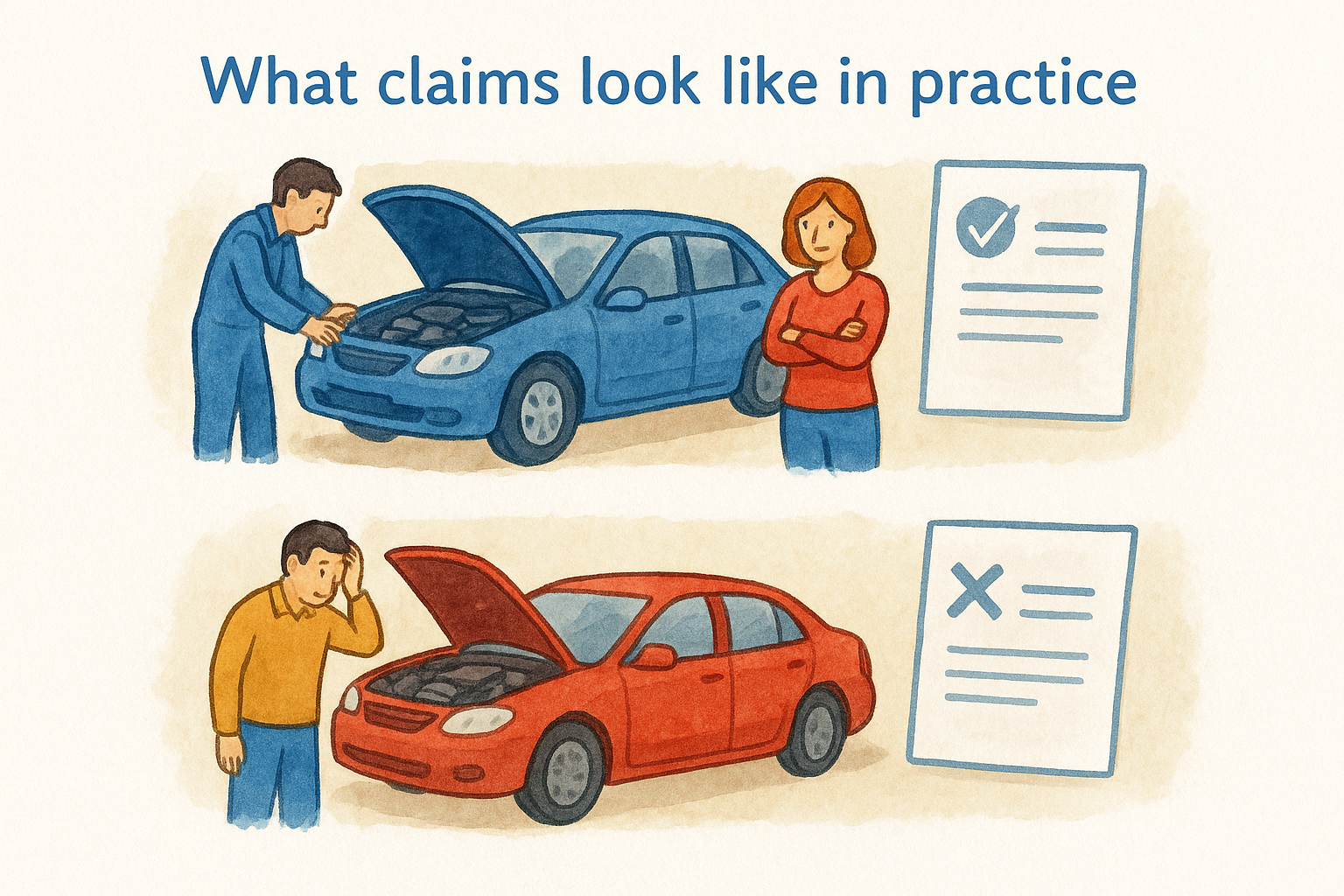
In practice, a claim goes smoothly when the fault is clear, the part is covered and the garage works within the claims process. It goes badly when diagnostics, labour rates or wear arguments come into play. Customer experiences fall into those two patterns, and knowing which one you are in saves a lot of frustration.
Where claims go well
Positive experiences share a pattern. The failed part is a significant covered component, the garage is in the claims network, and authorisation comes before the repair starts. The owner then pays little or nothing beyond any excess. Some dealers who bundle the AA warranty with their cars report smooth claim handling, which is a useful sign because they deal with claims regularly.
The upside is greatest on a car where one failure costs more than the policy. A gearbox, turbocharger or hybrid system fault can easily run to four figures. If you are insuring against that, and the failed part is covered, the warranty does its job.
Where claims go wrong
Complaints repeat the same themes, and they are worth knowing before you buy. One owner on a consumer forum described a claim that fell apart on no diagnostics, a low labour allowance and a short time allowance to fit the part. Those three limits are common in warranty terms across the industry, not unique to the AA, but they decide whether a covered repair is actually free.
- Diagnostics: You pay for the investigation if the policy excludes it.
- Labour rate: A garage charging more than the policy rate leaves you paying the difference.
- Time allowance: If a job takes longer than the policy allows, the extra hours are yours.
- Wear and tear arguments: The claims handler may classify a failure as wear, especially on older cars.
- Pre-existing faults: A fault that was present before the policy started is typically refused.
A fault soon after buying from a dealer
A breakdown in the first weeks after buying from a dealer is a separate issue, and the warranty should not be your first move. Under the Consumer Rights Act 2015, a trader must supply a car of satisfactory quality, and the GOV.UK guide to consumer protection rights sets this out. You generally have a short right to reject a faulty car within 30 days. For six months after purchase, a fault is presumed to have been there at the time of sale unless the dealer proves otherwise.
Those rights sit alongside the warranty and do not depend on it. They apply to purchases from traders, not private sellers. If a car fails soon after you buy it, put the problem to the dealer in writing, quoting your statutory rights, before you assume the warranty claims route is the only one.
If a car fails within weeks of purchase from a dealer, your consumer rights come before your warranty.
How to decide if the AA used car warranty is worth it
The AA used car warranty is worth buying when the car is young enough to qualify, expensive to repair, and the policy wording matches the faults you fear. It is not worth buying for a cheap car where one repair would cost more than the car is worth, or where you expect it to cover wear. You are paying for risk transfer, so match it to the risk you actually have.
Weigh cost against repair risk
Start with the car, not the warranty. The table below shows how the decision usually plays out.
| Your situation | Is the AA used car warranty likely to be worth it? |
|---|---|
| Car under about five years old, modern electronics, mid to high value | Often yes. Repairs are costly and the car qualifies for the better plans |
| Hybrid or electric car out of manufacturer cover | Often yes, if battery and drivetrain parts are covered in the wording |
| Reliable model with easy, cheap parts and a trusted garage | Probably not. You can self-insure with a repair fund |
| Cheap, older car near the eligibility limit | Doubtful. Wear exclusions and low value limit what you can claim |
| Dealer already includes six months of cover | Use that first and only extend if the extension terms are clearly better |
Be honest about your alternatives. Setting aside a repair fund works if you can absorb a large bill. A warranty works if you cannot. Price the warranty against a realistic repair, not a worst case.
Check the car before you rely on any cover
A warranty does not fix a car's history. Run a vehicle check before you pay, because the history tells you how likely a claim is and whether the car is a sound purchase at all. The MOT history shows mileage readings, recurring advisories and past failures. A run of advisories for the same area, such as suspension or corrosion, suggests wear that a warranty will probably not pay for.
Other history problems sit outside any warranty. A car with outstanding finance, a written-off record or a stolen marker is a problem that no repair cover solves. Our free car registration check shows MOT status and history, tax status and registration details. The premium report adds write-off, stolen and finance checks. Do this first, then decide whether the car deserves a warranty.
Questions to ask before you pay
Put these to the AA or the dealer, and get the answers in writing.
- What is the maximum payout per claim and in total?
- What labour rate and time allowance apply?
- Are diagnostic costs covered, or only the repair?
- Is there an excess, and how much is it?
- Can I use my own garage, or only the claims network?
- Do I need a full service history, and how often must I service the car?
- Is there a waiting period before I can claim?
- What is the cancellation and refund policy?
- Where do I complain if a claim is refused?
How to make a successful AA warranty claim
A successful claim comes from three habits: keep your paperwork in order, contact the claims team before any repair work begins, and challenge a refusal in writing. Most disputes in customer reviews trace back to one of these steps being skipped. None of it is difficult, but it has to happen in the right order.
Before you ever need to claim
Prepare when you buy, not when the car breaks down. Keep every service record and invoice, because most policies require servicing to the manufacturer's schedule and a claims handler may ask for proof. Save the claims number in your phone, and note the policy start date, the mileage at purchase and any waiting period.
Read the policy once, with a pen. Mark the labour rate, the time allowance, the excess and the exclusions. This takes ten minutes, and it turns the policy from a leaflet into a tool you can use when a handler says "that is not covered".
What to do when the car breaks down
Follow these steps in order.
- Stop driving once a warning light, noise or loss of power appears. Continued use can cause further damage, which a handler may refuse as consequential.
- Call the claims line before you authorise any work. Policies typically require approval first.
- Ask which garage to use and confirm who pays for diagnosis. Get the answer before the garage starts.
- Provide your service history and the mileage, and answer questions accurately.
- Get authorisation in writing, including the parts, the labour rate and the hours agreed.
- Keep all invoices and any messages, and check the final bill against the authorisation.
If a claim is refused
Ask for the refusal in writing, quoting the exact clause. Then compare the clause with the fault. If the reason is wear and tear, ask for evidence, such as an independent inspection report, because a failure of a covered part is not automatically wear. Use the provider's complaints procedure next, and keep the dates.
If the policy is insurance-backed, you can usually take an unresolved complaint to the Financial Ombudsman Service once you have a final response or after eight weeks. Your policy documents should state the route. If the car failed soon after a dealer sale, raise your consumer rights with the dealer in parallel, as covered earlier. Citizens Advice can also help you work out your options.
Write everything down and ask for refusals in writing, because a documented claim is far harder to dismiss.
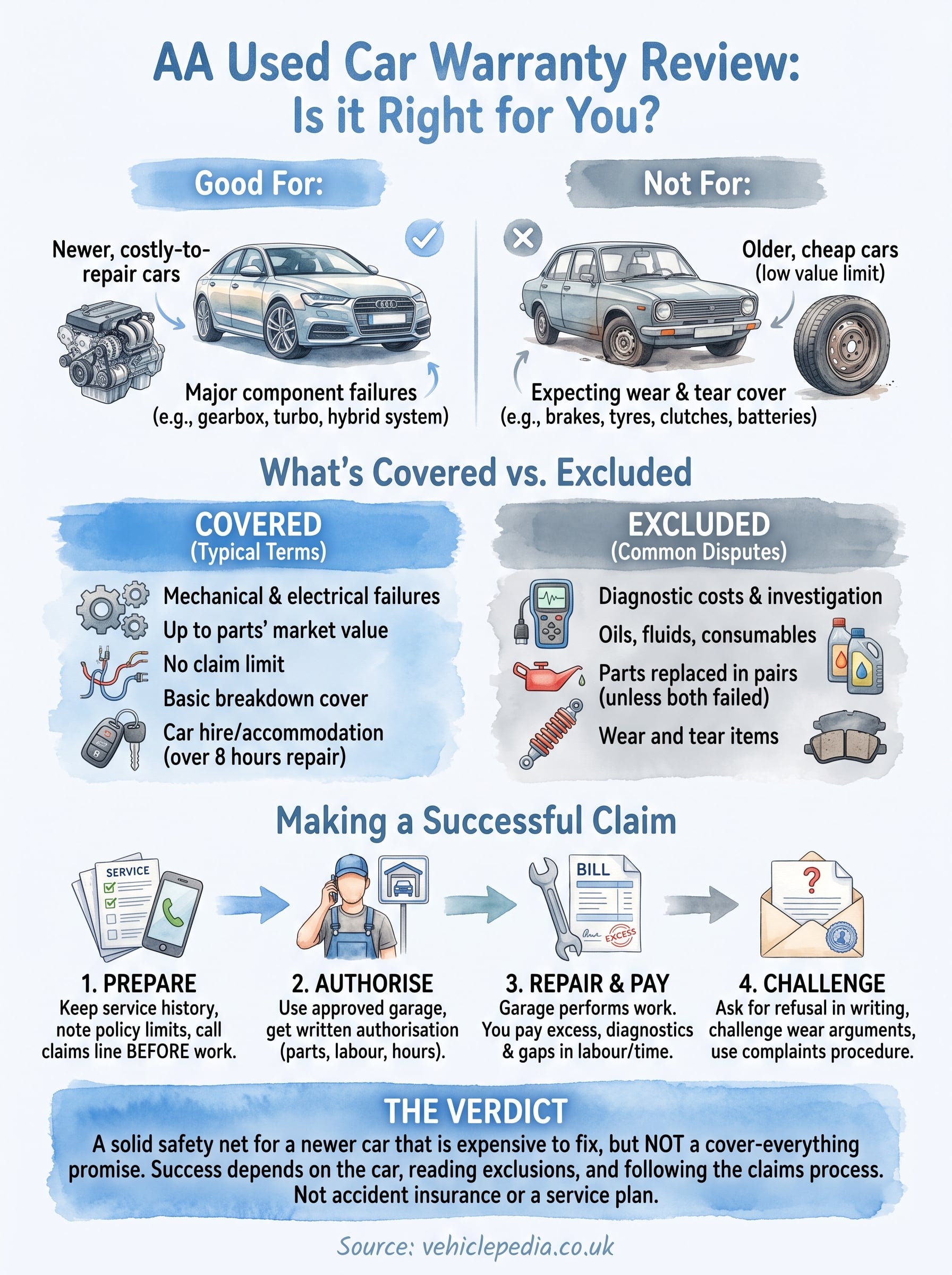
Our verdict on the AA used car warranty
The AA used car warranty is good value for the right car and poor value for the wrong one. It suits a newer, costly-to-repair car where you have read the exclusions, accept the labour and time limits, and will follow the claims process. It disappoints anyone expecting wear and tear cover or free diagnostics.
Before you buy any warranty, check the car underneath it. A free MOT history and a premium write-off, stolen and finance check tell you whether the car deserves cover at all. See what a premium Vehiclepedia report includes and check the car before you commit.