Car Safety Features Explained: What Matters When Buying
Car safety features explained: how active and passive systems differ, what AEB, blind-spot monitoring and lane assist do, and which to prioritise.
Car Safety Features Explained: What Matters When Buying
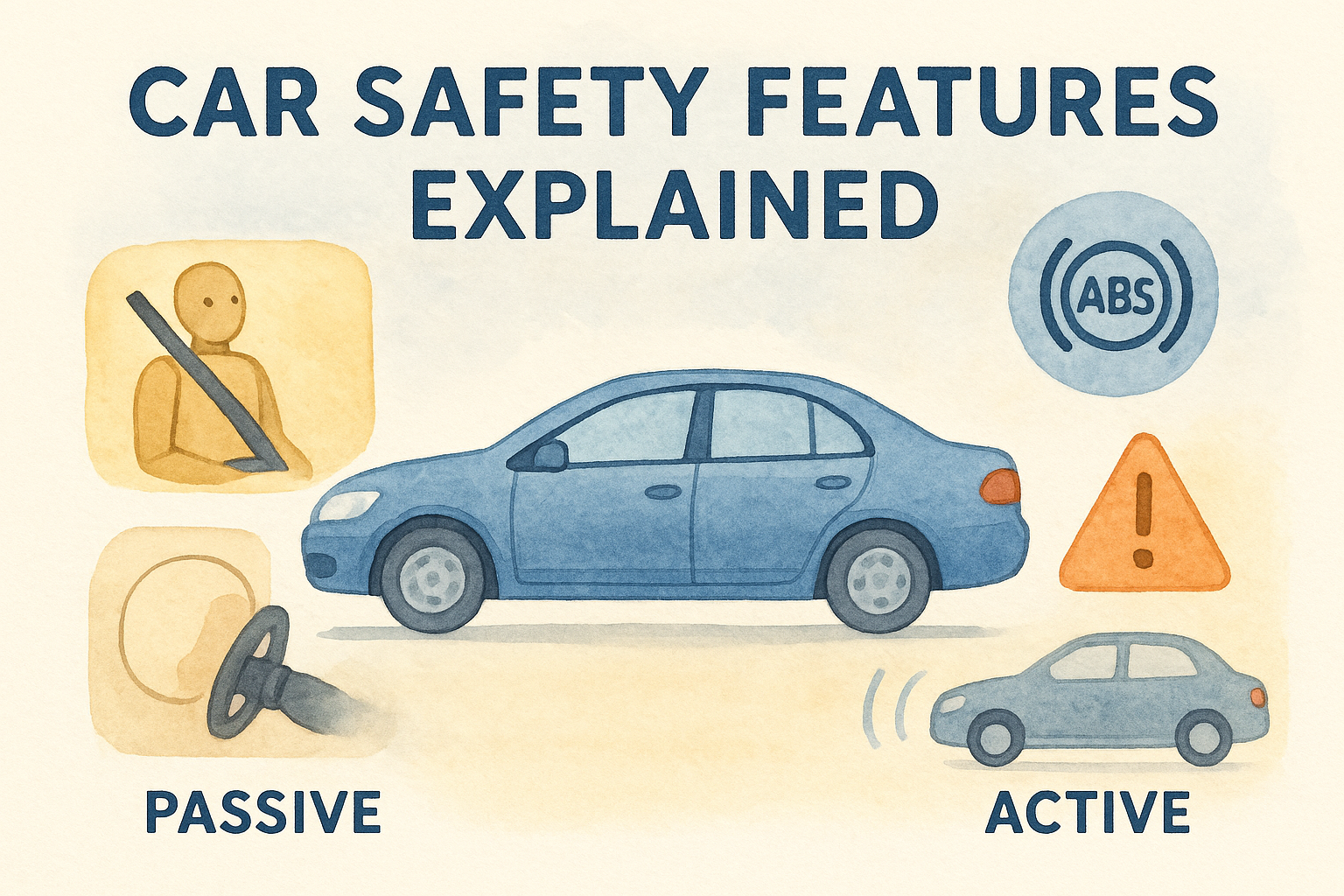
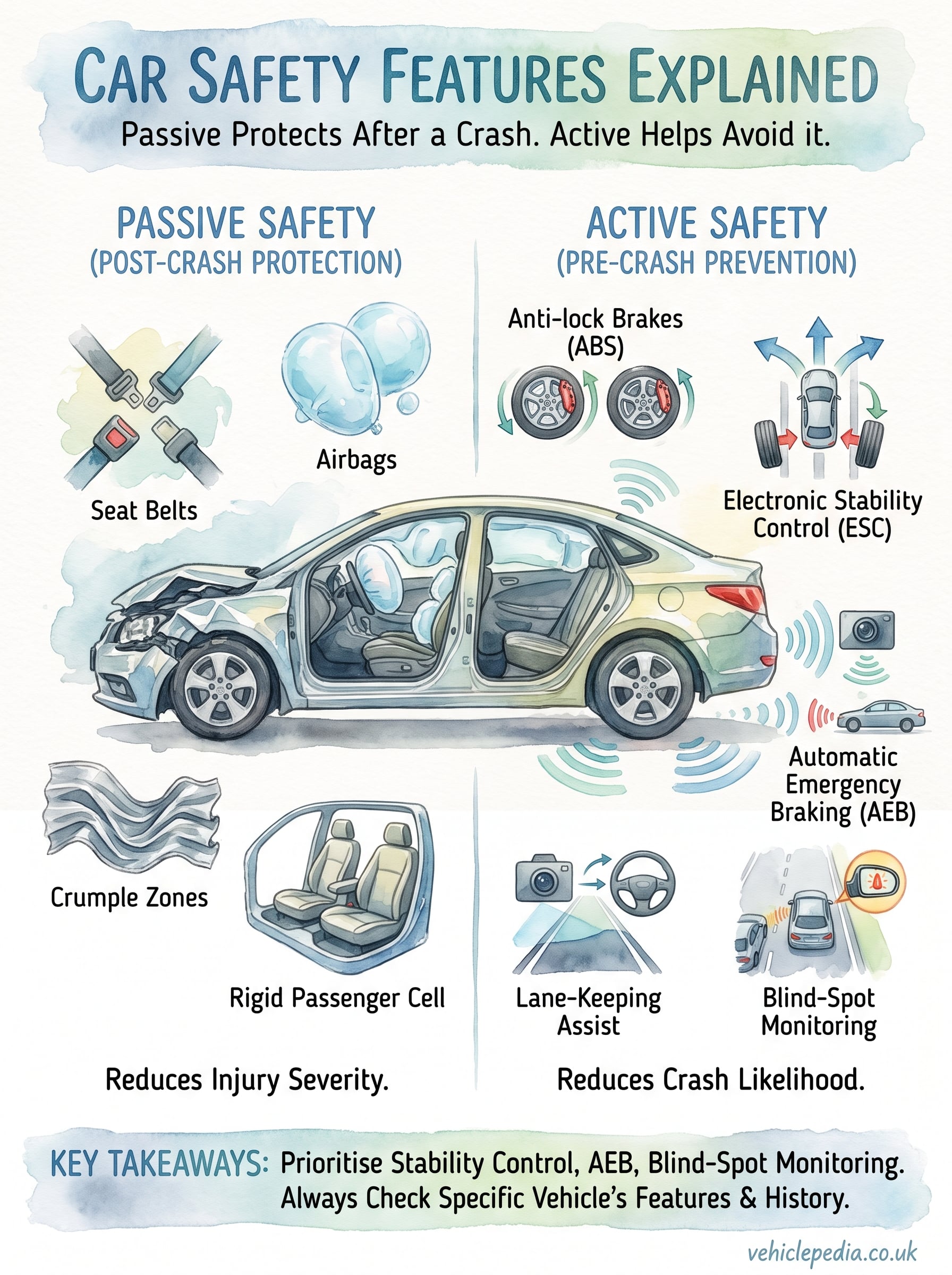
Car safety features explained in one line: passive features, such as seat belts, airbags and crumple zones, protect you once a crash happens. Active features, such as anti-lock brakes, electronic stability control and automatic emergency braking, help you avoid the crash in the first place. When you choose a car, the active systems that matter most are stability control, automatic emergency braking and blind-spot monitoring.
This guide covers why the split between active and passive matters, how each major system works, and which ones are worth insisting on. It also shows you how to confirm what a specific used car really has. Manufacturers give the same feature different brand names, so each system here is described by what it does.
At Vehiclepedia you can check a used car by registration plate, and a car's history matters as much as its specification. A safety feature only protects you if the car has not been damaged, repaired badly or recalled. We cover that at the end.
Why car safety features matter when you buy a car
Safety features matter because they decide how likely you are to crash and how badly you are hurt if you do. Two cars at the same price can differ widely here, and the difference is rarely obvious from the advert.
Active and passive safety do different jobs
Passive safety limits injury during a crash. Seat belts, airbags, crumple zones and a rigid passenger cell all work without any input from you. They cannot stop a collision, but they decide how much force reaches the people inside.
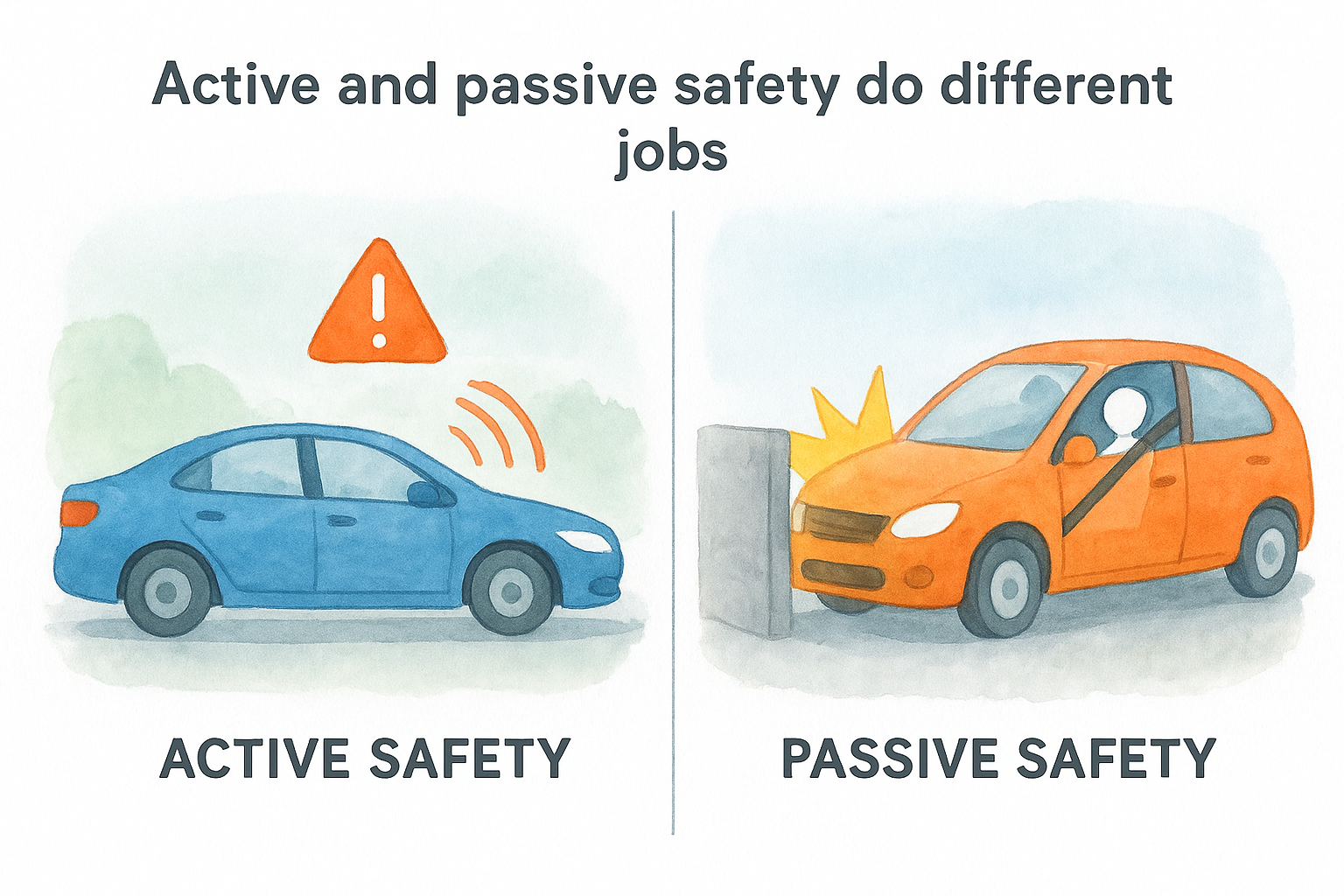
Active safety tries to stop the crash happening. Cameras, radar and sensors watch the road and the car, then warn you or step in with braking or steering. Anti-lock brakes and stability control are the oldest examples. Automatic emergency braking and lane-keeping assist are newer ones.
Passive safety reduces the harm of a crash, while active safety reduces the chance of one.
Why the exact specification matters
Active features are not standardised. The same model can have a system fitted as standard on one trim, as a paid option on another and not at all on an earlier year. Anti-lock brakes and electronic stability control have been made mandatory on new cars sold in the UK, but most other systems depend on the age, trim and options of the individual car.
Star ratings help, but only up to a point. Euro NCAP will not award five stars to a car without automatic emergency braking, so a recent top rating suggests the system exists. The rating belongs to the car as tested, though, not to the one on the forecourt. Always check the specification of the exact car you are viewing.
How the main car safety features work
Most active systems share a pattern. A sensor watches something, software decides whether there is a problem, and the car either warns you or acts. Knowing which of the two a feature does is the most useful thing you can learn about it.
Braking and stability systems
Anti-lock brakes (ABS) stop the wheels locking when you brake hard, so you can keep steering while you slow down. Electronic stability control (ESC) detects a skid and brakes individual wheels to bring the car back onto your intended line. Both are mandatory on new cars sold in the UK, but a much older used car may lack ESC.
Automatic emergency braking (AEB) uses a forward-facing camera, radar or both. It warns you of a likely collision with a vehicle, pedestrian or object, then brakes if you do not react. Car and Driver's testing found that these systems work as intended but do not always brake hard enough or early enough to avoid the crash altogether. Some work only at low speeds, while others work at motorway speeds.
Forward-collision warning is the cut-down version. It alerts you with sounds and lights but does not brake, so check which one a car has.
Steering and speed control
Lane-departure warning uses a camera to read lane markings and alerts you if you drift out of lane without indicating. Lane-keeping assist goes further and makes small steering corrections to keep you in lane. Some cars do this quietly, and you feel the wheel move without any input from you. Using the indicator overrides both.
Adaptive cruise control (ACC) holds a set speed but slows the car when it detects a slower vehicle ahead. Many cars let you choose one of three following distances. Advanced versions bring the car to a full stop in queues and pull away again when traffic moves, which cuts fatigue on long drives.
Warning-only systems tell you about a danger, while intervention systems act on it.
Awareness and parking aids
These systems cover what you cannot easily see. They are less likely to save your life than braking and stability systems, but they prevent many low-speed knocks.
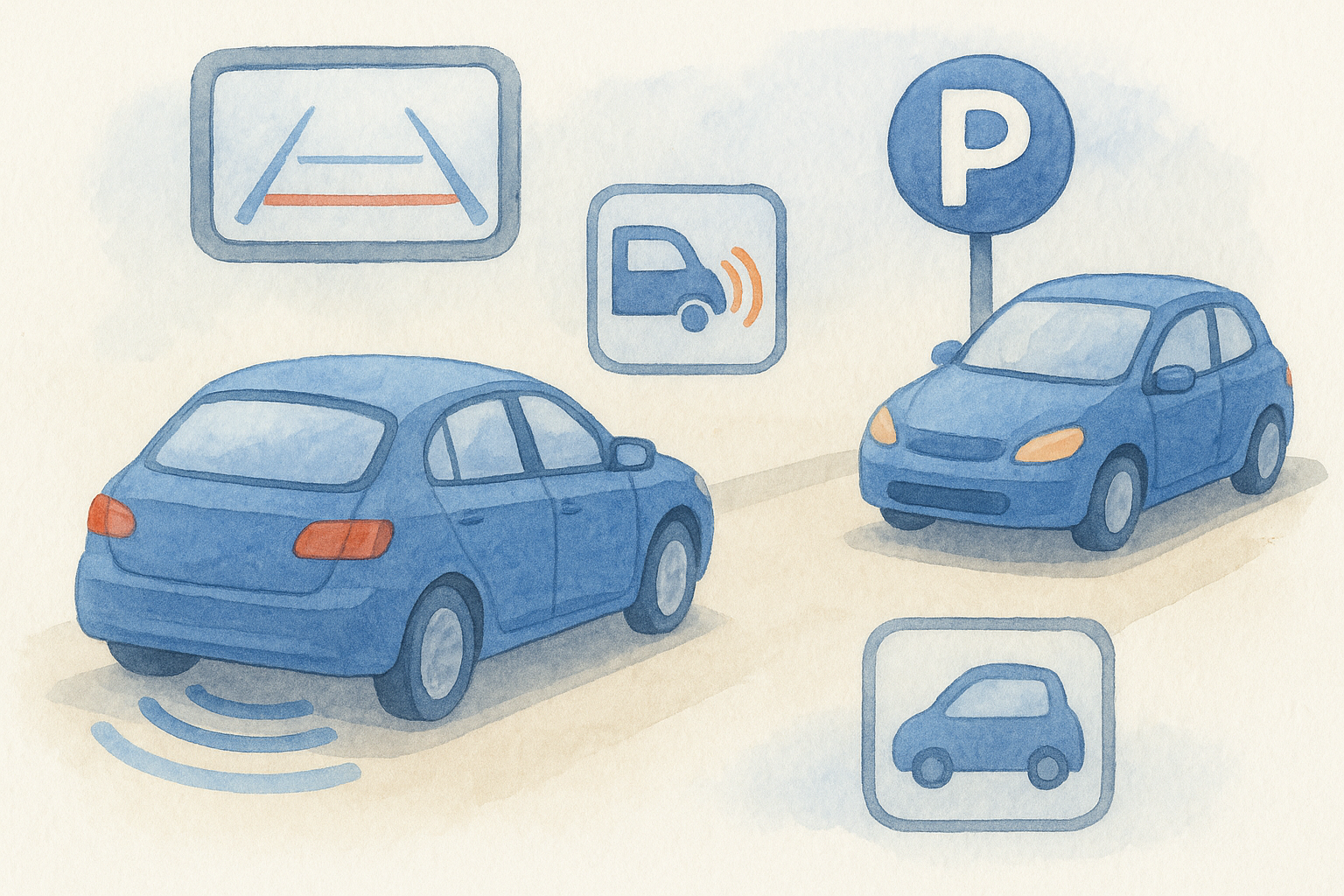
| Feature | What it does | Worth knowing |
|---|---|---|
| Blind-spot monitoring | Warns of vehicles in the adjacent lane, usually with a light in the mirror | Some systems also beep if you indicate with a car alongside |
| Rear cross-traffic alert | Warns of traffic approaching from the side as you reverse | Most useful in crowded car parks |
| Driver-attention warning | Detects drowsy or distracted driving from steering behaviour or a cabin camera | Prompts you to take a break |
| Traffic-sign recognition | Reads road signs and shows the speed limit on a display | A reminder, not a substitute for watching signs |
| Parking sensors | Ultrasonic sensors beep faster as you near an obstacle | Usually fitted to front and rear bumpers |
| Reverse camera | Shows the area behind the car on the screen | Does not replace looking over your shoulder |
| Automatic high-beams | Switches main beam off for oncoming traffic | Modern camera systems tell headlamps from reflective signs |
Which car safety features matter most
Rank the features by how serious the problem is that each one addresses, not by how impressive it sounds. Here is the order I would use, from essential to useful.
The features worth insisting on
- Electronic stability control and ABS. These are the baseline. On a car you will drive regularly, treat missing stability control as a reason to look elsewhere.
- Automatic emergency braking. It covers the most common lapse, a late reaction to traffic ahead. Prefer a car with pedestrian detection and check the speed range it works across.
- Blind-spot monitoring. It earns its place if you drive on motorways or multi-lane roads.
- Rear cross-traffic alert and a reverse camera. Worth having if you park in busy car parks or on streets, especially in a high-sided SUV with poor rear visibility.
- Lane-keeping assist and adaptive cruise control. These matter most if you commit to long motorway journeys.
Pay first for the systems that stop a crash, then for the ones that make driving easier.
Features that are nice but not decisive
Head-up displays, night vision and self-parking are pleasant, but I would not pay extra for them on safety grounds. Night vision is limited to a handful of luxury models. Car and Driver found self-parking systems can be tripped up by kerbs and closely parked cars. Hands-free driving assist varies by manufacturer, and you must still pay attention and be ready to take over.
Weigh your own driving too. A city commuter gets more from AEB and parking aids than from adaptive cruise control. A motorway commuter should rank blind-spot monitoring and ACC higher.
How to check a used car's safety features and history
A safety feature is only useful if the car actually has it, it works, and the car has not been compromised. You can verify all three before you hand over any money.
Confirm what the car actually has
Work through this checklist before you commit:
- Get the exact specification from the seller, the handbook or the manufacturer's dealer, rather than relying on the advert.
- Look up the model's Euro NCAP rating for the correct test year, and remember it describes the car as tested.
- Watch the dashboard at start-up. Warning lights for airbags, ABS and stability control should light briefly, then go out.
- Test the systems on the drive. Check that lane-keeping, adaptive cruise control and parking sensors respond.
- Inspect the bumpers and windscreen area. Cameras and radar sensors sit there, and damage or poor repairs can affect how they work.
Check recalls, write-off status and MOT history
Safety defects are often fixed under recall, so an unrepaired recall on a braking or airbag component matters. Our free car recall check looks up recalls on a vehicle in seconds using DVLA and DVSA data, with coverage going back to 1992. MOT history, taken from the DVSA, shows past advisories on brakes, tyres and seat belts, and these flag a poorly maintained car.
Write-off history matters for passive safety. A car that was written off and repaired may have had structural damage, which affects how its crumple zones perform. Our premium reports check insurance write-off data from the MIAFTR database, and they carry a data guarantee of up to £30,000 for non-trade users.
A car's spec sheet tells you what it was built with, while its history tells you what is left of it.
What to take away
Passive features protect you in a crash, and active features help you avoid one. Stability control, ABS and automatic emergency braking come first, with blind-spot monitoring close behind. Everything else depends on how and where you drive.
Before you buy, confirm the specification of the exact car, then check its recalls, MOT history and write-off status. If you want to know what a full history report shows before you pay for one, look at a sample of the premium report.