How to Check DVLA Number Plate Retention and Retain a Plate
No public DVLA number plate retention check page exists. See how to confirm a plate's status, retain it for £80 and renew it in time.
How to Check DVLA Number Plate Retention and Retain a Plate
There is no public DVLA number plate retention check page that tells you whether someone else's plate is on retention. If the plate is yours, check your V778 retention document and its expiry date. If you want to take a plate off a car, apply through the DVLA's online service or by post with form V317, pay the £80 fee, and wait for your V778 and an updated V5C before you sell or scrap the vehicle.
Most people reach this search in a hurry. You are about to sell, scrap or part-exchange a car and don't want the plate leaving with it. Or you are buying a plate or a car and want to know whether someone already holds the registration. A retention checker would answer both, but DVLA doesn't offer one. Guessing is costly, because a plate that leaves with the car is hard to recover and an expired V778 cannot be renewed late.
Vehiclepedia is a UK vehicle history check service. The steps below cover what retention is, how to confirm a plate's status, how to check the vehicle qualifies, how to apply, and how to keep the retained plate valid.
What retention means and why no public checker exists
Retention means a private registration is taken off a vehicle and held in your name on a V778 retention document, so you can use it later. DVLA publishes no retention checker, because the right to a retained plate belongs to the person holding the document, not to the public.
What a retained plate is
A retained plate is not displayed on any vehicle. DVLA holds your right to it for 10 years, and in that time you can assign it to a suitable vehicle, sell it or give it away. The car it came off goes back to its original registration, or to an age-related one if the original is unavailable.
Three terms get mixed up, so it helps to separate them.
| Term | Meaning |
|---|---|
| Retain | Take a private registration off a vehicle and hold it on a V778 |
| Transfer | Move a registration straight from one vehicle to another |
| Assign | Put a registration held on a V750 or V778 onto a vehicle |
Why you cannot look up someone else's plate
DVLA's vehicle enquiry service returns details only for registrations that are currently on a vehicle. A plate that returns nothing could be on retention, but that is only one possible reason. The table shows how far each result gets you.
| What you see | What it usually means |
|---|---|
| Vehicle enquiry shows a vehicle | The plate is on that vehicle now |
| Vehicle enquiry finds no vehicle | On retention, never issued to a vehicle, or typed wrongly |
| Listed for sale on DVLA's personalised registrations site | Nobody holds it on retention or on a car |
| Marked as taken or not found there | In use on a car, or on retention |
No result in that table confirms retention. The only proof is a document in the holder's hands.
No lookup can prove a plate is on retention, so the V778 is the only evidence that counts.
Step 1. Check the plate's status
Start with the document if the plate is yours, and with a request for the document if it isn't. A DVLA retention check comes down to reading a V778, not searching a database.
If you hold the plate
Find your V778 and check three things on it:
- The plate number is the one you expect.
- Your name appears as the grantee, the person with the right to the plate.
- The expiry date is still ahead of you.
Retention lasts 10 years, and DVLA sends a renewal reminder as the date approaches. If you can't find the document, you can apply for a replacement. This works only while the V778 is unexpired and you are the person with the right to the plate, and a replacement usually takes three to four weeks. Destroy any older copy once the new one arrives.
If you are checking someone else's plate
Ask the seller to show the V778 or V750 before you commit any money. Check that the plate number matches and that the expiry date has not passed. For a V750 certificate of entitlement, DVLA's personalised registrations site has a validity checking service that confirms whether it is the latest valid certificate.
The DVLA vehicle enquiry service is a useful second check. A plate that shows a live vehicle is not on retention. You can also phone DVLA with the plate details, though it will share ownership information only with the right person.
Using a vehicle check alongside
If you are buying a car that carries a private plate, enter the registration into our free DVLA vehicle check. It lists plate and colour changes with tax, emissions and MOT history, so you can see whether the registration has changed over the car's life. It won't show retention status, because DVLA doesn't expose that, but it flags a car whose identity has moved around.
Ask for the V778 and read the expiry date, because no website can do that for you.
Step 2. Confirm the vehicle can have the plate removed
You can retain a plate only if both the vehicle and the registration qualify, and a failed application wastes time you may not have. Check these rules before you pay.
Vehicle rules
The vehicle must meet every item below:
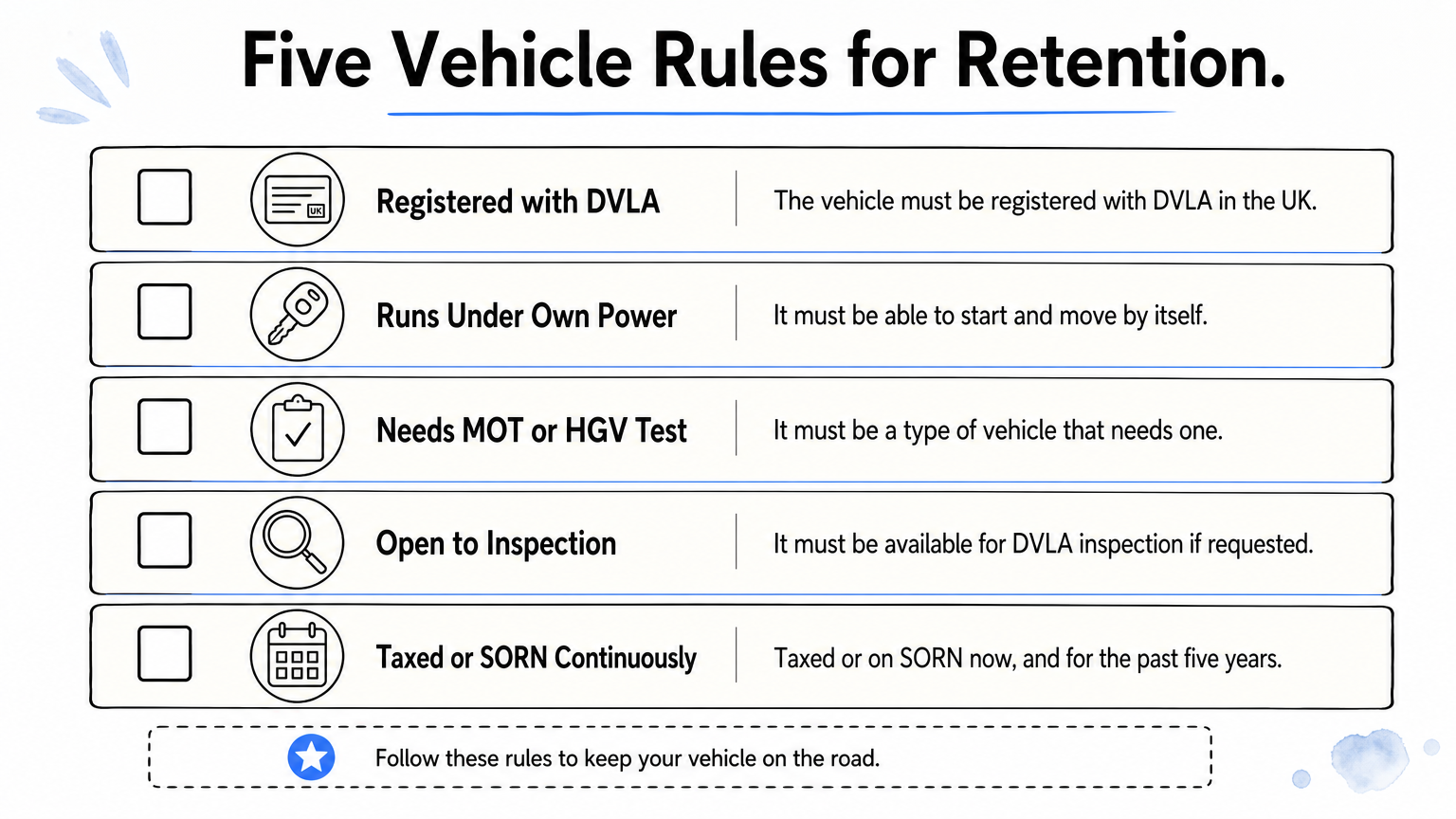
- Be registered with DVLA in the UK
- Be able to start and move under its own power
- Be a type of vehicle that needs an MOT or HGV test
- Be available for DVLA inspection if requested
- Be taxed or on SORN now, and have been taxed or on SORN continuously for the past five years
If the vehicle has been on SORN for more than five years, tax it and give it a current MOT first. A classic car that is normally MOT exempt still needs a valid MOT to retain its plate.
Plates you cannot retain
You cannot retain a registration starting with Q or QNI. You also can't retain one marked non-transferable on the V5C. If your V5C carries that marking, the plate stays with the vehicle.
Documents and details to have ready
Gather these before you start:
- The vehicle's V5C log book, with your name as registered keeper
- The 11-digit V5C document reference number, for the online route
- The registered keeper's postcode as shown on the V5C
- Payment for the £80 fee, by card online or cheque, banker's draft or postal order by post
- A completed V317 form, for the postal route
Mismatched details are the usual cause of delays, so copy them from the V5C exactly.
If the car is written off, move fast. Tell your insurer you want to keep the plate before they settle the claim. Once the insurer pays out, the registration becomes theirs, and once the car is scrapped you can't get the plate back.
Retain the plate while the car is still in your hands, because an insurer's payout or a scrapyard visit ends the option.
Step 3. Take the plate off online or by post
Apply through DVLA's "take a private number off a vehicle" service, or post form V317. Both cost £80, and online is quicker. The GOV.UK page for taking a private number off links to both routes.
Apply online
The online service runs Monday to Friday 7am to 9pm and Saturday to Sunday 7am to 8pm. If you see a "service unavailable" message outside those hours, try again later. The steps are:
- Check your name is on the V5C.
- Open the DVLA take-off service and enter the registration you want to remove.
- Enter the 11-digit V5C document reference number and the keeper's postcode.
- Confirm you are the registered keeper.
- Pay the £80 fee.
- Wait for your V778 and an updated V5C showing the replacement registration.
If DVLA doesn't need to inspect the vehicle, the plate is normally removed straight away.
Apply by post
Postal applications suit you if the online service rejects your details or you prefer paper. Download form V317 from GOV.UK and follow these steps:
- Mark an X in the box for Option B, which keeps the registration number.
- Fill in section 1 with the vehicle details from the V5C.
- Mark the relevant boxes in section 2.
- Give your name, address, postcode and daytime phone number in section 3.
- Fill in section 4.1 only if the registration will change hands, with the nominee's name. Use 4.2 if a dealer is acting for you.
- Enclose a cheque for £80 payable to DVLA Swansea, the V317 and the V5C.
Send everything to:
DVLA Personalised Registrations
Swansea
SA99 1DS
Check the latest form for any change to the address before you post.
What it costs in practice
The cost is a single £80 DVLA fee, online or by post. Say you sell your car in March and keep the plate for six years before fitting it to a new one. You pay £80 once. Renewal is free if you want another 10 years, and you don't pay a second DVLA fee when you assign the plate to the new car. Dealer or broker charges are separate and are your decision.
Whether you apply online or by post, the DVLA fee is £80, so choose the route that gets the paperwork done before the car leaves your hands.
Step 4. Finish the process and keep the plate valid
Retention is complete only when you hold the V778 and the updated V5C. After that, one date matters: the V778's expiry.
What to do straight after
Do not sell, scrap or part-exchange the car until both documents have arrived. The updated V5C can take four to six weeks, so build that into your timeline. Before you drive again, the car must show road-legal plates with the replacement registration. Then:
- Tell your insurer that the registration has changed.
- Update accounts that recognise the car by plate, such as the London Congestion Charge and ULEZ.
- Keep the V778 somewhere safe, because you need it to assign or renew.
Renewing before it expires
Renewal is free and gives another 10 years. DVLA lets you apply up to 28 days before the expiry date. It will not accept an application made after that date, and the right to the plate is then permanently lost. Put the expiry date in your calendar with a reminder a few weeks earlier, and read the GOV.UK renewal guidance when the time comes.
Putting the plate on another vehicle
You can assign a retained plate to a suitable vehicle online or by post, using the V778 and the receiving vehicle's V5C. The plate can't make the vehicle look newer than it is, and Q and QNI registrations can't be assigned. You can assign it to someone else's car if the nominee's details match their V5C. Don't fit plates showing the retained registration until DVLA confirms the assignment.
A retained plate is safe only while its V778 is in date, so renew before the final 28 days run out.
Keep the plate, then check the car
A DVLA number plate retention check is a document check, not a lookup. Read the V778, confirm the expiry date, and apply to retain while the vehicle is still yours. Check the vehicle rules, pay the £80 fee, and wait for both the V778 and the new V5C before the car goes anywhere.
If you are on the buying side, the same care applies to the car itself. A private plate can hide a vehicle's past, so look past the registration. See what a full Vehiclepedia report covers before you commit to a used car.