DVLA Vehicle Owner Check Free: What You Can Actually See
See what a DVLA vehicle owner check free actually reveals, why keeper names stay hidden, and how to spot issues before buying a used car.
DVLA Vehicle Owner Check Free: What You Can Actually See
You've found a car online, you've got the registration number, and now you want to know who owns it before you go any further. Typing dvla vehicle owner check free into Google feels like the obvious next step, but the results rarely explain what you'll actually get. That gap between expectation and reality catches out a lot of buyers.
Here's the direct answer: the DVLA doesn't let anyone search registered keeper details online, free or paid, because that's personal data protected by law. What you can check for free is everything around ownership that actually matters for a purchase: MOT history, tax status, vehicle age, and technical specifications tied to that plate.
This article walks through exactly what a free vehicle check reveals, why keeper information stays private, and the legitimate routes for tracing an owner when you genuinely need to, such as reporting an accident. We'll also cover how premium checks fill in the risk details, like outstanding finance or write-off history and how to check it, that free lookups can't show.
Why a free DVLA check won't reveal a vehicle's owner
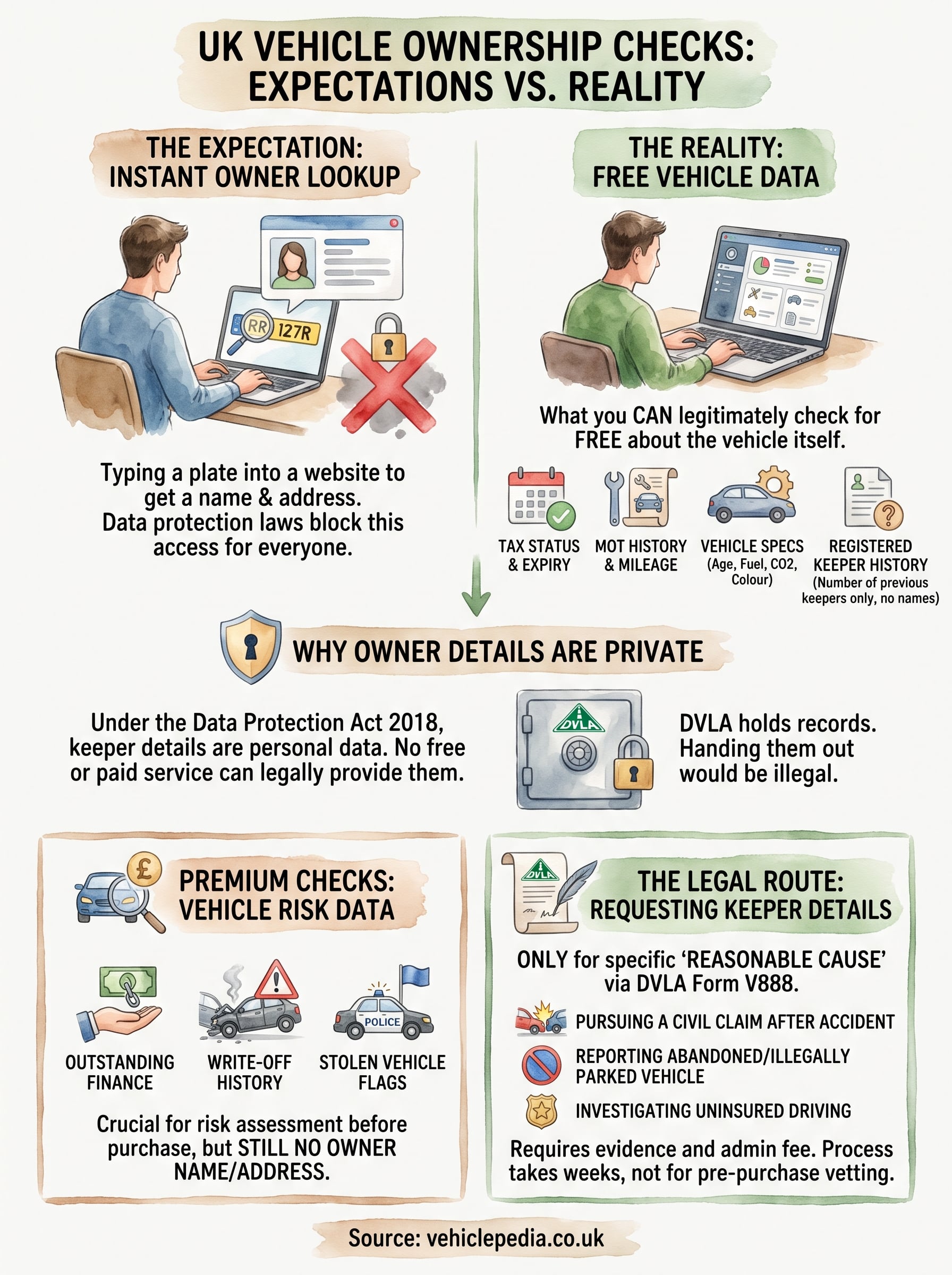
Most people running a dvla vehicle owner check free search expect a name and address to pop up alongside the registration plate. That's not how the system works, and it never will be. The DVLA holds registered keeper records under the Data Protection Act 2018, which treats a person's name, home address, and vehicle association as personal data. Handing that over to anyone who types a plate into a website would breach the law, so the DVLA simply doesn't build that access into any public tool, free or paid.
Ownership and the registered keeper aren't quite the same thing either, and this distinction trips up a lot of buyers wondering whether they can find out who owns a car from a plate. The registered keeper is whoever's responsible for the car day to day, taxing it, insuring it, and dealing with fines. That's often the owner, but not always, think company cars, lease vehicles, or a car bought on finance where the finance house technically owns it until the balance clears. A dvla vehicle ownership check can't untangle this either, because the register only tracks the keeper, not legal title, which is worth knowing before you try to check car ownership online.
No free or paid car check will ever hand you a stranger's name and address, because that's exactly what data protection law exists to prevent.
There's also a persistent myth that paying for a report unlocks personal details the free check hides. It doesn't. Premium vehicle history services, including the one you'll find on Vehiclepedia, source their data from the same official channels: DVLA, insurance registers, and police databases. None of these bodies release keeper names or addresses to commercial services for public resale. What premium reports add is risk data tied to the vehicle itself, outstanding finance, write-off markers, stolen vehicle flags, not who's sitting in the driver's seat.
So if you're wondering whether a dvla vehicle check address search exists somewhere online, it doesn't, at least not one you can legally access without a specific, approved reason. The DVLA does have a formal process for requesting keeper information, but it's restricted to cases like pursuing a civil claim after an accident or reporting a vehicle for parking on private land, and it requires proof. We'll walk through that process later in this article. For now, the practical takeaway is this: stop searching for owner lookup tools that promise names and addresses, because you'll waste time chasing something that doesn't exist. Focus your energy instead on the vehicle data you can legitimately pull, because that's what actually protects you when you're about to hand over money for a used car.
How to run a free DVLA vehicle check online
You can run a DVLA vehicle check online in less than a minute, and you don't need an account or a card number for the basic version. All you need is the registration plate, either from the seller's listing or a photo you've taken yourself. Two routes get you there: the government's own free vehicle tax and MOT checker, or a consolidated tool like Vehiclepedia's free car check, which pulls the same official data into one report instead of making you check tax and MOT separately.
What you'll need before you start
Before you search, have these ready:
- The registration number, typed exactly as it appears on the plate
- A rough idea of the car's age, so you can sanity-check the results against what the seller told you
- Five minutes of quiet time, since you'll want to actually read what comes back rather than skim it
Running the check step by step
- Go to the checker's homepage and find the registration search box.
- Type the plate in without spaces, most tools auto-format it.
- Hit search and wait a few seconds for the DVLA and DVSA databases to respond.
- Review the results screen, which should show MOT and tax together along with basic vehicle specs.
- Cross-reference what you see against the seller's description, particularly the year, fuel type, and colour.
A free dvla car data check takes one minute and can save you weeks of dealing with a car that isn't what it was advertised as.
Don't stop after step one search either. If anything looks inconsistent, run it again a day later or compare it against a second source before you commit to viewing the car in person.
What information a free vehicle check actually shows
A free car data check dvla report focuses on the vehicle itself, not the person behind the wheel, and that's actually the data that matters most before you buy. Every field pulls from official DVLA and DVSA records, updated as the databases change, so you're looking at the same information a dealer would check, not a guess.
Core data points you'll see
Here's what a typical free check returns:
| Data Point | What It Tells You |
|---|---|
| Tax status | Whether the car is currently taxed and when it's due |
| MOT status | Pass/fail history, expiry date, and advisories |
| Vehicle age | First registration date |
| Make and model | Confirms the seller's description matches DVLA records |
| Engine size and fuel type | Useful for checking insurance and running costs |
| CO2 emissions | Relevant for tax band and environmental checks |
| Colour | Flags any undisclosed colour changes |
Everything in a free report describes the car, never the person who owns it, and that split is by design, not a limitation.
Learning to check a car's MOT history free by registration deserves particular attention, because it's often the most revealing section. Each test entry lists mileage, so you can spot a car that's covered fewer miles than the odometer suggests, or one where advisories keep repeating year after year, a sign of a fault that's never been properly fixed.
Ownership history sits in a slightly different category. A basic dvla check vehicle ownership search won't name anyone, but some free tools do show how many previous owners a car has had, without identifying who they were. A high number of keepers in a short space of time is worth asking the seller about directly, since it can point to a car that's changed hands quickly for a reason worth knowing before you commit.
How to request registered keeper details with reasonable cause
Sometimes you genuinely need a name behind a plate, not to snoop, but because something's gone wrong. Maybe a car scraped yours in a car park and drove off, or someone's abandoned a vehicle blocking your driveway. For these situations, the DVLA runs a formal process that sits completely outside any free or paid vehicle check, and it exists precisely because ordinary lookups can't and shouldn't reveal this.
The DVLA will hand over keeper details only when you can prove a legitimate legal reason, not simple curiosity.
Requesting this information means completing form V888, available through gov.uk, and demonstrating what the DVLA calls reasonable cause. Accepted reasons include:
- Pursuing a civil claim after an accident or damage
- Reporting a vehicle abandoned or parked illegally on private land
- Investigating a suspected case of driving without insurance
- Acting on behalf of a solicitor or insurer with a genuine legal interest
You'll need to supply evidence alongside the form, photos of the incident, dashcam footage, or a witness statement, plus a small administrative fee. The DVLA reviews each request individually and won't release details on a hunch or a vague suspicion that something's off with a seller.
Applying doesn't guarantee a fast turnaround either. Processing typically takes several weeks, so this route works for resolving a dispute after the fact, not for vetting a car you're about to buy this weekend. If you're mid-purchase and something about the seller feels wrong, a dvla vehicle ownership check through this formal process isn't the tool for that moment, a thorough vehicle history report is. Save the V888 route for genuine legal disputes, and rely on registration-based checks for everything you need to know before handing over your money.
Getting the full picture before you buy
A dvla vehicle owner check free search was never going to hand you a name and address, and now you know why: data protection law keeps registered keeper details locked away from everyone, not just casual buyers. What you can get for free is genuinely useful though. Tax status, MOT history, mileage patterns, and basic specs tell you far more about whether a car is worth buying than a stranger's name ever would.
Where free checks stop, risk still lurks. Outstanding finance, write-off markers, and stolen vehicle flags don't show up in any free report, and they're exactly the problems that turn a good deal into a costly mistake. Before you hand over any money, run the plate through a full premium check that covers those gaps. You can see exactly what a full premium report reveals before you buy one, so there are no surprises about what you're paying for.