MOT Historic Vehicle Check: How to Check Exemption Status
Run a full MOT historic vehicle check to confirm exemption eligibility, spot disqualifying changes, and verify roadworthiness before buying a classic car.
MOT Historic Vehicle Check: How to Check Exemption Status
If your car is getting on in years, you might be wondering whether it still needs an annual MOT at all. Running an mot historic vehicle check is the fastest way to find out, because vehicles built or first registered more than 40 years ago can qualify for a MOT exemption under DVLA rules, but only if they haven't been substantially changed.
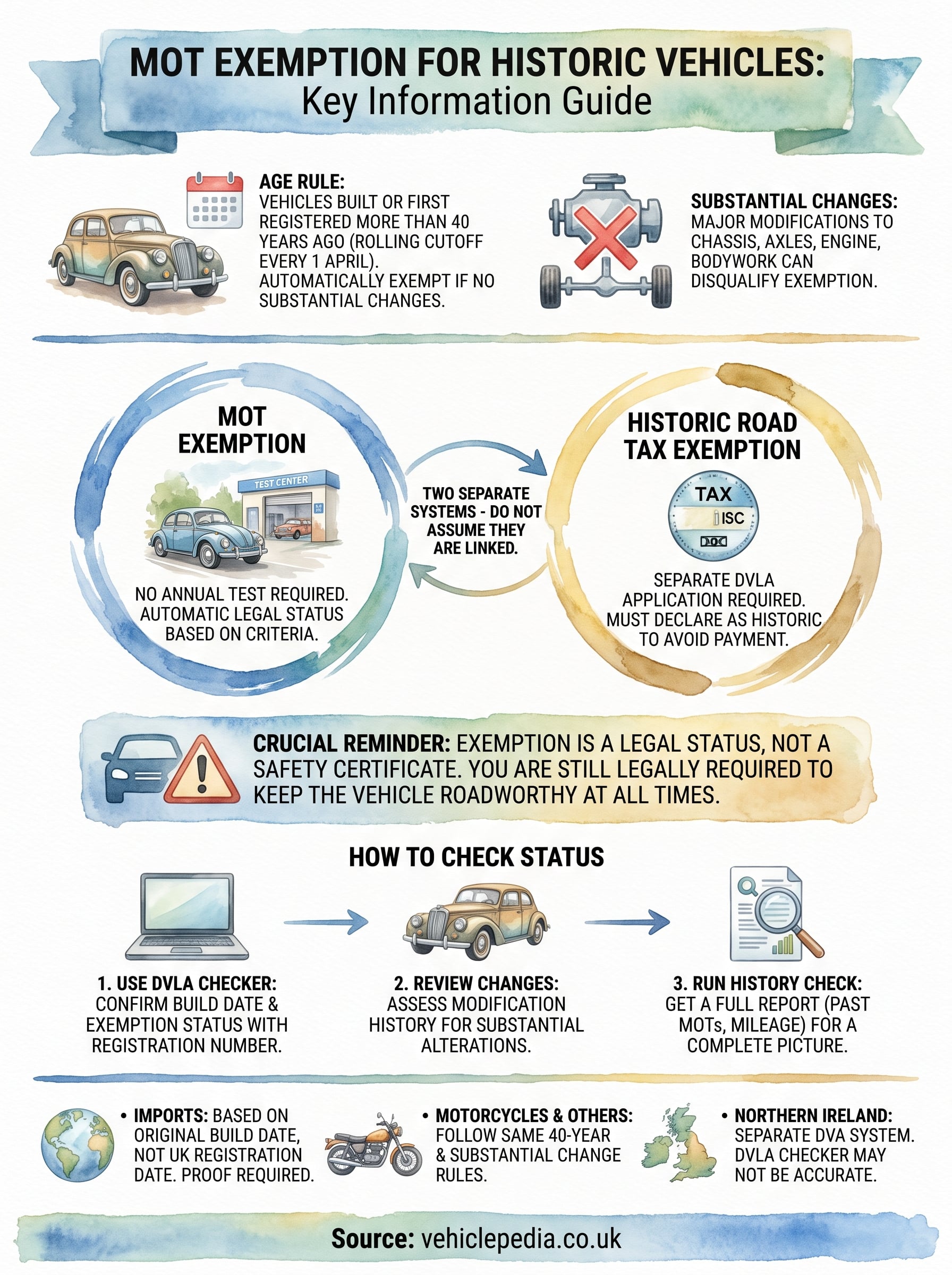
The rule itself is straightforward: cars and motorcycles registered before 1 January 1986 (with the 40-year cutoff rolling forward each year) are generally exempt, unless they've had major modifications to the chassis, axles, engine, or bodywork. Checking your specific vehicle's status takes seconds using its registration number, and confirms whether you're legally exempt or still on the hook for testing.
This article walks through exactly how the historic vehicle exemption works, who qualifies, and how to check your car's MOT history and exemption status using official DVLA data. We'll also cover what to do if you're buying a used classic and want reassurance before handing over any money, since an exemption doesn't mean a car is roadworthy, just that it isn't legally required to prove it.
Why MOT exemption matters for classic car owners
Qualifying for an MOT exemption isn't just a bureaucratic footnote, it changes how you budget for and maintain a classic car. Skipping the annual test saves you the test fee itself, but more importantly, it removes the pressure of an arbitrary pass/fail deadline that doesn't always reflect how a well-maintained older vehicle actually performs. Owners of genuinely historic vehicles often argue, rightly, that a car looked after with proper knowledge and original parts is safer than the test's blanket criteria would suggest. Still, exemption status only applies if you know for certain your vehicle meets the DVLA's definition, which is why running a classic car MOT exemption check before you assume anything is worth the two minutes it takes.
Saving money without cutting corners
Financially, the exemption removes one recurring cost from classic car ownership, but it shouldn't change how much attention you pay to the car's condition. Brakes, steering, tyres and lights all wear the same way whether or not a tester signs off on them annually. Many long-term owners of exempt vehicles choose to keep having voluntary inspections done anyway, simply to catch problems early and keep a paper trail that proves the car has been properly maintained.
Exemption doesn't mean the car is safe
This is the point that trips people up most often: MOT exemption is a legal status, not a safety certificate. A car can be fully exempt under DVLA rules and still have worn brake lines, a cracked windscreen, or bald tyres. You're still required by law to keep the vehicle in a roadworthy condition at all times, exemption or not, and driving an unsafe vehicle carries the same penalties whether it's due an MOT or not.
An MOT exemption removes the test requirement, not the legal duty to keep your car roadworthy.
Insurance, sales and paperwork implications
Exemption status also has knock-on effects beyond the test centre. Some insurers ask specifically whether a vehicle is MOT exempt, and how you answer can affect your premium or the terms of a classic car policy. If you're planning to sell, buyers researching the car's background will often run a vehicle history check and expect to see either a valid MOT or a clear explanation of exempt status, so having documentation ready builds trust and speeds up the sale. Here's what typically matters most to owners once they've confirmed exemption:
- Proof of eligibility: a DVLA record or exemption confirmation you can show insurers or buyers.
- Maintenance records: receipts, invoices and service history that demonstrate the car is genuinely roadworthy.
- Voluntary inspections: an independent check every year or two, even without a legal requirement.
- Ongoing checks: a quick mot historic vehicle check whenever ownership, address, or vehicle details change, since exemption isn't always applied automatically.
Getting this wrong in either direction causes real problems. Assuming you're exempt when you're not means driving illegally and invalidating your insurance. Assuming you still need a test when you don't means wasting money and time on a check the law doesn't require. Either way, confirming the facts through official data removes the guesswork, which is exactly what the next section covers in detail.
How to check if your vehicle qualifies for exemption
Qualifying for a historic vehicle exemption comes down to two tests: the age of the vehicle and whether it's been substantially changed. The DVLA rolls the cutoff forward every year, so a vehicle becomes exempt on the 1st of April, 40 years after the end of the year it was built. If you don't know the exact build date, the registration date on your V5C logbook is usually close enough to work from, though it's the build date that legally counts if the two differ.
Checking the date criteria
Start with the free DVLA vehicle enquiry service, which tells you whether a vehicle is currently taxed as historic and whether an MOT is recorded as required. Here's the quickest way to confirm eligibility:
- Look up your registration number on the DVLA's official checker.
- Check the "date of first registration" and compare it against the current 40-year rolling cutoff.
- Confirm the result matches what your V5C logbook states, since discrepancies do happen with older paperwork.
- Note that tax and MOT exemption are recorded separately, so check both fields rather than assuming one implies the other.
What counts as a "substantial change"
Age alone doesn't guarantee exemption. Substantial changes to the chassis, monocoque bodyshell, axles, running gear, engine, or the number and layout of seats can disqualify an otherwise eligible vehicle. A straight engine swap for an equivalent period-correct unit usually doesn't count, but fitting a modern engine, changing the wheelbase, or replacing the chassis almost certainly does. Owners restoring a car with mixed original and reproduction parts should keep detailed records, since the burden of proof sits with the owner if the DVLA ever queries the vehicle's status.
If your vehicle has had major mechanical or structural changes, don't assume the exemption still applies, check it properly first.
Once you've confirmed both the date and the modification history line up, you can be confident the exemption genuinely applies rather than just assuming it based on the car's appearance or age alone.
How to check your vehicle's MOT and history records
Even exempt vehicles carry a testing past worth reviewing, and that's where a full vehicle history check earns its keep. The official government MOT history checker shows every test result, mileage reading, and advisory note going back years, which is useful even after exemption kicks in because it tells you exactly what condition the car was in before testing stopped. Gaps in that record, or a sudden jump in mileage right before the exemption date, are worth questioning rather than ignoring.
Beyond the bare MOT record, a broader check fills in details the government tool doesn't cover. Running a free check through Vehiclepedia pulls together registration details, tax status, previous MOT results, and vehicle age in one lookup, using the same registration number you'd use on the DVLA site. It's a sensible first step whether you're confirming your own car's status or vetting a classic before you buy it.
A vehicle's past MOT record tells you more about its real condition than its current exemption status ever will.
Here's what each type of check actually shows you:
| Check type | What it shows | Where to get it |
|---|---|---|
| MOT history | Past test results, mileage, advisories | GOV.UK MOT checker |
| Tax and exemption status | Whether the vehicle is taxed as historic | DVLA vehicle enquiry service |
| Full vehicle history | Ownership changes, write-offs, finance, stolen status | Vehiclepedia free and premium checks |
Deeper questions, like whether a car has ever been written off, reported stolen, or still has finance outstanding, sit outside what any MOT record can tell you. Premium checks cover exactly those risks, and they matter most when you're buying rather than simply confirming your own car's paperwork. Given how much money is on the line with a classic car purchase, spending a few pounds on a proper history check before you commit is cheap insurance against buying someone else's expensive problem.
Gathering all three pieces, the MOT record, the tax and exemption status, and the wider ownership history, gives you a complete picture rather than a partial one. That combination is what genuinely protects you, whether you're maintaining your own historic vehicle or deciding whether someone else's is worth the asking price.
MOT exemption versus road tax exemption explained
People often assume that once a car stops needing an MOT, it automatically stops needing road tax too. That's not how it works. MOT exemption and vehicle tax exemption are two completely separate DVLA processes with their own age rules, their own application steps, and their own paperwork, and mixing them up is one of the most common mistakes classic car owners make.
Two separate systems, one shared birthday
Both exemptions use the same 40-year rolling cutoff, which is why owners assume they're linked. In reality, historic vehicle tax status has to be applied for separately through the DVLA, usually when you tax the vehicle each year, while MOT exemption is simply a status that applies automatically once the age and modification criteria are met. You don't fill in a form to become MOT exempt, but you do need to actively declare your vehicle as historic when you renew tax, otherwise you'll keep paying it even though you no longer need to.
Being MOT exempt doesn't make your car tax exempt, and you have to apply for one of them separately.
Checking and applying for each one
Sorting out both statuses properly means treating them as two separate checks rather than one combined box to tick:
- Confirm MOT exemption using your registration number on the official DVLA checker, based on build date and modification history.
- Apply for historic tax class through the DVLA when you next tax the vehicle, either online, by post, or at a Post Office, declaring the vehicle as historic.
- Keep your V5C updated, since an incorrect registration date can delay or block either exemption being recognised.
- Recheck annually, particularly in the years right around your vehicle's 40th anniversary, since the cutoff date shifts every April.
Getting the tax side wrong is the costlier mistake in practice. Vehicles that qualify but aren't declared as historic keep incurring the standard rate, sometimes for years, simply because nobody flagged the change with the DVLA. A quick mot historic vehicle check confirms the testing side, but it's worth pairing that with a look at your tax class too, since one doesn't guarantee the other.
Exemption rules for imports, motorcycles and Northern Ireland
Not every historic vehicle follows the same straightforward path to exemption, and imports, motorcycles, and vehicles registered in Northern Ireland each carry their own quirks worth knowing before you assume the standard rule applies.
Imported classics
Imported vehicles qualify for MOT exemption using the same 40-year rolling cutoff, but the date that counts is the vehicle's original build date, not the date it was first registered in the UK. This trips up a lot of owners, because a car imported and registered here in 2015 might still be old enough to qualify if it was actually built decades earlier. You'll need documentation proving the original manufacture date, since the DVLA won't take a UK registration date as proof on its own, and without that paperwork an otherwise eligible import can get stuck showing as non-exempt.
An import's exemption depends on when it was built, not when it was registered in the UK.
Motorcycles and other vehicle types
Motorcycles follow identical age and modification rules to cars, so a bike built more than 40 years ago and left substantially unmodified is exempt in exactly the same way. The same applies to buses, tractors, and other historic vehicle classes, provided the chassis and major mechanical components haven't been substantially changed. Running a mot historic vehicle check works the same way regardless of vehicle type, since the DVLA checker pulls the same registration and build data whatever you're driving.
Northern Ireland's different system
Northern Ireland handles vehicle testing through a separate body, the Driver & Vehicle Agency, rather than through DVSA-run test centres used across the rest of the UK. The exemption principle is the same, historic vehicles over 40 years old that haven't been substantially modified don't need annual testing, but the checking process and record-keeping sit on a different system entirely. If your vehicle is registered in Northern Ireland, checking exemption status through the standard GOV.UK MOT checker may not return accurate results, so it's worth confirming directly with the DVA rather than assuming the mainland process applies unchanged.
Keeping your historic vehicle road-legal
Exemption from testing never means exemption from responsibility. Whether your car qualifies under the 40-year rule or not, the same basic duty applies: keep it genuinely roadworthy, keep the paperwork straight, and don't assume anything without checking it properly. A proper mot historic vehicle check takes minutes and settles the age, modification, and tax questions in one go, saving you from either driving illegally or paying for tests you don't owe.
Before you rely on a classic's exemption status, whether it's your own car or one you're about to buy, run a full history check rather than trusting appearances or a seller's word. It's the cheapest safeguard against an expensive mistake. Compare what's included at each level on the pricing page and see exactly what a full report covers before you commit.