7 Most Accurate Car Valuation Sites In The UK (2026)
Compare 7 tools to find the most accurate car valuation UK sellers and buyers trust, plus why a Vehiclepedia history check matters too.
7 Most Accurate Car Valuation Sites In The UK (2026)
Every valuation tool seems to give you a different number for the same car, and that's frustrating when you're trying to price a sale or check if a dealer's offer is fair. Finding the most accurate car valuation UK tools means looking past the marketing and understanding which sites actually pull from real transaction data rather than guesswork.
The truth is no single tool nails your car's exact worth every time, because valuations depend on local demand, condition, mileage, and how recently comparable cars sold nearby. What works is knowing which platforms use the most reliable data sources and comparing two or three results to land on a realistic figure rather than trusting one number blindly.
In this guide, we've tested and ranked the seven tools UK sellers and buyers trust most for valuation accuracy in 2026, from the well known names to lesser known options worth checking. We'll also show you how a full vehicle history check, like the one we run at Vehiclepedia, adds context that valuation figures alone can't give you, so you know exactly what you're pricing or buying.
1. Auto Trader car valuation tool
Auto Trader dominates UK car classifieds, and that scale is exactly why its valuation tool carries weight. With millions of live listings and completed sales flowing through its site every month, Auto Trader's valuation tool has more real-world pricing data behind it than almost any competitor in this list.
How it works
You punch in your registration number, current mileage, and a rough condition rating, and Auto Trader crunches that against its own marketplace data. It doesn't just look at asking prices either. The tool factors in actual sold prices from dealers and private sellers who've listed on the platform, then adjusts for regional demand, since a diesel estate might fetch more in rural Yorkshire than in central London. You get three figures: a private sale estimate, a part-exchange value, and a dealer forecourt price, which gives you a realistic spread rather than one flat number.
How accurate it is
This is where Auto Trader pulls ahead of many rivals. Because the valuation draws from live transaction data rather than historical averages or manufacturer guide prices, it tends to reflect what buyers are actually paying right now, not what they were paying six months ago. That said, the tool leans on the details you input, so if you're generous with the condition rating or vague about mileage, the output skews optimistic. Cross-check the figure against a handful of similar live listings on the site itself to sanity-check it before you rely on it for a sale or negotiation.
If you want a number that reflects what UK buyers are paying today, Auto Trader's live marketplace data beats static guide prices every time.
Best for
Auto Trader suits private sellers who want a quick, credible starting price before listing their car, and it works equally well for buyers trying to judge whether a dealer's asking price is fair. If you're negotiating a part-exchange, having the Auto Trader figure printed out or on your phone gives you real leverage.
Cost
The basic valuation is free and takes under a minute once you've got your reg and mileage to hand. Auto Trader does push you toward listing your car with them afterwards, but you're under no obligation, and the free valuation stands on its own whether you sell through the platform or not.
2. Parkers car valuation
Parkers has been a fixture in UK car buying guides since long before the internet, and its valuation tool still carries that heritage. It's owned by the same group behind Auto Trader now, but Parkers built its reputation on guide pricing rather than live marketplace listings, which gives it a slightly different flavour of accuracy worth understanding.
How it works
You enter your registration and mileage, and Parkers generates a valuation based on its own pricing algorithms, which blend historical sales data, depreciation curves, and market trends for that specific make and model. Unlike Auto Trader, it doesn't pull directly from thousands of live listings in real time, so the figure reads more like an informed estimate than a snapshot of today's market.
How accurate it is
Parkers tends to be reliable for mainstream cars with predictable depreciation, but it can lag behind sudden shifts in demand, like when fuel prices spike and small petrol cars briefly become more desirable. Treat it as a solid baseline rather than the final word.
Parkers gives you a dependable starting point, but pair it with a live-listings tool if the market's moving fast.
Best for
It suits buyers doing early research on a car they haven't found yet, and sellers who want a second opinion to confirm what Auto Trader's telling them.
Cost
The standard valuation is completely free, with no registration or payment details required to get a figure.
3. HPI valuations
HPI built its name on vehicle history checks long before valuations became part of the package, and that history-first approach still shapes how it prices cars today. Rather than treating valuation as a standalone product, HPI valuations sit alongside outstanding finance, write-off, and stolen vehicle data, so you get a price alongside the risk factors that should affect it.
How it works
You enter the registration, and HPI generates a valuation using trade pricing data combined with the vehicle's own history record. If the car has a finance marker, a write-off category, or a mileage discrepancy flagged in its check, that context sits right next to the price, which most pure valuation tools simply don't offer.
How accurate it is
HPI's figures skew toward trade-influenced pricing, meaning they often sit closer to what a dealer would offer than what a private buyer would pay. That makes sense given HPI's roots in dealer and finance company services. Treat the number as a trade benchmark rather than a private sale target.
HPI's real value isn't the price alone, it's seeing that price next to the vehicle's finance and write-off history in one place.
Best for
HPI suits buyers who want pricing and risk data together, particularly when considering a car with an uncertain history. It's less useful if you just want a quick private sale figure.
Cost
A basic valuation is often free, but the full history check that gives the valuation real context typically costs £19.99 to £29.99 depending on the report tier.
4. Motorway
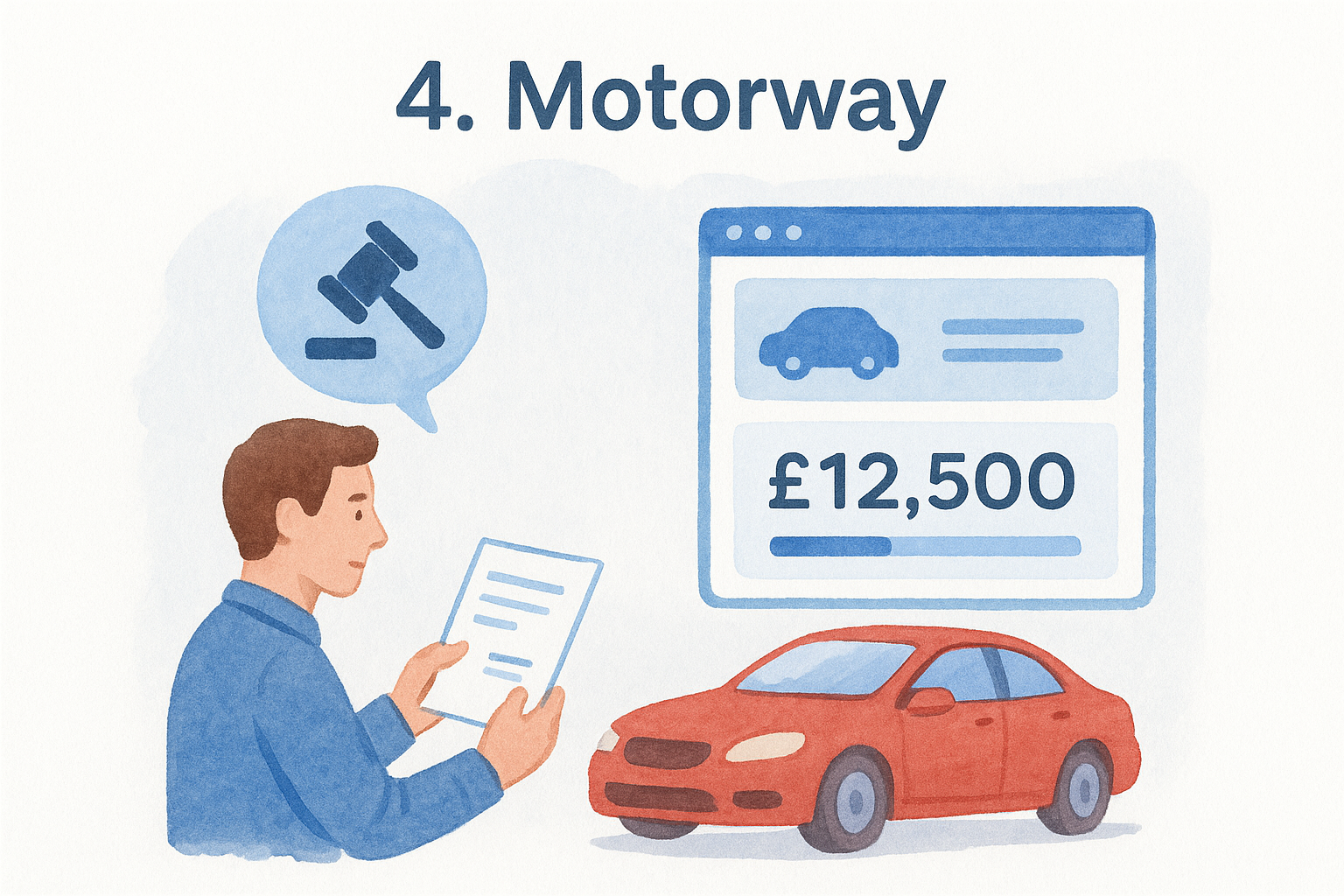
Motorway built its business around getting sellers a genuine offer rather than just a number on a screen, and that changes how you should think about its valuation. Instead of estimating what your car might be worth, Motorway's valuation tool runs a live auction among thousands of verified dealers, so the figure you end up with is an actual offer someone's willing to pay today.
How it works
You enter your registration and a few details about condition, then Motorway lists your car to its network of dealers, who bid against each other over a set window, usually a day or two. The highest bid becomes your offer, and you can accept, decline, or wait for the next round if you're not happy with the result.
How accurate it is
Because dealers are bidding with real money, the figure reflects genuine demand rather than an algorithm's best guess. It's arguably one of the most accurate signals of your car's worth available, precisely because it's not an estimate at all.
A dealer auction bid beats any algorithm because it's real money on the table, not a guess.
Best for
Motorway suits sellers who want a fast, hassle-free sale without haggling face-to-face with buyers, and who'd rather have certainty than chase the highest possible private sale price.
Cost
Getting a valuation and entering the auction is free, and Motorway only takes a fee if you sell through the platform.
5. Carwow
Carwow started as a new car buying platform, but its used car valuation and sell-your-car service now competes directly with Motorway for sellers who want offers rather than estimates. Carwow's valuation tool works on a similar principle: instead of guessing a number, it pushes your details to a network of dealers who compete for your car.
How it works
You enter your registration, mileage, and condition details, and Carwow generates an instant estimate first, then invites verified dealers to submit firm offers if you choose to sell through the platform. The initial figure comes from market data, but the real value shows up once dealers start bidding, because that's when you see what buyers are genuinely willing to pay for your exact car.
How accurate it is
The instant estimate is a reasonable ballpark, similar to Parkers or Auto Trader's guide figures. Where Carwow gets properly accurate is in the dealer bidding stage, where competition between buyers pushes the price toward true market value rather than an algorithm's assumption.
The first number Carwow shows you is a guess; the number dealers actually bid is the truth.
Best for
Carwow suits sellers who want to compare multiple dealer offers quickly without visiting forecourts, and buyers who want to check what a car's owner might realistically accept before making contact.
Cost
The valuation and dealer offers are free to request, and Carwow earns its money through commission from the dealer, not from the seller, so you never pay to get a price.
6. RAC Cars valuation tool
The RAC name carries weight from decades of breakdown cover and vehicle inspections, and its car valuation tool trades on that same trust for reassurance. RAC Cars valuation sits inside a wider marketplace, so you get a price alongside listings for similar cars, which helps you judge whether the figure lines up with what's actually for sale nearby.
How it works
You enter your registration and mileage, and RAC generates a valuation using market pricing data drawn from its own listings network and third-party sources. The tool also nudges you towards an RAC vehicle inspection or history check, which makes sense given the brand's background, but it means the valuation feels like one part of a bigger safety-first package rather than a standalone tool built purely for speed.
How accurate it is
RAC's figures land somewhere between Parkers' guide pricing and Auto Trader's live marketplace data, useful but not the sharpest tool here. It works well for mainstream models with stable demand, though it can miss quick shifts in niche markets like performance cars or newly popular EVs.
RAC's valuation works best as a trust-backed second opinion, not your only source.
Best for
RAC suits buyers and sellers who already trust the brand for breakdown cover or inspections and want a valuation from the same source, keeping everything under one roof.
Cost
The basic valuation is free, though RAC will offer paid add-ons like inspections or history checks alongside it.
7. Hagerty valuation tool for classic cars
Hagerty made its name insuring classic and collector cars, and its valuation tool reflects that specialism rather than trying to cover every car on the road. If you own a 1970s MGB or a well-kept air-cooled Porsche, Hagerty gives you a figure that generic valuation sites simply can't match, because they weren't built with classics in mind.

How it works
You select your make, model, and year rather than entering a registration, since many classics predate DVLA digital records or have modifications that skew a reg-based lookup. Hagerty then pulls from its Price Guide, built using auction results, private sales, and insured values gathered from owners' clubs and specialist dealers across the UK. You get separate figures for cars in fair, good, excellent, and concours condition, which matters far more with classics than with a five-year-old hatchback.
How accurate it is
For genuinely collectible cars, Hagerty is the most reliable source going, because mainstream tools have almost no sales data for low-volume classics. It's less useful for anything under 20 years old or without collector status.
Hagerty is the only tool here built specifically for classics, and it shows in the depth of its condition-based pricing.
Best for
Owners and buyers of classic or collector cars who need a valuation that understands rarity and condition, not just mileage and age.
Cost
The Price Guide lookup is free to use, with no account required.
8. How to combine these tools for the most accurate figure
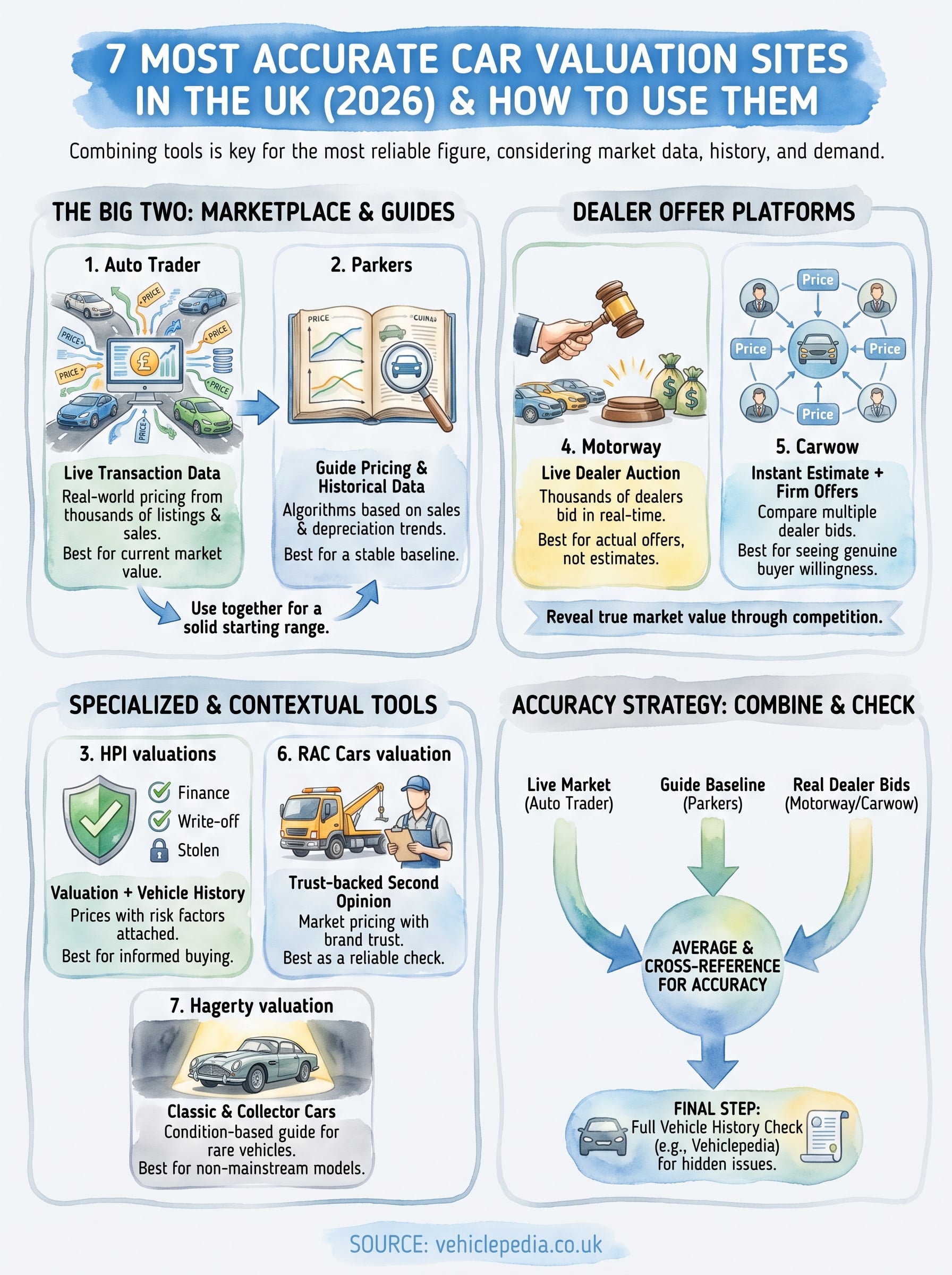
Smart sellers never rely on one number. Run your registration through Auto Trader for a live marketplace figure, then check Parkers for a guide-price baseline, and you'll immediately see whether the market's moving faster or slower than the standard depreciation curve suggests. If those two figures sit within a few hundred pounds of each other, you've got a solid range to work from.
Testing the actual market matters just as much as reading estimates. Feed the same details into Motorway or Carwow to see what dealers actually bid, since real offers cut through any algorithm's guesswork. Where the estimate and the bid diverge significantly, that gap tells you something: either your condition rating was too generous, or demand for your specific model has shifted since the guide prices were last updated.
Three numbers that agree beat one number you hope is right.
Here's a practical sequence to follow:
- Get a live-market figure from Auto Trader
- Get a guide-price baseline from Parkers
- Get real dealer bids from Motorway or Carwow
- Average the three, weighting the dealer bid most heavily
Classic owners should skip straight to Hagerty and ignore the mainstream tools entirely, since they simply won't have relevant data. Whatever category you fall into, cross-referencing costs you ten minutes and saves you from underselling or overpaying based on a single, possibly skewed, estimate.
Knowing your car's true worth
No single tool gives you the most accurate car valuation UK figure on its own, but combining a live-market check, a guide-price baseline, and a real dealer bid gets you as close to the truth as you'll find. The gap between those numbers usually tells you more than any single one ever could, whether that's an inflated condition rating or a shift in demand you hadn't noticed.
Price is only half the picture, though. A fair valuation means little if the car's hiding outstanding finance or a written-off history you didn't know about. Before you commit to buying or pricing a sale, run the registration through a proper history check to see what's actually behind that number. Check out our sample report to see exactly what turns up, then get your own report and know precisely what you're pricing.