Car Finance Check UK: How To Find Past PCP/HP For Claims
Find old PCP or HP records and start your compensation claim. Learn how to perform a car finance check UK to gather evidence and contact lenders for free.
Car Finance Check UK: How To Find Past PCP/HP For Claims
Millions of UK drivers took out PCP or HP agreements over the past two decades, and many had no idea their dealer was earning a hidden commission that inflated the cost. If you're trying to run a car finance check UK to dig up old agreements and figure out whether you're owed compensation, you're not alone. The mis-sold motor finance scandal has prompted a wave of claims, but the first hurdle most people face is simply finding the details of deals they signed years ago.
That's where things get practical. Whether your finance was with Black Horse, Close Brothers, or another lender, there are specific steps you can take to trace past PCP and HP agreements, even if you've long since sold the car. You don't need a solicitor to get started, and in many cases, you don't need to pay anyone a fee either. What you do need is the right information and a clear process to follow.
At Vehiclepedia, we help UK car buyers check a vehicle's history before purchase, including whether it has outstanding finance attached to it. We've seen first-hand how common car finance issues are, which is exactly why we've put this guide together. Below, we'll walk you through how to find your past finance agreements, check for discretionary commission arrangements, and take the next steps toward making a claim if you're eligible.
What a car finance check for claims actually means
When most people hear "car finance check," they think about checking whether a car they want to buy has outstanding finance attached to it. That type of vehicle finance check is useful before a purchase, but what we're discussing here is something quite different. A car finance check UK in the context of mis-sold finance means going back through your own borrowing history to find agreements where a lender or dealer may have charged you more than they should have, without telling you.
What the scandal is actually about
The core issue is called a discretionary commission arrangement, or DCA. Before the Financial Conduct Authority banned DCAs in January 2021, many car dealerships had the power to set the interest rate on your finance deal within a range provided by the lender. The higher the rate the dealer set, the bigger their commission payment. Because this arrangement was not disclosed to customers, the FCA found it created a serious conflict of interest, and that millions of UK consumers likely paid more for their car finance than they needed to.
The FCA has confirmed it is reviewing whether lenders should pay redress to affected customers, with a decision on next steps expected in 2025.
The FCA's review covers agreements taken out between April 2007 and January 2021, which is why so many people are now trying to locate records from years or even a decade ago. Some of those agreements relate to cars people no longer own, with lenders whose names they can barely recall.
The difference between PCP, HP, and a commission claim
A Personal Contract Purchase (PCP) and a Hire Purchase (HP) are the two most common types of car finance affected by the DCA issue. With PCP, you pay a deposit, make monthly payments, and then either return the car, make a balloon payment to keep it, or trade it in against a new deal. With HP, you pay in instalments until you own the vehicle outright. Both product types could have had a discretionary commission arrangement applied to them.
What you're checking for is not the finance product itself, but whether a commission arrangement existed between your dealer and lender that was not disclosed to you, and whether that arrangement caused you to pay a higher interest rate than you otherwise would have. It's a specific question about the terms of a historical deal, which is why you need to locate the original agreement or at least the key details from it.
Why this is not the same as a standard vehicle finance check
When Vehiclepedia runs a vehicle history check using a registration plate, it looks at DVLA records, police databases, and insurance registers to show whether a car currently has finance outstanding on it. That tells a buyer whether someone else's loan is still attached to a car they're considering purchasing. It's a forward-looking check designed to protect the next buyer.
A claim-related car finance check is a backward-looking process. You're the borrower, and you're looking at your own past agreements to understand whether you were treated fairly by the lender and dealer at the time. You need the lender's name, the agreement dates, the vehicle registration, and ideally the interest rate you were charged. Once you have those details, you can check whether a DCA was in play and whether you have reasonable grounds to raise a complaint.
These are two entirely different purposes. Confusing them is the most common reason people waste time chasing the wrong records or approaching the wrong organisations early in the process.
Are you likely eligible under the FCA scheme
Before you spend time tracking down old paperwork, it's worth understanding whether your situation fits the FCA's review. Not every car finance agreement is covered, and knowing the key eligibility criteria upfront will save you from chasing records that won't lead anywhere useful.
The core eligibility criteria
The FCA's review centres on a specific window and a specific type of arrangement. Your agreement generally needs to meet all of the following conditions to fall within scope:
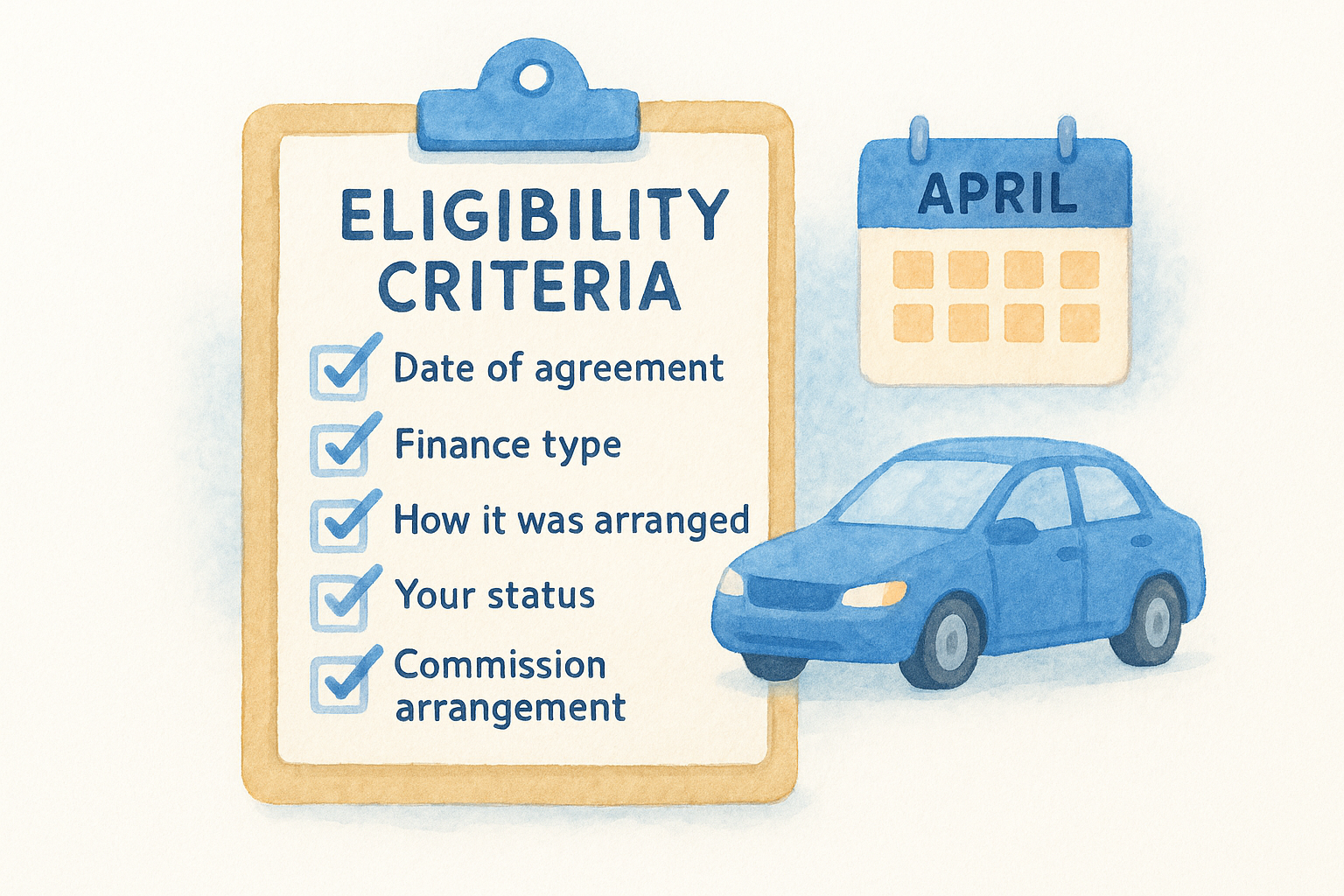
| Criteria | What it means for you |
|---|---|
| Date of agreement | Signed between April 2007 and January 2021 |
| Finance type | PCP or HP, not a personal loan or straight lease |
| How it was arranged | Through a dealership, not directly with a bank |
| Your status | You were a private individual, not a business buyer |
| Commission arrangement | A discretionary commission arrangement (DCA) existed between the dealer and lender |
You don't need to prove the DCA existed yourself at this stage. You only need to have a reasonable basis to suspect it was in play, which for most PCP and HP agreements arranged through dealers before January 2021 is a fair assumption. The lender is required to investigate and respond to your complaint with their findings.
The FCA has confirmed that lenders must keep complaints on hold while the review is ongoing, so raising a complaint now protects your position even if you don't have all the details yet.
Running a car finance check UK through your credit report is often the fastest way to confirm the dates and lender involved, which we cover in the next section.
When you are less likely to have a valid claim
Some agreements fall outside the scope of the current review entirely. If you arranged finance directly through a bank or building society without a dealer setting the rate, there was no third party with an incentive to inflate your interest, so the DCA issue does not apply. Similarly, if your agreement was signed after January 2021, when the FCA banned DCAs, your deal predates the fix rather than sitting within the problem period.
Business finance agreements are also excluded. If the car was registered to a limited company or sole trader rather than to you personally, the consumer protection rules that underpin these complaints do not apply in the same way. If any of these conditions describe your situation, it is worth checking the FCA's published guidance directly before investing time in a formal complaint.
What details you need before you start
Chasing old finance records without a clear picture of what you're looking for wastes time and leads to dead ends. Before you do anything else, gather the core information that lenders, credit agencies, and the Financial Ombudsman Service will ask you to provide. Having this ready from the start makes every subsequent step faster and keeps your complaint on solid ground.
The key details that make or break your claim
Every car finance check UK process for a potential DCA claim relies on a small set of critical data points. You may not have all of them yet, and that's fine, but you need to know which ones you're missing so you know what to go and find. The more of these you have, the stronger your starting position.
Here's what you need to track down before you raise a formal complaint:
| Detail | Why it matters | Where to find it |
|---|---|---|
| Lender name | Your complaint goes directly to them | Old paperwork, credit report, bank statements |
| Agreement start date | Confirms you fall within April 2007 to January 2021 | Finance agreement document, credit report |
| Agreement number | Identifies your specific deal | Finance agreement document, old correspondence |
| Vehicle registration | Links the deal to the car | V5C logbook, old insurance documents |
| Monthly payment amount | Helps verify the agreement on your credit file | Bank statements |
| Interest rate (APR) | Key evidence if a DCA inflated it | Finance agreement document |
If you can confirm the lender name and approximate agreement dates, you have enough to start a complaint. The lender is legally required to investigate and provide the remaining details.
A template to keep your records organised
Once you start gathering information, things can quickly get disorganised across multiple cars or agreements. Use a simple record-keeping template so nothing slips through the gaps.
Copy this into a document or spreadsheet and fill in what you know:
Vehicle registration:
Make and model:
Approximate purchase year:
Finance type (PCP / HP):
Lender name:
Agreement number (if known):
Agreement start date:
Agreement end date (or when car was sold/returned):
Monthly payment:
APR / interest rate:
Source of information (e.g. credit report, paperwork, bank statement):
Notes:
Work through one agreement at a time if you had multiple cars on finance. Keeping records separate avoids mixing up dates or lenders, which can cause problems later when you're tracking complaint responses against specific deals.
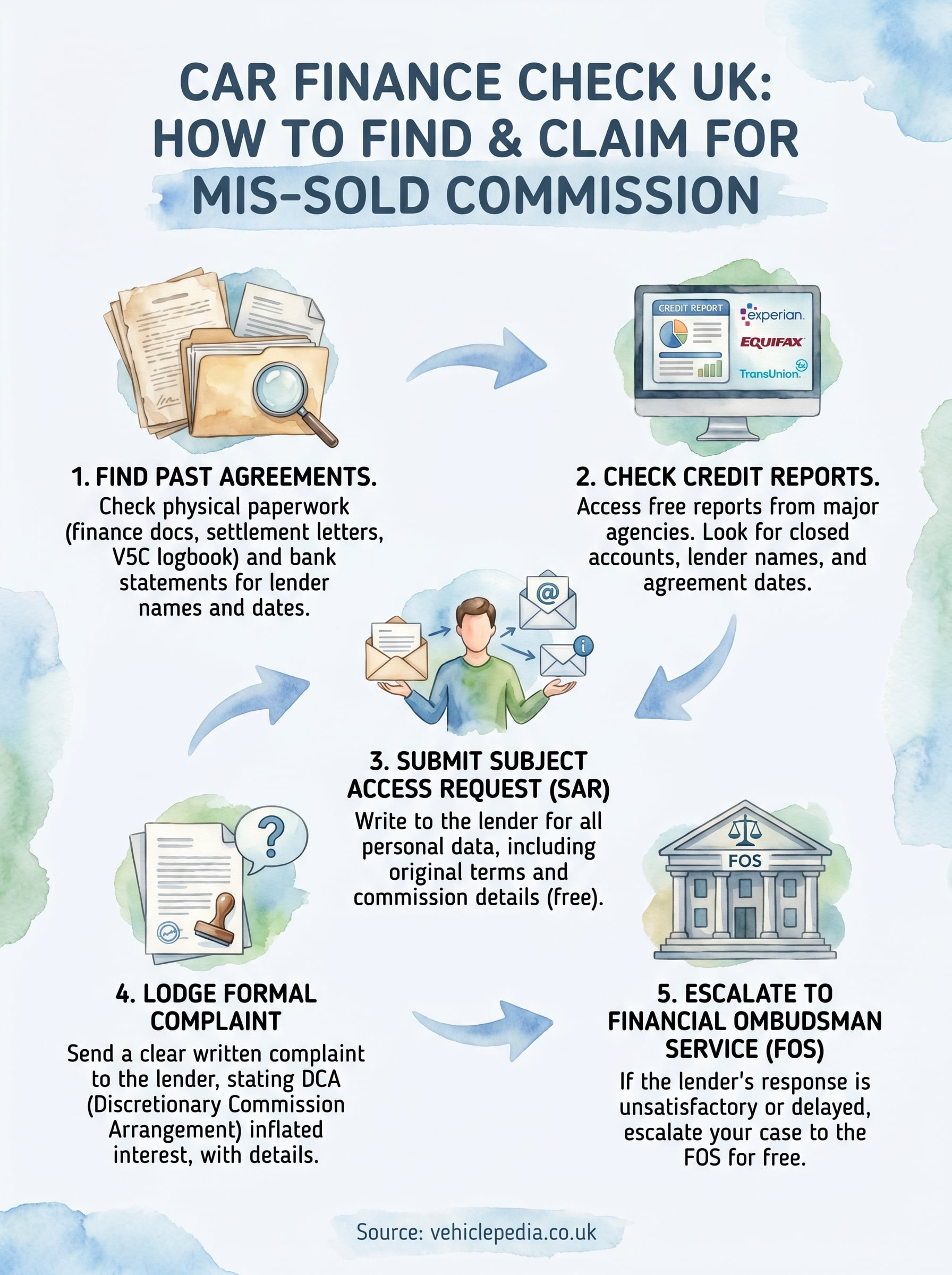
Step 1. Find your lender and agreement dates
The first thing you need is the lender's name and the dates your agreement ran. Without these, you cannot raise a complaint, request data, or check whether your deal falls within the FCA's review window. Start with what you already have before you go looking anywhere else, because the answer is often closer than you think.
Check physical paperwork first
Your original finance agreement document is the most reliable starting point. It will carry the lender's full legal name, your agreement number, the start date, the APR, and the term length. Check any folders, filing cabinets, or document wallets where you keep financial records. If you kept the V5C logbook, it may have the registration number you need to cross-reference against other sources.
Look for any of the following:
- The original finance agreement or welcome letter from the lender
- A settlement letter if you paid off the agreement early
- Any annual statements of account sent by the lender
- Email confirmations from the dealer or finance company
If you find even one of these documents, you likely have enough to begin your complaint without relying on credit reports or subject access requests.
Keep everything you find in a single folder, physical or digital, labelled by registration number so you can match documents to specific agreements without confusion.
Bank statements fill the gaps
If you cannot find the original paperwork, your bank statements are the next best source. Monthly payments to a finance company will show up as standing orders or direct debits, and the payee name on those transactions is usually the lender, not the dealership. Log in to your online banking and search back as far as your records go, or request archived statements from your bank directly.
Once you spot a regular payment to a name you recognise as a finance company, note the first and last payment dates. That gives you an accurate picture of when the agreement started and ended, which is exactly what a car finance check UK process requires before you can move forward. If the payee name is abbreviated or unclear, a short search using the name alongside "car finance UK" will usually confirm whether it is a lender and what their full trading name is.
Write down the lender name, the first payment date, and the approximate monthly amount in your record-keeping template from the previous section before moving on to Step 2.
Step 2. Pull your agreement info from credit reports
If physical paperwork and bank statements haven't given you everything you need, your credit file is the next place to look. All three major UK credit reference agencies hold records of your borrowing history, and a car finance agreement will appear as a credit account on your file, usually showing the lender name, the opening date, the closing date, and the account status. You can access this information for free, with no need to pay for any premium subscription.
The three main credit reference agencies
The UK has three credit reference agencies that lenders report to: Experian, Equifax, and TransUnion. Not every lender reports to all three, which means a finance agreement might show on one agency's file but not on another's. For a thorough car finance check UK, pull your report from all three rather than assuming one gives you the full picture.
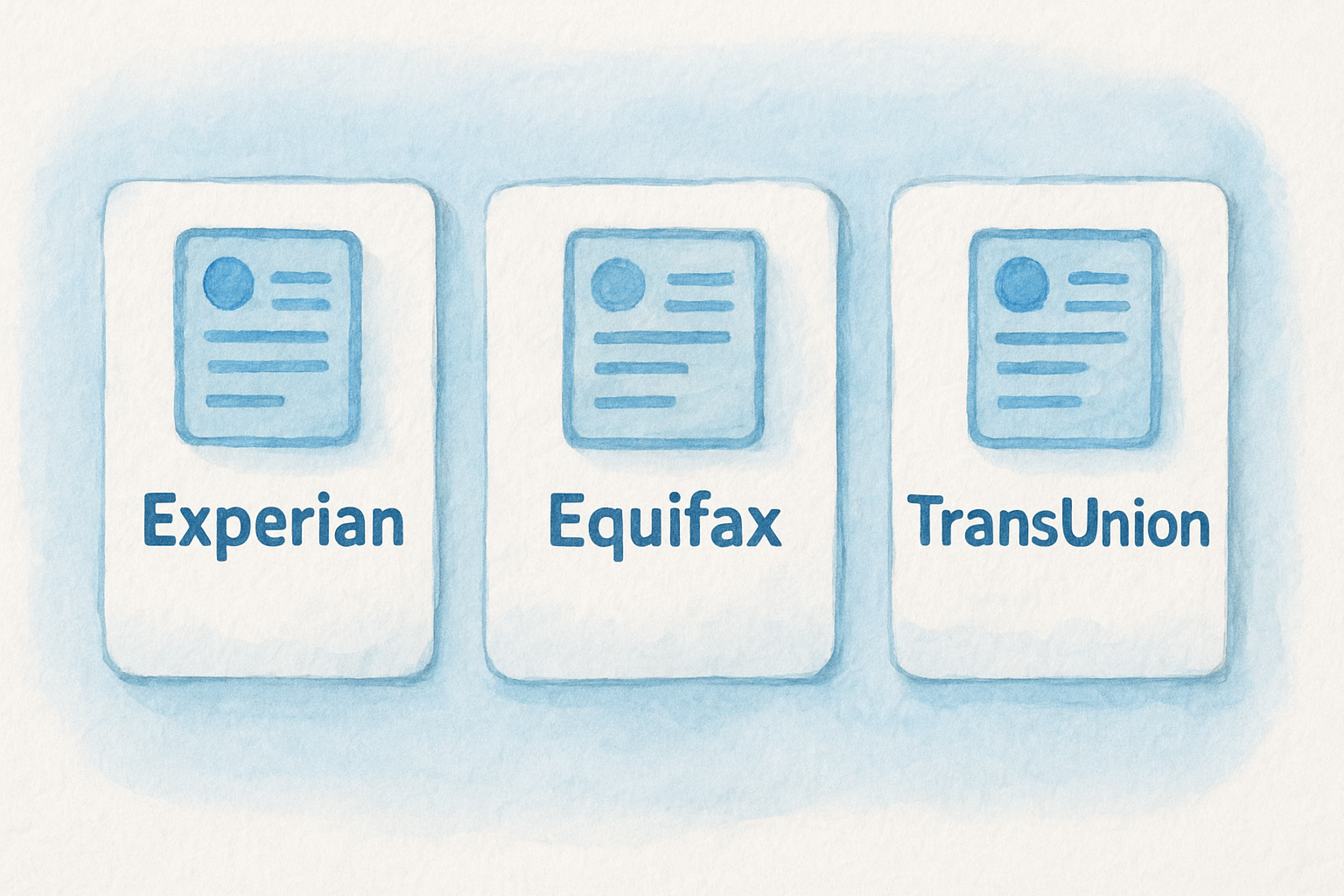
Here's how to access each one for free:
- Experian: Use the free CreditExpert trial or request your statutory report directly through Experian's website
- Equifax: Access your full report free through ClearScore, which pulls live Equifax data
- TransUnion: Access your report free through Credit Karma, or request your statutory report directly from TransUnion
Each agency holds up to six years of credit history by default, but you can write to the agency directly and request records beyond that window if your agreement predates it. Explain in writing that you need the full historical data for the purpose of a financial complaint, and the agency is obliged to respond under UK data protection law.
Under UK data protection law, you have the right to request all personal data a credit reference agency holds about you, with no fixed time limit restricting how far back that request can reach.
What to look for in your credit file
Once you have your reports, search for closed and settled accounts as well as active ones, because a finance deal you paid off years ago will likely sit in an archived section rather than appearing under your main account list. Look under headings labelled "settled accounts," "closed accounts," or "previous credit" depending on which platform you're using to view the report.
For each finance entry you find, note down the lender name, account open date, account close date, and any reference number shown. Cross-reference these details against the record-keeping template you filled in during the earlier section. If the same lender appears across multiple agencies' reports, check that the dates match across both files before using the data as the basis for a formal complaint.
Step 3. Ask the dealer or lender for missing records
If your credit reports and bank statements have left gaps, the next step is to go directly to the source. Both the original dealership and the finance lender are legally required to hand over personal data they hold about you under UK GDPR. This is called a Subject Access Request (SAR), and it costs nothing to submit. Your right to request personal data is not time-limited in the same way as a legal claim, so older agreements are still fair game.
Submit a Subject Access Request to the lender
A SAR sent to the lender is the most productive move at this stage of a car finance check UK process. The lender holds the original agreement terms, the interest rate applied, and any records of commission arrangements linked to your deal. Send your request in writing by post or email to their data protection or compliance team.
Use this template as a starting point:
To: [Lender name] Data Protection Team
Subject: Subject Access Request

I am requesting all personal data you hold about me under UK GDPR.

Full name: [Your full name]
Date of birth: [Your date of birth]
Vehicle registration (if known): [Registration number]
Approximate agreement dates: [e.g. 2013 to 2016]

Please include all records relating to motor finance agreements,
commission arrangements, and related correspondence.

Yours faithfully,
[Your name]
The lender has 30 calendar days to respond once they receive your request. If they ask for proof of identity, send it promptly so the response deadline does not restart from scratch.
What to do if the dealer has closed down
Many dealerships that arranged finance before 2021 have since closed or changed ownership, so a SAR sent to them may go unanswered. The lender remains your primary contact because they hold the financial records independently of the dealer. You can check whether a firm is still regulated and under what current trading name using the FCA's Financial Services Register at register.fca.org.uk, which is updated in real time.
If the lender has merged or rebranded, the acquiring company inherits all data obligations, so direct your SAR to the current trading entity rather than the original name.
Should you receive no response within 30 days from either party, you can report the failure to the Information Commissioner's Office (ICO), which enforces UK GDPR compliance. You can also flag the non-response to the Financial Ombudsman Service if the lender is refusing to cooperate with a legitimate data request connected to a potential mis-selling complaint.
Step 4. Submit a complaint to your lender
Now that you have gathered your agreement details, you are ready to raise a formal complaint directly with the lender. This is a straightforward step, but the way you structure your complaint affects how quickly the lender can process it. A clear, written complaint with the key facts included gives the lender no excuse to delay with follow-up questions. You do not need a claims management company to do this part of a car finance check UK process, and paying one a percentage of your redress is rarely worth it.
What your complaint letter must include
Your complaint needs to cover four core points: who you are, what agreement is in question, why you believe a DCA was applied, and what outcome you are requesting. Keep the letter factual and brief. Lenders receive high volumes of these complaints, and a focused letter gets processed faster than a lengthy narrative.
Use this template as your starting point:
To: [Lender name] Complaints Team
Subject: Formal Complaint – Discretionary Commission Arrangement

Dear Sir or Madam,

I am writing to raise a formal complaint regarding a motor finance
agreement I held with your organisation.

Full name: [Your full name]
Date of birth: [Your date of birth]
Agreement number (if known): [Agreement number]
Vehicle registration: [Registration number]
Approximate agreement dates: [e.g. March 2014 to March 2017]

I believe a discretionary commission arrangement (DCA) was applied
to my agreement without my knowledge or consent, resulting in a
higher interest rate than I would otherwise have paid.

I am requesting that you investigate this complaint, confirm whether
a DCA existed on my agreement, and provide appropriate redress
if one did.

Yours faithfully,
[Your full name]
[Your address]
[Your email address]
[Date]
Send your complaint by email and keep a copy of the sent message, as this gives you a timestamped record you can reference if you need to escalate to the Financial Ombudsman Service later.
Where to send the complaint
Direct your complaint to the lender's dedicated complaints team, not a general customer service inbox. Most lenders publish a complaints email address or an online submission form on their website under a section labelled "complaints" or "contact us." If you cannot locate it, call their main number and ask specifically for the complaints department contact details before sending anything.
Once the lender logs your complaint, they must acknowledge it promptly. Under FCA rules, they have eight weeks to issue a final response before you can escalate. Because of the ongoing FCA review, most lenders are currently pausing DCA complaints rather than resolving them immediately, but your complaint still needs to be formally registered now so your position is protected when a decision is eventually reached.
Step 5. Track timelines and reply to offers
Once your complaint is logged, the process does not run on autopilot. You need to actively monitor what arrives from the lender and respond within the timeframes they set. Missing a deadline or ignoring a settlement offer can close off your options, so treat this stage of your car finance check UK claim as a live task that needs your attention at regular intervals.
Know the deadlines that apply to your complaint
The FCA has extended the window for lenders to resolve DCA complaints, which means you may be waiting longer than you would for a standard financial complaint. Lenders are currently permitted to pause their final responses until the FCA concludes its review, with a decision expected in 2025. That does not mean nothing happens in the meantime. The lender must still acknowledge your complaint and write to you confirming it is on hold.

Keep a simple log so you can track where each complaint stands:
Lender name:
Complaint submitted (date):
Acknowledgement received (date):
Hold notification received (date):
FOS escalation deadline:
Settlement offer received (date):
Offer amount:
Response deadline:
Action taken:
If you do not receive an acknowledgement within two weeks of submitting your complaint, contact the lender in writing to confirm they have received it, and keep a copy of that follow-up.
How to respond to a settlement offer
When the lender does issue a final response or a settlement offer, read it carefully before accepting anything. Check whether the offer covers the full period your agreement ran, and whether the redress calculation reflects the interest you actually overpaid rather than a flat figure the lender has chosen for convenience.
You have three clear options when an offer arrives:
- Accept the offer if the amount fairly reflects what the inflated rate cost you over the term
- Reject the offer and negotiate in writing if you believe the calculation is too low, providing your own workings based on the agreement terms you have gathered
- Escalate to the Financial Ombudsman Service (FOS) if the lender refuses to budge or you receive no final response within eight weeks of the hold being lifted
To escalate, visit the FOS website and submit your case online. You will need to attach copies of your original complaint, the lender's response, and any supporting documents such as your credit report entries or SAR response. The FOS charges nothing to consumers and its decisions are binding on the lender if you accept the ruling.
Avoid scams and protect your data
The mis-sold motor finance story has generated significant public attention, and where there is public attention, there are fraudsters looking to exploit it. Before you start a car finance check UK complaint process, you need to know how to spot the organisations and individuals who will try to take advantage of you, and what personal data you should never hand over unless you are certain who is asking for it.
How to spot a claims management scam
Claims management companies (CMCs) are regulated by the FCA and can legitimately help you submit a complaint, but many operate in ethically grey territory, charging fees of 25 to 40 percent of any redress you receive. Given that you can submit a complaint directly to your lender for free and escalate to the Financial Ombudsman Service at no cost, paying a CMC is rarely in your financial interest.
Watch out for these specific warning signs:
- Unsolicited contact by phone, text, or social media claiming they have found a finance claim in your name
- Requests for upfront fees before any complaint has been submitted or assessed
- Promises of a guaranteed payout amount before your agreement has been reviewed
- Pressure to sign documents quickly without time to read the terms
- Companies that are not listed on the FCA register at register.fca.org.uk
Before engaging any third party, search their firm name on the FCA register. If they are not listed as authorised to conduct claims management activity, do not share any personal information with them.
What data to share and what to withhold
When you submit a Subject Access Request or a formal complaint, you will need to provide your name, date of birth, address, and agreement details. This is normal and expected. What you should never provide to anyone who contacts you without your initiation is your full bank account number, sort code, or online banking login credentials. No legitimate lender, credit reference agency, or FOS caseworker will ask for these.
Use this checklist to assess any data request you receive:
Is this organisation on the FCA register?                  Yes / No
Did I initiate this contact, or did they contact me?       I initiated / They contacted
Are they asking for bank login details?                    Yes / No (No = safe)
Are they asking for upfront payment?                       Yes / No (No = safe)
Is their request in writing with a reference number?       Yes / No
If any answer raises a concern, stop the interaction and report it to Action Fraud at actionfraud.police.uk before proceeding further.
Your next move
You now have everything you need to run a proper car finance check UK process from start to finish. You know how to locate old agreements through credit reports, bank statements, and Subject Access Requests, how to submit a formal complaint without paying a claims management company, and how to escalate to the Financial Ombudsman Service if the lender does not respond fairly.
Start with the simplest step available to you today. If you have paperwork, pull it out. If you do not, log in to ClearScore or Credit Karma and check your closed credit accounts for finance entries. Get the lender name and dates confirmed before you do anything else, because everything that follows depends on those two pieces of information.
If you are buying a used car and want to check whether it has outstanding finance attached to it before you commit, view a sample vehicle history report to see exactly what Vehiclepedia checks for you.