How to Do an MOT Check on a Car Using Its Reg Number
Do an MOT check on a car with just its reg. See status, expiry date and full test history, then learn to read fails, advisories and mileage.
How to Do an MOT Check on a Car Using Its Reg Number
To run an MOT check on a car, all you need is its registration number. Enter it into the GOV.UK MOT service or a free checker such as Vehiclepedia, and you see within seconds whether the car has a valid MOT, when it expires and what it has been through at every test. Then compare the mileage and advisories with what the seller tells you.
The trouble is that most people only glance at the expiry date. A car can show six months of MOT left and still have a record of repeated failures, mileage that goes backwards, or the same corroded brake pipe flagged three years running. A paper certificate proves very little. It can be out of date or forged, and it never shows what the tester noticed in previous years.
This guide takes you through four steps: getting the right registration, running the check, reading the result properly, and deciding what to do next. Along the way you will see what the law says, what each defect category means and which mileage patterns should make you walk away.
What an MOT check tells you and why it matters
An MOT check shows whether a vehicle has a current MOT certificate, when it runs out and the results of its past tests. It tells you how roadworthy the car was on the day of each test. It does not tell you how it has been treated since.
What you can see from a registration number
A lookup returns the same core information wherever you run it. The official history records go back to 2005.
- Current MOT status and expiry date
- The date and result of each past test
- The odometer reading recorded at each test
- Failure reasons, minor defects and advisories
What the law says
A car needs its first MOT by the third anniversary of its registration, then once every 12 months. Driving without a valid MOT can bring a fine of up to £1,000. The main exception is driving to a pre-booked test, or to a garage for repairs after a failed one. Cars over 40 years old are exempt if they have not been substantially changed. Cars registered in Northern Ireland are tested under a separate scheme, so the GB services below will not cover them.
A valid MOT proves a car was roadworthy on one day, so the history matters more than the certificate.
Step 1. Get the registration number right
Start by writing down the exact registration, because one wrong character returns a different car or no result at all. Where you get it from matters when you are buying.
Where to find it
For a car you own, read it from the number plate or the V5C logbook. For a car you are thinking of buying, take it from the advert, but ask the seller to confirm it by message. Photographs can hide a character with a thumb or a shadow, and a typo in a listing is common.
Check the plate against the car
Once you have a result, make sure it describes the car in front of you. The make, model and colour returned should match the vehicle. If the lookup says a silver Ford Fiesta and the seller shows you a black Vauxhall Corsa, stop. That is either a mistake or a cloned plate, and you should not continue until it is explained.
Always confirm that the make, model and colour in the result match the car you are looking at.
Step 2. Run the check
Run the lookup on an official service first, then cross-check it on a second tool if you want the history presented more clearly. Both take under a minute and cost nothing.
Use the official GOV.UK services
GOV.UK offers two free services: check MOT status and check MOT history. Follow these steps:
- Open the GOV.UK check MOT status service.
- Enter the registration number without spaces and continue.
- Confirm that the make and colour match the car.
- Note the expiry date, then open the history to see each test.
Use Vehiclepedia's free MOT check
Vehiclepedia's free MOT check works the same way: type the registration and the result appears instantly. You get the current MOT status, the test date, a countdown of the days remaining and the due date, which you can copy straight into your calendar. Below that sits the full history, including the tester's comments, advisories and the mileage at each test. The data is refreshed nightly from official sources. The same lookup also shows road tax status and cost, so you can check both in one go.

Run the registration through the official service and a second tool, and treat any mismatch as a reason to ask questions.
Step 3. Read the result properly
Reading an MOT history means checking three things: the status and expiry date, the type of every defect recorded, and whether the mileage tells a believable story. Skipping any of them leaves gaps.
Status and expiry date
A car is either valid, with an expiry date, or expired. A new car shows its first test due date three years after registration. If a car's MOT expires on 15 July, you can test it from 16 June and keep the 15 July renewal date. Any earlier and the new 12 months start from the test date.
Pass, fail and advisory categories
Since 2018 testers use four defect categories. Knowing them lets you judge a history in seconds.
| Category | What it means | Result | Can you drive it? |
|---|---|---|---|
| Dangerous | Direct risk to road safety or the environment | Fail | No, not until repaired |
| Major | May affect safety or the environment | Fail | Must be repaired and retested |
| Minor | No significant effect | Pass | Yes, repair soon |
| Advisory | Could become a problem later | Pass | Yes, keep an eye on it |
Driving with a dangerous defect can lead to a fine of up to £2,500, three penalty points and a possible ban. An advisory repeated year after year on brakes, suspension or corrosion is a warning that someone has been ignoring it.
Mileage pattern
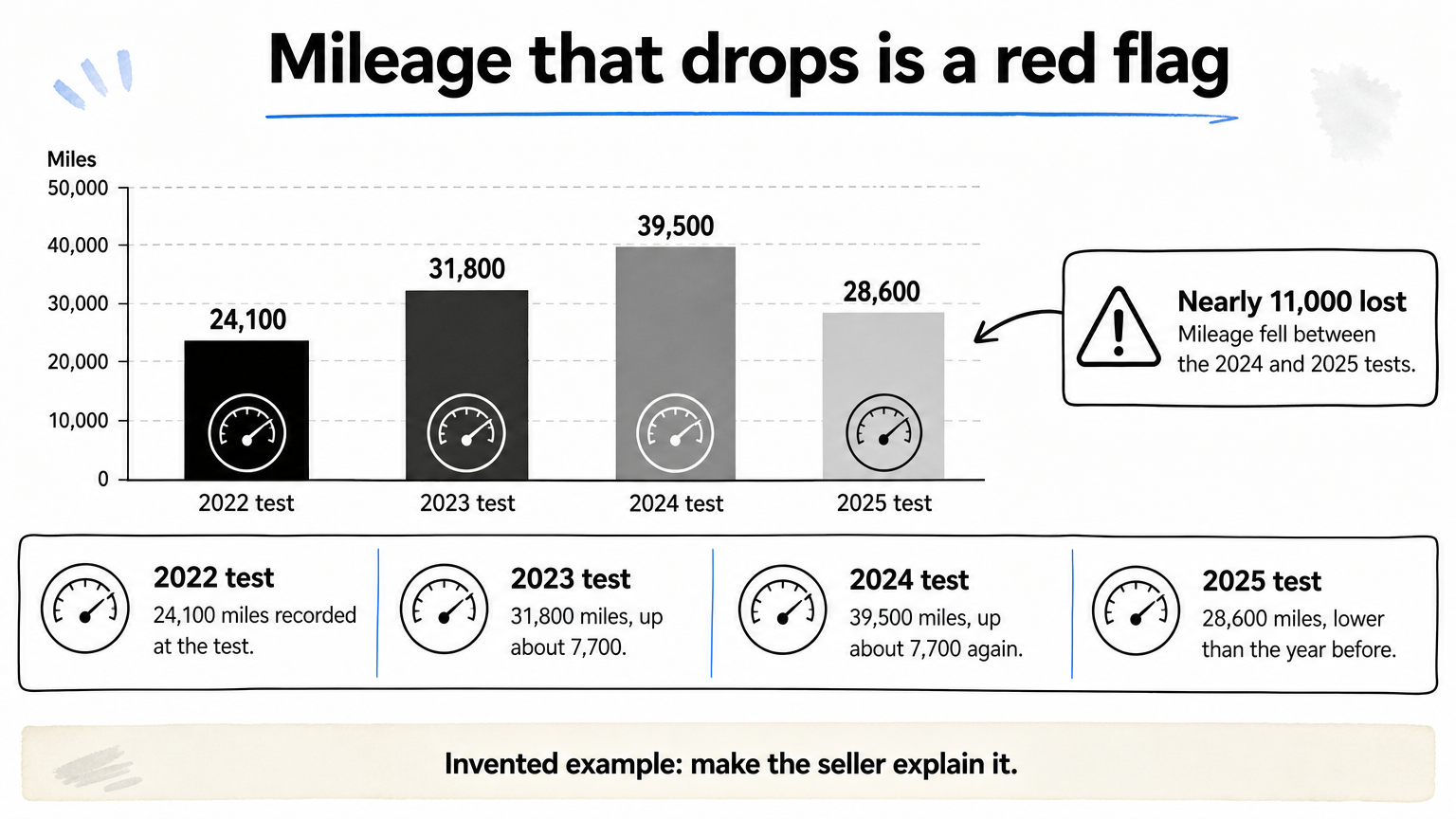
Odometer readings should rise steadily. Vehiclepedia raises instant warnings for mileage trends and sudden drops. This invented example shows what a red flag looks like:
| Test year | Recorded mileage |
|---|---|
| 2022 | 24,100 |
| 2023 | 31,800 |
| 2024 | 39,500 |
| 2025 | 28,600 |
The car adds about 7,700 miles a year, then loses nearly 11,000. That could be a data entry slip, but it could equally be clocking, so make the seller explain it.
Read the whole history and look for repeated advisories and mileage that stops adding up.
Step 4. Act on what you find
What you do next depends on whether you are buying the car or looking after one you already own. The check gives you evidence either way.
If you are buying
Walk away or renegotiate based on what the history shows. These are the points to act on:
- An expired MOT means you cannot legally drive the car home unless you are heading to a pre-booked test.
- Several failures for the same fault suggest poor repairs.
- Advisories for tyres, brakes or corrosion give you grounds to ask for a lower price.
- Missing years in the history are worth querying.
An MOT also says nothing about outstanding finance, theft or insurance write-offs. Those need a separate premium history check, and the sample report below shows what one looks like.
If you own the car
Check the expiry date at least a month before it runs out. Book the test within the early window so you keep your renewal date, and ask GOV.UK for a free reminder by text or email. If the car fails, fix the listed faults before driving it any further than necessary. A dangerous defect means it should not be driven at all.
Use the history to decide whether to buy, negotiate or walk away.
Run the check before you commit
An MOT check on a car takes a minute: get the registration right, run it, read the defects and mileage, and act on what you see. The expiry date is the least interesting part. The history tells you how the car has really been looked after.
Before you hand over any money, run the registration through Vehiclepedia's free MOT check, then view a sample premium report to see what finance, police and write-off checks add on top.