5 Risks of Buying a Car Privately and How to Avoid Them
The main risks of buying a car privately, from weak legal rights to hidden finance and scams, with practical checks to protect yourself before you pay.
5 Risks of Buying a Car Privately and How to Avoid Them
The main risks of buying a car privately are weak legal protection, faults you can't see, outstanding finance or theft, a hidden history of write-offs and clocked mileage, and payment scams. Buying privately suits you if you will run proper checks and can walk away from a deal. If you want a warranty, a right to reject the car and someone to chase when it goes wrong, a dealer is the safer choice.
Private sales are usually cheaper and easier to haggle, which is why so many people go that way. The catch is that nobody stands behind the car once you have paid. One missed problem can wipe out the saving, and a serious one can leave you without the car or the money.
This article takes the five risks one at a time. Each shows what the risk looks like in practice and what you can do about it. We built Vehiclepedia around official DVLA, DVSA and insurance data, so where a history check closes a gap, we say so and show what it costs.
1. Limited legal protection
When you buy from a private seller, the Consumer Rights Act 2015 does not apply, so you lose the safety net that comes with a dealer sale. This is the biggest difference between the two routes, and it is why every other risk on this list hurts more.
What the risk looks like
The table shows what changes when the seller is a private individual rather than a dealer.
| Protection | Dealer | Private seller |
|---|---|---|
| Satisfactory quality and fit for purpose | Yes | No, only "as described" |
| 30-day right to reject a faulty car | Yes | No |
| One repair or replacement within 6 months | Yes | No |
| Faults presumed present at sale in first 6 months | Yes | No |
| Warranty | Common | Not usually |
Once you drive away from a private sale, your pre-purchase checks are the only protection you have.
How to protect yourself
You are not left with nothing. The seller must describe the car honestly and must have the right to sell it. If they lied about mileage or accident history, you may have a claim for a repair, the repair cost or some of your money back. Making that claim is slow without proof.
So build the proof before you pay. Screenshot the advert, save every message, and get a written receipt showing both names and addresses, the registration, the price, the date and a line saying the car is sold as described. Viewing the car at the seller's home also gives you an address to use if something goes wrong.
2. Hidden faults and poor condition
Without a warranty or a dealer's pre-sale inspection, any fault you miss becomes your bill. A private car may have been valeted, but nobody has checked it mechanically.
What the risk looks like
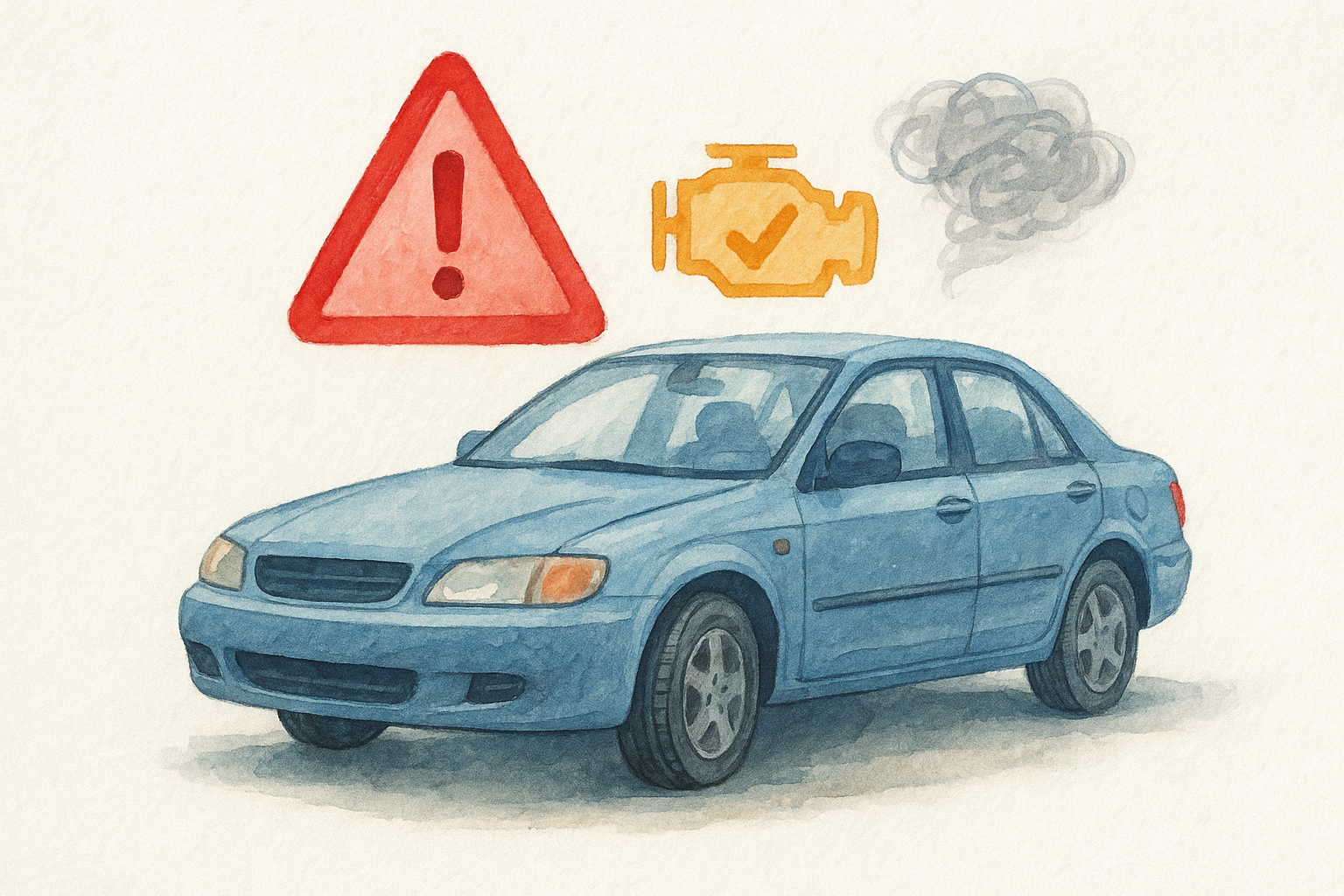
Some sellers do not know their car's problems. Others know and hope you will not look closely. Typical signs are uneven tyre wear, mismatched panel gaps, warning lights, rattles on a cold start and a thin service history. The free MOT history on GOV.UK helps too. Look for repeated advisories, past failures and gaps between tests.
A fault you find before paying is a negotiating point, and a fault you find afterwards is your repair bill.
How to protect yourself
Work through this list before you hand over any money:
- View the car in daylight and when it is dry, so damage shows.
- Ask for the engine to be cold when you arrive.
- Check you are insured to test drive, then drive for at least 15 minutes on different types of road.
- Ask to see the service records and compare them with the MOT history.
- Consider an independent inspection, which costs roughly £120 to £250.
On a £5,000 car, that inspection is 2.4% to 5% of the price. It is worth it for an expensive or unfamiliar car, and for any car where something feels off.
3. Outstanding finance or a stolen car
A car with outstanding finance may still belong to the lender, and a stolen car can be taken from you and returned to its owner. Either way, you risk losing both the car and the money you paid.
What the risk looks like
The usual line is "it's all paid off", with nothing to prove it. The V5C logbook does not show finance, so a clean-looking document tells you nothing. Stolen cars and cloned plates add to the problem, because the paperwork can be forged or borrowed from a genuine car. Be wary if the seller is not the registered keeper, or if the name and address on the V5C do not match their ID.
A seller's word that a car is "paid off" is not evidence, so check the finance record yourself.
How to protect yourself
Run a finance check and a police check before you pay. Our premium check costs £6 and covers both. Outstanding finance comes from an Experian Automotive feed, and stolen records come from the Police National Computer via Experian. Premium reports also carry a data guarantee of up to £30,000 for non-trade users.
On a £5,000 car, £6 is 0.12% of the price. Then check the original V5C, confirm the seller's details match it, and never buy a car without the logbook.
4. Write-offs, clocked mileage and cloned plates
A car can look spotless and still hide an insurance write-off, a wound-back odometer or a changed identity. Sellers are not obliged to volunteer any of it, and you often cannot see it.
What the risk looks like
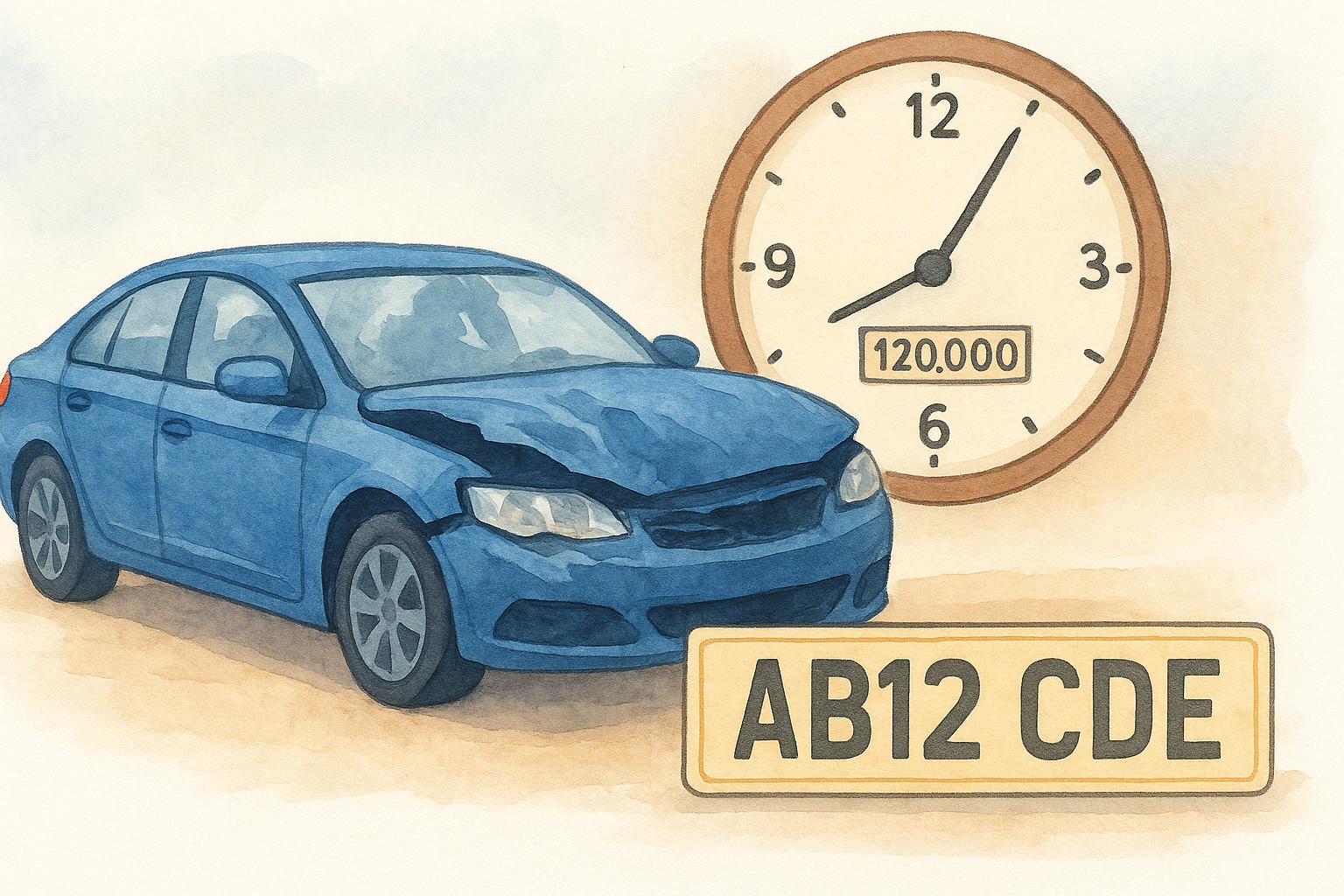
Write-offs range from Category S (structural damage) to Category N (non-structural). Repaired cars can return to the road, but they are worth less and may be unsafe if the repair was poor. Clocked mileage is common because lower miles raise the price. Plate changes, colour changes and a long list of past owners can also point to a car with a past worth questioning.
A low price is easier to explain once you know the car was written off, so find out before you negotiate.
How to protect yourself
Combine free and paid checks. This table shows what each one tells you.
| Check | Cost | What it shows |
|---|---|---|
| MOT history on GOV.UK | Free | Test dates, failures, advisories, mileage at each test |
| DVLA vehicle information | Free | Whether make, colour and tax status match the advert |
| Vehiclepedia free check | Free | MOT history, export, recall, make and model, tax and emissions |
| Vehiclepedia premium check | £6 | Everything in free, plus police, finance, write-off, ownership history, plate changes, colour changes, scrapped and mileage history |
Compare the mileage at each MOT with the odometer. A drop or a sudden stall is a reason to walk away. Write-off data comes from the MIAFTR insurance database.
5. Scams and payment fraud
Private sales attract fake adverts, deposit scams and traders posing as private sellers. These risks are at their worst before you have even seen the car.
What the risk looks like
Watch for these red flags:
- A price far below similar cars, with a story to explain it.
- A request for a deposit before you have viewed the car.
- Pressure to decide today, or a refusal to let you view, test drive or run a history check.
- A meeting at a car park or other odd location instead of the seller's home.
- Missing or mismatched paperwork, or a V5C that does not match the car.
The faster a seller pushes you to pay, the more reason you have to slow down.
How to protect yourself
Never pay a deposit for a car you have not seen. Cash leaves you with no protection, and a bank transfer has daily limits, while CHAPS usually costs a fee. Pay only once you have viewed, test driven and checked the car, and agree the method in advance. Make sure the change of keeper goes to the DVLA straight away, and keep your receipt, the advert and every message.
Is buying privately worth the risk?
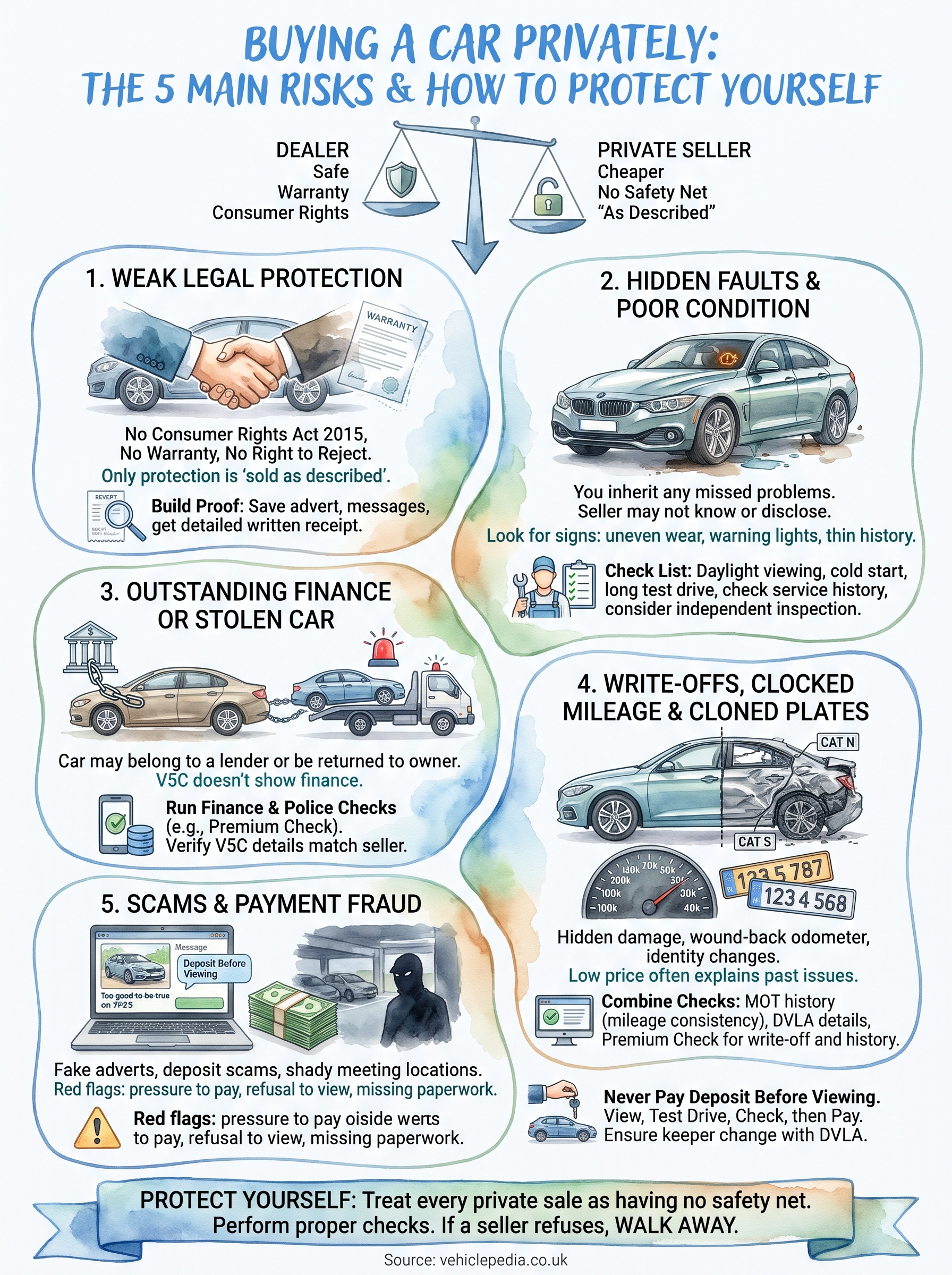
Buying privately can save you real money, but only if you treat every sale as one with no safety net. The five risks are weak legal rights, hidden faults, finance or theft, a concealed history and scams. Most are manageable with a few cheap checks and a seller who has nothing to hide. If a seller refuses a check, walk away. If you cannot or will not do the checking, a dealer's protections are worth paying for.
Before you view your next car, see what a premium report covers and run the registration through a check first.