Can You Buy a Written Off Car? What to Know Before You Do
Can you buy a written off car safely? Learn ABI categories, resale value risks, insurance impacts, and inspection tips before you purchase.
Can You Buy a Written Off Car? What to Know Before You Do
Yes, can you buy a written off car in the UK, and plenty of people do it every week. The real question isn't whether it's legal, it's whether it's a smart move for your situation. Write-off categories cover everything from cars with cosmetic damage to vehicles that should never see a road again, and lumping them all together is where buyers get caught out.
The short answer is that buying a write-off can save you thousands, but only if you know which category you're dealing with and what repairs actually cost. A Category N car with a cracked bumper is a very different prospect to a Category S vehicle with bent structural rails. Insurers, insurance status, and resale value all shift depending on the category attached to that car.
In this article, we'll walk through the write-off categories explained in plain English, the genuine risks around safety and insurability, when buying one makes financial sense, and the checks you should run before handing over any money. That includes how to spot a write-off using nothing more than a registration plate.
Why buying a written-off car is a bigger decision than it looks
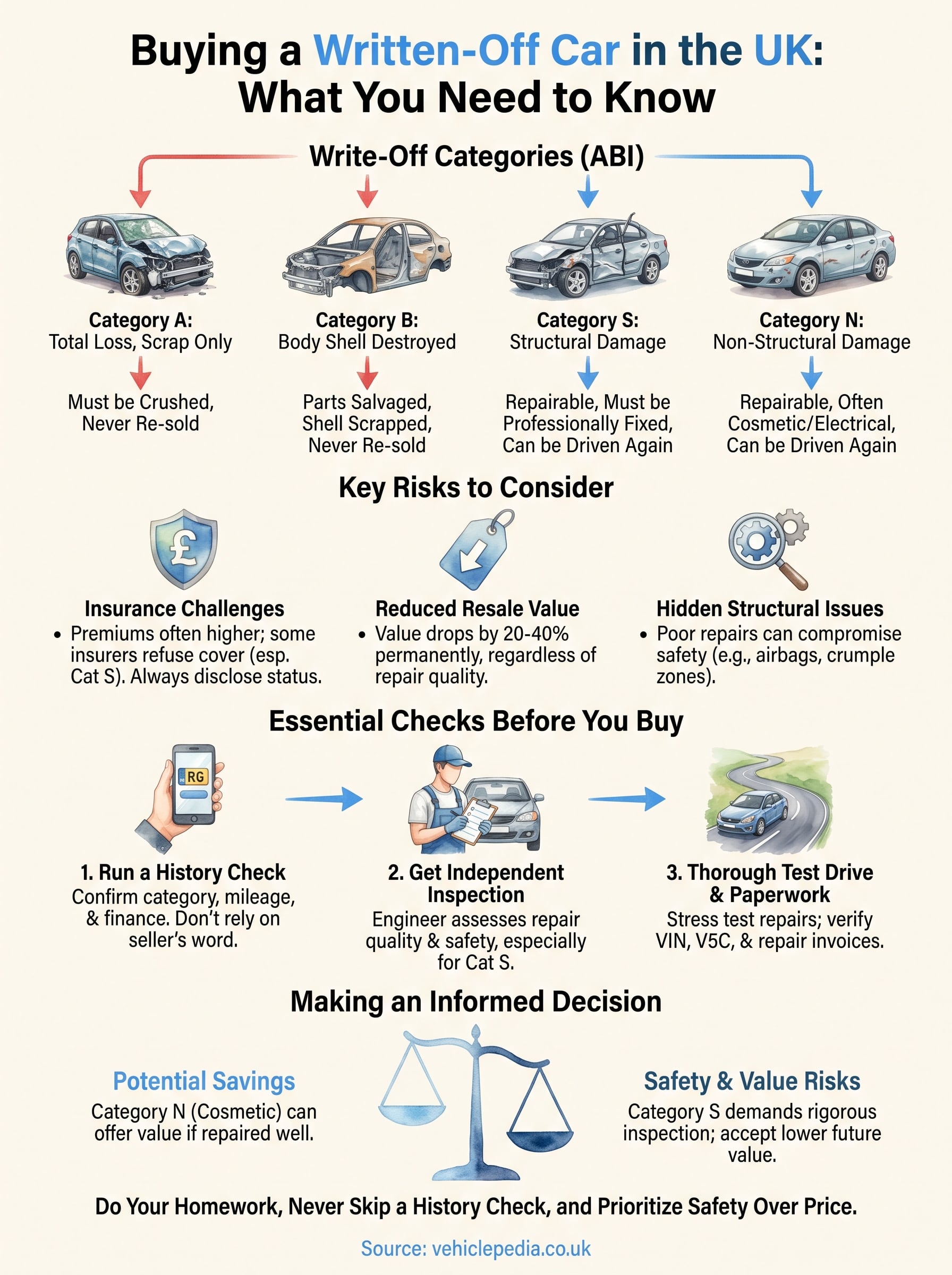
An insurer doesn't write off a car on a whim. After an accident, flood, or theft recovery, an engineer inspects the vehicle and decides whether repairs cost more than the car is worth, or whether the damage makes it unsafe to fix at all. That decision gets logged against the registration and follows the car for life. **[Write-off categories](https://vehiclepedia.co.uk/blogs/what-does-cat-d-mean-on-a-car)**, set out by the Association of British Insurers, tell you exactly what kind of damage you're inheriting if you buy one.The four write-off categories
Each category signals a different level of risk, and mixing them up is the single biggest mistake buyers make.
| Category | What it means | Can it be repaired and driven again? |
|---|---|---|
| A | Total loss, scrap only | No, must be crushed |
| B | Body shell destroyed, parts may be salvaged | No, body cannot return to the road |
| S | Structural damage | Yes, if professionally repaired |
| N | Non-structural damage (cosmetic, electrical) | Yes, often straightforward |
A car's write-off category matters more than its price tag, because it tells you exactly what you're inheriting.
The real risks buyers overlook
Beyond the category itself, three practical problems catch people out. First, insurance gets harder and pricier once a car carries a write-off marker, and some insurers refuse cover for Category S vehicles altogether. Second, resale value drops sharply, often by 20-40%, regardless of how well the repair was done, because future buyers see the same history you're seeing now. Third, hidden structural damage on a poorly repaired Category S car can compromise crumple zones and airbags in a way that's invisible until a second crash exposes it.
Getting this wrong isn't just an inconvenience, it can mean paying full price for a car that's worth a fraction of that, or worse, driving something that won't protect you properly in an accident. That's why the category, the repair standard, and the paper trail behind a write-off deserve more scrutiny than the price sticker ever does.
How to check if a car has been written off
Finding out a car's write-off status takes minutes, not days, and you should never skip this step before viewing a vehicle in person. Every write-off gets logged against the registration plate on the DVLA-linked databases that insurers update after a claim, so a simple vehicle history check will surface the category, the date it was recorded, and whether it's since been repaired and re-registered.
Start with a registration lookup
Run the plate through a proper history check rather than relying on what the seller tells you. A free check typically confirms MOT status, mileage, and basic registration details, while a full report adds the write-off category, any outstanding finance, and stolen markers pulled from police records. Compare what the seller says against what the report shows; any mismatch is a red flag worth walking away from.
Never take a seller's word for a car's history when a registration check can confirm it in seconds.
What to look for beyond the report
A history check tells you the category, but not the repair quality, so back it up with physical checks:
- Ask for before-and-after repair photos and invoices from the bodyshop
- Check for uneven panel gaps, mismatched paint, or fresh underseal hiding welds
- Request an independent engineer's inspection for any Category S vehicle
- Confirm the V5C shows the correct registration history, not a cloned plate
These steps together give you the full picture a report alone can't provide.
How to buy a written-off car safely
Buying a write-off isn't reckless if you approach it methodically. The trick is treating every step as a filter that either confirms the car is sound or gives you a reason to walk away before you've spent a penny.
Get an independent inspection before you commit
Never rely on the seller's assurance that "it's been fixed properly". Pay an independent engineer, not one connected to the seller or repairer, to physically examine the car. For any Category S vehicle, this inspection should check chassis alignment, weld quality, and whether airbags and seatbelt pretensioners were replaced rather than reused.
A £150 independent inspection can save you from a £15,000 mistake.
Confirm the paperwork before you pay
Don't hand over money until the documentation matches the car in front of you. Run through this checklist:
- Match the VIN stamped on the chassis to the V5C and the history report
- Ask for the insurer's repair authorisation letter, not just a garage invoice
- Check the MOT history for any advisory notes logged since the repair
- Confirm there's no outstanding finance still attached to the registration
Insist on a test drive that stresses the repair
Take it on a motorway and around tight corners, not just round the block. Listen for rattles, watch the steering for pull, and check the braking feels even. Any hesitation from the seller about a proper test drive is itself a warning sign worth taking seriously.
What to expect with insurance and resale value
Owning a written-off car changes two things immediately: what you pay for cover and what you'll get back when you sell. Neither surprise should catch you out if you've done your homework on the category before buying.
Insurance gets trickier, not impossible
Many mainstream insurers quote higher premiums for a Category S or N vehicle, and a few refuse cover outright once they see the marker. Specialist insurers exist for repaired write-offs, but expect to shop around rather than renew with your usual provider. Always disclose the write-off status upfront; failing to do so can void a claim entirely when you need it most.
Hiding a write-off from your insurer doesn't save you money, it just delays the moment your claim gets rejected.
Resale value takes a permanent hit
A write-off marker never disappears from the vehicle's history, so every future buyer sees exactly what you saw. Expect the car to sell for noticeably less than an equivalent model without that history, even years after a flawless repair.
| Category | Typical resale value versus equivalent non-written-off car |
|---|---|
| N | 10-20% lower |
| S | 25-40% lower |
That gap matters most if you're planning to sell within a few years rather than keep the car long term. Factor the lower resale price into your budget from day one, because it's guaranteed, unlike the repair quality you're hoping for.
Weighing up your next move
Buying a written-off car isn't a gamble if you go in with your eyes open. Category N vehicles with straightforward cosmetic repairs can be a genuine bargain, while Category S cars demand far more scrutiny before you trust them on the road. The category, the repair paperwork, and an independent inspection together tell you whether you're looking at a smart purchase or a costly mistake waiting to happen.
None of that works, though, if you skip the first step: confirming the car's history before you fall in love with it in a driveway somewhere. A registration lookup takes minutes and either confirms the seller's story or exposes a problem worth walking away from. Before you view another used car, see exactly what a full history report reveals by checking out a sample report and deciding if that level of detail is what stands between you and an expensive regret.