Is It Safe To Buy A Cat S Car? UK Risks & Repair Checks
Is it safe to buy a Cat S car? Learn how to verify structural repairs, check MOT history, and assess safety risks before buying a structural write-off.
Is It Safe To Buy A Cat S Car? UK Risks & Repair Checks
A Category S write-off can sell for 30–50% less than an equivalent clean-titled car, which makes the price tag tempting. But before you hand over any money, you need to ask yourself: is it safe to buy a Cat S car? The honest answer depends on who repaired it, how well they did it, and whether you can verify their work.
Cat S means the vehicle sustained structural damage serious enough for an insurer to declare it uneconomical to repair. That doesn't mean it can't be fixed, it means the insurer chose not to pay for it. Some Cat S cars are repaired to a high standard and drive perfectly well. Others are bodged back together and put straight on AutoTrader. The difference isn't always visible to the untrained eye.
This guide breaks down the real risks of buying a Cat S car, what checks to carry out before purchase, and how the classification affects insurance and resale value. We'll also explain how running a vehicle history check through Vehiclepedia can flag whether a car has been written off, something that sellers don't always disclose. If you're weighing up a Cat S bargain, read this before you commit.
What Cat S means in the UK
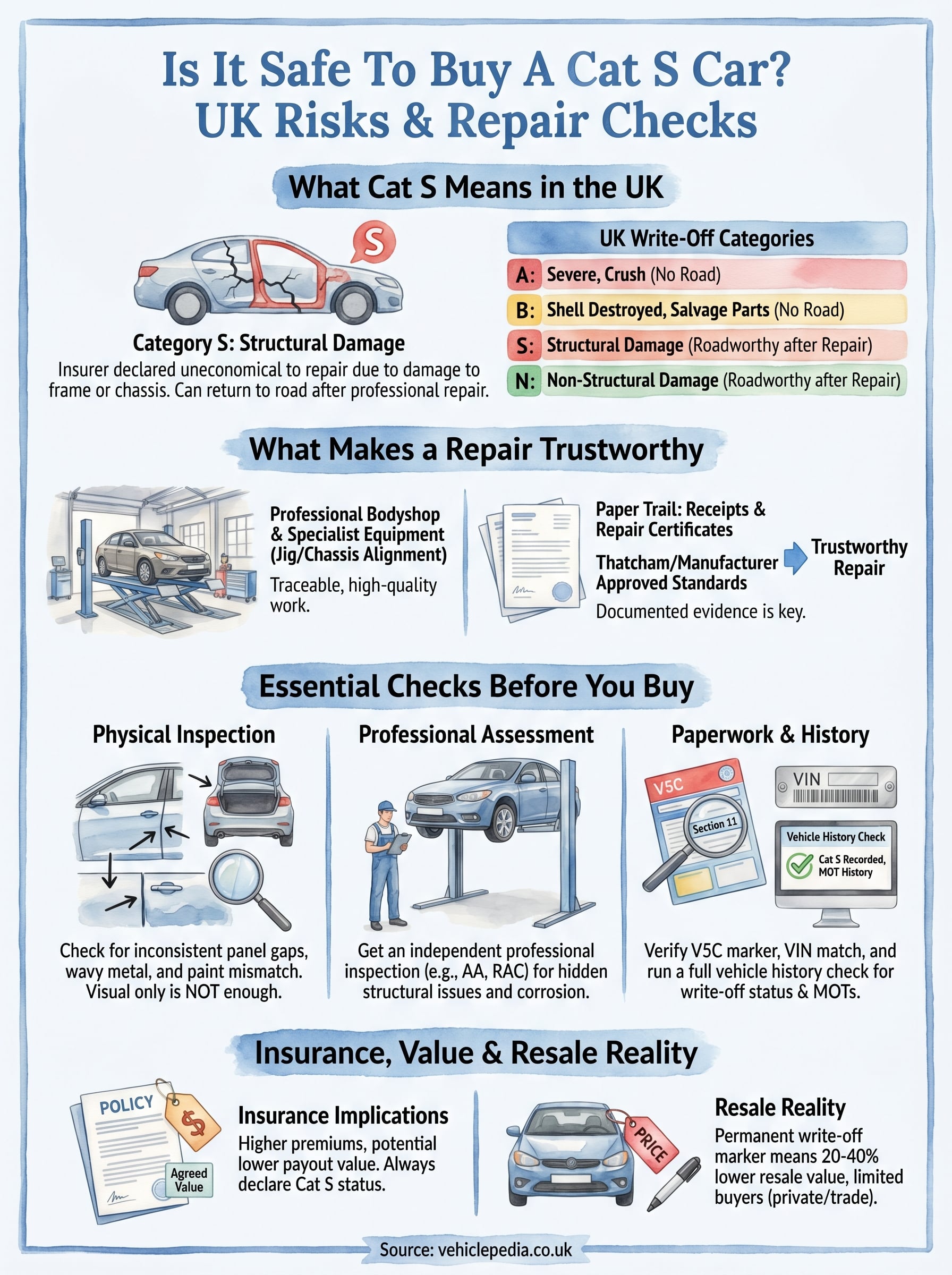
Category S is one of four write-off classifications used by UK insurers. The "S" stands for structural, which tells you the core issue: the vehicle suffered damage to its structural frame or chassis. When an insurer writes a car off as Cat S, it's not saying the car can never be driven again. It's saying the repair cost was close to or exceeded the car's market value, so paying for a full repair made no financial sense for the insurer.
A Cat S classification stays on a vehicle's record permanently, even after repairs are complete and the car returns to the road.
How UK write-off categories work
The Association of British Insurers (ABI) introduced the current four-category system to replace the older A, B, C, D framework. The four categories are A, B, S, and N, and each describes a different level of damage. Category A vehicles must be crushed entirely. Category B vehicles can have their parts salvaged but the shell must be destroyed. Category S and N are the two categories where the car can legally return to the road after repairs. If you're asking whether is it safe to buy a cat s car, understanding where it sits within this classification system is the right starting point.
UK insurers switched to the new S and N categories in October 2017 because the older C and D labels weren't precise enough. Under the old system, a car could be written off as Category D for relatively minor cosmetic damage, which gave buyers little useful information. The new labels tell you immediately whether structural components were involved.
| Category | Damage type | Can return to road? |
|---|---|---|
| A | Severe, all parts unusable | No |
| B | Body salvageable, shell destroyed | No |
| S | Structural damage | Yes, after repair |
| N | Non-structural damage | Yes, after repair |
What structural damage actually involves
Structural damage means the car's load-bearing components took the hit. This includes the chassis rails, sill panels, A-pillars, B-pillars, bulkhead, and floor pan. These parts form the skeleton of the car. They absorb impact in a collision, protect the occupants, and hold everything else in alignment. When they're bent, twisted, or cracked, the car's geometry changes. Door gaps open up, panels don't line up, and more importantly, the car no longer absorbs impact the way it was designed to.
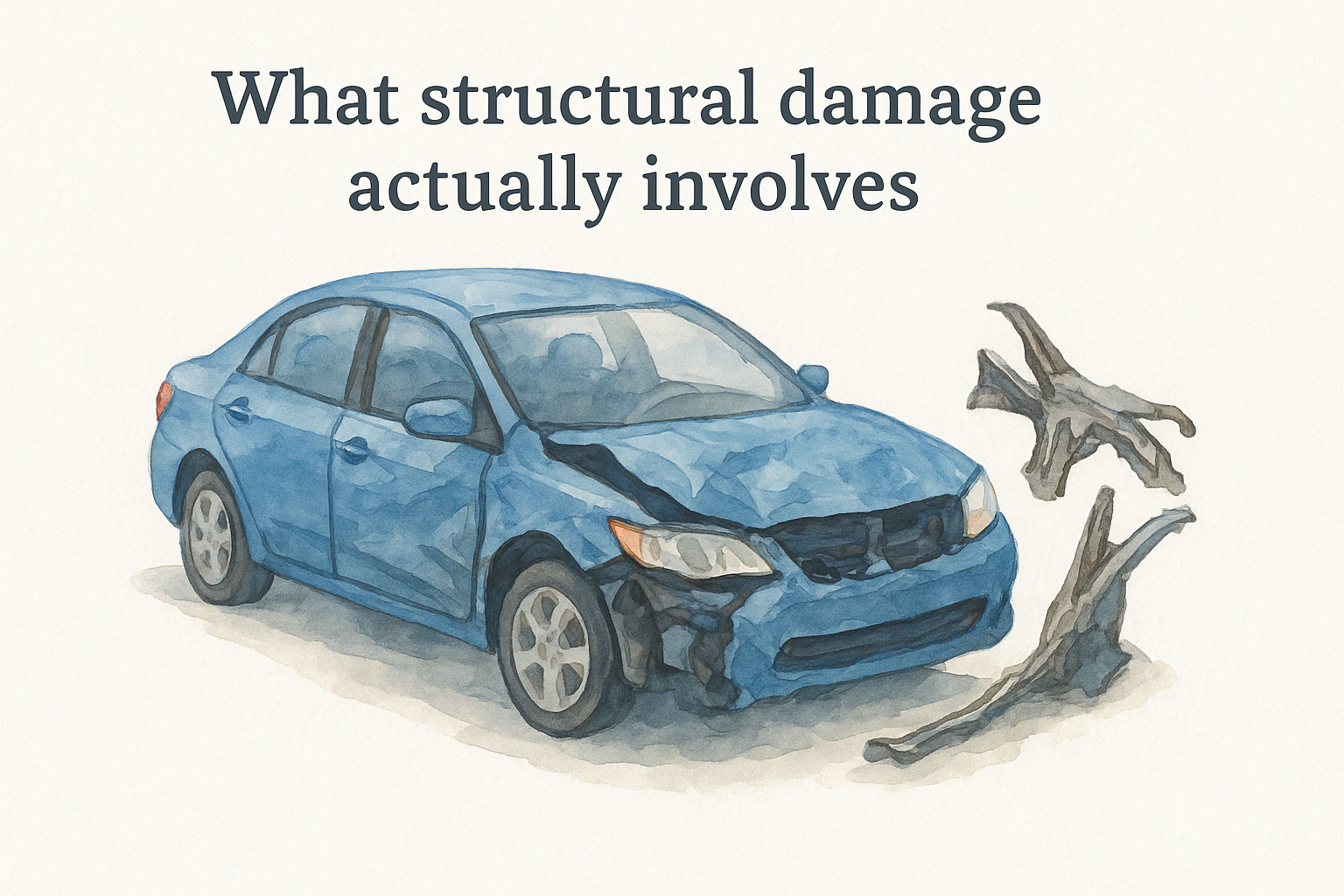
Repairing structural damage properly requires specialist equipment, including a jig or body straightening bench, to pull metal back into exact factory tolerances. It also requires a workshop that understands how to work with modern high-strength steel and, in newer vehicles, aluminium frames. Poor repairs can look fine to the eye but leave the structure compromised, which is why independent inspection before purchase is essential.
Cat S vs Cat N: why the difference matters
Cat N covers non-structural damage: bumpers, bodywork, electrical systems, and interior components. These repairs are typically less complex and carry lower safety risks when done correctly. Cat S repairs are a different level of work entirely because getting the structure wrong affects how the car performs in any future collision, directly putting you and your passengers at risk.
Both categories appear on a vehicle history check, but a Cat S flag should prompt a far more thorough inspection than a Cat N flag. Sellers sometimes list a car without mentioning its write-off status, which is why checking the history before you view the car protects you from buying a vehicle with undisclosed structural issues and no way to trace the repair work.
When a Cat S car can be safe
A Cat S car is not automatically unsafe to drive. Structural damage and a poor structural repair are two very different things, and high-quality work carried out by a competent bodyshop can restore a car to a fully roadworthy condition. The question of whether is it safe to buy a cat s car comes down entirely to the quality and traceability of the repair work done after the insurer declared it a write-off.
The safest Cat S cars are those repaired by a professional bodyshop with documented evidence of the work, not vehicles where the repair history is vague or missing entirely.
What makes a repair trustworthy
Proof of repair is the single most important factor when assessing a Cat S car. A trustworthy repair comes with a paper trail: receipts from a recognised bodyshop, details of the parts replaced, and confirmation that the car was put on a jig or chassis alignment rig to restore factory tolerances. Without this documentation, you have no way to verify what was actually done or whether the structure was fully corrected.
You should also look for repairs carried out by a Thatcham-approved or manufacturer-approved bodyshop, as these workshops follow defined repair standards and use the correct tooling for structural work. Informal repairs done in a private garage carry more risk because they are far less likely to have used the specialist equipment that structural repairs genuinely require, regardless of how skilled the individual doing the work was.
The type of car matters too
Older vehicles with simpler steel structures are generally more straightforward to repair correctly than modern cars built with high-strength steel, boron, or aluminium. Manufacturers design these advanced materials to deform in specific ways during a collision, and cutting or welding them incorrectly can compromise the entire safety cell in a way that is difficult to detect from a standard visual inspection.
Lower-speed impacts that caused the original structural damage also change the picture significantly. A car written off after a slow-speed shunt that bent a single chassis rail is a different proposition to one that was in a high-speed collision with multiple points of structural failure. Asking the seller for the original loss adjuster's report or insurer documentation can give you a clearer picture of what the car went through before any repair work began.
How to inspect a repaired Cat S car
Deciding whether is it safe to buy a cat s car becomes much clearer once you've carried out a thorough physical inspection. A repaired Cat S car may look clean at first glance, but structural issues often show up in subtle ways that are easy to miss if you don't know what to look for. Walk around the car methodically and treat any resistance from the seller as a red flag in itself.
Check the bodywork and panel alignment
Panel gaps are one of the most reliable indicators of structural work. Open and close every door, the bonnet, and the boot. The gaps between panels should be consistent and even all the way around. If you notice uneven gaps, doors that don't sit flush, or panels that require extra force to close, the car may not have been straightened to factory tolerances after the structural repair.
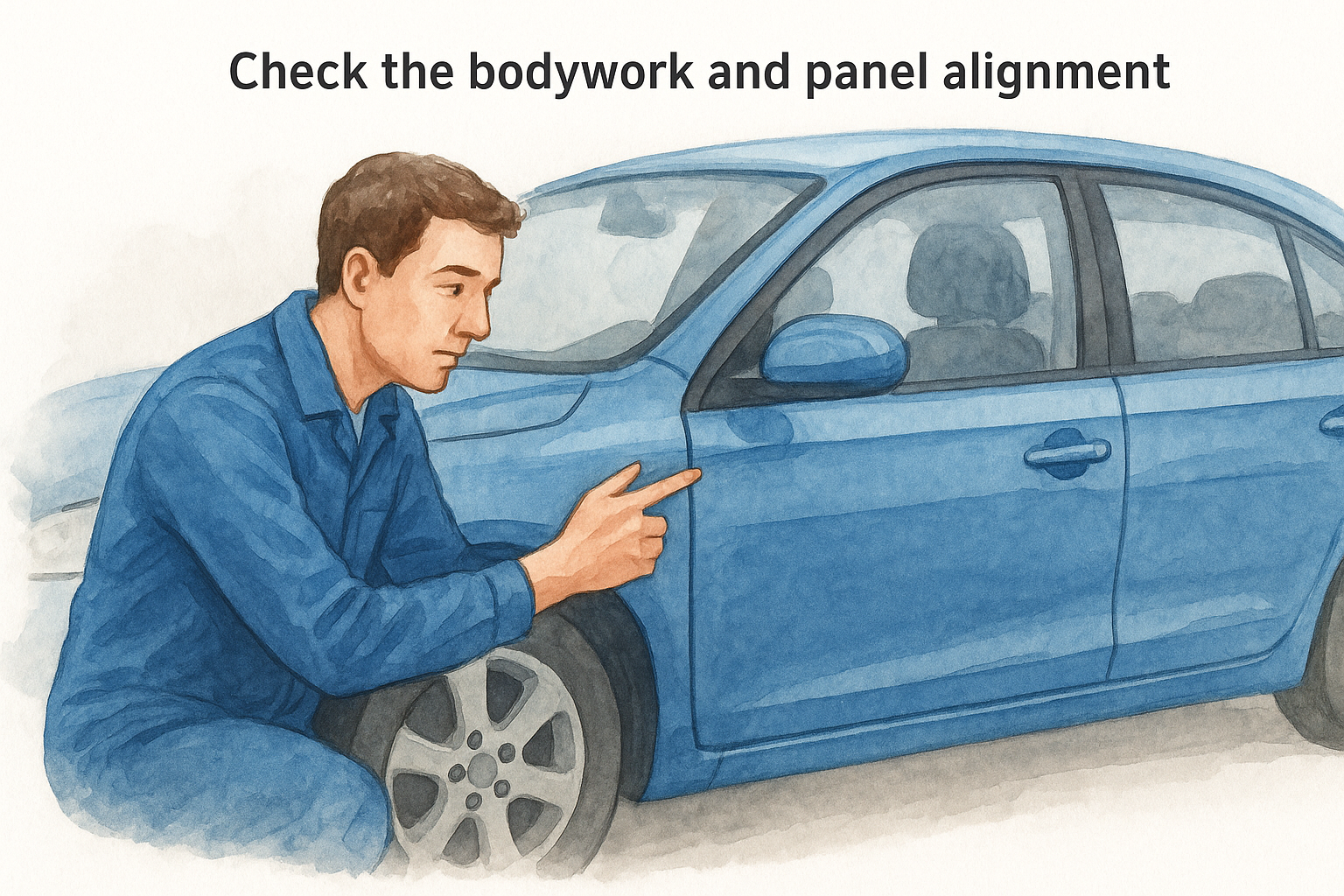
Wavy or rippled metalwork along the sill panels, roof line, or A-pillars is a strong sign that the structure was not fully corrected during repair.
Look closely at the paint finish along seams, pillars, and door edges. Fresh paint that doesn't match the surrounding areas or overspray on rubber seals and glass suggests recent bodywork. Mismatched paint can also indicate that panels were replaced rather than repaired, which is worth questioning if the seller hasn't mentioned it.
Get a professional inspection done
A visual inspection alone is not enough for a Cat S car. You should book an independent assessment with a qualified mechanic or a service like the AA or RAC, who can put the car on a ramp and check the underlying structure. They can identify corrosion around repaired weld points, signs of filler used over metal that should have been replaced, and whether any suspension or steering geometry was affected by the original impact.
Ask the inspector specifically to check the chassis rails and floor pan for any signs of twisting, previous welding, or improper repairs. These are the areas most likely to have sustained damage in a structural write-off, and they are also the areas where a poor repair is most dangerous in a future collision. Paying for a professional inspection may cost you £100 to £200, but it is a straightforward way to protect yourself from buying a car with a hidden structural fault that no amount of fresh paint can fix.
Paperwork, DVLA and MOT checks
When you're asking is it safe to buy a cat s car, the paperwork trail can answer a significant part of that question. A repaired Cat S vehicle must be re-registered with the DVLA before it can legally return to the road, and this process leaves a traceable record you can verify. Sellers who resist sharing documentation or repair receipts are giving you a clear signal to walk away.
What the DVLA requires before a Cat S car returns to the road
Before a Cat S car can be re-registered for road use, the person who repaired it must notify the DVLA and obtain a new V5C logbook. The new V5C will carry a marker indicating the vehicle was previously written off. When you check the V5C in person, look at section 11, which records any changes to the vehicle's status. If the car was properly returned to the road, this marker should be present. A clean V5C on a car that has a Cat S marker on its history check is a serious warning sign, as it may suggest the document has been altered or the registration was not handled correctly.
A Cat S vehicle sold without a re-issued V5C carrying the write-off marker should be treated as a major red flag until you can confirm the registration history independently.
You should also verify that the VIN (Vehicle Identification Number) on the V5C matches the number physically stamped on the car itself, typically found on the windscreen pillar and on a plate in the engine bay. Structural repairs sometimes involve replacing large sections of the vehicle, and in rare cases this can affect how the VIN is presented or whether it remains intact.
How to use MOT history and a vehicle history check
The DVSA MOT history database holds every MOT result for vehicles tested in Great Britain, and you can access it free by entering the registration number. For a Cat S car, you want to see a continuous and consistent MOT record. A large unexplained gap in the records, or a first MOT that appears well after the vehicle's manufacture date, can indicate the period when the car was off the road following the write-off.
Running a vehicle history check through Vehiclepedia gives you access to write-off category data, MOT records, and DVLA registration information in a single report. This confirms whether the Cat S status was properly recorded and whether the car has passed an MOT since the repair was completed.
Insurance, value and resale reality
Even if you've confirmed the repairs are solid and you've satisfied yourself on whether is it safe to buy a cat s car, the financial picture beyond the purchase price still needs careful consideration. A Cat S vehicle carries its write-off marker permanently, and that affects both what you pay to insure it and what you can expect to receive when you sell it on.
What insurers charge for Cat S cover
Not every insurer will cover a Cat S vehicle, and the ones that do will almost always charge a higher premium than they would for an equivalent car with a clean history. You need to declare the Cat S status when taking out a policy. Failing to do so is treated as a material misrepresentation, which can invalidate your cover entirely and leave you personally liable in the event of a claim.
Shopping around is essential for Cat S insurance because premiums vary significantly between providers, and some specialist insurers offer far more competitive rates than mainstream comparison results.
When an insurer agrees to cover a Cat S car, they may also apply a lower agreed value to the policy, meaning a total loss payout would reflect the reduced market value of a write-off category vehicle rather than the standard book price. Ask your insurer directly how they calculate the vehicle's value before you commit to a policy.
The resale reality when you come to sell
Buyers on the used market discount Cat S cars heavily, and the write-off marker shows up on any vehicle history check run by a future purchaser. The typical price reduction of 20 to 40 percent below equivalent clean-titled examples applies not just at the point you buy the car, but at the point you sell it too. That discount does not shrink over time. A ten-year-old Cat S car still carries its marker and still sells for less than a comparable car with no write-off history.
Private buyers are generally more cautious about Cat S vehicles than trade buyers, so your resale route may be limited to specialist dealers or online auctions where the price achieved is typically lower than a private sale. Factor this into your calculations at the start, not the end, of the buying process. If you buy a Cat S car expecting to sell it in two years at a reasonable return, the permanent marker will work against that plan in a way that the initial bargain price rarely compensates for.
Ready to decide
Whether is it safe to buy a Cat S car comes down to one clear principle: evidence beats instinct. A Cat S vehicle can be a genuine bargain or a serious liability, and the difference sits entirely in the repair quality, paperwork, and history behind it. If a seller can show you professional bodyshop receipts, a re-issued V5C, and a solid MOT record, you have something to work with. If they can't, walk away.
Before you view any Cat S car in person, run a full vehicle history check so you already know what the records show before the seller says a word. Checking the write-off status, MOT history, and DVLA data in advance puts you in a far stronger position to negotiate or reject. You can view a sample premium report to see exactly what a Vehiclepedia check covers, then decide whether the car you're considering is worth your time and money.