Should I Buy A Cat N Car? UK Risks, Value & Insurance Guide
Deciding should i buy a cat n car? Learn about insurance costs, resale value, and how to check repair quality before you commit to a purchase.
Should I Buy A Cat N Car? UK Risks, Value & Insurance Guide
A Category N car can be thousands of pounds cheaper than an equivalent model with a clean history, and that price gap is exactly why so many buyers find themselves asking, should I buy a Cat N car? It's a fair question with no single right answer, because the deal depends entirely on the specific vehicle, the damage it sustained, and the quality of the repair.
Cat N (short for Category N) means a vehicle was written off by an insurer due to non-structural damage. The bodywork, electrics, or mechanical components were affected, but the chassis and structural frame remained intact. That's a meaningful distinction from more severe categories, yet it still carries real implications for insurance costs, resale value, and safety.
Before committing to any used car, especially one with a write-off marker, you need to know its full history. That's where Vehiclepedia comes in. Our vehicle history checks pull data from official UK sources, including the DVLA and insurance registers, so you can verify whether a car carries a Cat N marker and spot other red flags before you hand over your money. In this guide, we'll walk you through the risks, financial impact, and insurance considerations of buying a Cat N car so you can make a confident, informed decision.
Why Cat N matters when buying used in the UK
The UK used car market moves fast, and private sellers are not legally required to volunteer a write-off history upfront. That matters because a Cat N marker permanently follows a vehicle on the insurance industry's database, meaning any insurer, future buyer, or lender can discover it with a straightforward history check. If you're already wondering should I buy a Cat N car, understanding why the marker exists and what it signals is the first step before you even look at a specific vehicle.
How insurers classify write-offs in the UK
When an insurer decides a vehicle isn't worth repairing at full market cost, they declare it a write-off and assign it a category. Category N and Category S are the two classifications for cars that can legally return to the road after repair. Category A and Category B vehicles are scrapped entirely. The classification system is coordinated by the Association of British Insurers (ABI) and shared across the industry, so a Cat N marker recorded by one insurer becomes visible to all others and to anyone who runs a history check.
A Cat N car can return to the road without a formal DVLA inspection, which means the quality of any repair sits entirely with whoever carried it out.
Why sellers don't always disclose Cat N status
Not every seller hides a Cat N history deliberately, but private listings frequently omit it because the seller either doesn't consider it relevant or assumes you won't check. Dealers carry stronger obligations under the Consumer Rights Act 2015, but private sales operate on a buyer-beware basis. You carry the risk if you skip the history check, and that risk isn't small given how common undisclosed write-offs are in the used market.
The financial ripple effect
Insurance premiums, resale value, and finance eligibility all shift the moment a Cat N marker is attached to a vehicle. Some insurers apply higher premiums to write-off history cars. Others decline to provide cover altogether, which shrinks your choice of providers. When you eventually sell, any buyer who runs a history check will see the marker and negotiate aggressively or walk away entirely, meaning the discount you secured at purchase may not compensate for the reduced selling price you'll face later.
What Cat N means and how it differs from Cat S
Cat N stands for Category N, the classification used when an insurer writes off a vehicle because the repair cost exceeds what they consider economical, but the damage is limited to non-structural components. That includes bodywork panels, trim, electronics, airbags, and mechanical parts like the engine or suspension. The key point is that the core frame and crash structure remain undamaged, which is why a Cat N car can legally return to the road without a mandatory DVLA inspection after repair.
The structural difference that separates Cat N from Cat S
Category S sits one step above Cat N in terms of severity. A Cat S car has suffered structural or chassis damage, meaning the parts of the vehicle engineered to absorb and redirect crash forces have been compromised. Repairing a Cat S vehicle requires specialist work to restore the structural integrity, and the car must pass a formal inspection before it can be re-registered for road use.
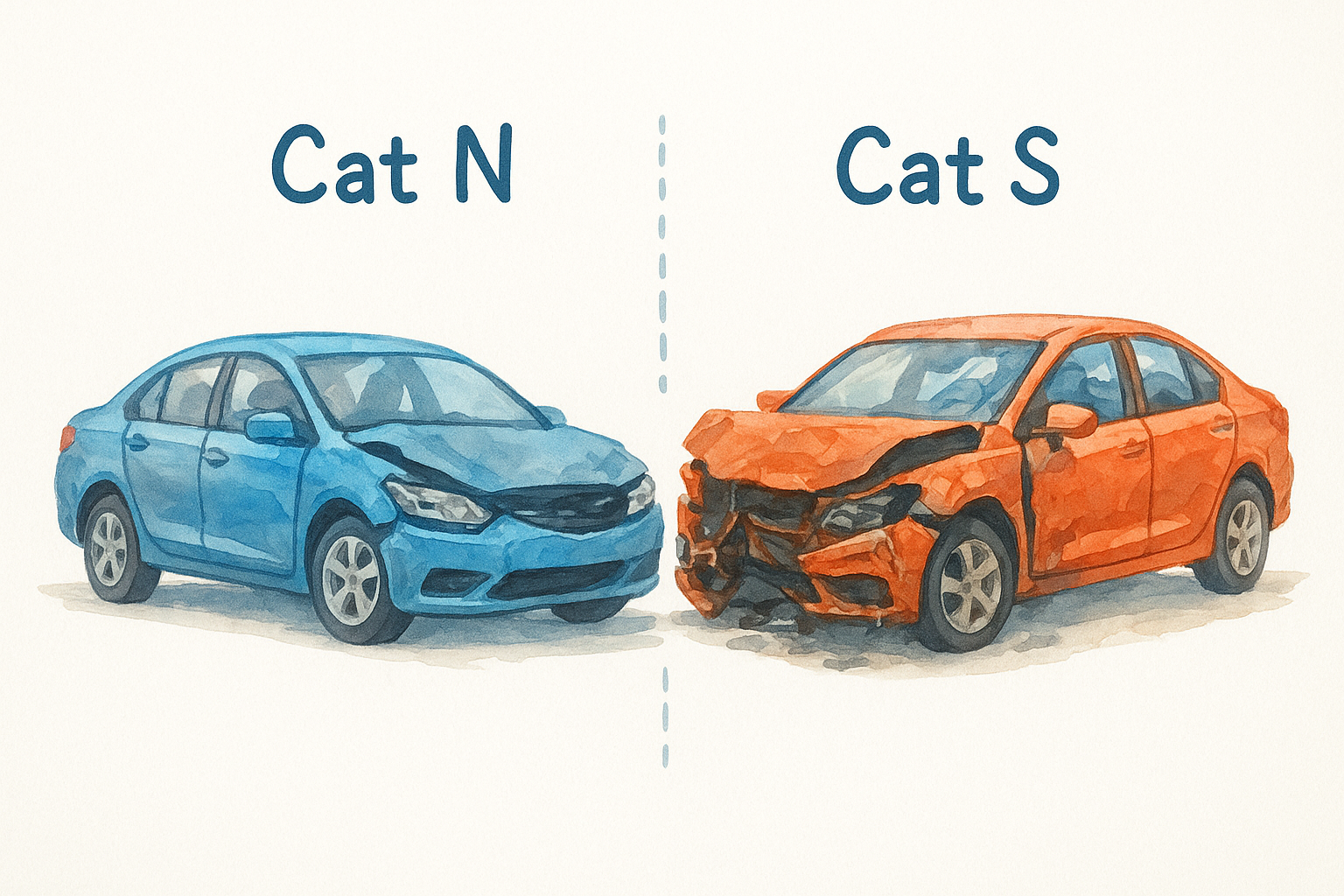
| Category | Damage type | DVLA inspection required? | Can return to road? |
|---|---|---|---|
| Cat N | Non-structural | No | Yes |
| Cat S | Structural | Yes | Yes, after inspection |
| Cat B | Severe | N/A | No (parts only) |
| Cat A | Catastrophic | N/A | Never |
A Cat N car skips the formal re-inspection process entirely, so the standard of repair depends completely on who did the work and how.
Why the distinction matters for your purchase decision
If you're asking should I buy a Cat N car, knowing it sits below Cat S in severity is reassuring, but it doesn't remove all risk. Airbag replacements, electronic resets, and hidden secondary damage are all possible in a Cat N vehicle, and none of those require any official sign-off to get the car back on the road.
How to check if a car is Cat N
The only reliable way to confirm a vehicle's write-off status is to run a vehicle history check before you arrange a viewing. Write-off markers are stored on the insurance industry's shared databases, not on any document the seller hands you, so asking the seller directly is not a substitute for verified data. If you're asking should I buy a Cat N car, that question only becomes meaningful once you know whether a Cat N marker actually exists on the specific vehicle.
Run a vehicle history check first
A vehicle history check using the car's registration plate pulls data from official UK sources, including insurance registers, to flag any Cat N or Cat S markers. Vehiclepedia's check covers this alongside MOT history, DVLA records, and outstanding finance, giving you a complete picture before you commit to viewing the vehicle in person.
Run the check before you travel, not after you've spent an hour inspecting the car and started to overlook problems.
Key details a history check can confirm:
- Whether a Cat N or Cat S marker is recorded
- The date the write-off was registered
- Any outstanding finance the seller hasn't disclosed
- Stolen vehicle status via the UK Police Database
What to look for on the logbook and MOT history
The V5C logbook won't explicitly state a Cat N history, but it can reveal useful signals. Look for gaps in ownership or frequent short-term keepers, which sometimes indicate a car passed through the salvage trade.
Cross-referencing the MOT history through the DVLA's free online checker can surface advisory notes about bodywork repairs, panel misalignment, or replaced components that match common Cat N damage patterns.
How to judge the repair quality and safety
Once you know a Cat N marker exists, the next question is whether the repair work was done properly. Because no formal inspection is required before a Cat N car returns to the road, the standard of repair varies enormously between professional bodyshops and backstreet operations.
Signs of a quality repair
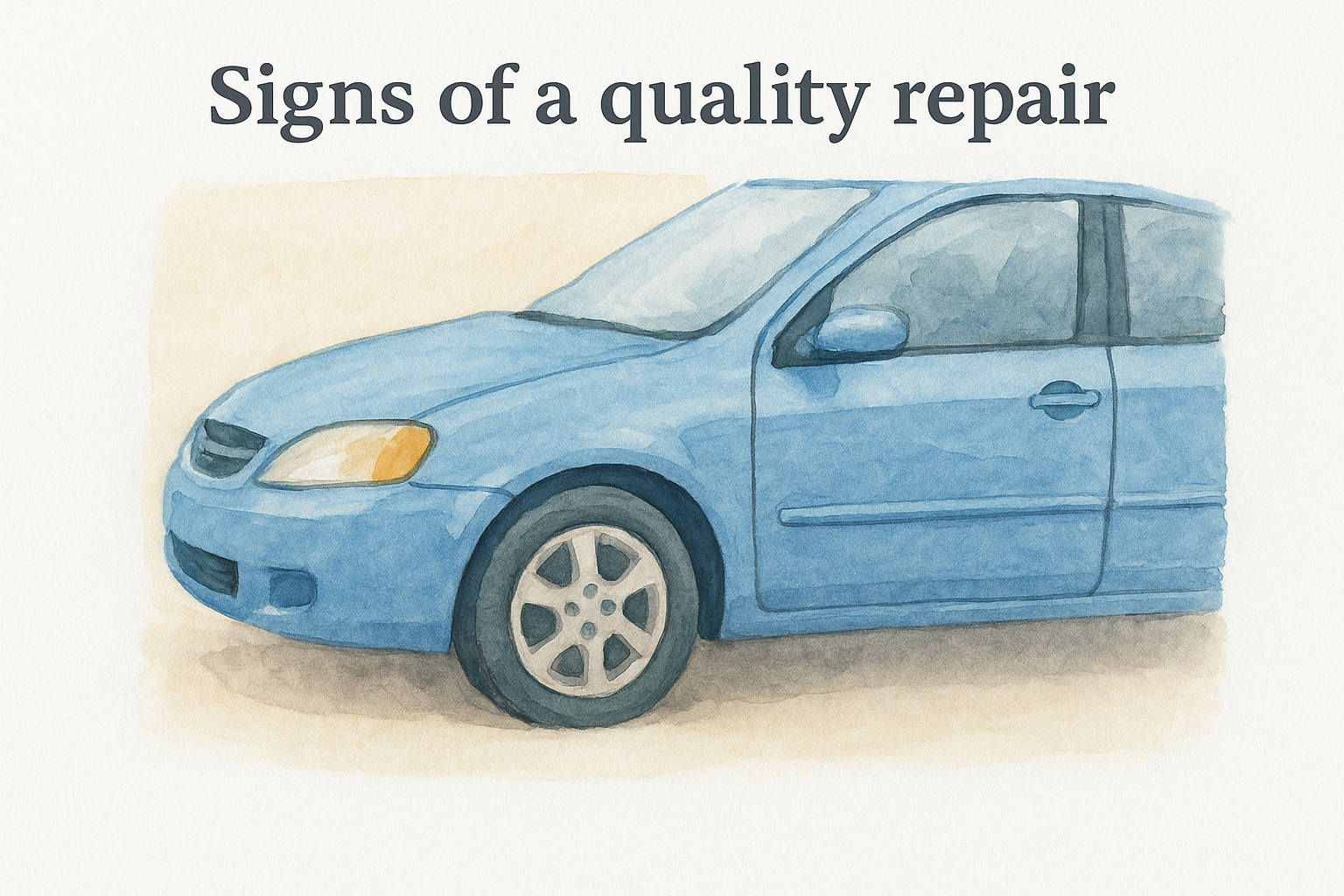
A well-repaired Cat N car leaves clear evidence of professional workmanship. Look for consistent panel gaps around doors, bonnets, and boots; uneven spacing suggests panels were removed and refitted without care. Paint matching is another reliable signal, because blending issues or texture differences between adjacent panels point to rushed or budget bodywork.
Ask the seller for receipts or an itemised repair invoice, because legitimate repairers document their work.
What to check mechanically
If the Cat N damage involved airbag deployment, confirm that replacement airbags were fitted and that the SRS warning light is not active on the dashboard. Airbag system resets require specialist equipment, and a lit warning light signals incomplete work. If the damage involved suspension or steering components, book an independent inspection with a qualified mechanic before you commit.
Working through this checklist gives you a practical basis to judge whether you should buy a Cat N car in a specific case:
- Panel gaps are even and consistent around all doors and the boot
- Paint texture and colour match across adjacent panels
- No warning lights are active on the dashboard
- Service history and repair receipts are present and verifiable
- Tyre wear is even across each axle
Costs and drawbacks: price, insurance and resale
A Cat N car typically sells for 10% to 40% below the equivalent clean-title example, and that price gap is the main reason buyers are drawn to them. But the discount comes with three concrete costs you need to factor in before deciding whether you should buy a Cat N car: higher insurance premiums, restricted financing options, and a lower resale value when you eventually come to sell.
Insurance: expect higher premiums or fewer providers
Most mainstream insurers will cover a Cat N vehicle, but they treat the write-off history as an increased risk and price accordingly. Some providers apply a meaningful premium uplift, while others simply decline to quote, which reduces your ability to shop around for the best rate.
You need to collect written insurance quotes from at least three providers before you agree a purchase price, not after. The additional annual premium cost can erode a large portion of the discount you negotiated on the purchase price.
Get insurance quotes before you commit, because the annual uplift can cancel out the savings within two or three years.
Resale value: the discount follows the car permanently
The Cat N marker stays on the vehicle's record indefinitely, so every future buyer who runs a history check will see it and negotiate hard. The discount you secured at purchase effectively gets passed on to whoever buys the car from you, compressing the amount you can realistically recover.
Finance and PCP agreements are also harder to arrange on write-off history cars, which cuts out a significant portion of potential buyers when you sell and may limit your own financing choices at the point of purchase.
Your decision in two minutes
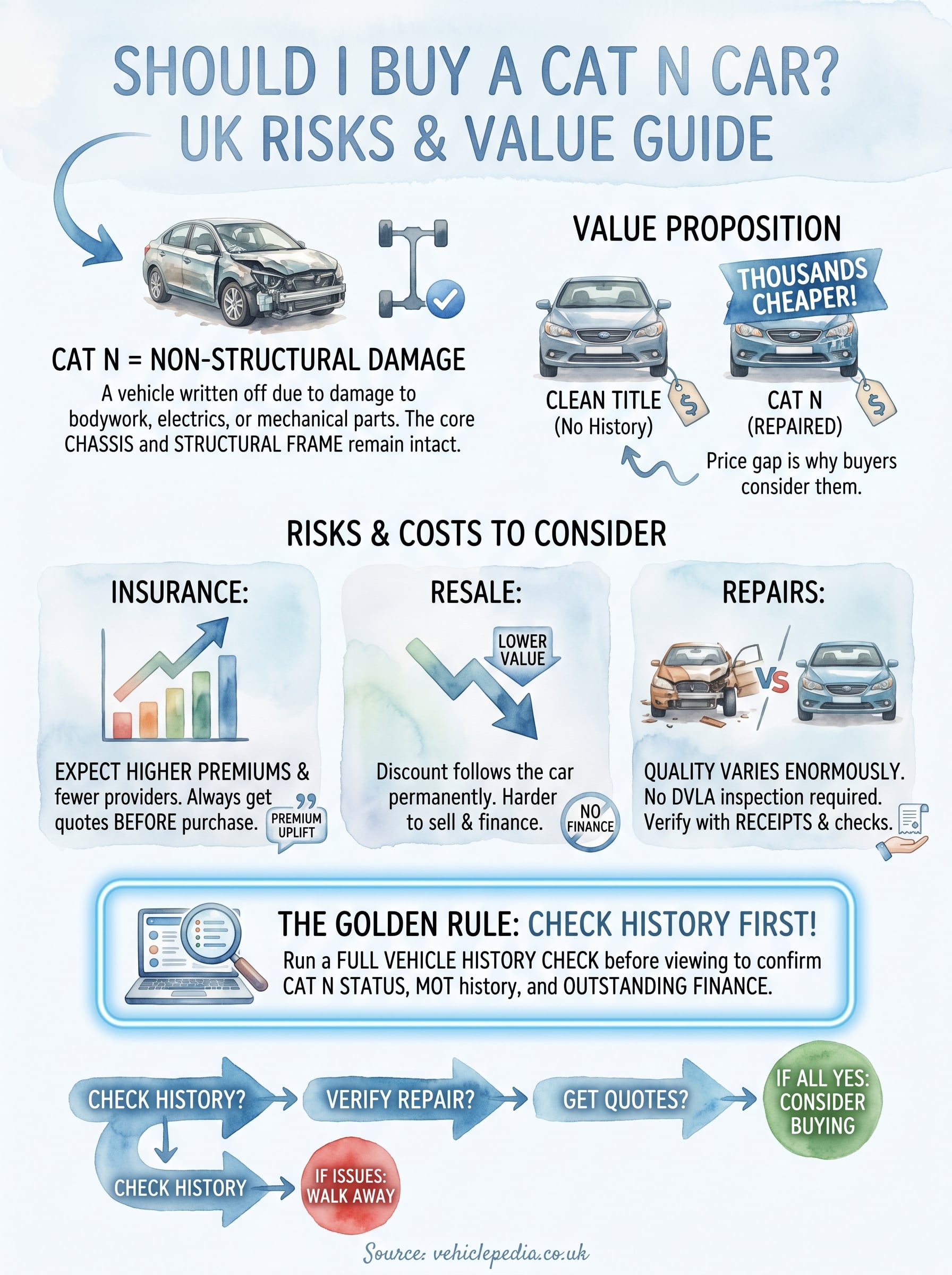
A Cat N car can represent genuine value or a costly mistake, depending entirely on one factor: whether the repair was done properly. If you can verify that a qualified bodyshop completed the work, receipts confirm it, no warning lights are active, and your insurance quotes are acceptable, then the price discount becomes a real advantage worth taking.
The risks are manageable when you check first and ask the right questions. Skip the history check and you're buying blind on a vehicle that an insurer already walked away from. That is the short version of should I buy a Cat N car: it depends on the specific car and the quality of the repairs, not the category marker alone. The discount is real, but so is the ongoing cost to your premiums and resale price.
Before you commit, run a full vehicle history check on Vehiclepedia to confirm Cat N status, MOT history, outstanding finance, and stolen vehicle status in one place.