Should I Buy A Cat S Car? UK Risks, Savings & What To Check
Wondering should I buy a Cat S car? Weigh up the 50% savings against safety risks, insurance hurdles, and why a history check is essential before you buy.
Should I Buy A Cat S Car? UK Risks, Savings & What To Check
A Cat S car can cost 30% to 50% less than an equivalent model with a clean history. That kind of discount turns heads, especially when used car prices remain stubbornly high across the UK. But if you're asking "should I buy a Cat S car", the price tag alone doesn't tell the full story. Category S means the vehicle sustained structural damage serious enough for an insurer to write it off, and that raises real questions about safety, repairability, and long-term value.
The truth is, some Cat S cars are repaired to a high standard and drive perfectly well for years. Others are bodged together and sold to unsuspecting buyers who have no idea what's lurking beneath the paintwork. The difference between a good deal and a costly mistake often comes down to what checks you run before handing over your money, and how thoroughly the repair work has been done. That's exactly where a vehicle history check from Vehiclepedia becomes essential, giving you access to write-off status, MOT records, and other critical data sourced from the DVLA and official UK databases.
This guide breaks down the risks, potential savings, insurance implications, and step-by-step checks you should carry out before buying a Cat S vehicle. By the end, you'll have a clear picture of whether the trade-offs make sense for your situation and budget.
Why Cat S matters when buying used
When you're buying a used car in the UK, write-off history is one of the most significant factors affecting safety, insurance costs, and resale value. A Cat S classification signals that the vehicle suffered structural damage serious enough for an insurer to decide repair costs outweighed the car's market value at the time. That decision doesn't automatically mean the car is dangerous, but it does mean you need to understand exactly what happened to it before you hand over your money.
The scale of write-offs in the UK used car market
Tens of thousands of vehicles are written off every year in the UK, and a significant proportion of those end up back on the road. Insurance companies sell salvage vehicles at auction, where traders buy them cheaply, carry out repairs, and put them back up for sale. Some repairs are completed to a high standard by qualified bodywork and structural specialists. Others are not. The core problem for buyers is that there's no legal requirement for sellers to proactively disclose write-off history, which means you can end up purchasing a Cat S car without realising it unless you run an independent vehicle history check first.
A seller is not legally obliged to volunteer write-off information unless you ask directly, which is why checking the vehicle's history independently is essential before any money changes hands.
Because the volume of Cat S vehicles circulating in the used car market is high, this is not a rare edge case. Every used car with an unusually attractive price for its age and mileage deserves a closer look, since write-off history is a common reason why sellers price vehicles below the market rate.
How structural damage changes the risk profile
Category S damage goes beyond cosmetic issues. Structural components such as the chassis, subframe, sill sections, or crumple zones may have been repaired, straightened, or welded back together. When these repairs are done correctly by a competent bodyshop using the right equipment and manufacturer specifications, the car can perform safely in normal driving conditions. When they're poorly executed, the vehicle may handle differently, develop alignment problems, or fail to absorb impact forces correctly in a collision.
Whether you're deciding "should I buy a Cat S car" for the first time or you've already looked at several options, the key risk is that structural repairs don't announce themselves on a test drive. Documented repair evidence and a professional inspection matter far more with Cat S vehicles than with any standard used car purchase.
Why the asking price can mislead you
A low asking price is the primary reason buyers consider Cat S vehicles, but the gap between that price and the true cost of ownership can close faster than you'd expect. Insurance premiums tend to be higher on write-off vehicles, and some mainstream insurers will decline to cover them altogether. Arranging finance against a Cat S car is more difficult, and many lenders refuse outright.
When it comes to selling the car later, the situation doesn't improve. The Cat S marker stays on the vehicle's record permanently, meaning every future buyer will discount it just as you are now. That permanent mark affects how much you'll realistically recover when you eventually sell, which is a factor worth pricing into your calculations from the start.
What Cat S means and how it differs
Category S is one of four write-off classifications used by UK insurers to categorise vehicles that have been damaged beyond economical repair. The "S" stands for structural, which tells you the most important thing about this classification: the damage affected the load-bearing structure of the vehicle, not just its panels, trim, or glass. Understanding what that means in practice helps you make a more informed decision about whether you should buy a Cat S car.
The UK write-off categories explained
UK insurers currently use four write-off categories, and each one describes a different level of damage severity.
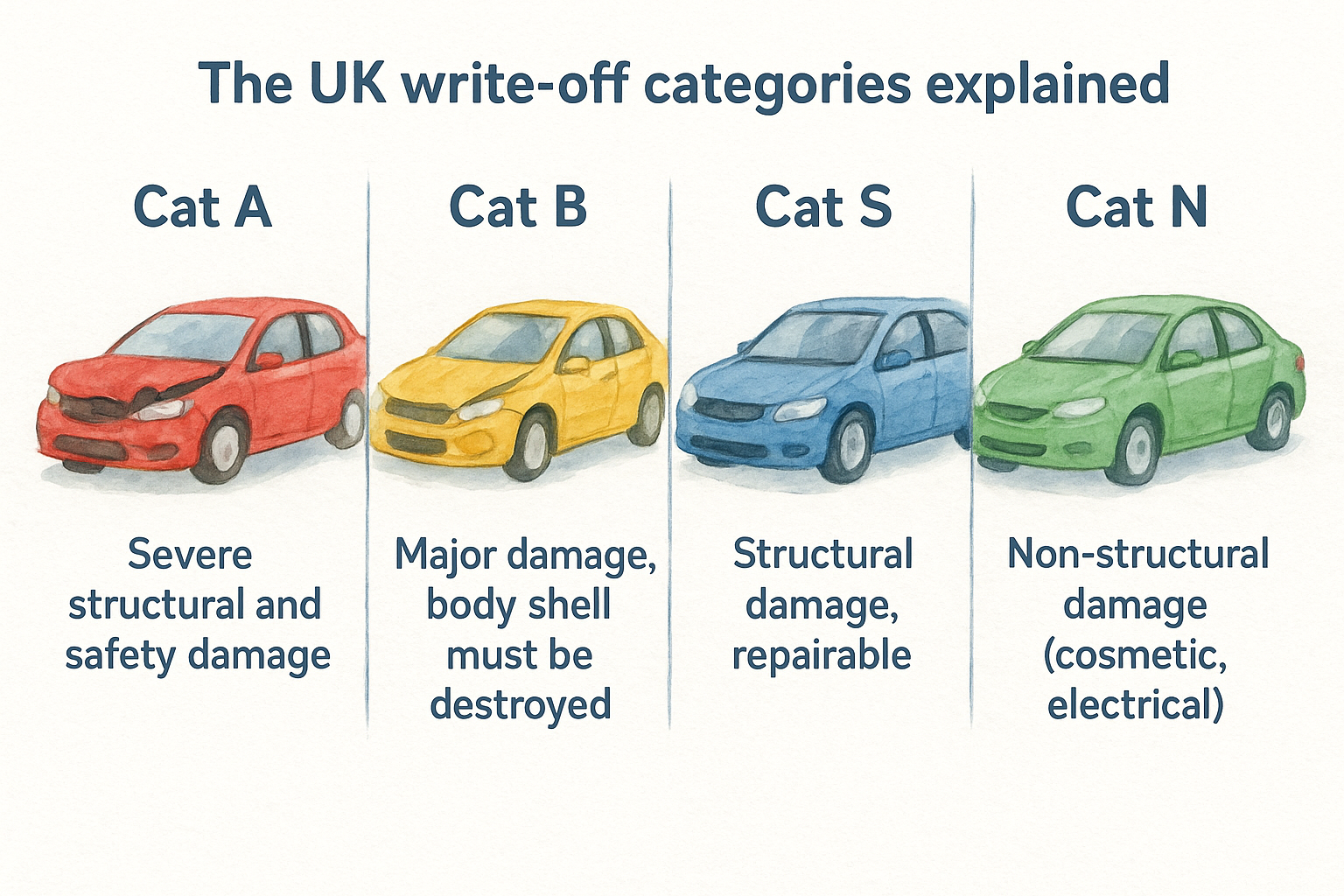
| Category | Damage type | Can it be repaired and resold? |
|---|---|---|
| Cat A | Severe structural and safety damage | No, must be crushed entirely |
| Cat B | Major damage, body shell must be destroyed | Parts only, no road use |
| Cat S | Structural damage, repairable | Yes, if repaired and re-registered |
| Cat N | Non-structural damage (cosmetic, electrical) | Yes, no re-registration required |
Cat S replaced the old Category C classification in October 2017, when the Association of British Insurers updated the system. If you're looking at older vehicles, a Category C marker on the history record is broadly equivalent to Cat S in terms of what it means.
The most important distinction to understand is that Cat S vehicles require a formal inspection and re-registration before they can legally return to the road, which Cat N vehicles do not.
How Cat S differs from Cat N
Cat N vehicles have sustained damage that doesn't affect the structural integrity of the car. That might include bumper scuffs, interior damage, or electrical faults. They're often easier to insure and slightly less heavily discounted than Cat S cars. Cat S vehicles, by contrast, have had their core structure compromised, which is why lenders and insurers treat them with greater caution. When you're comparing two similarly priced used cars and one carries a Cat S marker while the other carries a Cat N marker, they're not equivalent risks, and the gap in asking price should reflect that difference clearly.
When buying a Cat S car can make sense
Not every Cat S car is a bad purchase. For the right buyer, in the right situation, the lower asking price can represent genuine value rather than a trap. The key is being honest about how you plan to use the vehicle and what level of risk you're comfortable accepting before you start viewing cars.
You're buying a practical daily driver
If you're asking "should I buy a Cat S car" because you need affordable, reliable transport and you're not concerned about prestige or resale profit, the economics can work in your favour. A Cat S car that has been professionally repaired and independently inspected may give you several years of trouble-free motoring at a significantly lower upfront cost than a clean-history equivalent.
This scenario works best when you plan to keep the vehicle for several years and run it into the ground rather than trade it in. The permanent Cat S marker always reduces resale value, but if you're not selling, that factor matters a lot less. Buyers who purchase a Cat S car cheaply, drive it for three to five years, and then sell it for scrap or part-exchange it without high expectations often find the overall cost of ownership compares well with a more expensive clean-history vehicle.
The damage was minor structural and the repair is verified
Some Cat S vehicles received their classification after surprisingly limited damage. A low-speed collision that bent a subframe or crumple zone can trigger a write-off if the insurer's repair estimate nudges over the car's market value, even when the actual structural work required was straightforward. In those cases, the damage severity is far less alarming than the write-off label implies.
The Cat S category covers a wide spectrum of structural damage, from relatively minor repairs to serious rebuilds, so the classification alone doesn't tell you the full story.
What makes the difference is verified repair documentation: a full breakdown of what was repaired, which parts were replaced, which bodyshop carried out the work, and whether the vehicle passed a post-repair inspection. If that paperwork exists and checks out, a Cat S vehicle can represent a sound purchase.
What to check before you buy a Cat S car
If you're seriously asking "should I buy a Cat S car", having a clear checklist before you view the vehicle will protect you from making a rushed decision. The checks you run before purchase matter more with a Cat S vehicle than with any standard used car, because the consequences of missing something are much harder to reverse once the money has changed hands.
Run a vehicle history check first
Before you travel to view any Cat S car, run a vehicle history check using the registration plate. A check through Vehiclepedia will confirm the write-off category, flag any outstanding finance, and show whether the mileage is consistent across recorded service points. Inconsistent mileage readings or a gap in MOT history are both warning signs that deserve an explanation from the seller before you proceed.
A vehicle history check takes minutes and costs very little compared to the financial risk of buying a car with undisclosed problems or outstanding debt attached to it.
A good check will typically surface:
- Write-off category and date of the insurance claim
- Outstanding finance against the vehicle
- Full MOT history including advisories and failures
- Recorded mileage at each MOT test
Get an independent mechanical inspection
Never rely on the seller's word or a test drive to assess a structurally repaired vehicle. Book an independent inspection through a qualified mechanic or body inspection specialist who has no connection to the seller. They should check the chassis, sill sections, and suspension geometry for signs of misalignment or welding that falls short of manufacturer standards. Paint depth readings across body panels can also reveal filler or resprayed sections hiding imperfect structural repairs beneath the surface.
Ask for the repair documentation
Any reputable repairer will produce paperwork, so ask the seller for a full written breakdown of what was damaged, what was replaced, and who completed the structural work. Check whether the bodyshop used manufacturer-approved repair methods and whether the vehicle passed a post-repair structural inspection before returning to the road. If the seller cannot produce this documentation, treat that absence as a clear reason to walk away.
Insurance, finance and legal paperwork
Before you decide should I buy a Cat S car, you need to understand the practical hurdles that come with insuring, financing, and registering one. These aren't minor administrative details. Each of these areas can directly affect the total cost of ownership and whether you can legally or practically use the vehicle at all.
Getting insurance on a Cat S vehicle
Insurance is the first obstacle many buyers encounter. Not every insurer will cover a Cat S car, and those that do will often charge a higher premium than they would for a clean-history equivalent. When you start comparing quotes, disclose the write-off category upfront, because failing to do so can invalidate your policy entirely and leave you uninsured in the event of a claim.
Always declare the Cat S status when getting insurance quotes, even if the insurer doesn't ask explicitly during an online comparison.
Specialist insurers tend to offer better terms for write-off vehicles than mainstream comparison site results, so it's worth contacting brokers who deal with non-standard vehicles directly to find competitive cover.
Finance and lender restrictions
Most high-street lenders and mainstream car finance providers will refuse to approve a loan against a Cat S vehicle. The write-off marker makes the car harder to value accurately and reduces the security they hold against the debt. If you're planning to use personal contract purchase, hire purchase, or a secured car loan, check the lender's policy before you commit to a viewing.
Some specialist finance providers do offer products for write-off vehicles, but interest rates tend to be higher and deposit requirements larger than standard car finance deals. If you're buying outright with cash, this issue doesn't apply, which is one reason why Cat S vehicles tend to attract cash buyers specifically.
The legal paperwork you need
A Cat S vehicle must be re-registered with the DVLA before it can return to the road, and the V5C logbook should show the write-off category clearly. Check that the logbook is present, matches the vehicle's registration and VIN number, and hasn't been tampered with. Missing or inconsistent paperwork on a Cat S car is a serious red flag that should stop any purchase in its tracks.
Pricing, negotiation and future resale value
If you're weighing up should I buy a Cat S car, the price you pay determines whether the whole exercise is worthwhile. Cat S vehicles typically sell for 30% to 50% less than equivalent clean-history models, but that headline figure is only your starting point. The actual discount you should accept depends on the damage severity, the quality of the repairs, and what the permanent write-off marker will cost you when you eventually sell.
How to negotiate the right discount
Start your negotiation with comparable clean-history prices for the same make, model, year, and mileage. Use that figure as your benchmark, then apply a realistic write-off discount rather than accepting whatever the seller is asking. A larger or more complex structural repair warrants a steeper reduction than a vehicle written off for a minor subframe repair that cost little to fix. If the seller cannot produce documented repair evidence, push the price down further to account for the uncertainty, or walk away entirely.
The absence of repair documentation is not a minor inconvenience. It means you have no way to verify the quality of work done to the structure, and that uncertainty has a real financial value.
Factor in the additional costs you'll absorb after purchase. Higher insurance premiums and restricted finance options both add to your running costs, and you should subtract those from any apparent saving before deciding whether the deal stacks up.
What resale looks like further down the line
The Cat S marker stays on the vehicle's record permanently and will appear on any history check a future buyer runs. That means every person who eventually looks at your car will face the same questions you're asking now, and they will discount accordingly. You should expect to sell the vehicle for less than a clean-history equivalent regardless of the condition you maintain it in.
Plan your exit strategy before you buy. If you intend to drive the car for several years and sell through part-exchange or private sale with modest expectations, the numbers can still work in your favour. If you're hoping to recover most of your purchase price within a short period, a Cat S vehicle is unlikely to deliver that outcome.
Next steps before you commit
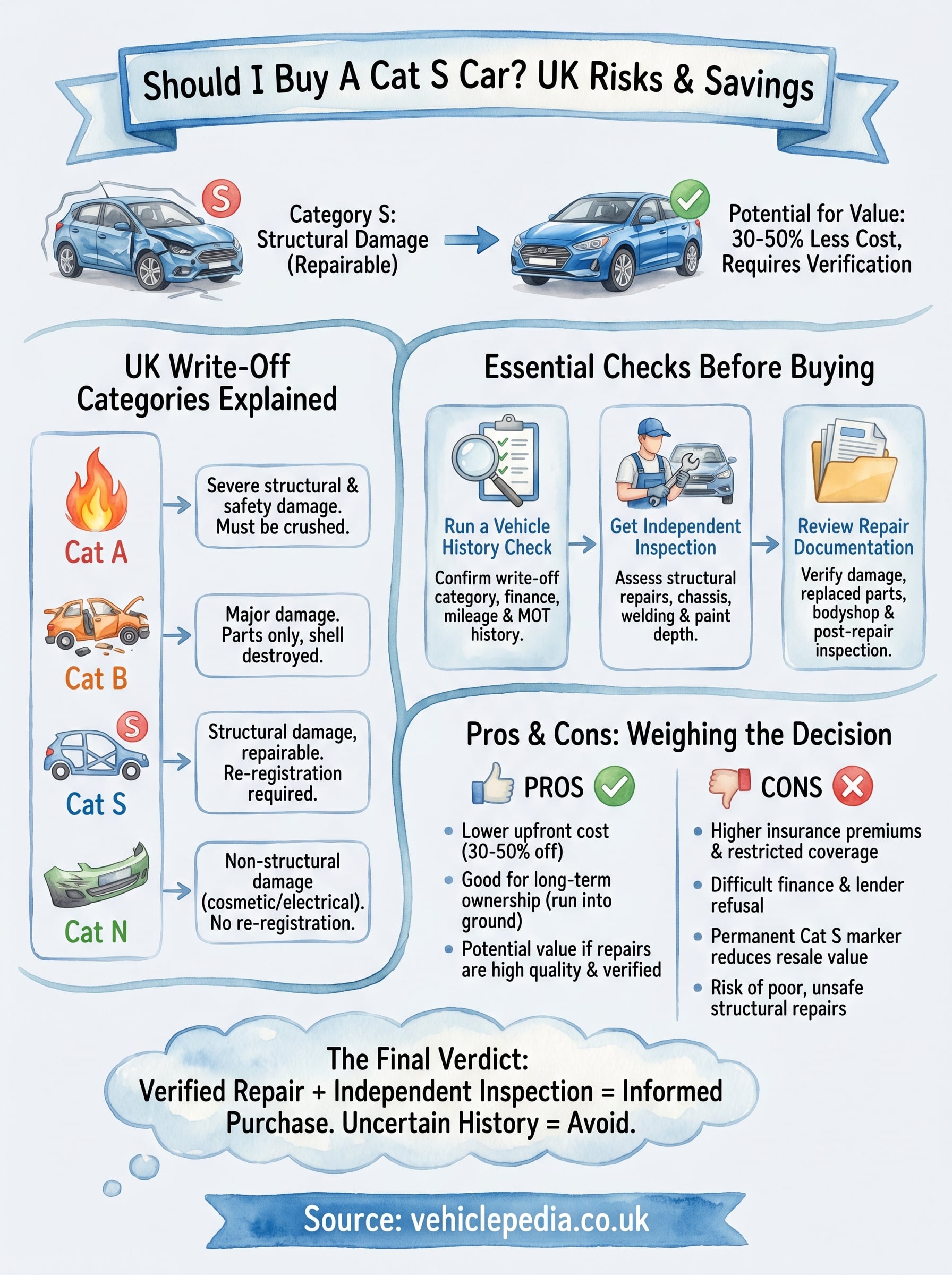
Deciding should I buy a Cat S car comes down to three things: verified repair history, an independent inspection, and an honest calculation of total ownership costs. If you can confirm all three, a Cat S vehicle can deliver real value. If any of those elements are missing, the risk outweighs the discount regardless of how attractive the price looks.
Before you view any vehicle, run a history check so you know exactly what you're walking into. Vehiclepedia's check pulls data directly from official UK sources, including the DVLA, giving you write-off status, MOT history, outstanding finance, and mileage records in one place. You can view a sample premium report to see exactly what a full check covers before you spend a penny. A few minutes of research before a viewing can save you from a purchase you'll regret for years.