How To Buy A Car Privately In The UK: Step-By-Step Checklist
Learn how to buy a car privately with our UK checklist. Spot red flags, verify V5C and MOT records, and handle paperwork to ensure a safe, legal purchase.

How To Buy A Car Privately In The UK: Step-By-Step Checklist
Buying from a private seller can save you thousands compared to a dealership, but it also means you're on your own. There's no consumer rights safety net, no warranty, and no salesperson to chase if something goes wrong. Knowing how to buy a car privately the right way is the difference between landing a great deal and inheriting someone else's expensive problem. In the UK, private sales account for a significant portion of used car transactions, and for good reason: prices are typically lower, and negotiation is more straightforward.
The trade-off? Every check, every question, and every piece of paperwork falls squarely on your shoulders. You need to confirm the car isn't stolen, isn't written off, doesn't have outstanding finance against it, and actually belongs to the person selling it. Miss any of these steps, and you could lose both the car and your money with very little legal recourse. That's exactly why we built Vehiclepedia, to give buyers access to detailed vehicle history data from official sources like the DVLA and UK police databases before they commit to a purchase.
This guide walks you through the entire process from start to finish: finding the right car, running the essential checks, inspecting it in person, handling payment safely, and sorting the paperwork to make it legally yours. Whether this is your first private purchase or you've done it before, use this as your checklist. Every step exists because real buyers have been caught out by skipping it.
What you need before you start
Before you search a single listing or contact any seller, you need a clear picture of what you're walking into. Private sales carry no statutory warranty, and unlike buying from a dealer, you cannot rely on the Consumer Rights Act 2015 to give you an easy route to a refund if something goes wrong after you drive away. The seller isn't obligated to disclose faults they didn't know about, which means every risk sits with you from the moment money changes hands.
Your budget and total cost of ownership
Many buyers set a purchase price in their head and forget everything that comes after it. The car price is only the starting point. You also need to budget for road tax (Vehicle Excise Duty), which can range from zero for low-emission vehicles to over £600 per year for older, higher-emission models. Factor in insurance, an independent inspection, any immediate repairs, and the cost of a vehicle history check before you commit to anything.
A rough pre-purchase budget breakdown looks like this:
| Cost | Estimated Range |
|---|---|
| Vehicle purchase price | Varies |
| Vehicle history check (premium) | £10-£20 |
| Independent mechanical inspection | £100-£150 |
| First year road tax | £0-£620+ |
| Insurance (first payment) | £50-£300+ |
| Immediate repairs or tyres | £0-£500+ |
Set a firm upper limit on your total spend before you start searching, not just the car price, and stick to it.
The documents you need to bring
When you meet a seller, arrive prepared. Bring a form of photo ID such as a passport or driving licence, and have your payment method organised in advance. You should also print or save a receipt template so you have a written record of the sale the moment it completes. Both parties should sign two copies and each keep one.
Here is a basic private sale receipt template you can use:
PRIVATE VEHICLE SALE RECEIPT

Date: _______________
Seller full name: _______________
Seller address: _______________
Buyer full name: _______________
Buyer address: _______________

Vehicle make and model: _______________
Registration number: _______________
VIN / Chassis number: _______________
Colour: _______________
Mileage at point of sale: _______________

Agreed sale price: £_______________
Payment method: _______________

I confirm I am the legal owner of this vehicle and it is sold
as seen, free of outstanding finance to the best of my knowledge.

Seller signature: _____________ Date: _______________
Buyer signature: _____________ Date: _______________
Know your legal position as a buyer
Understanding how to buy a car privately also means knowing exactly what protection you do and don't have. Under UK consumer law, private sellers must only ensure the car matches the description they gave of it. If a seller describes a car as having a full service history and it doesn't, you have legal grounds for a claim. Mechanical faults discovered after the sale are generally your problem, though, unless the seller actively misrepresented the vehicle.
This is why running checks before you pay is non-negotiable. A car with outstanding finance registered against it legally belongs to the finance company, not the seller. If you buy it without checking, the finance company can reclaim the vehicle even after you've paid, and recovering your money is extremely difficult. Knowing these legal realities before you start searching means you approach every advert and every viewing with the right level of caution built in.
Find the right car and shortlist
Once your budget is set and you understand your legal position, you can start searching. The UK used car market is large, and finding the right private listing takes more focus than scrolling through everything available. Decide on two or three target models before you open any platform, based on your specific needs: reliability data, insurance group, fuel costs, and how practical the car is for your regular use.
Where to look for private listings
The main platforms for private sales in the UK are AutoTrader, Facebook Marketplace, Gumtree, and eBay Motors. Each carries a mix of private and trade listings, so filter specifically for private sellers to avoid paying dealer prices without realising it. Facebook Marketplace tends to surface cheaper local cars, which is useful if you want to inspect without a long journey. AutoTrader has the largest volume of listings and lets you filter by postcode radius, mileage, year, and price, which makes narrowing your search straightforward.
Avoid any listing with no photos, a vague description, or a price that sits well below the market average for that model and mileage combination.
Build your shortlist properly
Part of knowing how to buy a car privately is building a structured shortlist rather than chasing every car that catches your eye. Limit yourself to three to five vehicles at a time so you can research each one carefully before moving on. For every car you add to your list, record the key details in a simple format like this:
| Detail | Notes |
|---|---|
| Registration number | Required for history check |
| Make, model, and year | For insurance and tax research |
| Advertised mileage | Cross-check against MOT history |
| Asking price | Compare against similar listings |
| Seller location | Consider travel and viewing logistics |
| Date listed | Prolonged listings may indicate problems |
Mileage consistency is worth investigating early. Use the registration number to check the MOT history for free via the DVLA's online service, which records the mileage at every test. If the figure shown at a recent MOT is higher than the mileage the seller is advertising, that is a serious red flag before you have even picked up the phone. Catching this at the shortlisting stage saves you the time and travel of a wasted viewing.
Screen the seller and the advert
Before you contact anyone, spend five minutes reading the advert critically. The way a seller presents their car tells you a great deal about how straightforward the transaction will be. A well-written listing includes clear photos from multiple angles, a realistic asking price, and specific details about service history, known faults, and the reason for selling. Vague adverts with minimal information are not just inconvenient; they are often deliberate.
Red flags in the advert itself
Most problems with private sales are visible before you ever speak to a seller. A price that sits significantly below the market average for that make, model, mileage, and year is the most common warning sign. Check three or four comparable listings on AutoTrader to calibrate what "normal" looks like for the car you want. If the price looks too good, assume there is a reason.
If the advert has no photos, stock images, or only one blurry picture, move on. Legitimate sellers have nothing to hide and photograph their cars properly.
Watch for these specific advert red flags before committing to a viewing:
- No address or only a vague location given (e.g. "Midlands" instead of a town)
- Seller insists on communicating only by text or WhatsApp, not by phone call
- Description copied word for word from a manufacturer brochure with no personal detail
- Mileage listed as "unknown" or not mentioned at all
- Request for a deposit before you have viewed the car in person
Questions to ask the seller before you view
Part of knowing how to buy a car privately safely is using a short phone or video call to qualify the seller before travelling anywhere. A genuine seller will answer questions directly and without hesitation. Anyone evasive about basic facts is telling you something important.
Ask the seller these questions in advance and note their responses:
| Question | What you are checking |
|---|---|
| Are you the registered keeper on the V5C? | Confirms legal ownership |
| How long have you owned the car? | Short ownership periods warrant further questions |
| Does it have a full or partial service history? | Sets expectations before you view |
| Are there any known faults or warning lights? | Establishes honesty baseline |
| Why are you selling it? | Listen for inconsistencies |
Compare what the seller tells you verbally against what the advert states. Any discrepancy in mileage, ownership length, or history between the call and the listing is a reason to be cautious, not curious.
Run the key checks with the reg plate
Running a vehicle history check is the single most important step in how to buy a car privately safely. All you need is the registration number, which you should have recorded from the advert. Do this before you arrange a viewing, not on the day. It takes minutes and it tells you whether the car is worth your time at all.
What a vehicle history check covers
A comprehensive history check uses the registration plate to pull data from official sources including the DVLA, the UK Police National Computer, and insurance industry registers. Free checks cover the basics: MOT history, road tax status, vehicle registration details, and recorded mileage at each MOT test. These alone can confirm whether the mileage on the advert stacks up against what official records show.
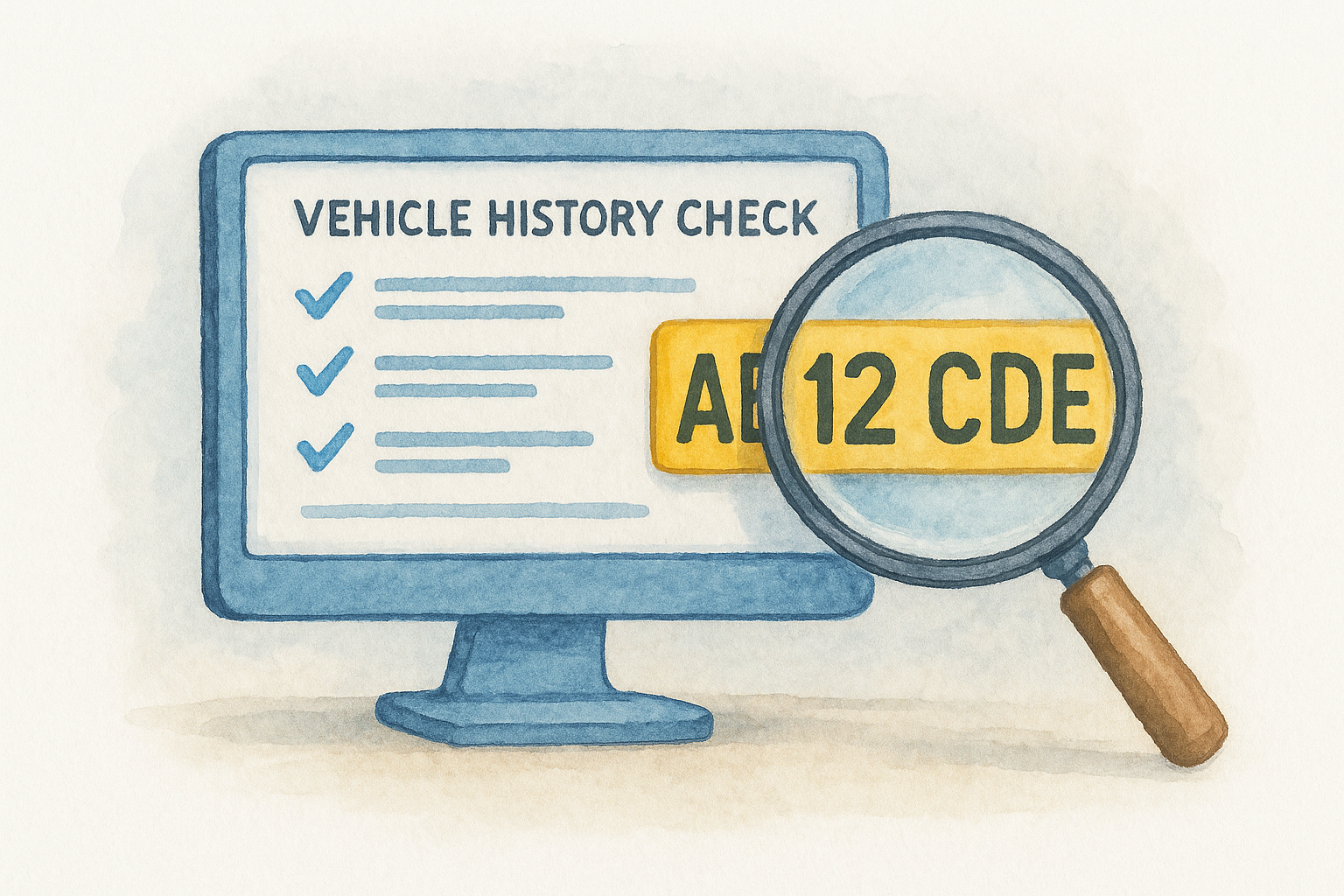
A premium check goes further and covers the information that actually protects your money:
| Check | What it tells you |
|---|---|
| Outstanding finance | Whether the car is subject to a hire purchase or PCP agreement |
| Written-off status | Whether the car has been declared a total loss by an insurer |
| Stolen vehicle check | Cross-referenced against the UK Police Database |
| Import and export records | Flags cars brought in from outside the UK |
| Colour change history | Can indicate the car has been resprayed to hide damage |
| Ownership history | Number of previous keepers and how long each held the car |
If the car has outstanding finance registered against it, the finance company legally owns it. Buying it without checking first puts you at serious risk of losing both the car and your money.
How to interpret what you find
Read the results carefully rather than just scanning for a "pass" indicator. A car with three previous keepers in two years and a recent change of colour warrants more questions, even if nothing is technically flagged. Look at the gap between MOT mileage entries too. A car showing 40,000 miles at one test and 38,000 at the next has had its odometer tampered with.
Check the number of previous keepers against what the seller told you on the phone. If they said they have owned it for three years but the data shows a keeper change six months ago, that is a direct contradiction. Print or save a copy of the report so you can refer back to it during your viewing and negotiation.
Arrange a safe viewing and check paperwork
Once your history check is done and nothing serious has flagged up, you can arrange a viewing. Do not let enthusiasm rush this stage. Choosing the right time and location for a viewing protects you physically and gives you the best conditions to assess the car properly. This is also the point where you verify the paperwork in person, which is a critical part of knowing how to buy a car privately without getting caught out.
Where to meet and when
Always view the car at the seller's home address, and confirm it matches the address shown on the V5C logbook. Sellers who insist on meeting in a car park, a petrol station, or any neutral location are often not the registered keeper of the vehicle. That alone is a reason to walk away before you make the journey.
Never view a car after dark. Poor light hides bodywork damage, rust, and fluid leaks that are obvious in daylight.
Arrange your viewing for a dry, clear day and in the morning when you are fresh and less likely to rush a decision. Bring a trusted second person with you if you can. A second pair of eyes spots things you miss, and their presence discourages a seller from applying any pressure during negotiation.
Paperwork to check before you pay
Before you look at a single panel or start the engine, sit down and go through the documents. Ask the seller to produce the V5C logbook, the MOT certificates, and any service records before you begin the physical inspection. A genuine seller will have these ready without hesitation.
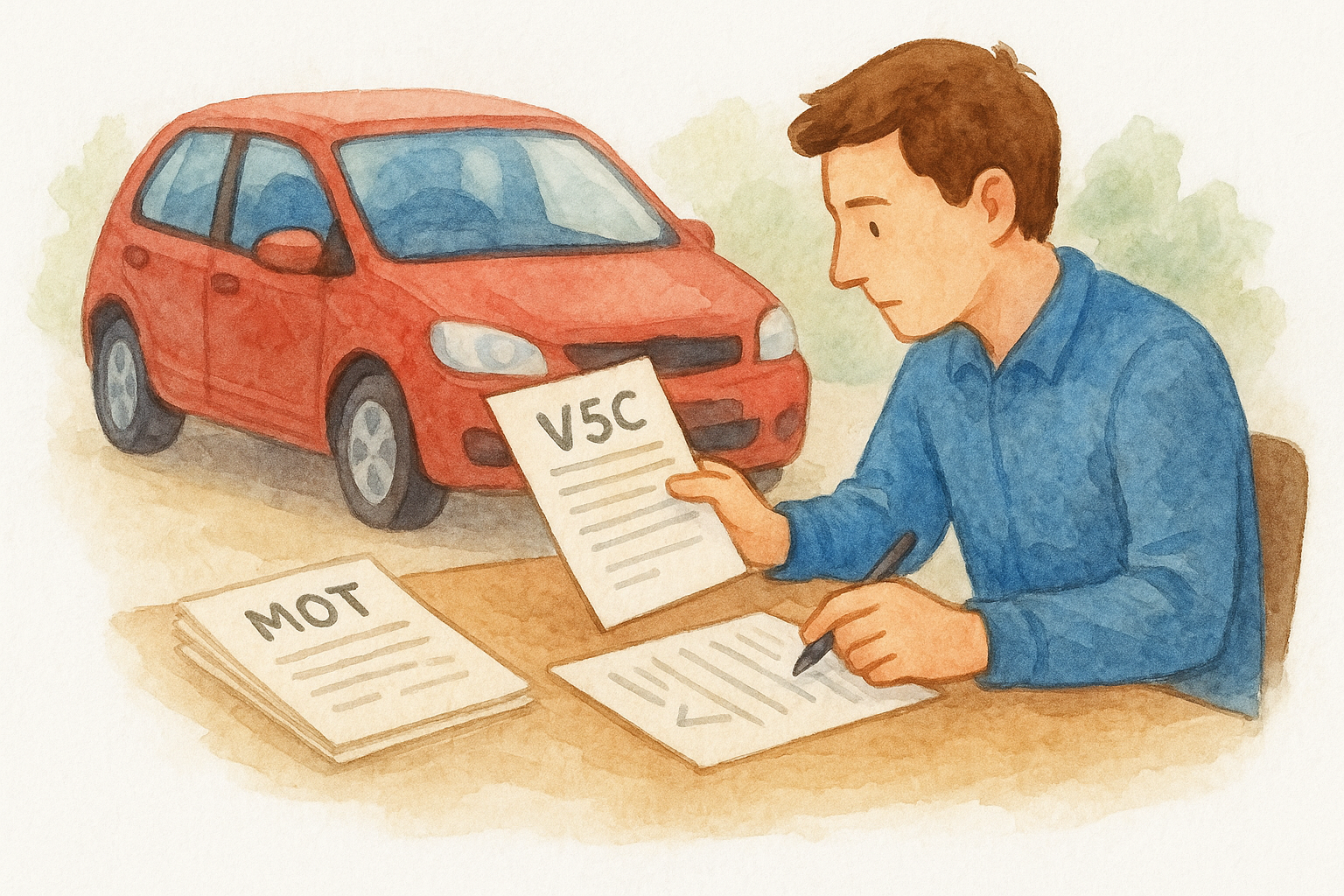
Work through this checklist when you review the paperwork:
| Document | What to verify |
|---|---|
| V5C logbook | Seller's name matches registered keeper; address matches where you are viewing |
| MOT certificates | Mileage figures at each test are consistent and increasing |
| Service history | Stamps match the mileage timeline; dealer or garage details are real |
| Finance settlement letter | If seller claims finance is cleared, ask for written proof |
Check the VIN number printed inside the V5C against the VIN stamped on the car, usually visible through the windscreen on the dashboard or inside the driver's door frame. Any mismatch between the document and the physical plate means the car's identity has been altered, which is an immediate reason to end the viewing and leave.
Inspect the car like you mean it
The physical inspection is where knowing how to buy a car privately pays off most directly. By this point you have confirmed the paperwork is clean and the documents match the car. Now you need to use your eyes and hands to find anything the history check cannot reveal: poorly repaired crash damage, rust hidden under trim panels, or fresh paint that covers something the seller would rather you missed. Work through the car systematically rather than looking at whatever catches your attention first.
Check the exterior methodically
Start at one corner of the car and work your way around it completely before moving on. Crouch down at each end and look along the panels from a low angle, which is the fastest way to spot ripples, filler, or uneven bodywork that indicates previous accident damage. Check that the panel gaps between doors, wings, and bumpers are even on both sides. Asymmetrical gaps are a clear sign that the car has taken a significant impact at some point.
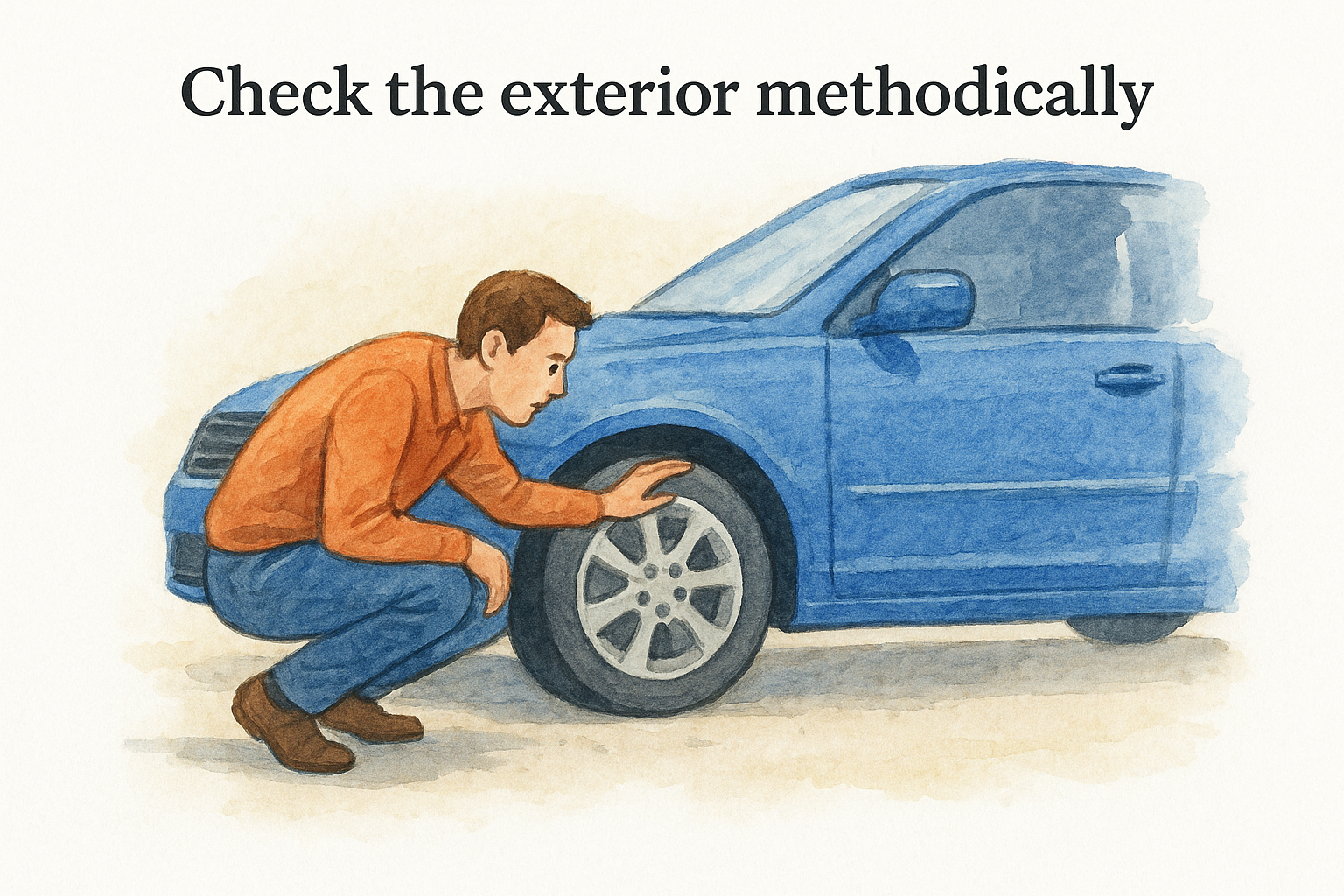
Mismatched paint shade between panels is one of the most reliable indicators of a repaired accident, even when the bodywork feels straight.
Use this checklist during your exterior walkround:
| Area | What to check |
|---|---|
| Roof and sills | Rust bubbles, dents, or resprayed sections |
| Wheel arches | Rust or filler at the inner arch lip |
| Windscreen | Chips, cracks, or crazing that could fail an MOT |
| Tyres | Tread depth across the full width, uneven wear patterns |
| Lights and lenses | Cracks, condensation inside the unit, or misaligned fittings |
Look inside and under the bonnet
Once you have finished the exterior, check the interior and then the engine bay. Every warning light on the dashboard should extinguish within a few seconds of starting the car. If any remain lit, ask the seller directly what fault triggered them and record their answer. Check the seat fabrics, carpets, and headlining for water staining or a damp smell, which points to a leak from the roof, windows, or bodywork seams.
Under the bonnet, look at the oil cap and dipstick for a brown, mayonnaise-like residue, which indicates a head gasket failure and a very expensive repair. Check the coolant reservoir level and colour, and look at the underside of the bonnet itself for any dark staining from fluid that has been thrown around at speed.
Test drive and listen for problems
A test drive is not a formality. It is one of the most direct ways to catch mechanical problems that paperwork and a static inspection cannot reveal. Understanding how to buy a car privately means knowing exactly what to listen, feel, and watch for during those 15 to 20 minutes behind the wheel. Take the route you want, not one the seller suggests, and include a mix of urban streets, a short stretch of faster road, and at least one sharp turn so you can test the car under realistic conditions.
Before you move off
Before you pull away, spend two minutes in the stationary car with the engine running. Check that the engine idles smoothly without hunting, shuddering, or making any tapping or knocking sounds. Turn on the heater, the air conditioning, the rear demister, and every electric window to confirm they all work. A fault with any of these is not automatically a deal-breaker, but it is a negotiating point and the cost of repair belongs in your calculation from this moment.
If the seller rushes you to move off before you have finished your stationary checks, slow down rather than skip them.
Work through this checklist before you drive:
| Check | What you are listening or looking for |
|---|---|
| Engine idle | Smooth and consistent; no misfires or tapping sounds |
| Warning lights | All should extinguish within seconds of starting |
| Electrics | Windows, mirrors, heater, and air con all functioning |
| Steering at rest | No pulling to one side when briefly released on a straight road |
What to listen and feel for while driving
Once you are moving, brake firmly at low speed first to check the car stops in a straight line without pulling or juddering. Any vibration through the brake pedal at speed suggests warped discs, which need replacing. Accelerate through the full rev range and listen for hesitation, misfires, or a smell of burning as the engine works harder. If the car has an automatic gearbox, each change should feel smooth and immediate with no slipping between ratios.
Pay attention to the steering at higher speeds if you can safely reach them. Vibration through the wheel typically points to wheel balancing or tracking issues. Check the handbrake on a slope to confirm it holds the car firmly without needing to be pulled beyond its normal operating travel, and listen for any clunking from the suspension as you go over speed bumps or uneven surfaces.
Agree a price and choose a payment method
By the time you reach this stage, you have a clear picture of the car's condition, its history, and any faults or issues you found during the inspection and test drive. Every problem you discovered is legitimate grounds for a lower price, and knowing how to buy a car privately means understanding that negotiation at this point is expected, not awkward. Private sellers price their cars with room to move, so use the evidence in front of you to make a fair, informed offer rather than simply accepting the asking price.
How to negotiate the price
Start by listing the specific faults you found and attach a realistic cost to each one. Worn tyres, advisory items from the last MOT, and minor bodywork repairs all have a market rate, and quoting them specifically shows the seller you have done your research. For example, if the car needs two new front tyres at roughly £80 each and has an MOT advisory on a rear brake, that is £200 to £250 of immediate spend you can reference directly when you make your offer.
Make your offer once, clearly, and with your reasoning behind it. Sellers respond better to a justified number than a random low figure with no explanation.
Compare the asking price against at least three similar listings on AutoTrader or Facebook Marketplace before you start negotiating. If comparable cars with similar mileage and condition are priced lower, that is another point in your favour. Keep your tone factual rather than critical of the car or the seller, and be prepared to walk away if the seller will not move to a price that reflects what you found.
Payment methods and which to use
Bank transfer is the safest payment method for private car purchases in the UK. Use a faster payment from your bank account directly to the seller's account, and confirm the account details with the seller verbally before you send anything. Never pay using PayPal Friends and Family, cryptocurrency, or a wire transfer service, as none of these offer you any meaningful route to recovering funds if a problem arises.
Avoid paying with cash for large amounts wherever possible, not because it is legally invalid but because it leaves you with no transaction record and no protection. If a seller insists on cash only, treat that as a red flag and proceed with caution. Confirm the payment has cleared before you hand over any signed documents or take the keys.
Complete the sale and change keeper online
Payment confirmed and keys in hand means the transaction is done, but the administrative steps that follow are just as important as everything that came before. Completing the paperwork correctly and notifying the DVLA promptly protects you as the new keeper and ensures the car is legally registered in your name without delay.
Sign the receipt and hand over the V5C
Both you and the seller need to sign the receipt you prepared before the viewing. Write the agreed sale price, the exact date, and the current mileage on both copies, and each keep one. Do not leave without your signed copy. Even if the seller seems trustworthy, a written record is the only evidence you have if a dispute arises later.
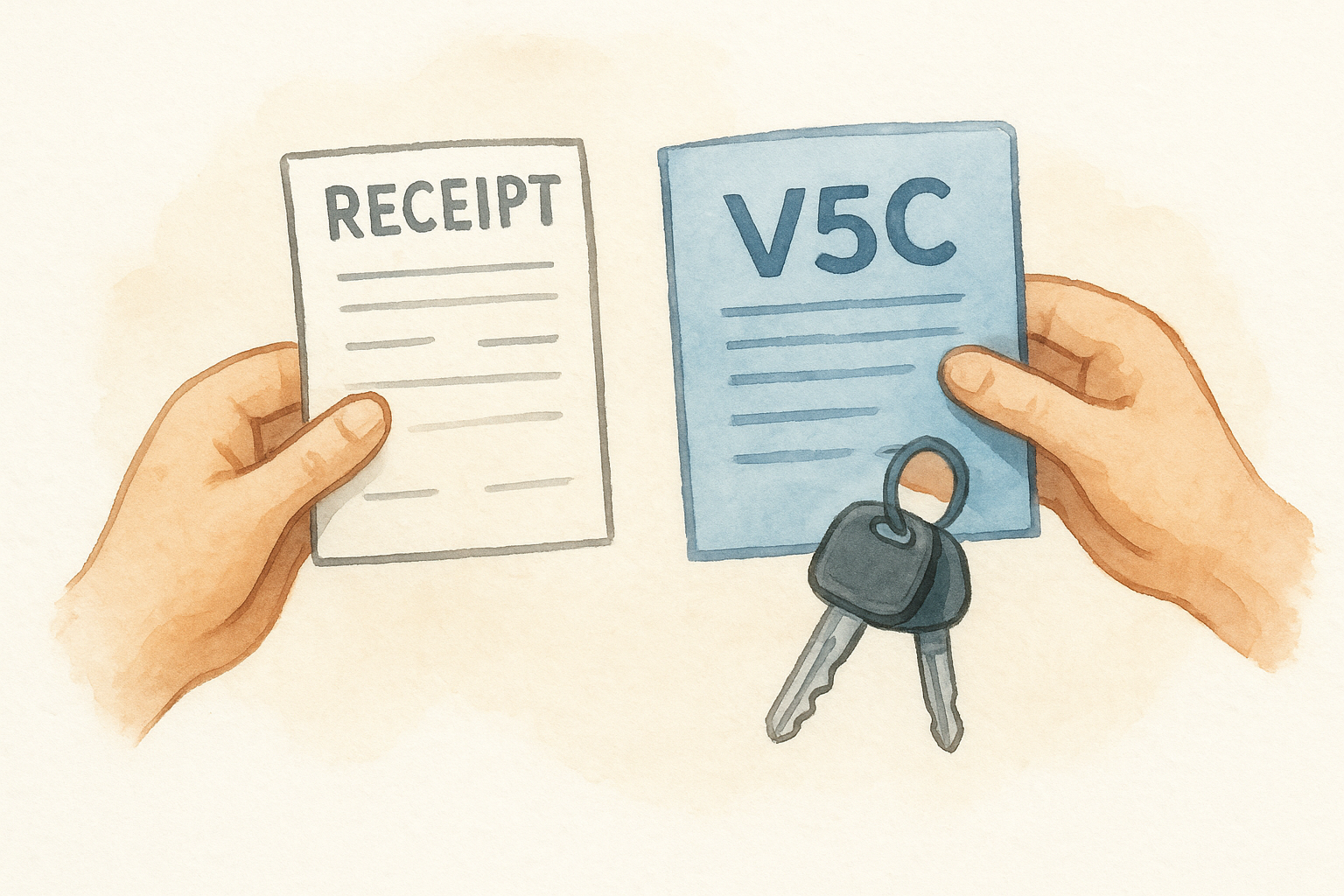
The V5C logbook needs to be handled carefully at this point. The seller tears out and keeps Section 6 (the yellow "new keeper" slip), and hands the rest of the green V5C to you. That yellow slip is your temporary proof of ownership while the DVLA processes the change of keeper, so keep it somewhere safe. If the seller gives you the entire V5C without removing the slip, do it together before you part ways.
Never drive away without either the yellow keeper slip or confirmation that the online notification has been submitted immediately.
Tell the DVLA you are the new keeper
Knowing how to buy a car privately in full means understanding that notifying the DVLA is not optional and carries a specific process. The seller is responsible for telling the DVLA they have sold the vehicle, and you are responsible for registering yourself as the new keeper. Both of you can complete this at gov.uk/change-vehicle-details using the reference number on the V5C.
The DVLA's online service is available 24 hours a day, and the change of keeper update typically processes within two to four weeks. You will receive a new V5C in your name at the address you provide. Keep the yellow slip as proof of ownership in the meantime and store it with your insurance documents.
Use this checklist to confirm you have completed every step at the point of sale:
| Task | Done |
|---|---|
| Signed receipt with price, date, and mileage | |
| Yellow keeper slip retained from V5C | |
| DVLA change of keeper submitted online | |
| Seller confirmed their notification is sent | |
| Keys and any spare keys received |
Tax, insure, and take the car home
The final part of understanding how to buy a car privately is making sure the car is legal to drive before it moves an inch. Road tax does not transfer between owners. The moment the seller notifies the DVLA that they have sold the vehicle, any remaining tax on the car is automatically cancelled and they receive a refund for the unused months. That means you are driving an untaxed vehicle if you pull away without sorting this first.
Get insurance in place before you collect
You cannot legally drive the car home without valid insurance in your name. Arrange this before your viewing day so that cover is active the moment you plan to drive away. Most major UK insurers allow you to set a specific start date and time for a new policy online, which makes it straightforward to have everything ready in advance. If you are adding the car to an existing multi-car policy, contact your insurer the morning of the collection and confirm the new registration is live on your policy before you set off.
Do not assume you are covered under your existing policy for a new vehicle, even temporarily. Check directly with your insurer and get written confirmation.
Bring your insurance documents or confirmation email with you to the viewing. If anything delays the sale and you end up not purchasing the car, you can cancel the policy within the cooling-off period and receive a full refund in most cases.
Tax the car immediately after purchase
Once the sale is complete and you hold the yellow V5C keeper slip, tax the car using the DVLA's online service at gov.uk/vehicle-tax before you start the engine for the drive home. You will need the 11-digit reference number from the yellow slip or the V5C itself, and you can pay by debit card, credit card, or direct debit depending on whether you choose an annual or monthly payment option. The DVLA's system updates in real time, so the car is legally taxed the moment your payment processes.
Road tax rates depend on the vehicle's fuel type, CO2 emissions, and the year it was first registered. Check the rate for your specific car using the registration number on the DVLA website before collection so the cost is already in your budget and you are not surprised at the checkout stage.
Quick recap and next step
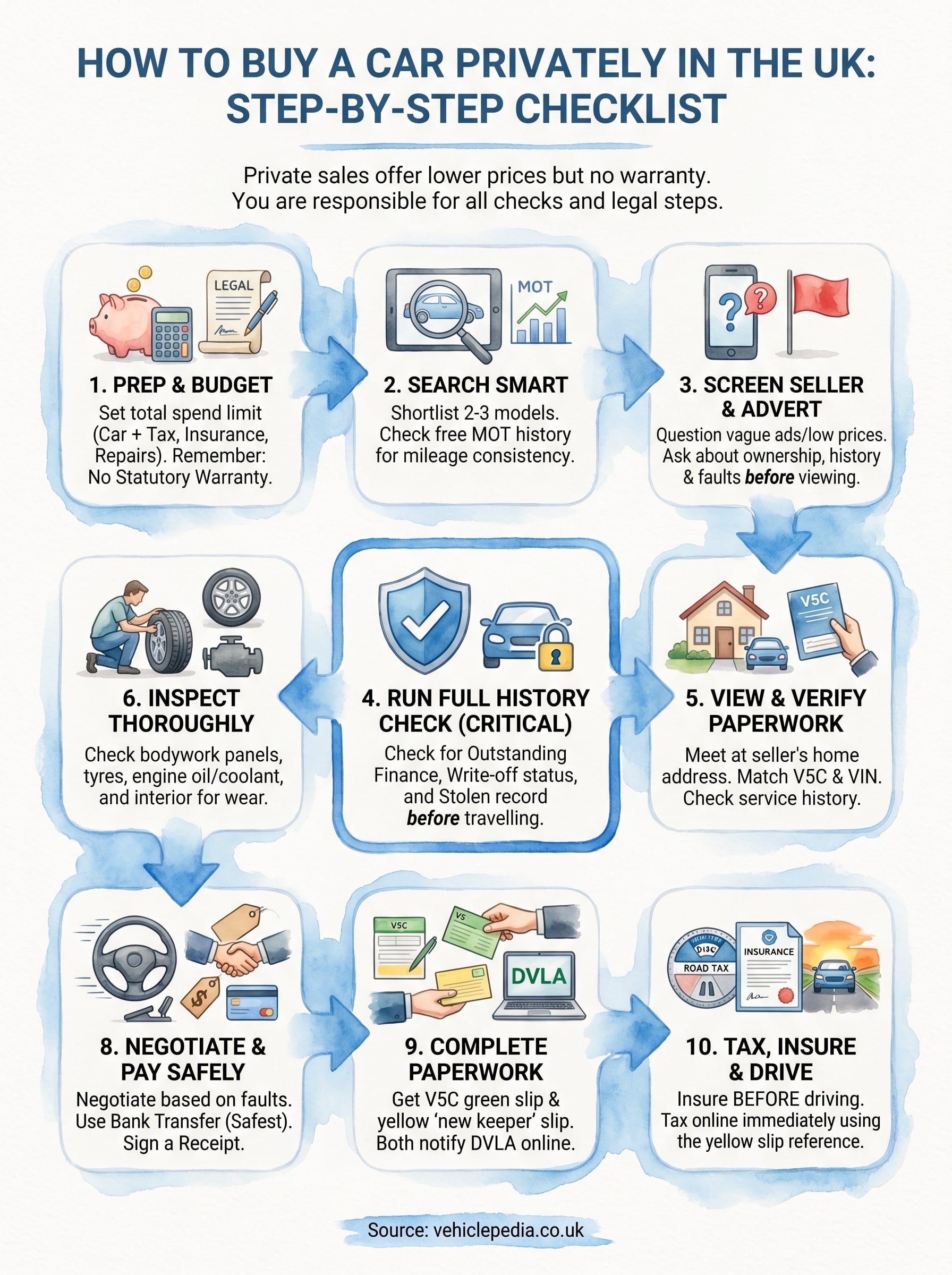
Learning how to buy a car privately comes down to doing the right things in the right order. Set your budget before you search, shortlist carefully, screen the seller and the advert critically, and run a full vehicle history check before you travel anywhere. At the viewing, verify the paperwork against the car, inspect every panel and system methodically, and complete a thorough test drive. Negotiate using the faults you found, pay by bank transfer, and handle the DVLA notification and road tax before you drive the car home.
Every step in this guide exists because buyers have lost money by skipping it. The one check that catches the most serious problems before a viewing is the vehicle history check. You can see exactly what a full premium report covers, including outstanding finance, write-off status, and stolen vehicle data, by reviewing the Vehiclepedia sample report before you run your first check.