Car Reg Check UK: How To Check MOT, Tax & History In Minutes
How to check car reg number details for free: MOT history, tax and keepers, plus spotting clones, clocked mileage and when to pay for a premium check.
Car Reg Check UK: How To Check MOT, Tax & History In Minutes
Running a car reg check UK lookup is one of the quickest ways to find out what's really going on with a vehicle. Whether you're about to hand over thousands for a used car or just need to confirm your own vehicle's MOT and tax status, a registration plate check gives you answers in minutes, no phone calls, no paperwork.
The problem? Most buyers skip this step entirely, or they don't realise how much information is actually available for free. MOT history, tax status, previous keepers, even whether a car's been written off, it's all accessible through official UK databases like the DVLA. And yet, plenty of people still buy cars blind, only to discover costly surprises after the fact.
That's exactly why we built Vehiclepedia. Our platform pulls together vehicle data from trusted official sources so you can check a car's background using nothing more than its registration number. In this guide, we'll walk you through how to run a full reg check step by step, covering MOT, tax, ownership history, and the premium checks worth considering before you commit to a purchase.
What a UK car reg check can tell you
A car reg check UK lookup retrieves data directly from official sources, so you get accurate, up-to-date information rather than guesswork. The registration plate acts as a unique identifier tied to every piece of recorded data about that vehicle, from its first registration to its most recent MOT test. Understanding what's available, and what's free versus paid, helps you decide exactly how deep to dig before committing to a purchase.
Free data: MOT, tax, and vehicle identity
The first layer of information costs you nothing. When you enter a registration number, you instantly pull up the vehicle's current MOT status, including whether it's valid, when it expires, and how many days remain. That makes it a quick number plate check for MOT, whether you're vetting a car you might buy or checking your own. Road tax status is also available for free through official DVLA records, showing whether the vehicle is currently taxed and what the annual tax cost is based on its emissions band.
Beyond compliance status, free checks return a solid profile of the vehicle itself. You'll see the make, model, engine size, and fuel type, alongside the vehicle's age and registered colour. Year of first registration, CO2 output, and number of previous keepers are also included, which matters if you're comparing running costs or assessing how many owners a car has had.
The free data alone is enough to catch obvious red flags, like a car that's been off the road for years or one that hasn't had a valid MOT since it last changed hands.
MOT history: more than just a pass or fail
MOT history is one of the most useful things a registration check surfaces. It is also the backbone of a car's reg history, because the same plate ties every test, failure and mileage reading together. Each test result is logged with the date, the mileage recorded at the time of the test, and a full list of any failures or advisory notices. This lets you build a timeline of how the car has been maintained, not just whether it squeaked through its most recent inspection.
Advisories deserve close attention. A pattern of recurring advisories for the same component, such as corroded brake pipes or worn suspension bushes, suggests either deferred maintenance or a vehicle that's been used hard without proper upkeep. Mileage entries across multiple tests also give you a reliable way to check whether the current odometer reading is consistent with the car's history, a key indicator of potential clocking.
Premium checks: finance, stolen status, and write-off records
Some information doesn't come from the DVLA and requires checking against additional databases. Outstanding finance is one of the most critical issues to investigate. If a previous owner borrowed money against the car and never cleared the debt, that liability follows the vehicle. A finance company can legally reclaim the car from you even after you've paid the seller in full.
A stolen vehicle check runs the registration against the UK Police National Computer, confirming whether the car has been reported stolen. Write-off status checks the insurance register to flag whether the car has ever been declared a total loss, and if so, under which damage category. Category S and N vehicles can be repaired and legally returned to the road, but Category A and B write-offs must never be driven again. Spotting one listed for private sale is an immediate reason to walk away.
Taken together, these checks give you a complete picture of what you're actually buying, not just what the seller tells you.
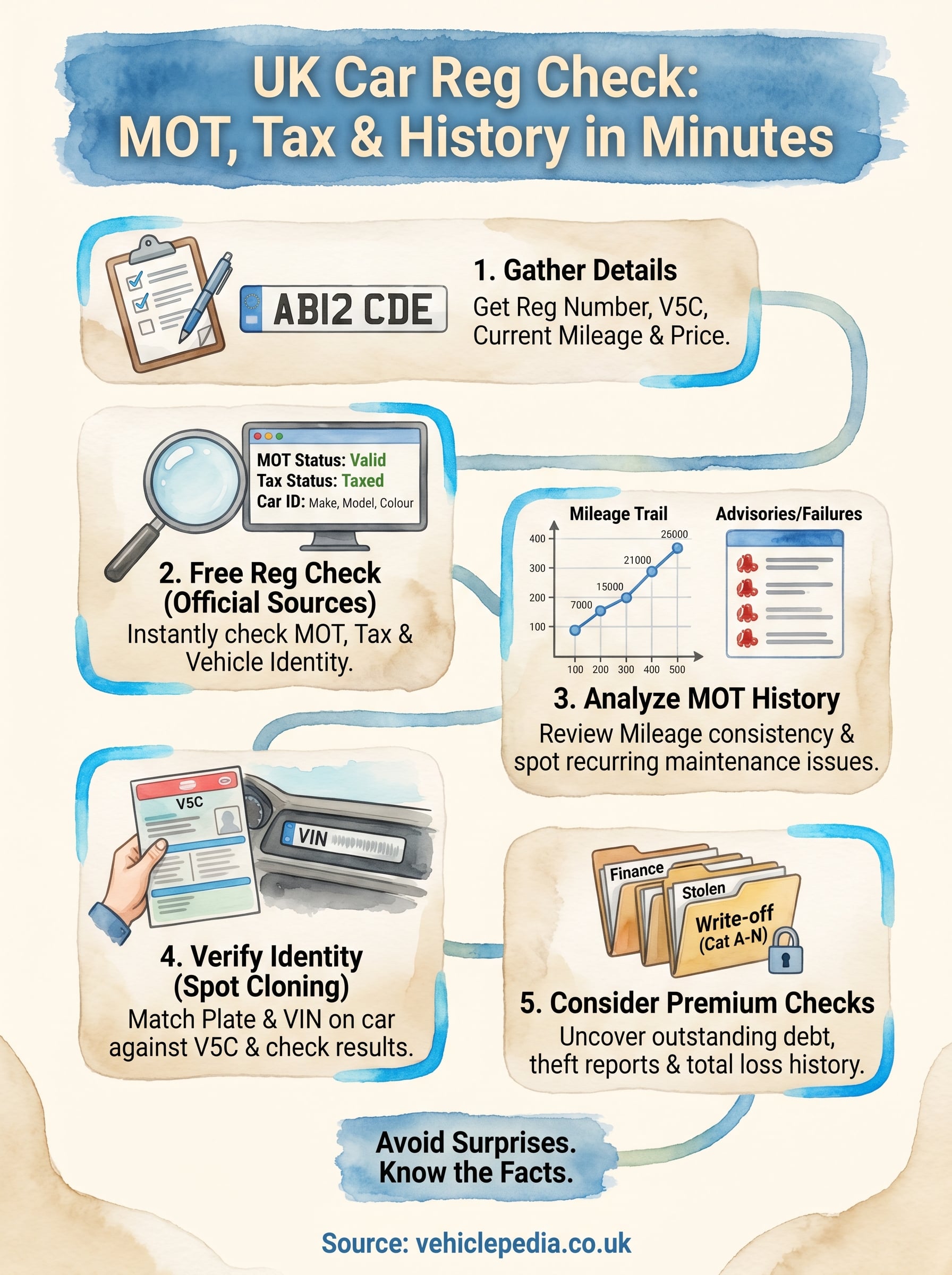
Step 1. Gather the details you need
Before you run a car reg check UK lookup, you need one thing: the registration plate number. That's all it takes to start pulling data from official sources. Having a couple of additional details ready before you begin saves time and makes it much easier to cross-reference what the check returns against what the seller has told you.
Locate the registration number
The registration number appears in two obvious places on the vehicle: the front and rear number plates. On most UK cars, the format follows the standard two-letter, two-digit, three-letter structure, for example, AB12 CDE. If you're viewing the car remotely before an in-person visit, ask the seller to confirm the registration in writing, which also gives you a useful record to keep.
You'll also find the registration printed clearly on the V5C logbook (the vehicle's registration certificate), on the front page. If the seller hands you the V5C at the viewing, confirm that the plate on the car matches the one in the document before you run any checks.
A registration number that doesn't match the V5C is an immediate warning sign and could indicate a cloned or stolen vehicle.
What else to have ready
While the registration number is all you need to start a check, having a few extra details to hand lets you verify the results properly rather than just read them passively.
- The V5C document number (printed top right of the logbook): useful for cross-checking registered keeper information
- The seller's asking price: helps you evaluate whether a write-off or finance flag changes the car's value significantly
- The current mileage shown on the dashboard: so you can compare it directly against the mileage recorded at each MOT test
None of these are required to run the check itself. However, the more context you bring to the results, the more useful the data becomes. A mileage discrepancy means nothing without a figure to compare it against, but it becomes highly significant when the odometer reading in front of you doesn't line up with the MOT history.
Step 2. Run a free reg check for MOT and tax
Running a free reg check takes under a minute and requires nothing beyond the plate number you gathered in the previous step. Head to Vehiclepedia, type the registration number into the search field, and press check. The platform queries official DVLA records in real time and returns results immediately, with no account required and no payment prompt for the basic data. You don't need to share any personal information, and the check itself leaves no trace on the vehicle's history record. This is your starting point for every car you seriously consider buying, and the same lookup works if you simply want to check your own car registration, MOT expiry and tax status.
Where to enter the registration
Vehiclepedia's homepage search bar is where you start. Enter the registration in the standard UK format, such as AB12 CDE, and submit. The system is not case-sensitive, so entering it in lowercase or without the space between character groups still returns the correct vehicle. If you're running a car reg check UK lookup on a car you haven't viewed in person yet, doing this before arranging a visit lets you rule out obvious problems without spending time on a wasted journey.
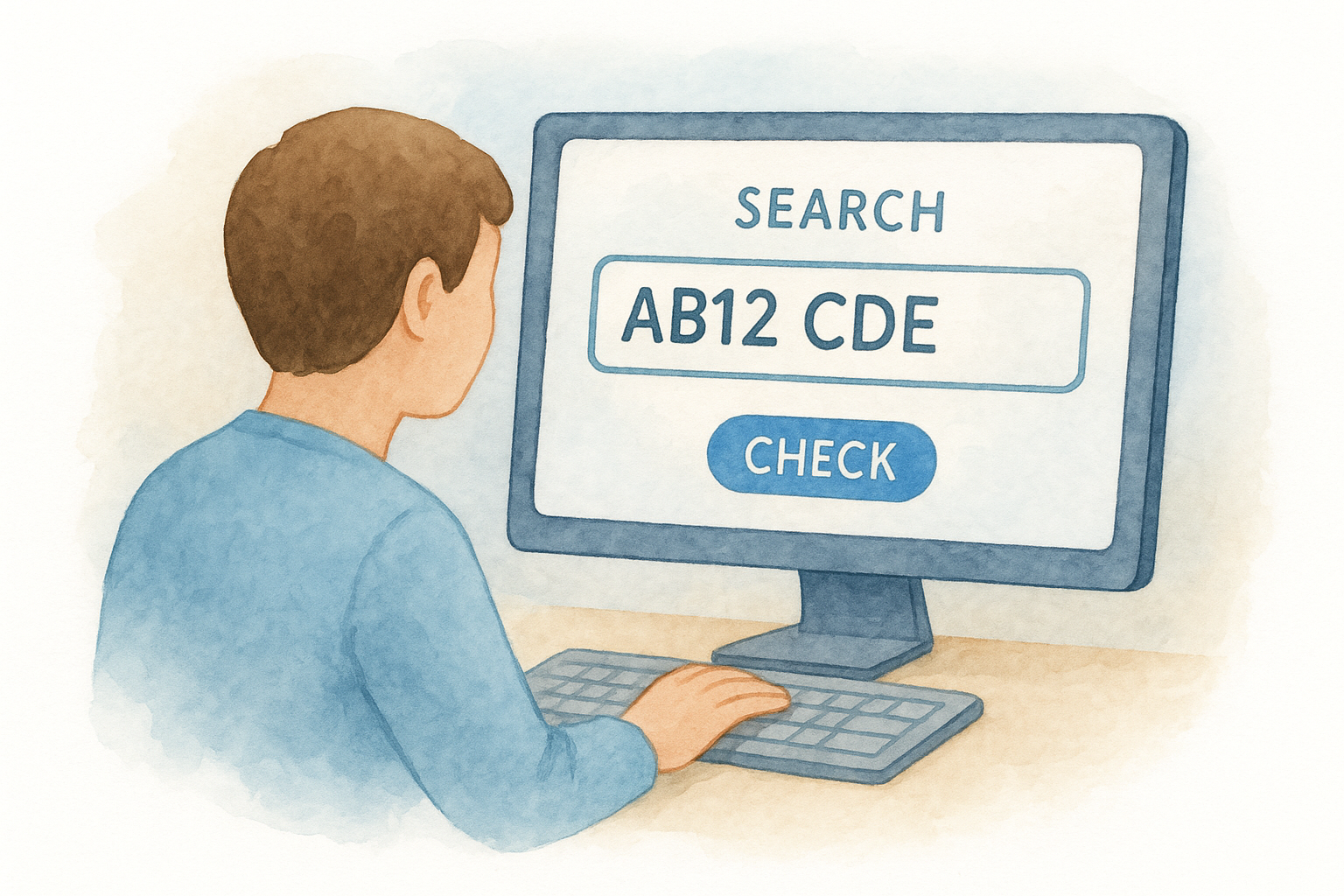
Follow these steps to go from registration number to results:
- Visit vehiclepedia.co.uk
- Type the full registration number into the homepage search bar
- Press the check button to submit
- Review the results page for MOT status, tax status, and vehicle identity
If the registration returns no match, or the vehicle details contradict what the seller has told you, ask them to verify the plate before going any further.
What the results show you
The free results page puts MOT and road tax status at the top, so you immediately see whether both are currently valid. Below that, you'll find the vehicle's make, model, engine size, fuel type, registered colour, and year of first registration. Cross-referencing these details against the seller's listing takes seconds and confirms whether the plate you've searched actually corresponds to the car being advertised. Make a note of these details before you visit in person.
Beyond vehicle identity, the results include the number of previous keepers recorded against that registration, along with how recently ownership changed. A car with multiple owners over a short period is worth examining more carefully, even if the MOT record appears clean. The page also shows the annual road tax cost calculated from the vehicle's CO2 emissions band, giving you a realistic running cost figure to use when comparing your shortlisted options.
GOV.UK also lets you check vehicle details for free, including make, colour, tax and MOT status. That is the same basic DVLA data. It won't show finance, stolen or write-off records, which is where a fuller vehicle reg check earns its place.
Step 3. Read MOT history like a mechanic
The MOT history section of a car reg check UK result is where experienced buyers find information that sellers rarely volunteer. Each test entry includes the date, recorded mileage, pass or fail result, and a detailed breakdown of any failures or advisory notices. Reading these entries in sequence gives you a far clearer picture of the car's condition than a single viewing ever could.
Check the mileage trail first
Mileage consistency is the quickest thing to verify, and it's one of the most revealing. Start at the oldest test entry and work forward, confirming that the odometer reading increases steadily from one test to the next. If the numbers jump backwards at any point, that's a strong indicator the car has been clocked, meaning someone wound back the mileage to inflate the car's perceived value.
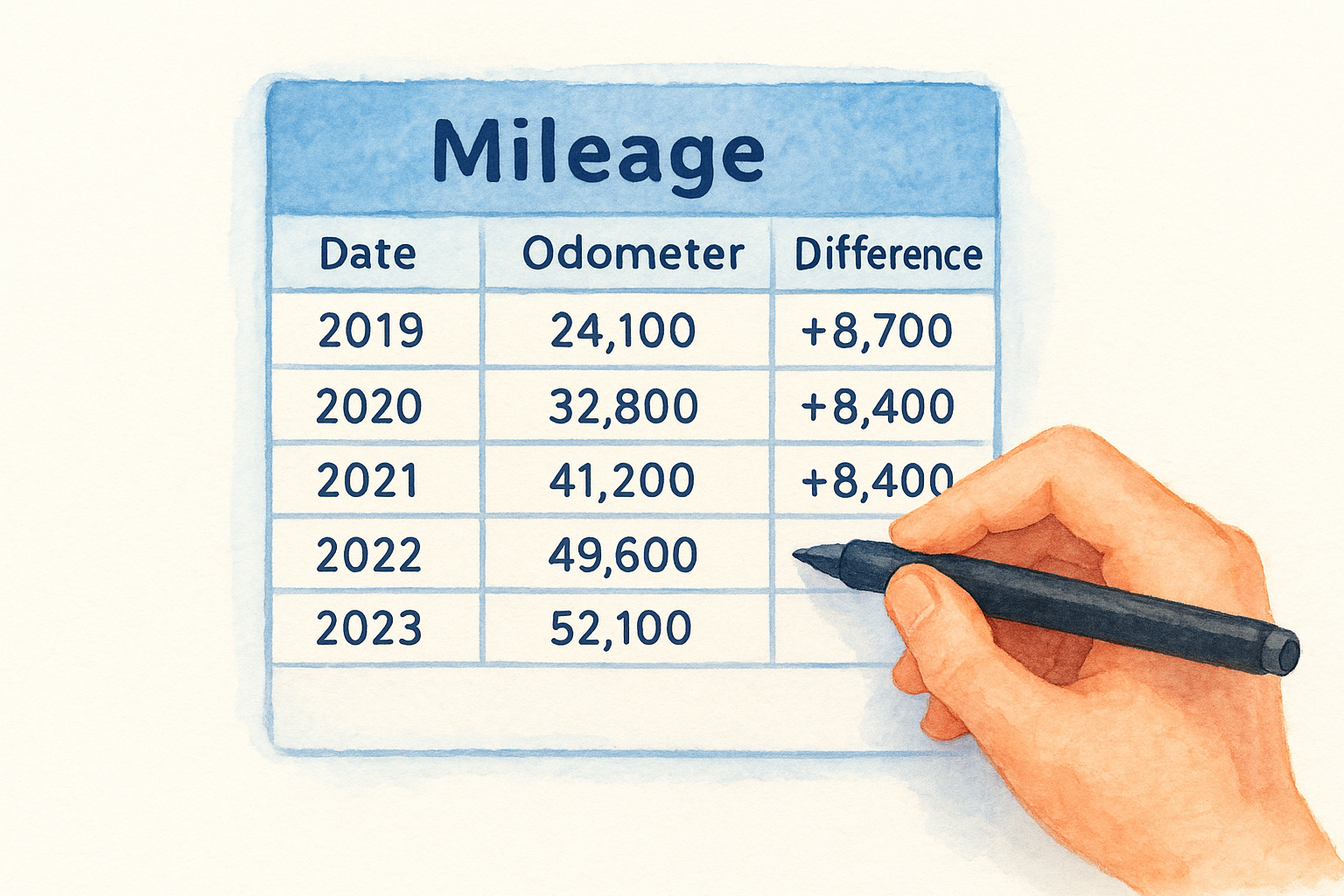
Use this format to map the readings yourself before your viewing:
| MOT Date | Mileage Recorded | Difference |
|---|---|---|
| Jan 2019 | 24,100 | - |
| Jan 2020 | 32,800 | +8,700 |
| Jan 2021 | 41,200 | +8,400 |
| Jan 2022 | 49,600 | +8,400 |
| Jan 2023 | 52,100 | +2,500 |
Consistent annual mileage is normal. A sudden drop in mileage between two tests, or a figure that contradicts the current odometer reading, warrants a direct question to the seller before the conversation goes any further.
Decode advisories and failures
Failures tell you what was dangerously wrong at the time of testing. Advisories tell you what was borderline. Both matter, but advisories often get overlooked because they didn't prevent the car from passing. A single advisory for worn rear brake pads is unremarkable. The same advisory appearing across three consecutive years without any record of work being done tells a very different story.
Recurring advisories for steering, brakes, or structural corrosion suggest deferred maintenance that may now be at a critical point.
Pay attention to the specific wording in failure and advisory descriptions. The government's official MOT records use standardised language, so terms like "excessive play," "corrosion to a structural component," or "brake imbalance" carry precise meanings. If you're unfamiliar with a specific term, search it directly to understand what the component is and what a repair typically costs before you commit to a viewing.
Step 4. Verify identity and spot cloning
Vehicle cloning happens when someone takes the registration plate of a legitimate car and attaches it to a different vehicle, usually one that's been stolen or declared a write-off. The cloned car then appears completely clean in every database because you're effectively looking at the record of an entirely different vehicle. A car reg check UK lookup is a critical part of your due diligence, but the check alone isn't enough. You need to physically confirm that the car sitting in front of you actually matches the data the check returned.
What cloning looks like in practice
Cloned vehicles typically share a registration with a genuine car of the same make, model, and colour, so the plates look plausible at first glance. Sellers of cloned vehicles often push for a quick decision, pricing the car below market value and discouraging close inspection. Watch for a V5C that looks recently printed, a seller who deflects questions about ownership history, or a number plate that appears noticeably newer than the surrounding bodywork and general wear on the vehicle.
If the asking price sits well below market rate for a car with a clean check result, treat that as a reason to look harder, not faster.
A common situation involves a high-value vehicle advertised through a private sale with minimal photos and a seller who insists on meeting in a public car park rather than at the address listed in the V5C. These details may seem minor individually, but together they form a recognisable pattern worth taking seriously before you go any further.
How to cross-check the plate against the physical car
When you arrive at a viewing, bring your reg check results and compare each data point directly against the vehicle in front of you. Work through the following before the conversation moves forward:
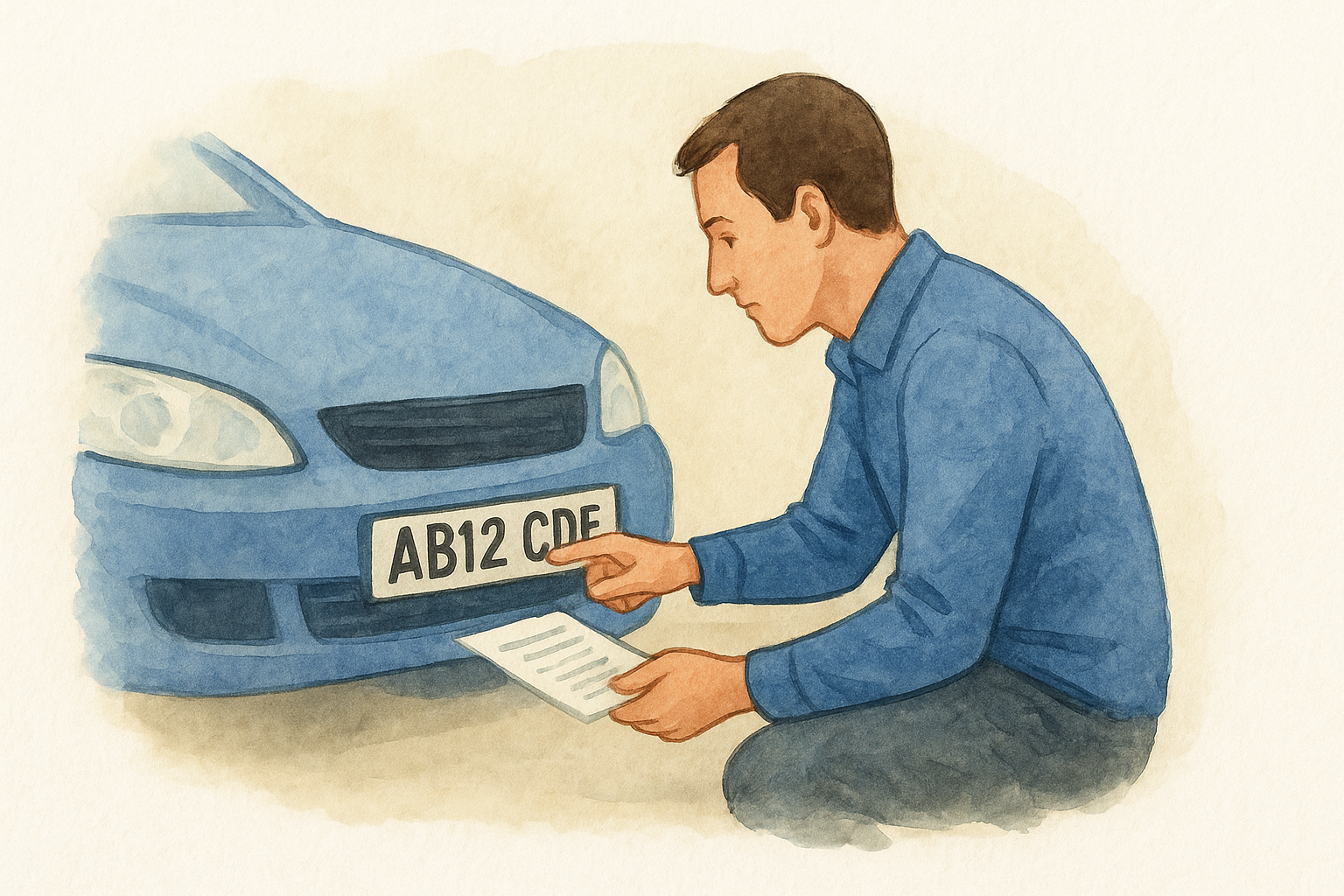
- Make, model, and colour: all three must match the check results exactly
- Year of manufacture: cross-reference the car's age against the registration plate format, which encodes the year of first registration
- VIN (Vehicle Identification Number): locate it on the dashboard (visible through the windscreen), on the door frame, and in the V5C; all three must match
- Engine number: stamped on the engine block; compare it against the V5C entry
The VIN is the most reliable identifier a vehicle has. It's a 17-character code stamped into the chassis at manufacture and cannot be legitimately altered. If the VIN on the car differs from the one in the V5C, or if it shows signs of grinding and re-stamping, walk away immediately. A tampered VIN is one of the clearest indicators that a vehicle's identity has been interfered with.
Step 5. Decide when to pay for deeper checks
A free car reg check UK lookup covers a lot of ground, but it doesn't access every database. The DVLA holds MOT history, tax status, and vehicle identity data, but it doesn't hold records of outstanding finance agreements, insurance write-off categories, or stolen vehicle reports. Those sit in separate registers, and accessing them requires a premium check. Understanding exactly when that extra spend is justified helps you prioritise where your money goes.
When the free data raises concerns
If the free check returns a clean result but something about the seller's behaviour or the vehicle itself doesn't add up, that's the clearest signal to go further. Mismatched mileage, a car that's changed hands multiple times in quick succession, or a seller who resists giving you time to verify details all suggest the free data isn't telling the full story.
A premium check costs a fraction of what you'd lose if you bought a car subject to a finance agreement you weren't told about.
Situations where paying for deeper checks is a straightforward decision include:
- The asking price is significantly below comparable listings for the same make, model, and mileage
- The seller claims there's no V5C and promises it's "on its way from DVLA"
- The MOT history shows a gap of two or more years with no recorded tests
- You're buying a high-value vehicle where a write-off or finance issue would represent a substantial financial loss
- The car was imported and has limited UK history visible in the free check results
What a premium report includes
Vehiclepedia's premium report checks the car against three additional databases that the free lookup doesn't reach. A finance check searches the national register of hire purchase and loan agreements to confirm whether any outstanding debt is secured against the vehicle. A stolen vehicle check queries the UK Police National Computer to verify the car hasn't been reported as stolen. A write-off check confirms whether the car has ever been declared a total loss and, if so, under which insurance category.
These checks use the same registration number you've already used. You don't need to re-enter any details, and the results are presented alongside the free data you've already reviewed, giving you a single consolidated report to work through before you make any final decision.
Next steps before you buy
A car reg check UK lookup takes minutes and can save you from buying a vehicle with problems that cost far more to resolve than the car was ever worth. You now have a clear process: confirm the plate, run the free check, read the MOT history carefully, verify the physical vehicle against the data, and decide whether the situation calls for a premium report. Follow each step in order, and you arrive at the viewing with facts rather than assumptions.
Before you hand over any money, run the full check on every car you seriously consider, not just your final choice. If the free results raise any concern at all, add the premium checks for finance, stolen status, and write-off records. The combined cost is a fraction of what you stand to lose if a finance company reclaims the car. Look through a premium report example to see exactly what you get before you commit.