Vehicle Registration Lookup UK: Check MOT, Tax & History
Check MOT, tax, and mileage with a vehicle registration lookup uk. Spot hidden red flags like outstanding finance or write-offs before you buy.

Vehicle Registration Lookup UK: Check MOT, Tax & History
Every used car on a UK forecourt or private listing has a story, and not all sellers are upfront about what that story includes. A vehicle registration lookup UK search lets you pull back the curtain on any car's past by retrieving its MOT history, tax status, mileage records, and more, all from official sources like the DVLA and police databases.
At Vehiclepedia, we built our platform around this exact need. Enter a registration plate, and you'll get instant access to a car's key details, from its MOT expiry date and advisory notices to whether it's been reported stolen or has outstanding finance against it. It's the kind of check that can save you thousands of pounds and a serious headache.
This guide walks you through how a UK registration lookup actually works, what information you can uncover for free, and when it's worth going deeper with a premium vehicle history check. Whether you're buying your first car or your fifteenth, you'll know exactly what to look for and where to find it.
What a UK vehicle registration lookup shows
A vehicle registration lookup UK search pulls data from multiple official sources and brings it together in one report. The information you get back covers everything from the car's make, model, and engine size to its MOT history and current tax status. Knowing what's included helps you decide which checks matter most before you hand over any money.
Free information available on any registration
The free tier of a registration check gives you a solid baseline on the vehicle's official status. You'll see the car's registered colour, year of manufacture, and engine capacity, along with its current MOT expiry date and road tax status. This data comes directly from the DVLA's official database, so you can trust it reflects what the government has on record.
Most free checks also show you the full MOT history for vehicles tested since 2005. This includes pass and fail records, mileage readings at each test, and any advisory notices flagged by the mechanic. That mileage data is particularly useful because it lets you spot inconsistencies that could point to clocking.
If the mileage at a recent MOT test is lower than at an earlier one, that is a strong signal the odometer has been tampered with.
Premium data: finance, write-offs, and theft
Free checks cover the basics, but they do not tell you everything. For a full picture, you need to look at the data that only premium checks can surface. This includes whether the car has outstanding finance registered against it, meaning the previous owner borrowed money using the vehicle as security and has not paid it back.
A premium check also reveals whether the car has been written off by an insurance company, which category it was written off under, and whether it was subsequently repaired and returned to the road. Alongside this, the check runs the registration against the UK Police Database to confirm the car has not been reported stolen. Buying a stolen vehicle means you could lose both the car and the money you paid for it, with no legal recourse.
| Check type | Free | Premium |
|---|---|---|
| MOT history and expiry | Yes | Yes |
| Road tax status | Yes | Yes |
| DVLA vehicle details | Yes | Yes |
| Mileage anomaly detection | Yes | Yes |
| Outstanding finance | No | Yes |
| Write-off category | No | Yes |
| Stolen vehicle check | No | Yes |
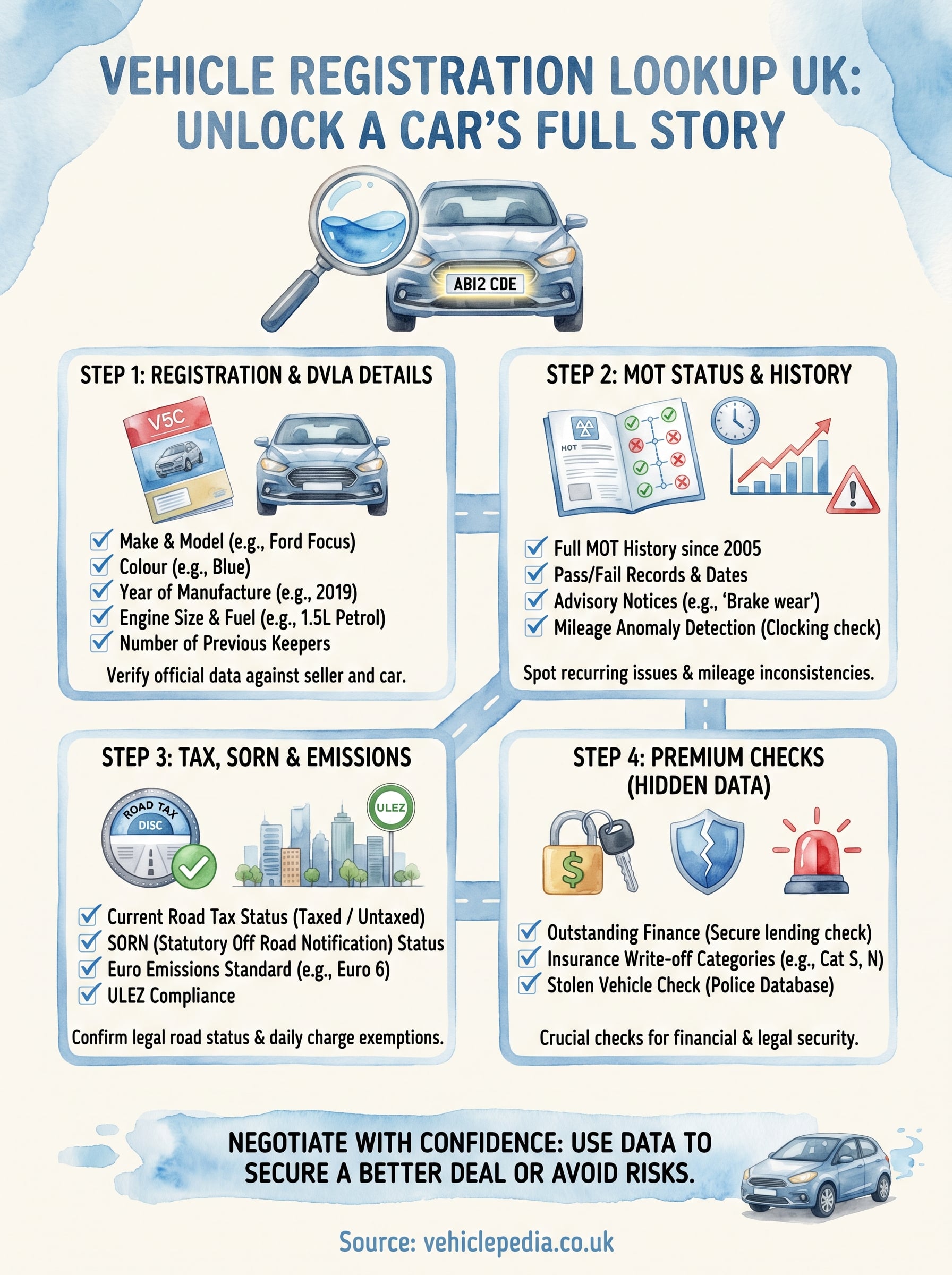
Step 1. Get the reg and verify DVLA vehicle details
Before you run any vehicle registration lookup UK check, you need the correct registration number. It sounds obvious, but entering a single wrong character will pull up data for a completely different vehicle, and you could walk away with a false sense of security.
Where to find the registration number
The registration plate itself is the most reliable source, but you should cross-reference it against the V5C logbook before you do anything else. The V5C lists the registration number on the front page, and it should match exactly what is displayed on both the front and rear plates of the car.
If the plates and the V5C show different numbers, walk away from the deal immediately.
You can also find the registration on the MOT certificate, the insurance certificate, and any service history documents. Checking across multiple documents confirms the number is consistent and has not been altered.
What DVLA details to verify
Once you have the registration and run the lookup, compare the official DVLA data against what the seller has told you and what you can physically see on the car. Work through this checklist:
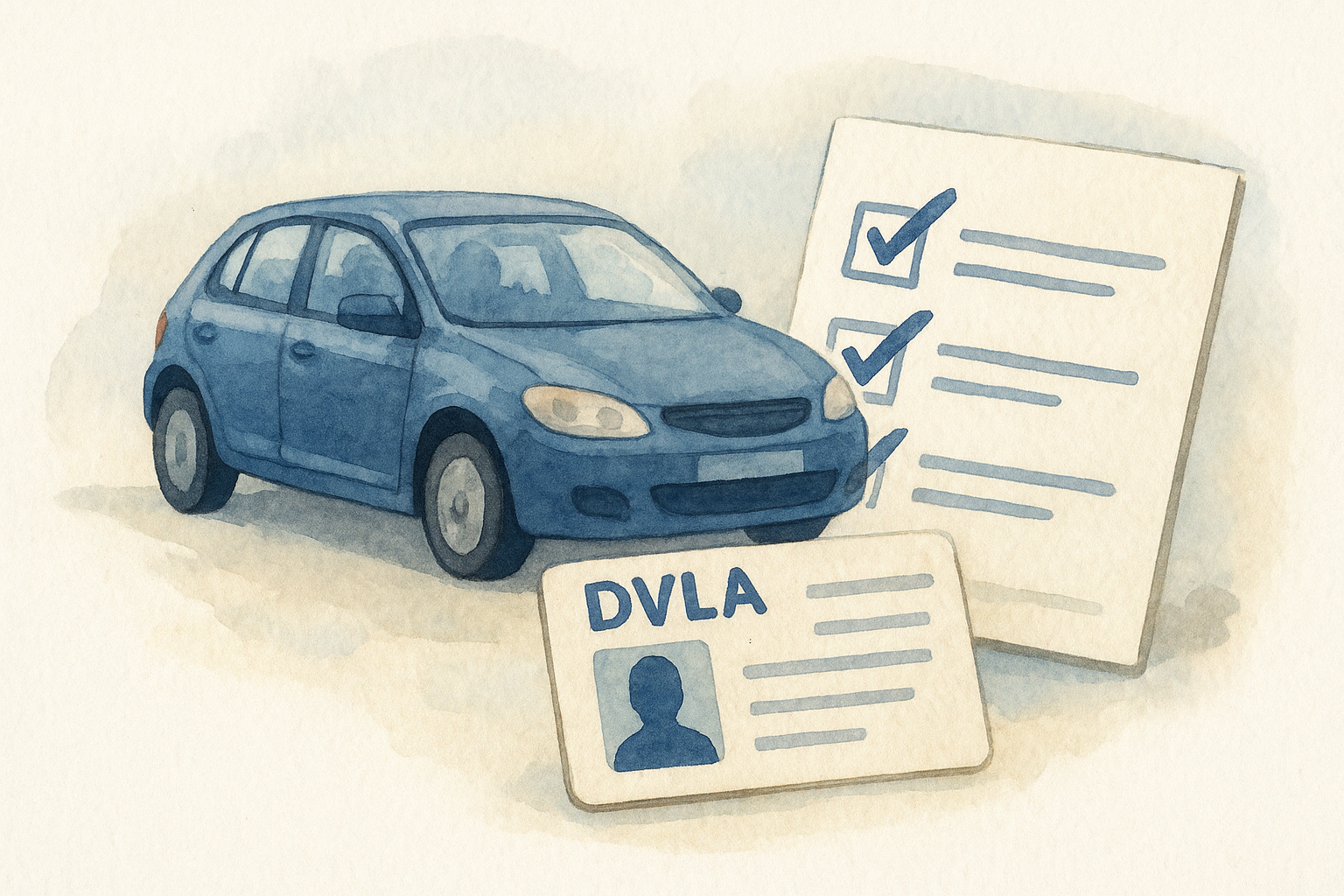
- Make, model, and colour: The registered colour should match the actual paintwork. A colour mismatch suggests the car was resprayed, which is not always a red flag, but it does warrant questions.
- Engine size and fuel type: Confirm these match the seller's description and the V5C.
- Year of manufacture and first registration date: These affect insurance premiums and depreciation, so verify them carefully.
- Number of previous keepers: A high keeper count on a young car can indicate persistent problems.
Step 2. Check MOT status and history for warning signs
The MOT history is one of the most revealing parts of any vehicle registration lookup UK check. Every test result since 2005 is stored on the DVLA's database, and the patterns within that history can tell you far more than the current pass or fail status alone. A single failed test is not necessarily a deal-breaker, but repeated failures on the same components suggest the car has underlying problems that keep coming back.
Reading advisory notices carefully
When a car passes its MOT, the mechanic can still flag items that are not serious enough to cause a fail but need monitoring or repair soon. These are called advisory notices, and they carry real weight. If the same advisory notice appears across multiple consecutive MOT tests, it means the owner has not addressed the issue, and the problem may have deteriorated since the last test.
An advisory that shows up three years in a row is a maintenance red flag, not a minor observation.
Pay particular attention to advisories mentioning brake wear or corrosion, as these directly affect safety and can be expensive to repair. A car with recurring advisories may look presentable on the outside but cost you significantly more to maintain.
Checking the mileage trail
Each MOT record includes a mileage reading at the time of the test. Pull up all the historical entries and confirm the figures increase consistently year on year. A reading that drops between tests is a strong sign of odometer tampering, commonly known as clocking. Watch for these patterns:
- Any decrease in mileage between tests, however small
- Unusually large gaps in recorded mileage with no clear explanation
- Missing test years that break an otherwise regular testing pattern
Step 3. Check tax, SORN, emissions and ULEZ status
A vehicle registration lookup UK check pulls the car's current tax and SORN status directly from DVLA records, and this step is worth doing before you see the vehicle in person. An untaxed car cannot legally be driven on a public road, and if a seller is driving it to viewings, that already signals the car has been poorly managed.
Road tax and SORN status
Your lookup will show whether the car is currently taxed or registered as SORN (Statutory Off Road Notification). A SORN declaration means the owner told the DVLA the car is being kept off the road. That is not automatically a problem, but you should ask why and for how long. A SORN stretching back several years suggests the car has been sitting unused, which can cause mechanical issues from inactivity such as seized brakes, deteriorated seals, and flat-spotted tyres.
A vehicle that has been SORN for over 12 months needs a thorough mechanical inspection before you consider buying it.
Emissions standard and ULEZ compliance
Every car has an emissions category tied to its engine type and registration year. Your registration check will show the car's Euro emissions standard, which tells you immediately whether it qualifies for free access to clean air zones across the UK.
A non-compliant car in a city like London can cost you a daily charge just to drive it. That adds up to hundreds of pounds a year, so factor the ULEZ compliance status into your offer price before you commit.
Step 4. Confirm mileage, finance, write-offs and theft
The final layer of any thorough vehicle registration lookup UK is confirming the four data points that most directly affect whether you should buy the car at all. Mileage discrepancies, outstanding finance, insurance write-offs, and theft records can each independently kill a deal, and in some cases they combine to make a car completely worthless as a purchase.
Mileage cross-check beyond the MOT records
You already reviewed the MOT mileage trail in Step 2, but now you want to cross-reference that data against the service history and any other documents the seller provides. A full service history will show mileage readings at each servicing interval. Compare those figures directly against the MOT entries from the same period.
- If a service record shows 45,000 miles in May but the MOT from the same month shows 38,000, that is a clear inconsistency worth challenging.
- Gaps in service records covering high-mileage periods are a warning sign on their own.
Finance, write-offs and stolen vehicle checks
These three checks are only available through a premium report, and they are the most important data points when buying privately. Finance checks confirm whether a lender has a legal claim on the vehicle. If outstanding finance exists, the lender can repossess the car from you even after you have paid the seller in full.
Never complete a private sale without confirming the finance status first, regardless of how credible the seller appears.
A write-off category check tells you whether an insurer has previously declared the car a total loss, and the theft check confirms the registration against the UK Police Database for any active stolen reports.
Next steps before you buy
Running a vehicle registration lookup UK check is the single most effective thing you can do before agreeing to a price. The free check covers MOT history, tax status, and DVLA details, giving you a factual baseline to work from. If any of those results raise questions, or if you are serious about the vehicle, a premium report adds the checks that matter most: outstanding finance, write-off category, and theft records.
Use every piece of data you retrieve to negotiate. A car with recurring MOT advisories or a SORN period gives you concrete grounds to ask for a lower price, and a clean report gives you confidence to proceed. Do not rely on the seller's word alone when official records are available instantly.
Before you meet the seller, view a sample premium report so you know exactly what you are getting and can read the results with confidence.