VIN Number Format UK: 17 Characters Explained & Checked
Learn how to decode the 17-character vin number format uk. Discover what each digit reveals, where to find it on a car, and how to spot fraud before buying.
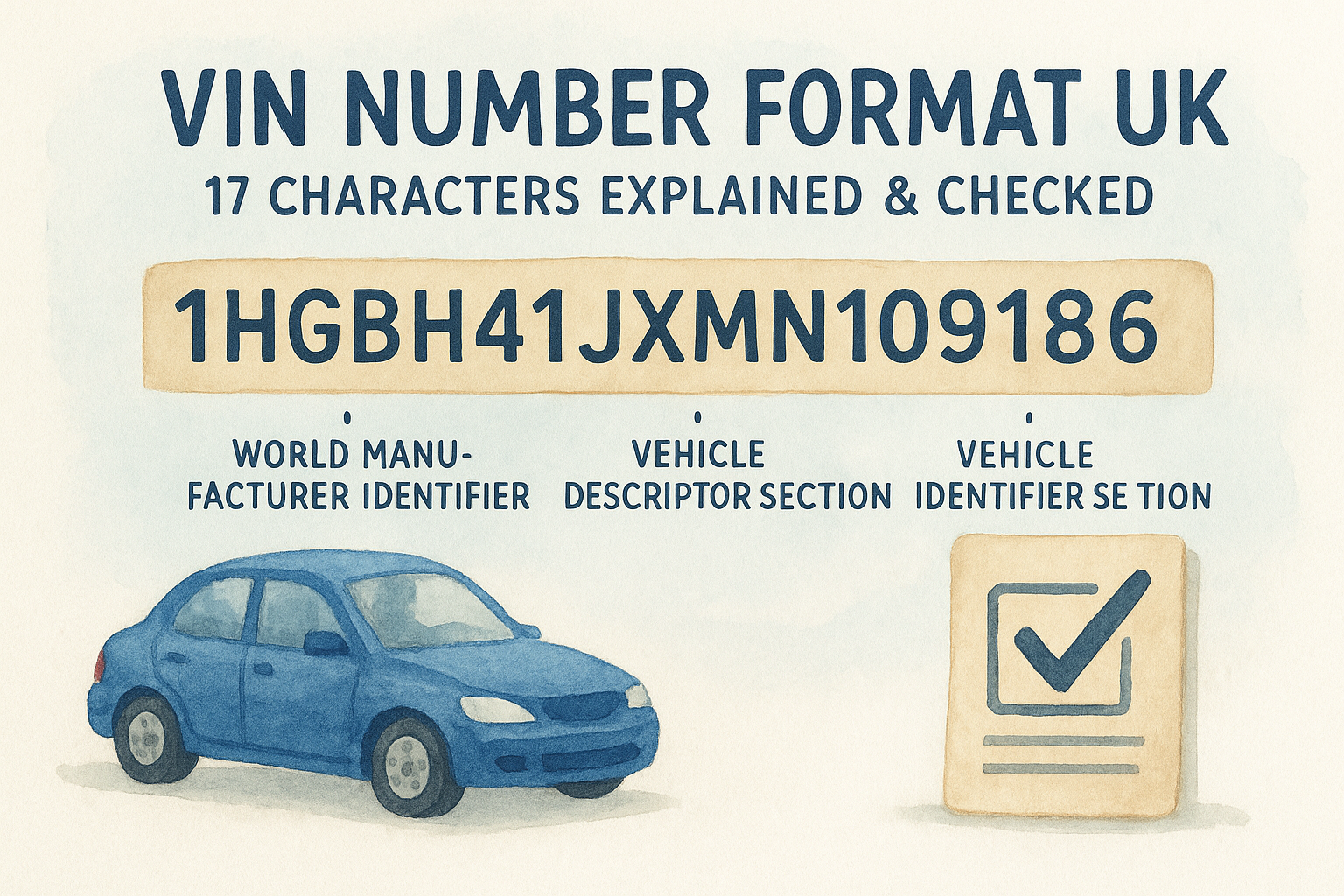
VIN Number Format UK: 17 Characters Explained & Checked
Every car on UK roads carries a 17-character code stamped somewhere on its body, and that code works like a fingerprint. Learn to read the VIN number format UK vehicles use and you can work out where a car rolled off the production line, which manufacturer built it, and roughly what spec it left the factory with, all before you commit a single pound to the seller. If you're a used car buyer, this is one of the sharpest tools in your kit.
Every character in that sequence carries meaning, whether it's pointing to the country of manufacture, the engine fitted, or the exact production number of that individual car. The trouble is, VINs aren't self-explanatory, and getting the interpretation wrong means you can walk straight past a red flag without noticing it. That's the gap Vehiclepedia fills: we let you check a vehicle's history against official UK sources such as the DVLA, so you're not relying on your own reading of the VIN alone, you're confirming it against what's actually on file.
In this guide, we go through all 17 characters, explain what each block of the code represents, and point you to where to find the VIN on the car itself and in its paperwork. By the end, whether you're buying from a dealer forecourt or a private seller, you'll be able to read and cross-check a VIN yourself with confidence.
What the UK VIN number format looks like
The VIN number format UK vehicles follow comes from an international standard, ISO 3779, which became mandatory across Europe back in 1981. Every valid VIN runs to exactly 17 characters, mixing uppercase letters with digits. That sequence isn't random: it splits into three fixed sections, each covering a set range of positions and each telling you something different about the vehicle.
No two vehicles built within the same 30-year cycle should ever share a VIN, which is precisely what makes it the single most dependable identifier a car has.
The three sections that make up a VIN
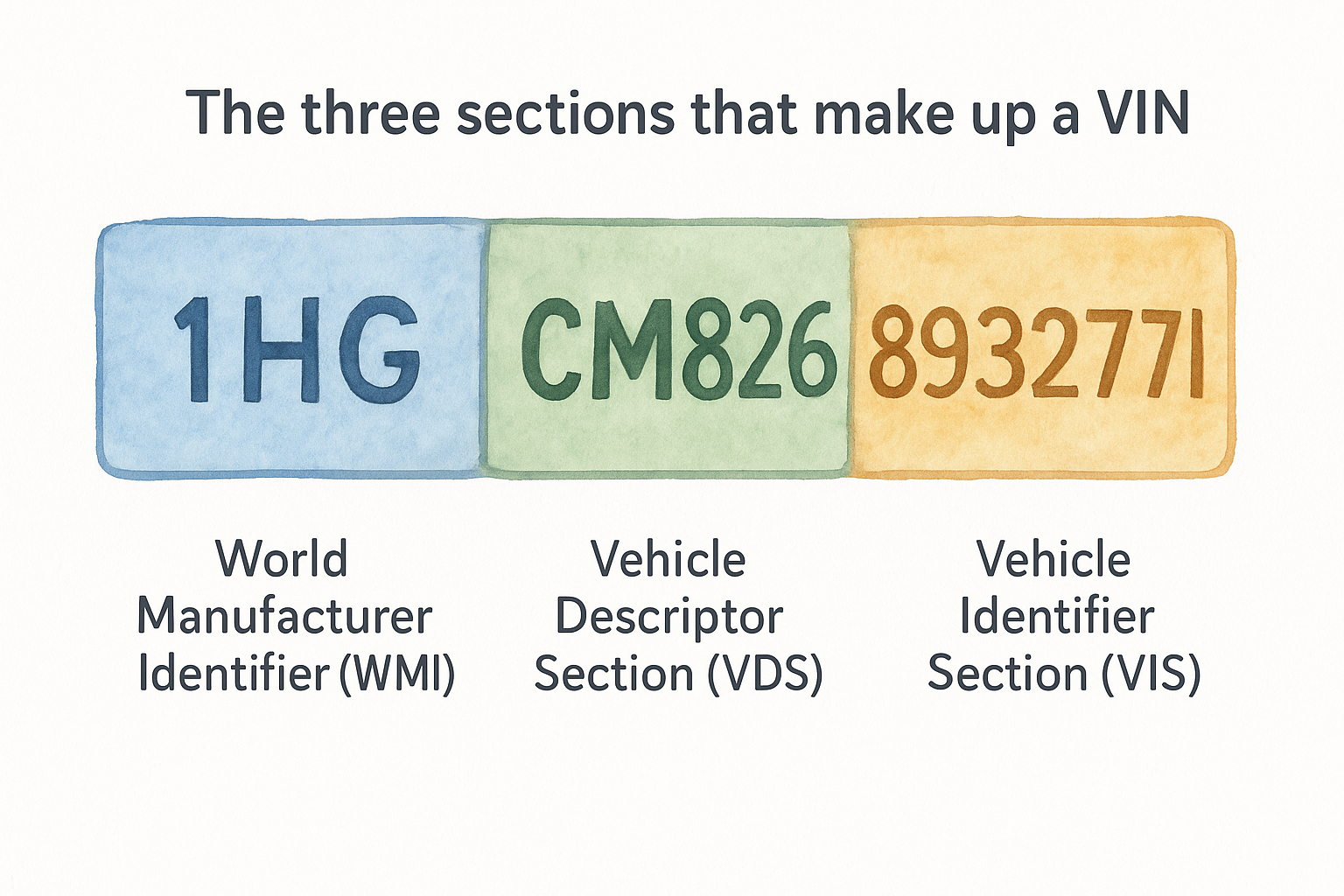
A VIN is made up of three named blocks: the World Manufacturer Identifier (WMI), the Vehicle Descriptor Section (VDS), and the Vehicle Identifier Section (VIS). Between them, these blocks cover characters 1 to 3, 4 to 9, and 10 to 17. Once you know how these blocks line up, you've got a structured, globally consistent code you can start decoding yourself.
| Section | Characters | What it covers |
|---|---|---|
| World Manufacturer Identifier (WMI) | 1-3 | Country of origin and manufacturer |
| Vehicle Descriptor Section (VDS) | 4-9 | Vehicle type, body style, engine, and check digit |
| Vehicle Identifier Section (VIS) | 10-17 | Model year, assembly plant, and production sequence |
Characters you will never see in a VIN
Three letters never appear in a genuine VIN: I, O, and Q. They're excluded on purpose, because I is too easily confused with the number 1, O looks just like a zero, and Q can be mistaken for O in the same way. If you spot any of these three letters while checking a VIN, treat it as an immediate red flag, it usually means the number has either been tampered with or misread off a damaged or worn plate.
On top of ruling out those three letters, specific positions in the VIN only accept certain types of character. Position 9 is always the check digit, worked out mathematically from the other 16 characters, and position 10 always encodes the model year through a standardised letter or number code.
What each VIN character means in practice
The VIN number format UK vehicles follow gives every position in the sequence its own job. Once you know what each character does, you can verify key facts about a car before you even glance at its service history. Positions 1 to 3 name the country of origin and the manufacturer: SAJ points to Jaguar in the UK, while WBA marks out BMW in Germany.
How the middle section describes the vehicle
Characters 4 to 8 fall within the vehicle descriptor section, where each manufacturer encodes body style, engine type, restraint system, and model line using its own internal schema. That means the same position can mean something different depending on who built the car, so you need to check the descriptor against manufacturer-specific decoding tables rather than rely on one universal guide.
Position 9 is the check digit, a single character worked out mathematically from the other 16 using a weighted formula. If the check digit doesn't match once you run the calculation yourself, the VIN has been altered or transcribed incorrectly.
How the final section identifies the individual car
Position 10 encodes the model year through a standardised alphanumeric code, where P stands for 2023 and R for 2024. Position 11 identifies the assembly plant where that specific car was built. Characters 12 to 17 make up the production sequence number, a six-digit figure that sets your individual vehicle apart from every other unit built to the same specification in that model year.
Where to find the VIN on a car and on the V5C
The VIN number format UK vehicles use is standardised, but the physical location of the number changes from one manufacturer to the next. Knowing where to look saves you time and stops you mistaking the VIN for other codes stamped elsewhere on the vehicle.
Physical locations on the vehicle
Manufacturers stamp the VIN in several places on a car. The most reliable spot is the base of the windscreen on the driver's side, where it's visible from outside on a small metal plate. Check the driver's side door jamb too, where a sticker or stamp will often carry the same number.
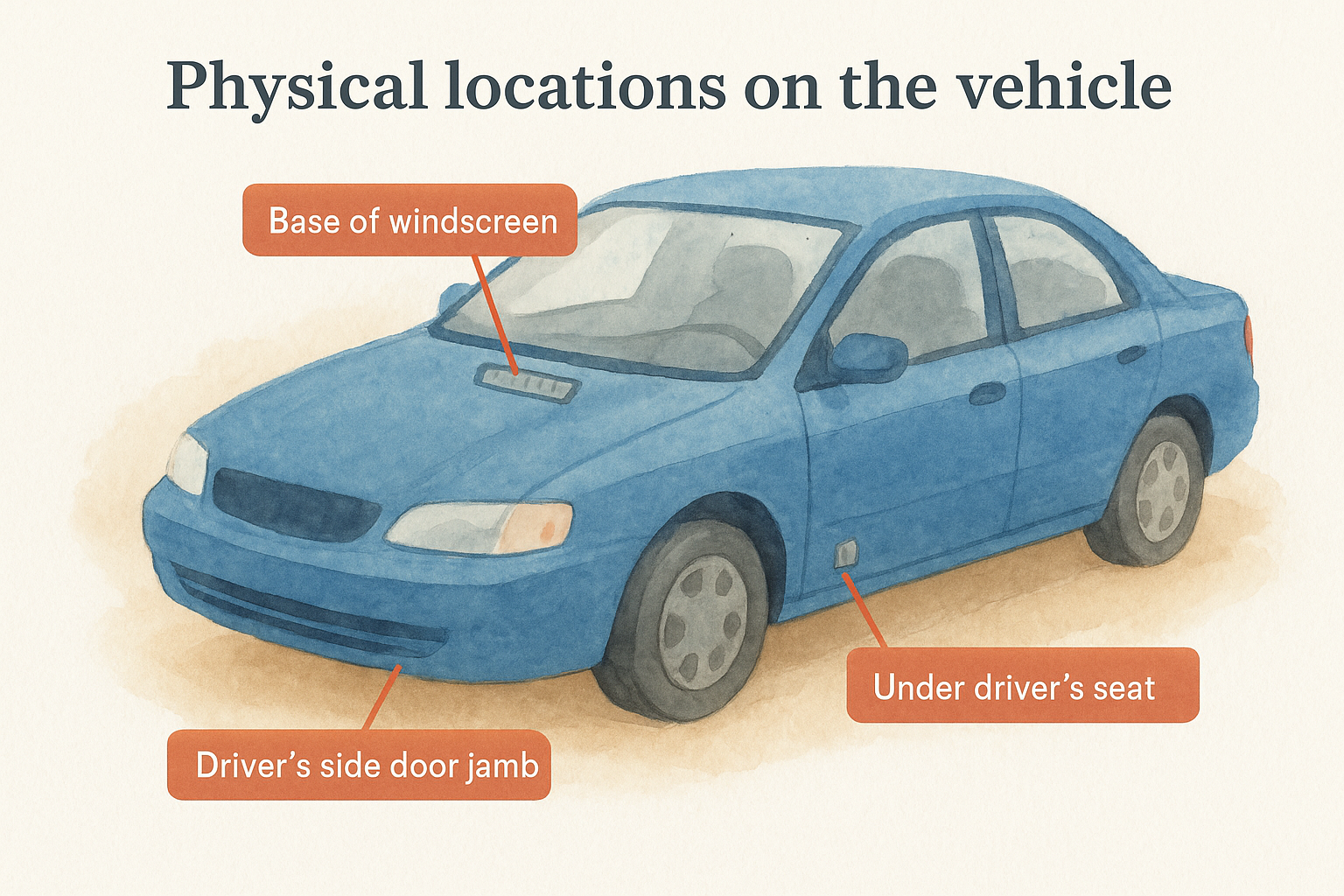
If the VIN on the windscreen plate doesn't match the number in the door jamb, treat that as a serious warning sign before you go any further.
Other common spots include the engine bay firewall, the chassis leg under the bonnet, and the floor beneath the driver's seat on older vehicles.
Finding the VIN on your V5C
Your V5C registration certificate lists the VIN in Section D.2, labelled as the vehicle identification number. The DVLA holds this number against the vehicle's registration, so it needs to match every physical location on the car exactly. Any discrepancy between the V5C and the stamped VIN is a red flag that either the documents or the vehicle have been tampered with.
How to check a VIN is genuine and matches
Verifying a VIN means more than just reading the characters correctly. A genuine VIN has to pass a mathematical check and line up with official records held against the registration plate, so any mismatch between those two sources tells you something's wrong before you hand over any money.
Run the check digit calculation
Position 9 in the VIN number format UK vehicles follow holds a check digit calculated from the other 16 characters. Each character gets a numerical value, each position carries its own weight, and the results are summed and divided by 11. The remainder of that calculation becomes the check digit, and if it doesn't match what's physically stamped in position 9, the VIN has been altered or recorded incorrectly somewhere along the way.
A failed check digit is one of the clearest signs a vehicle has been cloned or its identity tampered with.
Cross-check against official records
Running a vehicle history check using the registration plate is the quickest way to confirm the VIN the DVLA holds matches the one stamped on the car. Enter the registration at Vehiclepedia and the report pulls DVLA data directly, showing the VIN on file alongside MOT history, tax status, and ownership records. Any mismatch between the stamped number and the official record is reason enough to walk away from that vehicle immediately.
VIN vs registration, chassis and engine numbers
When buying a used car, you'll come across several identifying codes on the vehicle and its paperwork. Knowing how the VIN number format UK vehicles use differs from these other numbers stops confusion and helps you catch discrepancies that sellers might gloss over.
The VIN is the only identifier that stays fixed to a vehicle for its entire life, no matter where it's registered or resold.
How a VIN differs from a registration plate
Your registration plate is assigned by the DVLA and can change when a vehicle moves between owners or when a personalised plate gets transferred. The VIN never changes. It acts as a global identifier recognised in every country where the car might be registered or resold, not just in the UK.
Key differences at a glance:
- VIN: set by the manufacturer, permanent, recognised globally
- Registration plate: set by the DVLA, can change, UK-specific
Chassis and engine numbers explained
A chassis number is an older term that predates the standardised 17-character VIN. On vehicles built before 1981, the chassis number did the same job but followed no consistent format. On modern cars, the VIN has effectively replaced it altogether.
Your engine number identifies the specific unit fitted at manufacture. This number can legitimately differ from the VIN if the engine was replaced under warranty or during a major repair, so a mismatch there alone doesn't confirm fraud the way a VIN discrepancy would.
Quick recap and what to do next
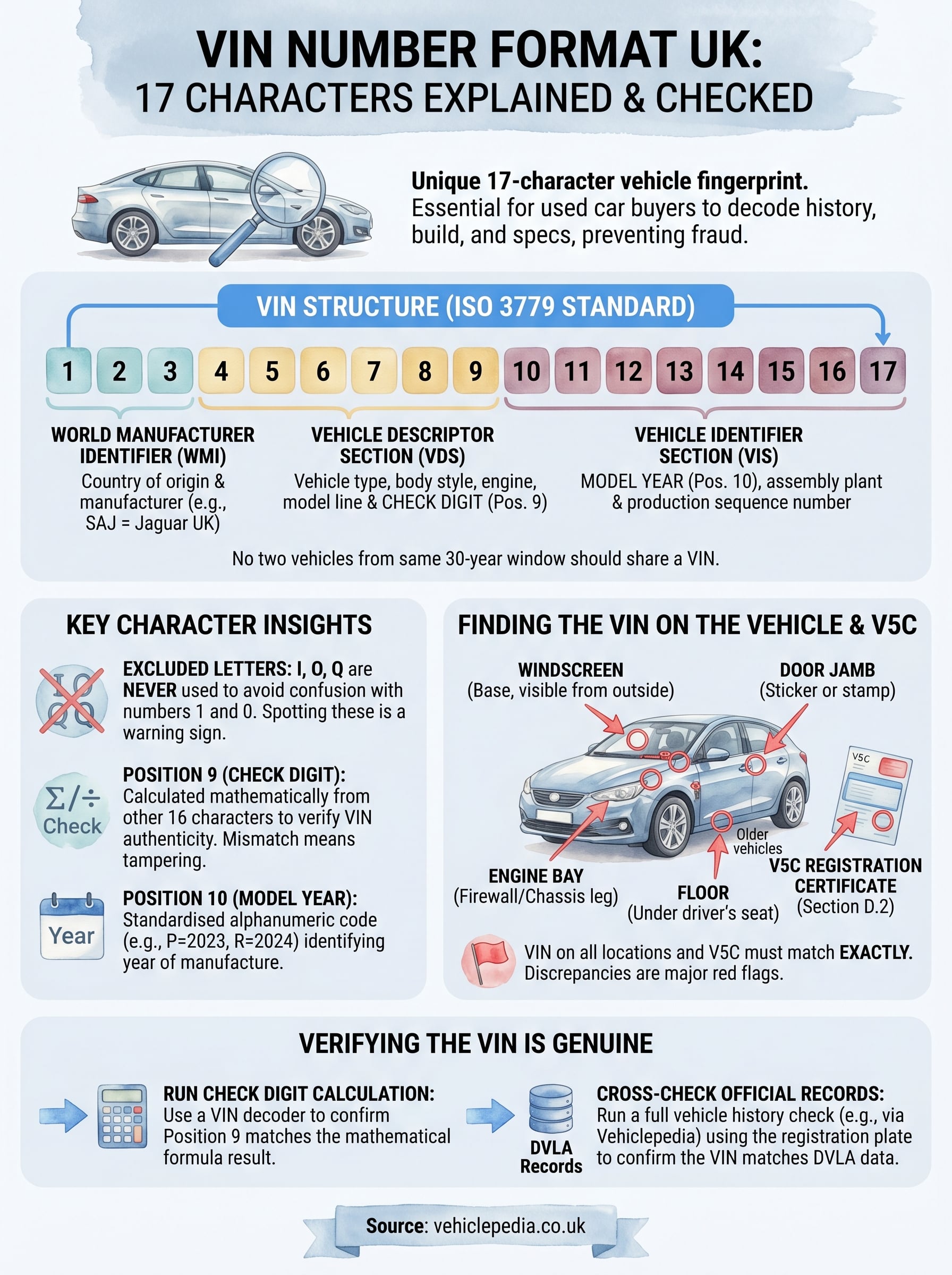
The VIN number format UK vehicles follow is a 17-character code split into three fixed sections: the world manufacturer identifier, the vehicle descriptor section, and the vehicle identifier section. Each position carries a specific meaning, from country of origin through to the individual production sequence number. Spotting the letters I, O, or Q in any VIN immediately signals a problem, and a failed check digit points to tampering or cloning.
Checking that the VIN stamped on the car matches the one on your V5C registration certificate and on official DVLA records is one of the most important steps you can take before buying any used vehicle. Run a full history check at Vehiclepedia to confirm the number on file, review MOT history, and screen for outstanding finance or stolen status in a single report. View a sample vehicle history report to see exactly what information you get before you commit to any purchase.