Free VIN Check UK: How To Check A VIN Online For Free
Run a free VIN check UK to see MOT history and mileage. Learn how to locate the VIN, spot red flags, and understand what free reports don't cover.
Free VIN Check UK: How To Check A VIN Online For Free
Every vehicle on UK roads carries a unique 17-character Vehicle Identification Number, a VIN, that holds the key to its full history. Whether you're buying a used car privately or from a dealer, running a free VIN check UK search is one of the smartest steps you can take before handing over any money. It helps you verify a car's identity, spot potential red flags like outstanding finance or theft markers, and confirm that what the seller is telling you actually lines up with official records.
The problem? Knowing where to check, what information is genuinely free, and what requires a paid report can be confusing. Not every service gives you the same depth of data, and some bury useful details behind paywalls without telling you upfront. That's where having a clear, step-by-step process matters, along with a service like Vehiclepedia that gives you access to one of the most comprehensive free car checks available in the UK.
This guide walks you through exactly how to check a VIN online for free, what information you can expect to uncover at no cost, and when it makes sense to go further with a premium vehicle history report. By the end, you'll know how to use a VIN to make a confident, informed buying decision, without getting caught out.
What a free VIN check can and cannot show
Before you search for a free VIN check UK service, it helps to understand exactly what data is available at no cost and what sits behind a paywall. Official UK databases like the DVLA hold a significant amount of publicly accessible information about every registered vehicle, and much of it is available without spending anything. The key is knowing which checks to run and where genuine free data ends, so you go in with realistic expectations.
What you can access without paying
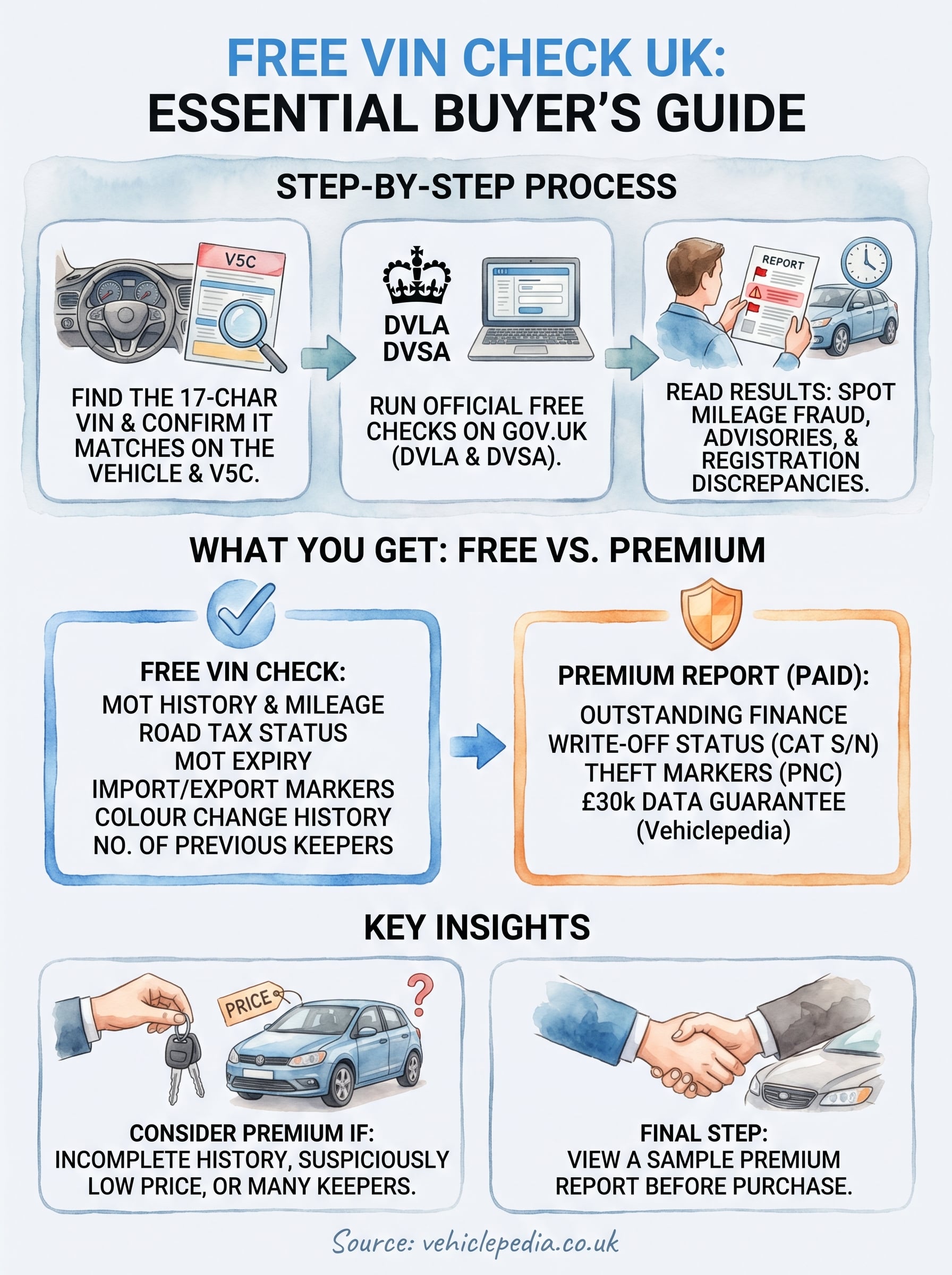
A standard free VIN or registration check in the UK pulls data from official sources, giving you a reliable snapshot of the vehicle's current status. MOT history is one of the most valuable pieces of free information available. Through DVLA-connected services, you can view every MOT test result going back years, including advisory notices, failure reasons, and the mileage recorded at each test. This alone can expose mileage fraud or a vehicle with a persistent mechanical history.
Beyond MOT records, a free check typically gives you access to the following:
- Vehicle registration details - make, model, colour, engine size, and year of manufacture
- Tax status - whether the vehicle has valid road tax or is SORN declared
- MOT expiry date - when the current certificate runs out
- Recorded mileage - from each MOT test on file
- Import and export markers - flagging whether the car entered the UK from abroad
- Colour change history - if the vehicle's colour differs from the original registered colour
- Number of previous keepers - in many cases, though depth varies by service
MOT mileage records are one of the most reliable free tools for detecting clocking, since every test date and mileage figure is logged permanently on official DVLA records.
What stays behind a paywall
Free checks cover official status data well, but they have clear limits. Finance checks are not available through any official UK source for free. If a vehicle has outstanding hire purchase or conditional sale agreements attached to it, that information sits on private credit industry registers, and accessing it requires a paid report. Buying a car with undisclosed finance means the lender can legally reclaim the vehicle, even after you have paid the seller in full.
Similarly, write-off status information is held on insurance industry databases that are not publicly accessible. A car can be repaired after a serious accident and put back on the road without that history appearing on a free check. Knowing whether a vehicle carries a Category S or Category N insurance marker matters both for your safety and the car's future resale value. That detail only appears on a full premium report.
Theft markers from the Police National Computer sit outside free checks entirely. Without confirming a vehicle is clear of theft records, you risk purchasing a car that could later be seized and returned to its original owner, leaving you out of pocket with no vehicle and no legal recourse against the seller. Understanding this boundary between free and paid data is not about pushing you towards spending money unnecessarily. It is about making sure you know exactly what you are and are not verifying before you commit to a purchase.
Step 1. Find the VIN and confirm it matches
Before you run any free VIN check UK search, you need the correct VIN in hand. A single character error will return the wrong vehicle record entirely, so taking a few minutes to locate and verify the number accurately is worth doing before you search.
Where to locate the VIN on the vehicle
Every UK-registered vehicle displays the VIN in several places, and checking more than one location is the first step in spotting a potential problem. If the numbers do not match across different points on the car, that is an immediate red flag worth investigating before you go any further with the purchase.
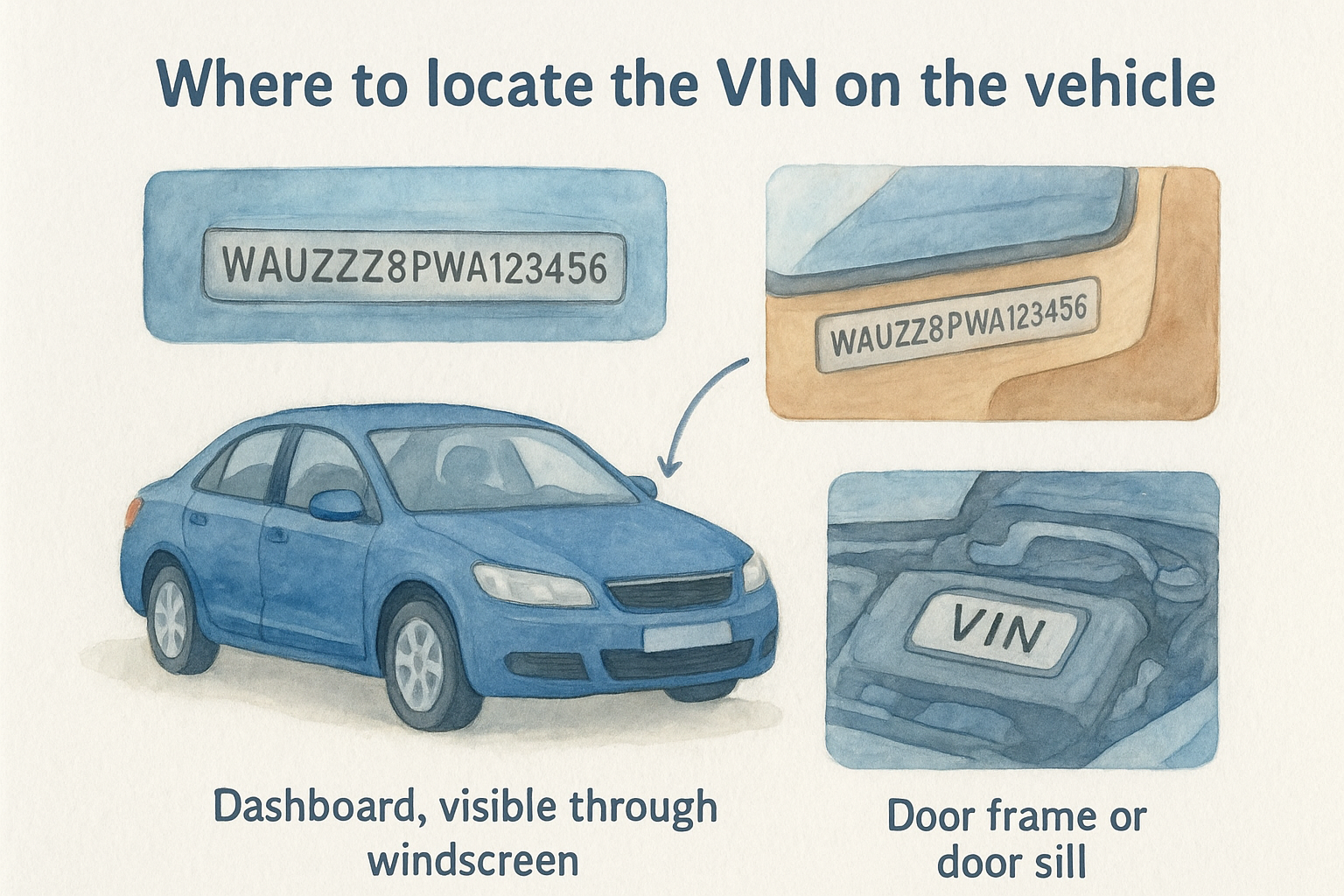
Common places to find the VIN include:
- Dashboard, visible through the windscreen on the driver's side (the most accessible location on most vehicles)
- Door frame or door sill on the driver's side, stamped directly into the metal
- Engine bay, usually on a plate or stamped onto the chassis near the front
- Vehicle registration document (V5C), listed in the top right section under "Vehicle Identification Number"
- Service history documents and previous MOT certificates, where the VIN is often printed
If the VIN stamped on the dashboard does not match the VIN recorded on the V5C, do not proceed with the purchase until you have a clear explanation from the seller.
How to confirm the number is genuine
A legitimate UK VIN always contains exactly 17 characters, combining both letters and numbers. Manufacturers exclude the letters I, O, and Q from all VINs to avoid confusion with the digits 1, 0, and 0 respectively. If the number you are looking at includes any of those letters, the VIN is either misread or it has been altered.
Cross-reference the VIN against the vehicle's registration plate using the V5C document. The V5C lists both the registration number and the full VIN, allowing you to confirm they belong to the same vehicle on paper before running any online checks. Write the VIN down carefully or photograph it to avoid entry errors. Getting this right directly affects the accuracy of every result you receive.
Step 2. Run the official UK checks
Once you have confirmed the VIN is genuine and consistent, you are ready to run the searches. Using a free VIN check UK service alongside official government tools gives you access to DVLA and DVSA data that reflects the vehicle's actual registered status. There are two official government sources to use, and running both gives you a complete picture of the vehicle's legal standing before you take things any further.
Check MOT history through the DVSA
The Driver and Vehicle Standards Agency provides a free MOT history checker at gov.uk, where you can search by either registration number or VIN. Enter the VIN you confirmed in Step 1, and the service returns a full list of every MOT test on record, including pass and fail outcomes, advisory items flagged by the tester, and the mileage recorded at each test.
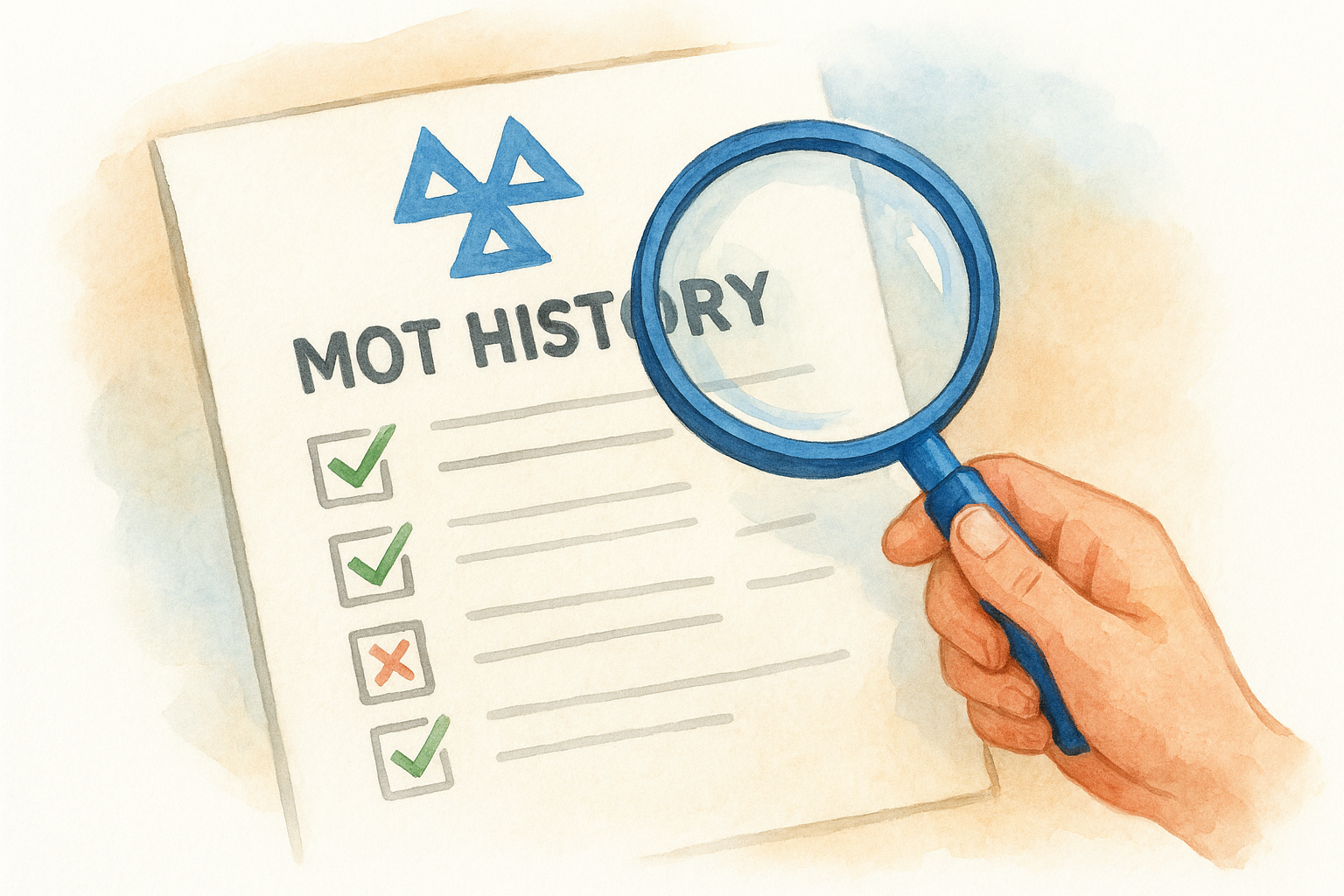
Pay close attention to the mileage figures across each test date. If the recorded mileage drops between tests or shows an implausibly small increase over several years, the vehicle has almost certainly been clocked and the odometer reading cannot be trusted. Note down any recurring advisory notices too. A repeated advisory about the same component across multiple tests suggests the owner has consistently deferred repairs rather than addressing them.
A single DVSA MOT check can tell you more about a vehicle's real condition and mileage history than most sellers will volunteer unprompted.
Check road tax and registration status through the DVLA
The DVLA provides its own free vehicle enquiry service at gov.uk, which confirms whether a vehicle holds valid road tax or carries a SORN declaration. Enter the registration plate, and the result shows the tax expiry date, vehicle make, colour, and year of manufacture. Driving a vehicle with lapsed road tax is a legal offence, so confirm this before you agree to anything with the seller.
Cross-referencing the DVLA result against the V5C document confirms that the basic registration details match what the seller has told you. Any discrepancy between the DVLA record and the paperwork the seller provides is a reason to ask direct questions before you proceed any further with the purchase.
Step 3. Read the results and spot red flags
Once your free VIN check UK results load, read them systematically rather than scanning for a simple pass or fail. Each data point tells you something specific, and understanding what to look for helps you separate a clean vehicle from one carrying hidden problems. Take your time going through every field before making any decision about the purchase.
MOT history: what to look for
Start with the mileage recorded at each MOT test. Write the figures down in date order and confirm they increase consistently over time. A drop in recorded mileage between any two tests, or a suspiciously low annual increase for a vehicle supposedly used regularly, points directly to odometer fraud. If you spot this, walk away without hesitation, because the true mileage is unknown and every service interval and component lifespan becomes unreliable as a result.
Look at failure reasons and advisory notices across all tests on record. A one-off failure for a minor item is not alarming on its own. Repeated failures or advisories for the same component across multiple years, such as brake wear or suspension joints, suggest the owner has consistently delayed repairs rather than fixing the root problem. That pattern has a direct impact on the car's current condition and what you might need to spend after buying it.
If the same advisory appears across three or more consecutive MOT records, treat it as a near-certain upcoming repair cost rather than something the seller has already resolved.
Registration details: cross-check everything
Compare the colour, make, and year of manufacture shown in the DVLA result against the V5C document the seller provides. Any mismatch between the two is a concrete reason to pause. A colour change not declared to the DVLA can indicate the vehicle was involved in an incident and resprayed without the change being recorded through official channels, which affects both its history and its value.
Check the number of previous keepers against what the seller tells you verbally. If the DVLA result shows significantly more keepers than the seller claims, ask for a direct explanation backed by documentation before taking the conversation any further.
When you should pay for a full history check
A free VIN check UK search covers a lot of ground, but it leaves genuine gaps in your knowledge about any vehicle you are considering. Free data from the DVLA and DVSA confirms a vehicle's official status, tax standing, and MOT history. What it cannot confirm is whether outstanding finance is attached to the car, whether an insurer has written it off, or whether it appears on the Police National Computer as stolen. Those three gaps represent the most financially damaging risks in any used car purchase.
The three situations that make a premium report worth it
If any of the following apply to the vehicle you are looking at, running a paid history check before handing over money is the right call rather than an optional extra.
- The seller cannot provide a full service history, making it harder to verify the car's maintenance and past ownership independently
- The asking price sits noticeably below market value for the age, mileage, and condition, which is a common sign the seller knows something about the vehicle's history they are not disclosing
- The V5C shows multiple previous keepers in a short timeframe, particularly if any keeper held the vehicle for fewer than six months before selling it on
A car priced noticeably below comparable listings in the same condition is worth treating with extra caution until a full history report confirms it is clear of finance and write-off markers.
What a premium report adds to your free checks
Vehiclepedia's premium report pulls data from insurance registers, the Police National Computer, and finance industry databases that no free check can access. The service carries a £30,000 data guarantee for non-trade buyers, giving you legal protection if inaccurate data from the report leads directly to a financial loss.
Running both a free check and a full premium report together gives you the most complete picture available before you commit to buying. For any vehicle where the purchase price represents a meaningful sum of money, the cost of a premium report is minor compared to the risk of buying a car carrying hidden problems that a free check alone would never surface.
Next steps before you buy
Running a free VIN check UK search takes less than five minutes and gives you verified data that protects you against the most common used car scams. Start by confirming the VIN physically on the vehicle and cross-referencing it against the V5C document before running any online searches. Work through the DVLA and DVSA checks, read the results carefully, and flag any mileage inconsistencies or mismatched registration details before you agree to anything with the seller.
Your free checks cover the essential official records, but they leave finance, theft, and write-off history unverified. For any car where the numbers add up and you want to move forward, a full premium report fills those gaps and gives you legal protection through the £30,000 data guarantee. Before you commit your money to any vehicle, view a sample premium report to see exactly what a complete history check covers.