What Are Car Safety Ratings? Euro NCAP, NHTSA and IIHS
What are car safety ratings? Learn how Euro NCAP, NHTSA and IIHS score cars, what each star means and how to check a rating before buying used.
What Are Car Safety Ratings? Euro NCAP, NHTSA and IIHS
So, what are car safety ratings? They are scores that independent testing bodies give a car after crashing it under controlled conditions and assessing its safety technology. Euro NCAP awards zero to five stars, NHTSA in the United States awards one to five, and the IIHS uses Good, Acceptable, Marginal and Poor. The higher the score, the better the car protects its occupants and other road users, and the better it is at avoiding a crash in the first place.
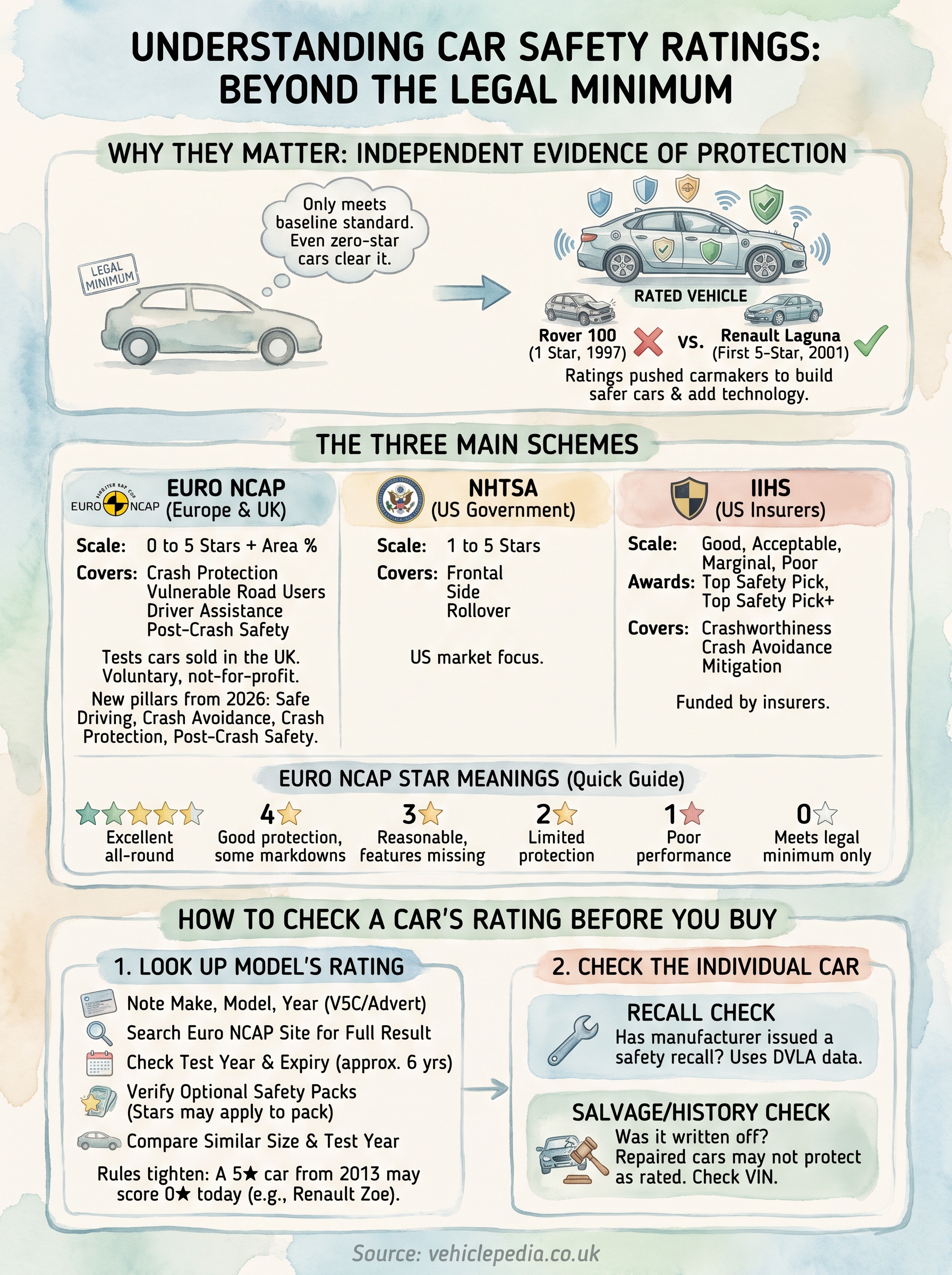
A rating is not the same as legal approval. Every new car sold in the UK has to meet a minimum standard, and even a zero-star Euro NCAP car clears it. The stars tell you how far a car goes beyond that floor, which is what you actually want to know before you hand over money.
This guide explains why the ratings matter, how Euro NCAP, NHTSA and IIHS each score a vehicle, what the stars mean, and how to check a rating for the exact used car you are considering. We run Vehiclepedia, a UK vehicle history check service, so we also show where a model's rating stops and checks on the individual car begin.
Why car safety ratings matter when you buy a car
Car safety ratings matter because they are the only independent, comparable evidence of how well a car protects you. Legal approval says very little about that.
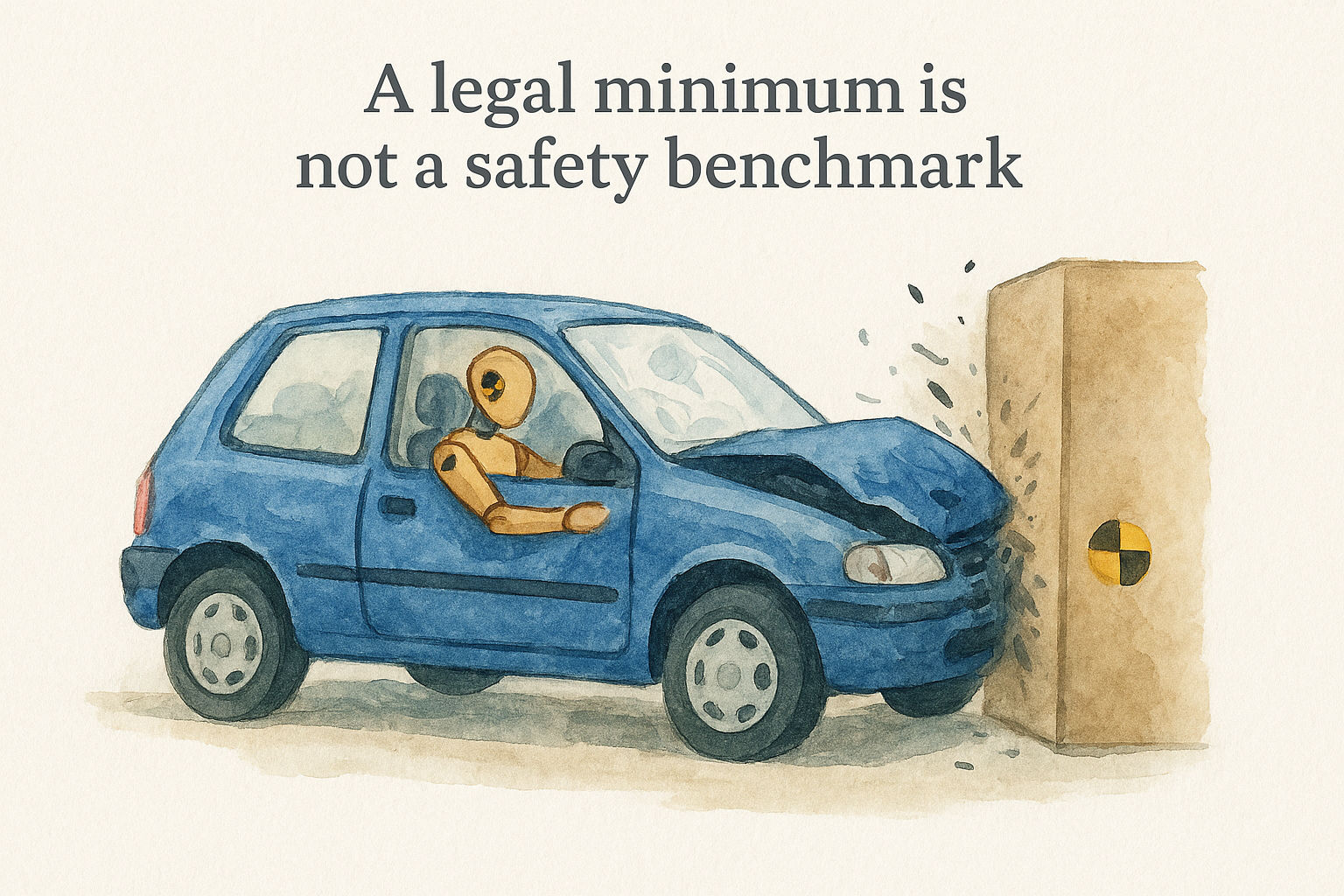
A legal minimum is not a safety benchmark
New cars must pass type approval before they can be sold, but that approval sets a minimum standard, not a measure of quality. Euro NCAP is explicit that even zero-star cars meet it. Before Euro NCAP started publishing results in 1997, the only mandated crash test in Europe was a 30mph frontal impact, and buyers had to rely on the claims manufacturers made about their own cars.
The first results exposed the gap. The Rover 100 scored one star, with the steering wheel hitting the dummy and heavy intrusion into the passenger compartment, and it was withdrawn about a year later. Popular small cars of the time were criticised too, even though all of them met the legal requirements.
A car can be legal to sell and still protect you poorly.
Ratings pushed carmakers to build safer cars
Manufacturers responded quickly once buyers could compare results. Volvo's S40 earned four stars within months of those first tests, and the Renault Laguna became the first five-star car in 2001. Euro NCAP began testing electronic stability control in 2011, and a year later it became mandatory on new cars sold in the EU.
For a used car buyer, the rating is also the fastest way to filter a shortlist. Two cars at the same price, of the same age, can differ sharply in crash protection and in the driver assistance they carry. A few minutes with the ratings can settle which one deserves a viewing.
How to read a car safety rating
To read a rating, work out which body issued it, which scale it uses and which test version applied. A star from one scheme does not equal a star from another.
The three main schemes side by side
Euro NCAP is the scheme that matters most in the UK, because it tests the cars sold here. NHTSA and the IIHS test cars for the US market, which is useful for imports and for models sold on both sides of the Atlantic. Other regions run their own schemes, including Global NCAP and Japan's JNCAP.
| Body | Based in | Scale | What it covers |
|---|---|---|---|
| Euro NCAP | Europe, including the UK | 0 to 5 stars, plus a percentage for each area | Crash protection, vulnerable road users, driver assistance, post-crash safety |
| NHTSA | US government | 1 to 5 stars | Frontal crash, side crash, rollover resistance |
| IIHS | US, funded by insurers | Good, Acceptable, Marginal, Poor, plus Top Safety Pick awards | Crashworthiness, crash avoidance and mitigation |
How Euro NCAP scores a car
Euro NCAP is a voluntary, not-for-profit programme. It buys cars anonymously through dealers, crashes them with sensor-fitted dummies and also tests how the driver assistance technology behaves. Up to 2025, the overall star rating came from four areas: adult occupant protection, child occupant protection, vulnerable road user protection and safety assist. The final score was limited by the weakest of them, so a car could not hide a poor area behind strong ones.
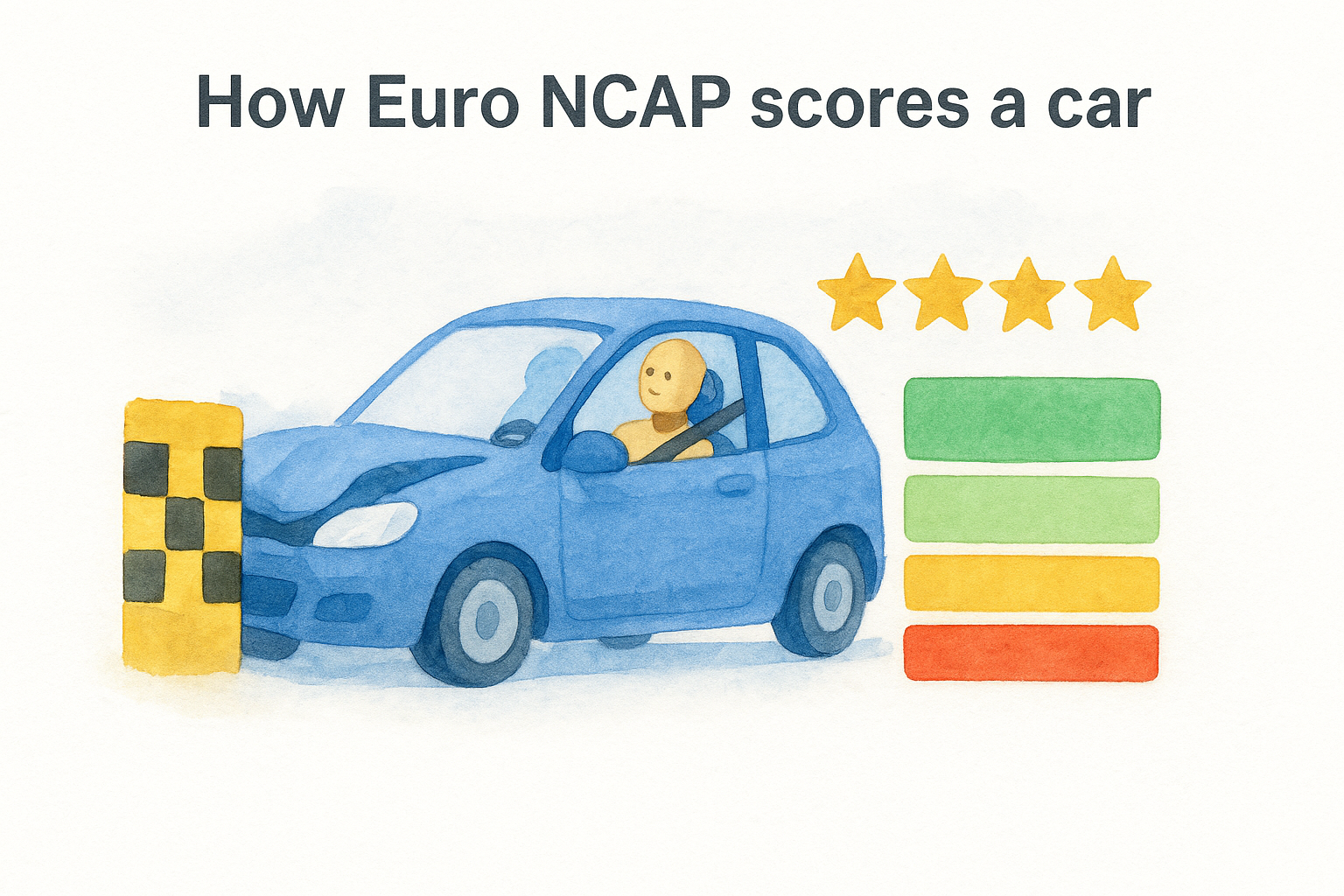
The programme introduced in 2026 reorganises the assessment into four pillars: Safe Driving, Crash Avoidance, Crash Protection and Post-Crash Safety. It puts more weight on driver assistance and on how well a car helps emergency services after a collision. Each pillar gets a percentage, so you can see where a five-star car is strongest.
The overall star is a summary. The percentages underneath show where a car is strong or weak.
What each star level means
Euro NCAP stars work as a quick guide to overall safety. Read them alongside the test year, as the next section explains.
| Stars | What it generally means |
|---|---|
| 5 | Excellent all-round safety, with strong crash protection and advanced collision avoidance technology |
| 4 | Good protection and the usual safety technology, but marked down in some areas |
| 3 | Reasonable protection, though some features may be missing or weaker |
| 2 | Limited crash protection and little safety technology |
| 1 | Poor overall performance, with few modern safety systems |
| 0 | Meets the legal minimum but lacks features buyers now expect |
NHTSA's stars run from one to five and follow the same logic. The IIHS awards Top Safety Pick and Top Safety Pick+ to the best performers, so look for those labels rather than a star count.
How to check a car's safety rating before you buy
Check the rating for the exact model, variant and year you are viewing, then check the individual car's history. The first step tells you what the model can do, and the second tells you what has happened to this particular car.
Look up the rating for your exact model
Follow these steps for any used car:
- Note the make, model, generation and year from the advert or the V5C. A registration lookup confirms the age and details.
- Search the Euro NCAP website for that model and open the full result, not just the headline stars.
- Check the test year and whether the rating is marked as expired. Ratings are usually valid for up to six years.
- See whether the stars apply to standard equipment or only to a version with an optional safety pack. Make sure your car has the pack.
- Compare it only with cars of a similar size and test year, using the area percentages as well as the stars.
- If the car was imported, check its import record and look at NHTSA and IIHS results too, because equipment can differ between markets.
Search by exact variant and test year, because the same model name can hide very different results.
Check the car itself, not just the model
A rating describes a model as tested, not the individual car on the forecourt. Two checks close that gap. A recall check shows whether the manufacturer has issued a safety recall for the car. Our free Car recall Check uses DVLA and DVSA data and covers recalls going back to 1992.
A salvage check shows whether the car was found at a salvage auction after being written off. It gives the auction date, the write-off category and the VIN details. A car that has been repaired after serious damage may not protect you as the model's rating suggests, and you want to know that before you buy.
Where car safety ratings fall short
Safety ratings are a reliable guide to a model's design, but they have limits you should understand. They age, they depend on specification, and they cannot describe the condition of one particular car.
Ratings expire and the rules change
Euro NCAP tightens its tests regularly, so a star count only means something against the standard of its own year. The Renault Zoe scored five stars in 2013. Its updated version scored zero in 2021, after its side airbags were replaced with less effective ones and automatic emergency braking was removed. The car did not become unsafe overnight. The bar rose, and the revised car fell below it.
Specification and size change the result
Since 2016, Euro NCAP has sometimes issued a dual rating. In 2024, lower-spec Premium trims of the Hyundai Santa Fe earned four stars, while versions with the SmartSense safety pack earned five. Size matters as well. Both NHTSA and the IIHS advise comparing vehicles of similar size, because a big heavy car and a small light one face different physics in the same crash.
Choose by the exact car, not the badge
Car safety ratings are independent scores from bodies such as Euro NCAP, NHTSA and the IIHS. They show how well a model protects people and how well it helps avoid crashes, and they go well beyond the legal minimum. Read the scale, the test year and the specification, and compare like with like.
Then look at the car in front of you. A strong rating describes the model, while recalls and write-off history describe the car. To see what a full history report can reveal, look at a sample premium report before you commit to a used car.