Vehicle Excise Duty: What It Is and How Much You'll Pay
Find out what is Vehicle Excise Duty, how rates are calculated by date and emissions, penalties for non-payment, and how to check tax before buying.

Vehicle Excise Duty: What It Is and How Much You'll Pay
You've seen it referred to as road tax, car tax, or the more official-sounding Vehicle Excise Duty, and the different names probably haven't helped you understand what you're actually paying for. What is Vehicle Excise Duty boils down to a straightforward question: it's the annual charge the government levies on almost every vehicle kept or driven on UK roads, and the amount depends on factors like your car's age, engine size, fuel type, and CO2 emissions.
This guide gives you a direct answer. You'll see exactly how VED is calculated, why two nearly identical cars can have wildly different bills, and what happens if you let a payment lapse. We'll also cover the first-year rate versus the standard rate, because that distinction catches out a lot of buyers who assume tax stays flat for the life of the car.
Before you commit to buying a used car, it pays to know its tax status alongside its history. That's where a proper vehicle check earns its keep, letting you check a car's tax band and expiry by reg alongside the MOT record and other details pulled straight from official DVLA data, so you're never caught out by a surprise bill after you've already handed over the cash.
Why vehicle excise duty matters for every driver
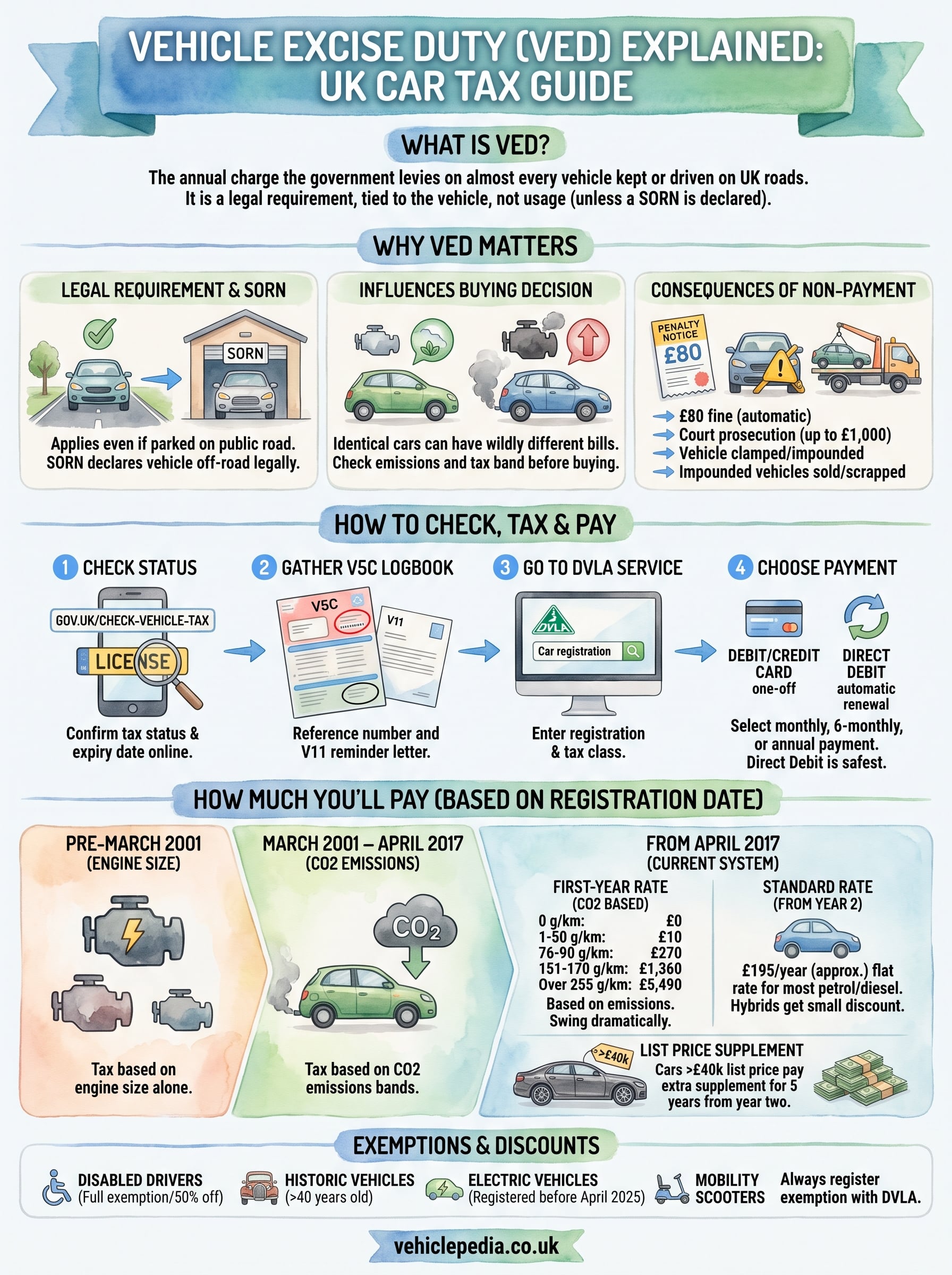
Getting your head around Vehicle Excise Duty isn't just an academic exercise. It's a legal requirement that keeps you on the right side of the law every single day your car sits on a public road, whether you drive it or not. Skip it, and you're not just risking a fine, you're risking your car being clamped, impounded, or even crushed. This isn't a fee you can quietly ignore until you fancy paying it.
It's tied to keeping your car on the road at all
Unlike some taxes that only apply when you use something, VED applies the moment your vehicle is registered to you and parked on a public street. There's one exception: a Statutory Off Road Notification (SORN), which tells the DVLA your car is off the road and untaxed legally, and it's worth knowing how long a SORN declaration stays valid. Without a SORN, the DVLA's automatic number plate recognition cameras and databases will flag an untaxed vehicle within days, not months.
Vehicle Excise Duty is the price of legally keeping a car on a UK road, and there's no grey area between paying it and not.
It directly affects what car you should buy
Here's where it gets practical for anyone shopping for a used car. Two vehicles that look nearly identical on the forecourt can carry very different annual tax bills, purely because of when they were registered and what emissions band they fall into. A used car with high CO2 emissions and tax band data registered before April 2017 might sit in a punishing tax band, while a newer, cleaner equivalent could cost a fraction as much annually. Ignoring this at the point of purchase means signing up for years of higher running costs you didn't budget for.
It carries real financial and legal consequences
Overlooking your car tax status doesn't just risk an awkward letter from the DVLA. The penalties escalate quickly, and they're designed to hurt:
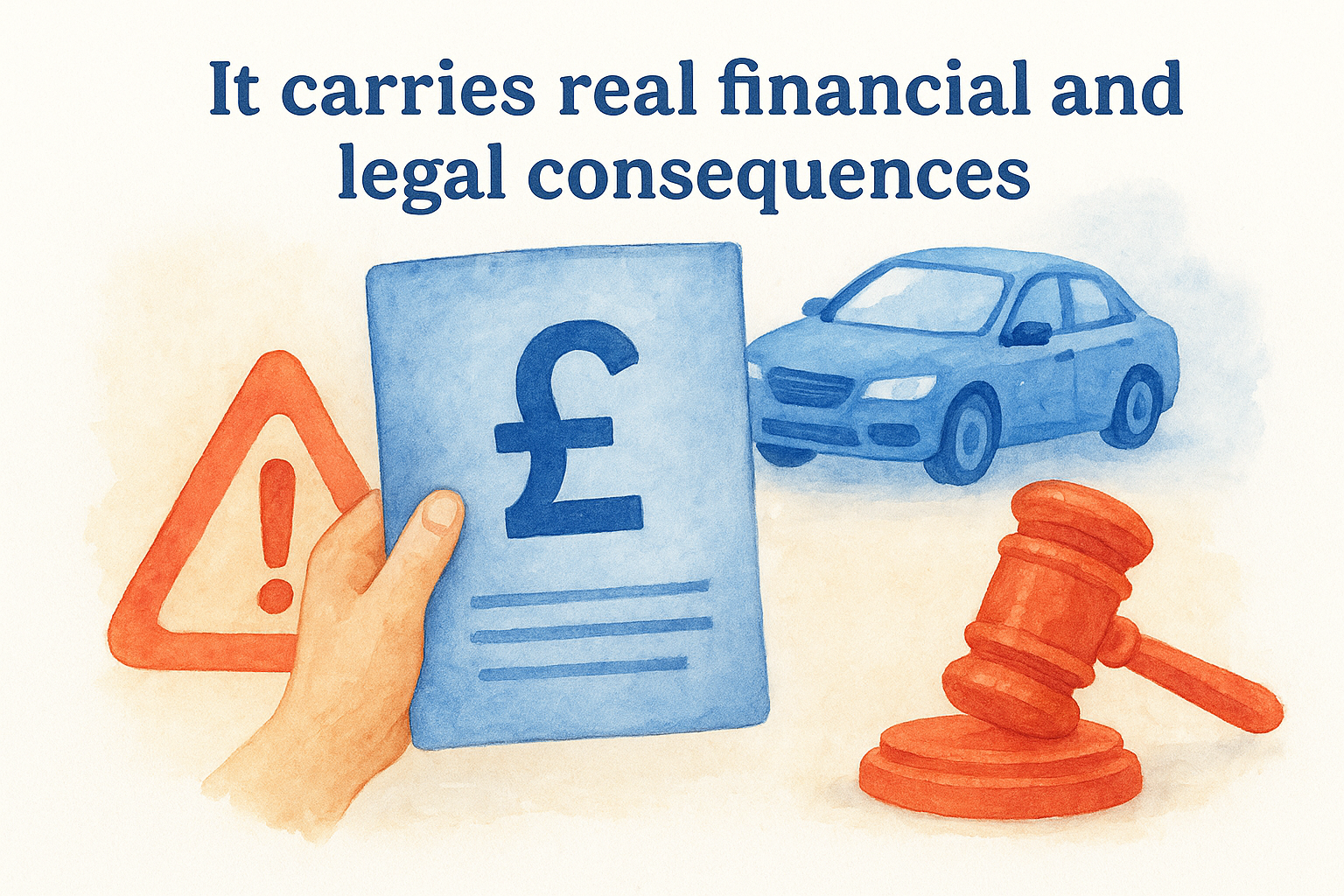
- An automatic £80 fine for driving or keeping an untaxed vehicle, reduced to £40 if paid within 28 days
- Court prosecution for repeat offenders, with fines up to £1,000 or five times the tax owed
- Your vehicle can be clamped or impounded, with a release fee plus the outstanding tax before you get it back
- Impounded vehicles not reclaimed within 14 days can be sold or scrapped entirely
Running through this list makes one thing obvious: VED isn't a minor administrative detail. It's a recurring cost that shapes your budget, your car-buying decision, and your legal standing every time you turn the key. Understanding it properly, before you buy rather than after, saves you money and hassle down the line.
How to check, tax and pay your vehicle excise duty
Sorting your car tax doesn't need to be complicated, but you do need to know where to look before you get behind the wheel. The DVLA runs the entire process online, and every detail you need is tied to your registration plate.
Checking your current tax status
Before you tax anything, confirm whether the car is actually taxed and what you're dealing with. The government's own vehicle tax check service shows you the tax status, expiry date, and MOT history for any UK-registered car in seconds. If you're buying secondhand, run this check alongside a full vehicle history check so you're not just seeing tax status but also mileage anomalies, outstanding finance, and write-off records the seller might not mention.
Never take a seller's word for a car's tax status. Verify it yourself in under a minute.
Taxing your vehicle step by step
Once you know where you stand, getting a car taxed is quick:
- Gather your V5C logbook document reference number, or the reminder letter (V11) if you've had one
- Head to the DVLA's tax service and enter your registration
- Confirm the tax class and select monthly, six-monthly, or annual payment
- Pay by debit card, credit card, or set up a Direct Debit for automatic renewal
Paying without letting it lapse
Direct Debit is the safest option for most owners, since it renews automatically and removes the risk of a forgotten deadline. Setting one up costs slightly more overall than paying annually in one lump sum, but the peace of mind usually outweighs the small premium. Whichever method you choose, keep an eye on renewal dates, because the DVLA no longer sends paper reminders in every case, and an untaxed vehicle notice arrives fast once you slip through the cracks.
How much VED you'll actually pay
Working out how much car tax you'll pay this year comes down to one key detail: when your car was first registered. The DVLA splits vehicles into three separate systems, and mixing them up is the easiest way to misjudge your annual bill. Cars registered before March 2001 pay based on engine size alone. Those registered between March 2001 and April 2017 pay according to CO2 emissions bands. Anything registered from April 2017 onwards follows the current system, which is the one that trips up most new buyers.
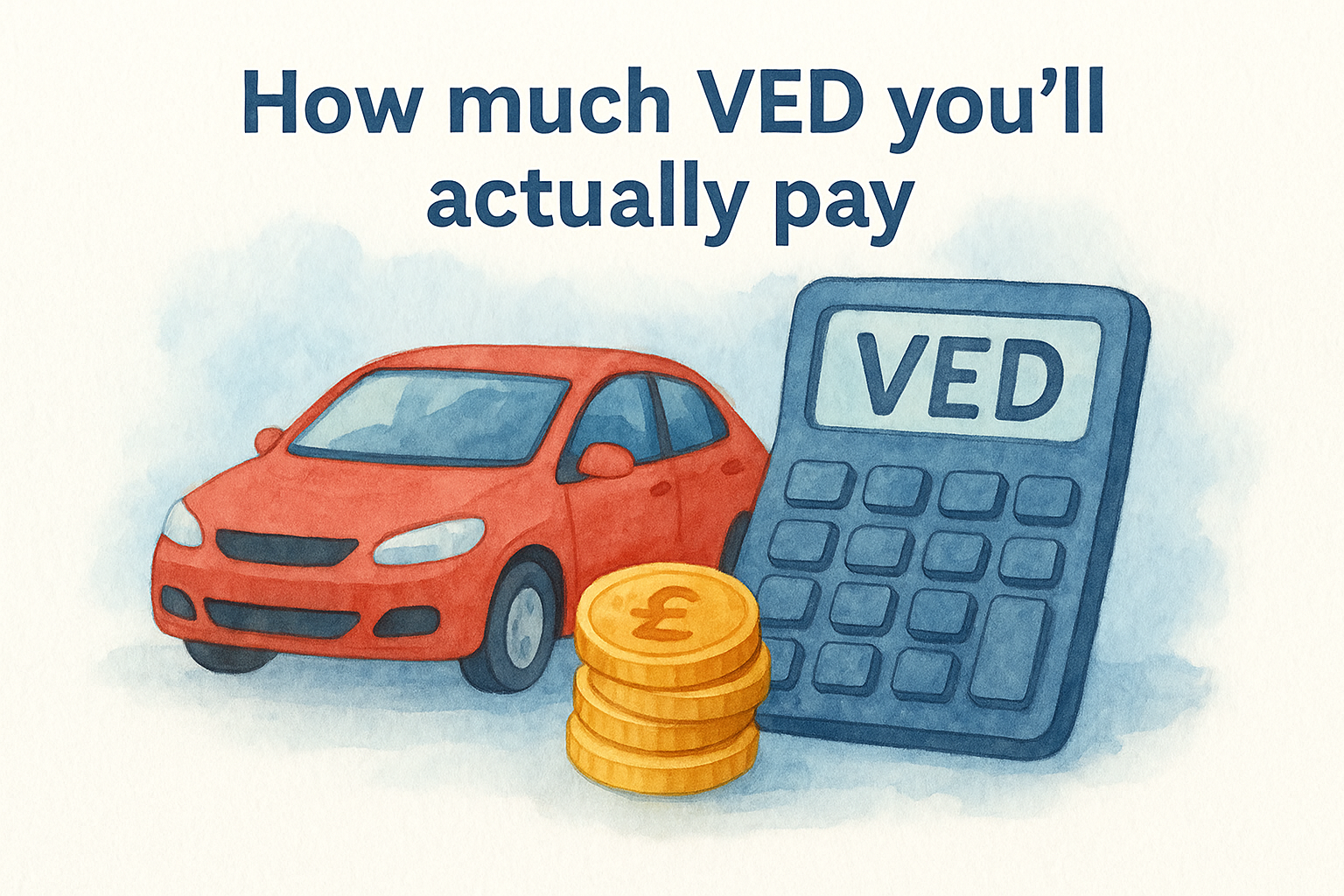
Under the current system, you pay a first-year rate calculated from the car's CO2 emissions, then a flat standard rate from year two onwards. The first-year figure can swing dramatically:
| CO2 emissions (g/km) | First-year rate |
|---|---|
| 0 | £0 |
| 1-50 | £10 |
| 76-90 | £270 |
| 151-170 | £1,360 |
| Over 255 | £5,490 |
Zero-emission cars registered from April 2025 no longer sit outside the system either, so don't assume an electric car means a lifetime of free tax.
Your first-year VED bill depends entirely on emissions, but from year two, almost every petrol or diesel car pays the same flat rate.
After that first year, most petrol and diesel cars settle onto the standard rate, currently £195 a year, regardless of how clean or dirty the engine actually is. Hybrids get a small annual discount, usually £10 less than the standard rate.
Expensive cars carry an extra sting. Any car with a list price over £40,000 when new pays a supplement on top of the standard rate for five years starting from year two, adding several hundred pounds annually even once the first-year charge has passed.
Exemptions, discounts and special cases
Not every vehicle owner pays full Vehicle Excise Duty, and knowing where you fit could save you hundreds a year. Certain vehicles qualify for a complete exemption, while others get a reduced rate depending on how they're used or who drives them. Getting this wrong in either direction, either paying when you shouldn't or assuming an exemption you don't actually qualify for, causes real problems down the line.
Who qualifies for a full exemption
Disabled drivers receiving certain rates of Personal Independence Payment or the higher rate mobility component of Disability Living Allowance can apply for a disability exemption, removing the tax bill entirely. Historic vehicles built more than 40 years ago also qualify automatically for exemption under the 40-year classic car tax rule, though you still need to declare the vehicle each year rather than assume it renews itself. Electric vehicles registered before April 2025 remain exempt too, though that window is closing fast as new rules phase in.
An exemption still needs registering with the DVLA. Ignore that step and you'll get chased for tax you never actually owed.
Discounts and other special situations
A smaller group of owners get a discount rather than a full exemption. Disabled drivers on the standard rate mobility component of PIP get 50% off, and vehicles used only for agriculture, horticulture, or forestry on private land often fall outside VED entirely.
- Historic vehicles: exempt if built before 1 January 1985 (rolling 40-year rule)
- Disability exemption: full or 50% off depending on benefit received
- Electric vehicles: exempt if registered before April 2025
- Mobility scooters and powered wheelchairs: exempt regardless of registration date
Always confirm your specific circumstances directly with the DVLA rather than assuming a category applies, since the criteria are stricter than most people expect.
Staying on top of your car tax
Knowing what Vehicle Excise Duty is takes away most of the guesswork around owning a car in the UK. It's not optional, it's tied directly to your registration plate, and the amount you pay depends on your car's age, emissions, and list price rather than anything you can negotiate. Get the tax band wrong when buying secondhand, and you're stuck with a bill that doesn't match your budget for years.
Before you hand over any money for a used car, check its tax status and history properly rather than trusting what the seller tells you. A proper vehicle check pulls the real DVLA data on tax, MOT, and more, so you know exactly what you're buying into. Want to see what that actually looks like before you commit to anything? See a full example report showing tax, MOT and history data and know exactly what information you'll get.