How Much Is Car Tax UK? VED Bands, 2026 Rates & Calculator
Check how much is car tax UK using the latest 2026 VED bands and rates. See how CO2 emissions, engine size, and fuel type determine your annual DVLA bill.
How Much Is Car Tax UK? VED Bands, 2026 Rates & Calculator
If you're wondering how much is car tax UK drivers actually pay, the answer depends on several factors, your car's CO2 emissions, when it was first registered, its fuel type, and its list price. Vehicle Excise Duty (VED) isn't one flat fee, and the rates changed again in April 2026, catching many drivers off guard.
For most petrol and diesel cars registered after 1 April 2017, you'll pay a first-year rate based on emissions, then a flat standard rate each year after that. Cars registered before that date follow an older banding system with 13 tax bands. Electric and hybrid vehicles, which previously enjoyed £0 rates, now pay VED too, a shift that's worth understanding before you buy a used car.
This guide breaks down every current VED band, lists the 2026/27 rates, and explains how each category applies to different vehicles. We've also built a tool at Vehiclepedia that lets you enter any registration plate to instantly check a car's tax status, annual cost, and expiry date, useful whether you're budgeting for your current car or sizing up a purchase.
What car tax is in the UK and who must pay
Car tax in the UK is the informal name for Vehicle Excise Duty (VED), a government charge you must pay to legally drive or keep a vehicle on public roads. It's administered by the Driver and Vehicle Licensing Agency (DVLA) and collected annually or in six-month instalments. When people ask how much is car tax UK residents pay, they're asking about this duty, which covers everything from city runarounds to motorhomes. The amount varies significantly depending on your vehicle's age, fuel type, and CO2 emissions record.
The legal requirement to tax your vehicle
Under the Vehicle Excise and Registration Act 1994, every vehicle kept or used on a public road must be taxed unless it holds a valid Statutory Off Road Notification (SORN). A SORN tells the DVLA your vehicle is off the road and stored on private land. If you fail to pay VED or declare a SORN, the DVLA can issue an automatic penalty of £80, which drops to £40 if you pay within 28 days. Enforcement uses automatic number plate recognition (ANPR) cameras, so undisclosed untaxed vehicles are detected quickly.
Keeping a vehicle on a public road without valid VED is a legal offence, even if you never drive it.
If you buy a used car, you need to know that tax no longer transfers with the vehicle when it's sold. Since October 2014, VED is tied to the registered keeper, not the car itself. The previous keeper receives a refund on any remaining full months, and you must take out new tax before driving the vehicle away. Confirming this before you collect any used car protects you from driving illegally without realising it.
Who is legally responsible for paying
The registered keeper of the vehicle holds the legal responsibility for keeping it taxed. That means if you're the name on the V5C logbook, you're the person liable. If you've recently purchased a vehicle but haven't updated the DVLA yet, confirming who holds the registered keeper status matters before assuming the obligation has passed to you.
Certain groups pay at a reduced rate or qualify for full exemption. Disabled drivers receiving the higher-rate mobility component of certain benefits pay no VED at all. Vehicles used exclusively for agriculture, forestry, or horticulture also qualify under specific categories. Classic cars manufactured before 1 January 1979, with the cut-off rolling forward each year on a 45-year basis, are exempt from VED entirely, though you still need to declare them taxed or notify the DVLA with a SORN.
Where your VED money goes
VED revenue does not go directly into road maintenance budgets, despite a widespread assumption. The money collected goes into the government's Consolidated Fund alongside income tax and other revenue streams. Decisions about road spending are made separately by the Department for Transport as part of the annual budgeting process. This distinction matters because VED is purely a legal obligation rather than a hypothecated road use charge.
The total VED collected runs into billions each year, and the government uses rate changes, like those introduced in April 2026, to nudge buying behaviour toward lower-emission vehicles. Understanding what the charge actually is helps you make sense of why rates differ so much from one car to the next.
What affects how much VED you pay
Several variables determine your annual VED bill, and knowing which ones apply to your car helps you understand exactly how much is car tax UK drivers pay for a given vehicle. The DVLA doesn't use a single scale. Instead, it groups vehicles into different charging systems based on when they were first registered, how much CO2 they emit, and what fuel they run on. Getting familiar with these factors before you buy a used car can prevent an unwelcome surprise when you go to tax it for the first time.
Registration date
Your car's original registration date is the first thing that determines which VED system applies to it. The UK uses three distinct frameworks: one for cars registered before March 2001, one for cars registered between March 2001 and April 2017, and one for cars registered from 1 April 2017 onwards. Each framework has different bands and different rates, so a car registered in 2016 and an otherwise identical car registered in 2018 can cost notably different amounts to tax each year.
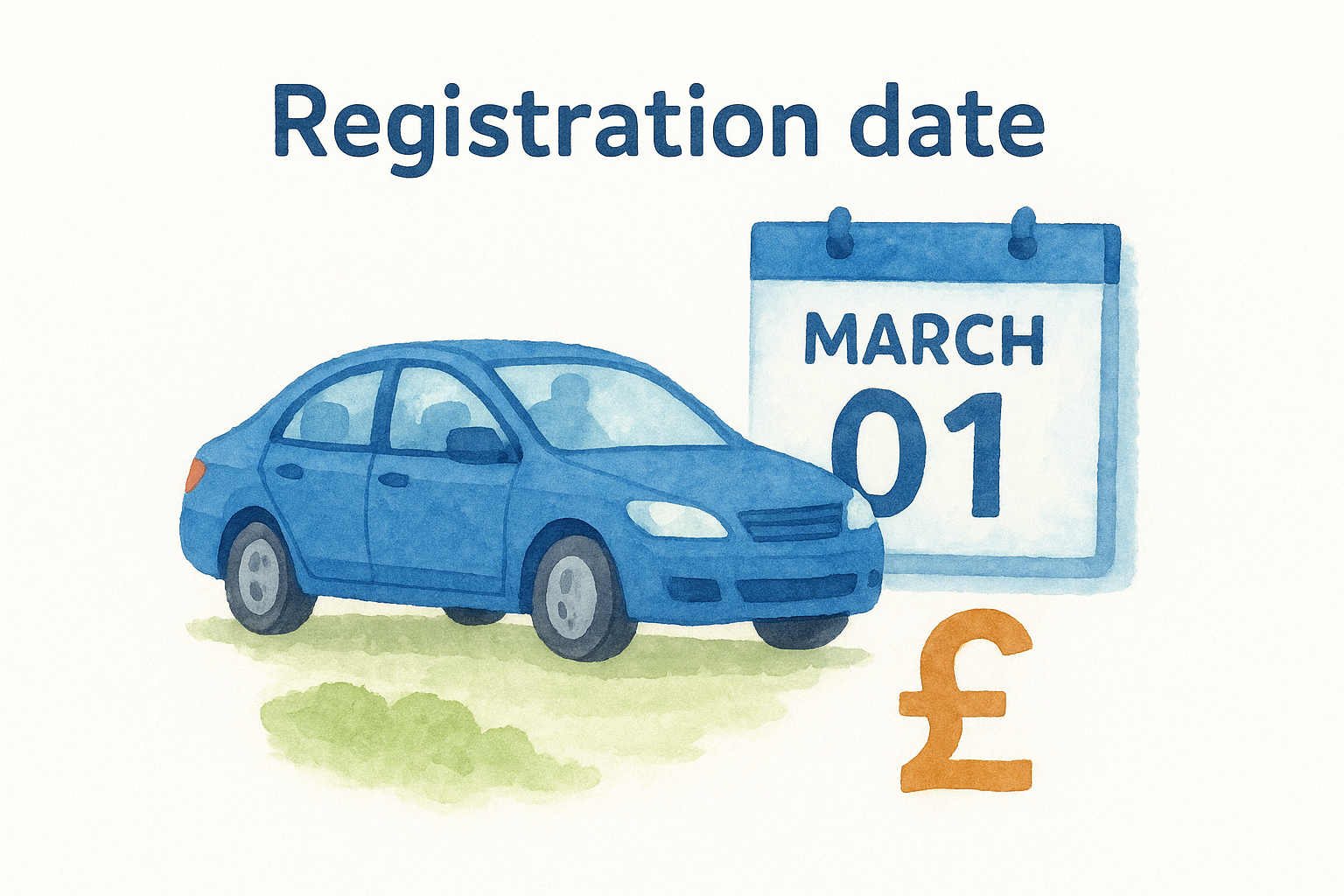
The registration date printed on the V5C logbook is the date that determines which VED system applies, not the model year or the date you bought the car.
CO2 emissions
For cars registered from March 2001 onwards, CO2 emissions data forms the backbone of how VED bands are calculated. Vehicles that emit lower levels of CO2 fall into cheaper bands, while higher-emitting cars attract higher rates. The CO2 figure used is the one recorded at first registration with the DVLA, based on the manufacturer's official test data. Modifications made after registration do not alter the figure on record.
Fuel type and list price
Fuel type affects your rate in two ways. First, diesel cars registered after April 2017 that do not meet the RDE2 standard face higher first-year rates than equivalent petrol cars with the same emissions figure. Second, electric and some hybrid vehicles now sit in their own rate categories following the 2025 changes.
For newer cars, list price at first registration also matters. Vehicles with an original manufacturer's list price above £40,000 pay an additional supplement on top of the standard annual rate for five years, regardless of how much the car is worth when you buy it second-hand.
VED rates for cars registered from April 2017
Cars registered on or after 1 April 2017 follow a two-stage charging structure: a first-year rate based on CO2 emissions, followed by a flat standard rate from year two onwards. This system replaced the older, single-band approach that had applied to cars registered since 2001. If you're researching how much is car tax UK for a newer vehicle, this is the framework that will apply, and the numbers changed again in April 2025 when first-year rates roughly doubled across most emission bands.
First-year rates based on CO2 emissions
When a car is first taxed after registration, the rate reflects its recorded CO2 output at the point of manufacture. Lower-emitting cars pay significantly less in that first year, which is why dealer listings often advertise first-year VED as a selling point for efficient models. The table below shows the current 2026/27 first-year rates for petrol and diesel cars.
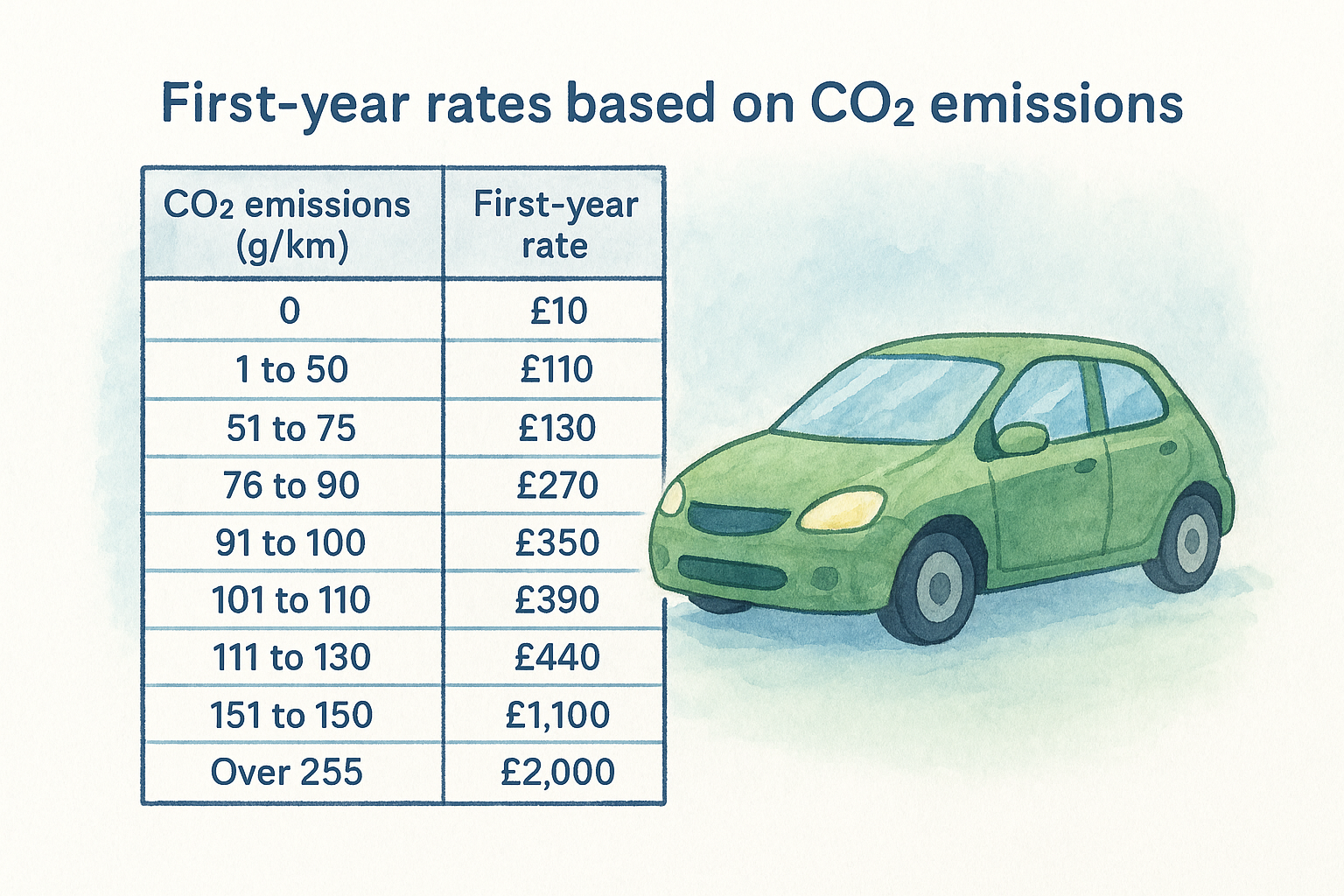
| CO2 emissions (g/km) | First-year rate |
|---|---|
| 0 | £10 |
| 1 to 50 | £110 |
| 51 to 75 | £130 |
| 76 to 90 | £270 |
| 91 to 100 | £350 |
| 101 to 110 | £390 |
| 111 to 130 | £440 |
| 131 to 150 | £640 |
| 151 to 170 | £1,100 |
| 171 to 190 | £2,000 |
| 191 to 225 | £3,300 |
| 226 to 255 | £4,680 |
| Over 255 | £5,490 |
Diesel cars that do not meet the RDE2 emissions standard are taxed one band higher than their CO2 figure alone would suggest. If you're buying a used diesel registered after April 2017, check whether it carries RDE2 certification before assuming which first-year band applies.
The first-year rate only affects the original taxing of a new car. If you buy the vehicle second-hand, you pay the standard rate immediately, regardless of what the first keeper paid.
Standard rate and the £40,000 supplement
From the second year of registration, most petrol, diesel, hybrid, and electric cars move onto the flat standard rate of £195 per year. This applies regardless of emissions, which means a low-emission hybrid and a high-output petrol car pay the same annual amount once that first year passes.
Cars with an original list price above £40,000 pay an additional supplement of £425 per year on top of the standard rate. This surcharge runs for five years from the second time the vehicle is taxed, ending at the start of the sixth year. The supplement applies to the original registered list price, not the price you paid second-hand, so a car that now sells for less than £40,000 may still attract the supplement if it originally listed above that threshold.
VED rates for cars registered 2001 to 2017
Cars registered between 1 March 2001 and 31 March 2017 follow a different system from newer vehicles. Instead of a split first-year and standard rate, these cars sit in one of 13 lettered bands (A to M), each tied directly to their official CO2 emissions figure. That single band determines what you pay every year you tax the car, with no additional list price supplement applying to this group.
The 13 CO2 bands
Your car's registered CO2 emissions figure is the only variable that matters here. Band A covers the lowest-emitting vehicles and carries a £0 annual rate, while Band M at the top of the scale applies to cars emitting over 255g/km. If you're working out how much is car tax UK owners pay for a car from this era, find the CO2 figure on the V5C logbook and match it to the table below for the 2026/27 annual rate.
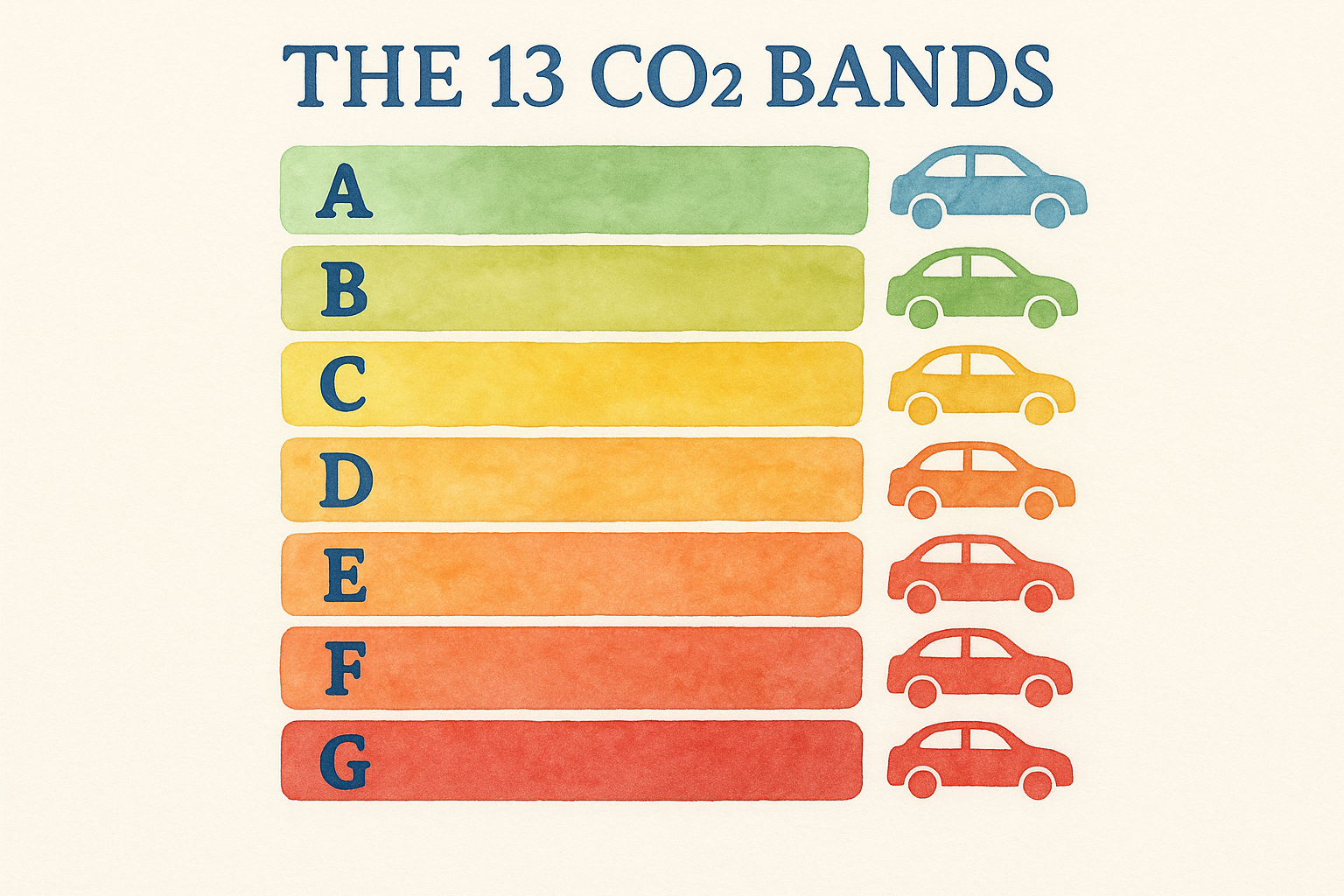
| Band | CO2 emissions (g/km) | Annual rate |
|---|---|---|
| A | Up to 100 | £0 |
| B | 101 to 110 | £20 |
| C | 111 to 120 | £35 |
| D | 121 to 130 | £150 |
| E | 131 to 140 | £195 |
| F | 141 to 150 | £215 |
| G | 151 to 165 | £285 |
| H | 166 to 175 | £350 |
| I | 176 to 185 | £390 |
| J | 186 to 200 | £460 |
| K | 201 to 225 | £505 |
| L | 226 to 255 | £715 |
| M | Over 255 | £755 |
Band K also includes some cars registered before 23 March 2006 that emit more than 225g/km but were placed into this band at the time of first registration.
What this means when buying used
Buying a car from this registration period means your running costs are locked into whichever band the car sits in, and that position never changes. Unlike the post-2017 system, there is no first-year premium to absorb as a second-hand buyer, so the figure in the table above is exactly what you pay from the moment you tax it.
Picking a car in bands A or B keeps your annual VED at £20 or lower, which makes efficient small cars from this era genuinely cheap to run on a tax basis. Band M cars can cost over £750 a year, so checking the CO2 figure on the V5C before you commit to a purchase can make a real difference to your annual outgoings.
VED rates for cars registered before March 2001
Cars registered before 1 March 2001 use an entirely different method to calculate VED. Rather than CO2 emissions, which weren't recorded at registration for most vehicles of this age, these cars are taxed based on engine size alone. There are only two categories: cars with an engine capacity at or below 1549cc, and cars above that threshold. This makes working out how much is car tax UK owners pay for an older vehicle straightforward compared to the more complex banding systems used for newer cars.
If you're buying a classic or older used car, the engine size printed on the V5C is all you need to determine which rate applies.
The two engine size categories
The simplicity of this system works in your favour. You don't need to track down an official CO2 test result or check whether a diesel meets RDE2 standards. You simply identify the engine size from the V5C logbook and apply the correct rate from the table below.
| Engine size | Annual rate (2026/27) |
|---|---|
| Up to 1549cc | £195 |
| Over 1549cc | £330 |
Both figures represent the full annual rate you pay each time you tax the vehicle. There is no first-year premium, no list price supplement, and no additional charge based on fuel type.
How this affects your running costs
Choosing a pre-March 2001 car with an engine at or below 1549cc keeps your annual VED at £195, the same as the standard rate for most post-2017 cars. That can make well-maintained older vehicles genuinely competitive on tax costs, even if their fuel economy lags behind more modern equivalents.
Larger-engined cars from this era attract £330 per year, which remains relatively modest compared to high-emission post-2017 cars or Band M vehicles from the 2001-to-2017 period. If you're drawn to a pre-2001 car with a bigger engine, the VED cost alone is unlikely to be the deciding factor, but confirming the figure before purchase ensures no surprises when you come to tax it for the first time.
How to check your exact car tax by reg
Rate tables give you a useful starting point, but the most accurate way to find out how much is car tax UK applies to a specific vehicle is to look it up by registration plate. Every car registered with the DVLA has its VED status, annual rate, and expiry date recorded against its registration number. Accessing that data directly removes any guesswork about which band applies or whether the previous keeper left the tax in date.
What a registration lookup tells you
When you run a check using a vehicle's registration plate, you get real data pulled from the DVLA's own records, not an estimate based on a rate table. That means you can confirm the exact annual cost, see when the current tax expires, and verify the car's CO2 figure and fuel type at the same time. This matters most when you're buying used, because the car's official records can differ from what the seller tells you about the vehicle's specification or history.
Checking the tax status before you buy protects you from inheriting a car where the tax has already lapsed, which would mean you can't legally drive it until you tax it yourself.
You can verify basic tax status for free through the DVLA's own vehicle enquiry service, which confirms whether a car is taxed and when that tax expires. This covers the essentials but doesn't give you the full picture of the vehicle's history, ownership, or any outstanding issues that could affect your purchase decision.
Using Vehiclepedia to check tax alongside history
Vehiclepedia's registration lookup pulls tax status and annual cost alongside a full range of vehicle history data, including MOT history, mileage records, import and export flags, and colour change records. You enter the registration plate and get instant results drawn from official UK databases. This means you can confirm the VED rate and check whether the car has a clean history in the same search, rather than running separate lookups through multiple services.
This is particularly useful if you're comparing several vehicles at once. Checking tax costs, MOT history, and ownership records together gives you a complete financial picture of each car before you make any commitment.
Quick recap and next steps
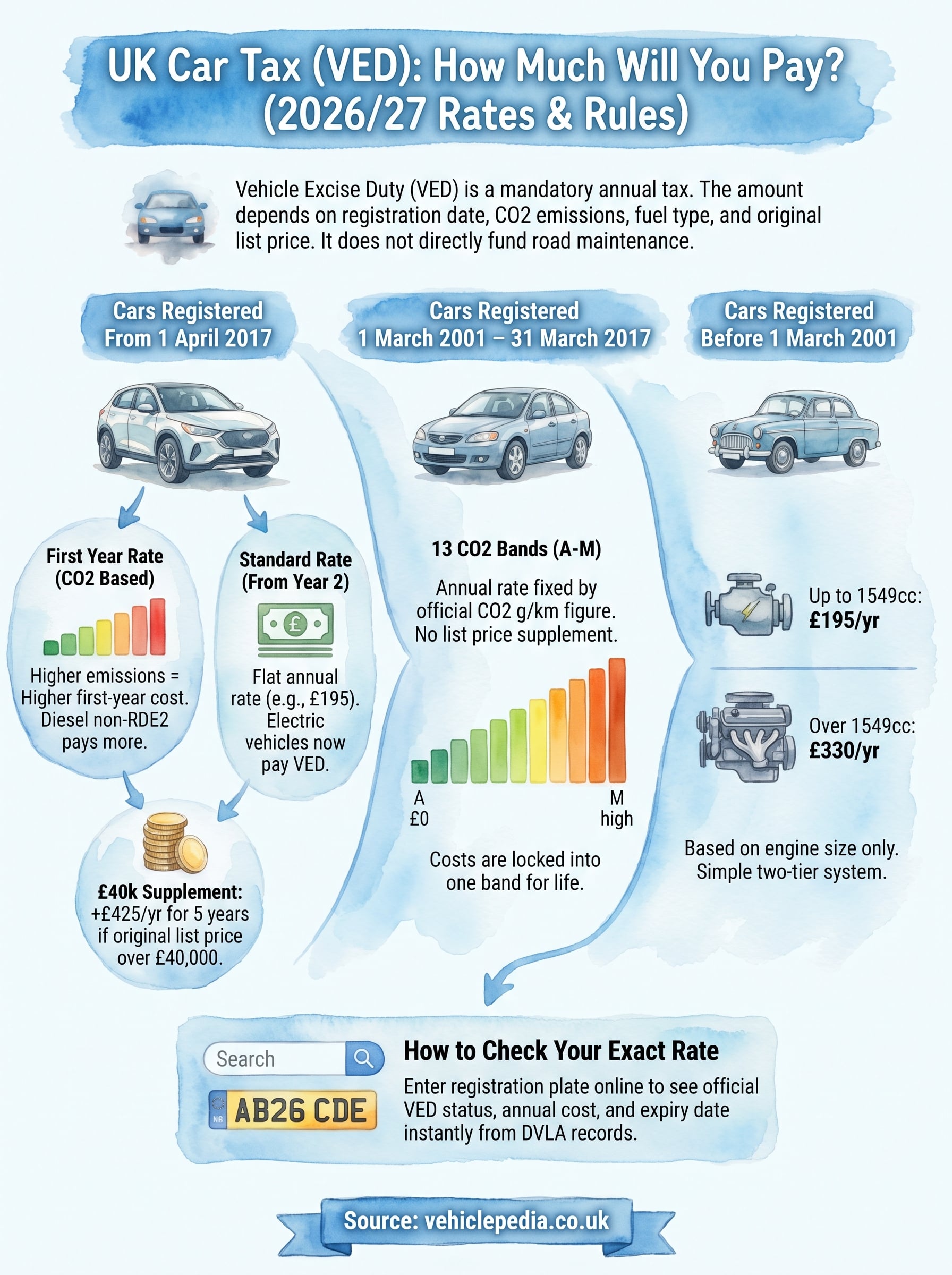
Working out how much is car tax UK drivers pay comes down to three things: when your car was registered, its CO2 emissions or engine size, and whether it originally listed above £40,000. Cars registered from April 2017 follow a two-stage system with first-year rates and a flat annual standard charge. Those registered between 2001 and 2017 sit in one of 13 CO2 bands. Vehicles from before March 2001 pay based on engine size alone, with just two categories to choose between.
Knowing the rate tables is a solid starting point, but checking the actual figures against a real registration plate is faster and more reliable. Vehiclepedia's free lookup pulls live tax status, annual cost, and MOT history in one search, so you know exactly what you're committing to before you hand over any money. Check any car you're considering with our free vehicle history report and see the full picture first.