What To Check When Buying A Used Car: UK Checklist 2026
Don't risk a bad deal. Use our 2026 checklist to learn what to check when buying a used car, from history reports and paperwork to mechanical inspections.

What To Check When Buying A Used Car: UK Checklist 2026
Buying a used car is one of the bigger financial decisions most of us make, and one where a wrong move can cost thousands. Dodgy MOT histories, outstanding finance, hidden accident damage… the list of potential pitfalls is long. Knowing exactly what to check when buying a used car can be the difference between driving away with a reliable motor and inheriting someone else's expensive problem. Yet many buyers still turn up to viewings armed with little more than a hopeful kick of the tyres. That's a gamble you don't need to take.
At Vehiclepedia, we provide free and premium vehicle history checks sourced from official UK databases, including the DVLA, police records, and insurance registers. Every day, we see the data behind cars that look perfect on the outside but carry serious red flags underneath, outstanding finance, write-off markers, or mileage that doesn't add up. That experience has given us a clear picture of where buyers get caught out and, more importantly, how to avoid it.
This guide is a complete UK checklist for 2026, covering everything from the paperwork and legal checks you should run before you even see the car, through to the hands-on mechanical and bodywork inspections at the viewing itself. Whether you're buying privately, from a dealer, or through an online marketplace, each section is designed to help you spot problems early and negotiate with confidence. Work through it step by step, and you'll be in a far stronger position to make a decision you won't regret.
What you should prepare before you start looking
Most people skip the preparation stage entirely and jump straight to browsing car listings. That tends to lead to impulse decisions and overlooked details. Good preparation is what separates a confident buyer from one who gets rushed into a bad deal. Before you contact a single seller or view a single car, spend time getting your research, budget, and questions sorted. The more work you do upfront, the easier it becomes to know what to check when buying a used car in real time.
Set a realistic budget that covers more than the asking price
The purchase price is only part of what you'll actually pay. When you buy a used car, you also take on immediate running costs that many buyers forget to factor in: road tax, insurance, an MOT if one isn't current, and possibly a service if the history is patchy. A realistic budget means adding at least 10 to 15 per cent on top of your target price to cover these costs comfortably.
Don't forget to check insurance costs before you fall in love with a car. A vehicle in a higher insurance group can easily wipe out any saving you made on the purchase price.
Use a simple budget breakdown like this before you start searching:
| Cost | Estimated amount |
|---|---|
| Purchase price | £X,XXX |
| Insurance (first year) | £XXX |
| Road tax (annual) | £XXX |
| MOT (if needed) | Up to £54.85 |
| Service / fluid check | £XXX |
| Emergency repair fund | £300 to £500 |
Research the models on your shortlist
Narrowing your search to two or three specific models before you browse listings saves significant time and gives you a clear benchmark for price and condition. Every car model has known weak points, whether that's a timing chain that needs early replacement or a gearbox that struggles at high mileage. Check owner forums and published reliability data for the exact model and engine you're considering, so you know in advance what to look for during the physical inspection.
Think about what the car actually needs to do for you. For example, if you cover mostly short urban journeys, a diesel engine is generally a poor fit because it rarely reaches full operating temperature and the diesel particulate filter can clog quickly. A petrol or hybrid will suit that kind of use far better.
Prepare your questions before you contact the seller
Walking into a viewing without prepared questions is how buyers get caught off guard. Write your questions down before you call or message, and don't rely on memory. You want to confirm the basics early so you're not wasting time and travel costs on a car that fails immediately on a key point.
Here is a template you can use before or during your first contact with any seller:
- How long have you owned the car?
- Why are you selling it?
- Is the V5C logbook in your name and does the address match?
- How many previous owners are recorded on the V5C?
- Is there a full or partial service history with receipts?
- Has the car had any accident damage or bodywork repairs?
- Is there any outstanding finance on the vehicle?
- Is the MOT current, and are there any advisories listed?
- Are all the original keys present?
Getting clear answers to these questions upfront means you filter out problem cars before you've spent anything beyond a phone call.
Start with an online history check using the reg
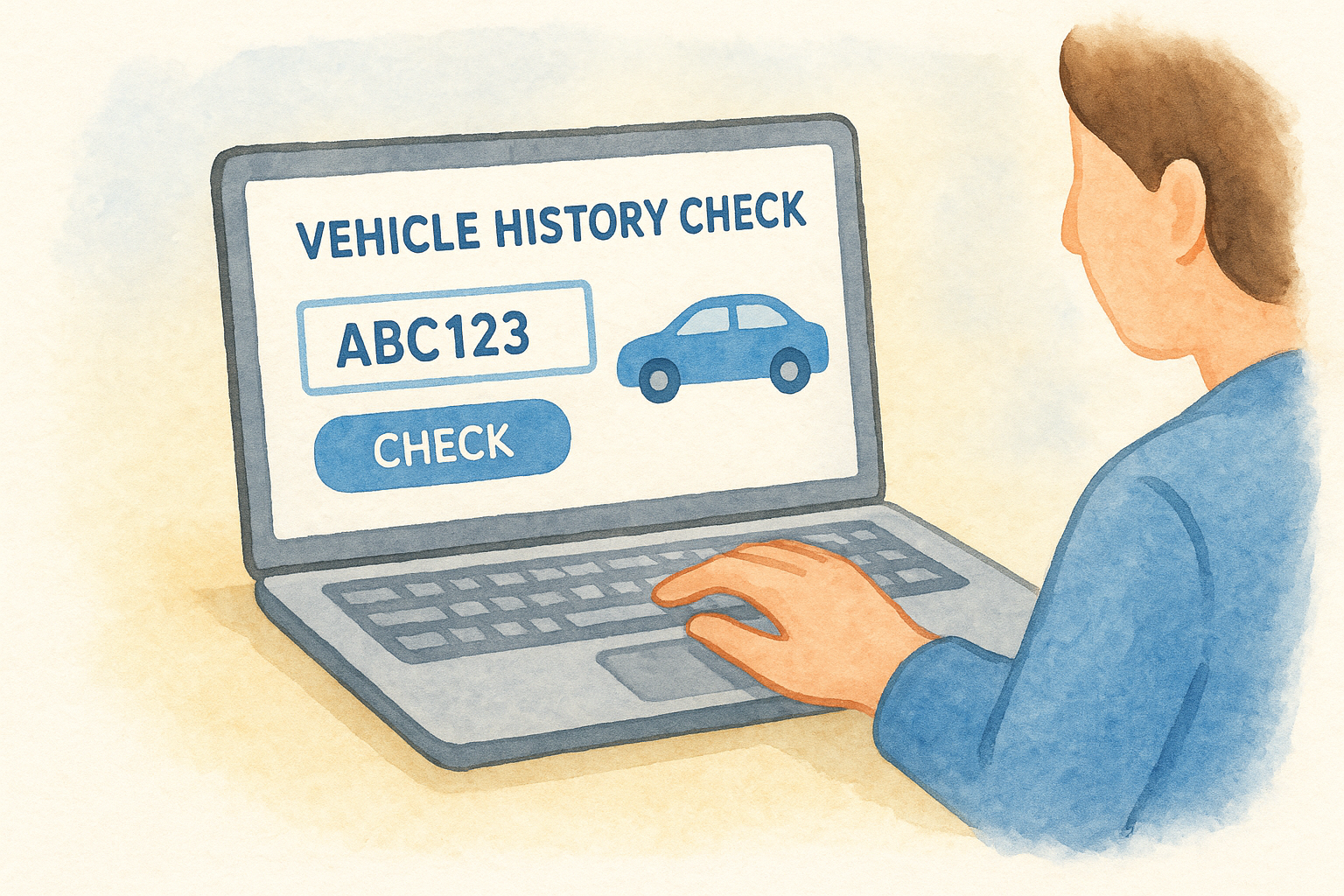
Before you arrange a viewing or hand over any money, run a vehicle history check using the registration number. This is one of the most important steps in knowing what to check when buying a used car, and it costs nothing to start. A reg-based check pulls data from official UK databases including the DVLA, giving you a reliable snapshot of the vehicle's background in under a minute.
What a free reg check covers
A free check on Vehiclepedia gives you a solid starting point. You'll see the make, model, colour, and engine size registered against the plate, which you can immediately compare against what the seller has told you. Any mismatch here is a warning sign worth taking seriously before you go any further.
You'll also get MOT status and the expiry date, the vehicle's age, road tax status, and basic performance data. These details alone can save you a wasted journey. If the MOT ran out six months ago and the seller hasn't mentioned it, that tells you something about how they've managed the car.
Run the check before you even book a viewing. If the basic data doesn't match what's in the advert, walk away.
When to upgrade to a premium report
Free checks cover the surface, but a premium report fills in the gaps that matter most. This is where you find out whether the car has outstanding finance registered against it, whether it has been written off by an insurer, and whether it appears on the UK Police stolen vehicle database. None of this is visible in a free check, and none of it is something you want to discover after you've already paid.
Vehiclepedia's premium reports include a £30,000 data guarantee for non-trade buyers, which gives you genuine legal protection if the data turns out to be inaccurate. That guarantee is worth having on any car purchase of real value.
Use this quick comparison to decide which level of check fits your situation:
| Check type | What it covers | Best for |
|---|---|---|
| Free check | DVLA data, MOT status, road tax, vehicle spec | Initial research before viewing |
| Premium report | Finance, write-offs, stolen status, full history | Before agreeing to buy any used car |
Check DVLA details, MOT history and recalls
Once you have the registration number, cross-referencing the DVLA record is one of the most straightforward steps in understanding what to check when buying a used car. The official data tells you the vehicle's registered colour, engine size, date of first registration, and fuel type. These details cost nothing to verify, and checking them takes under a minute, yet most buyers skip this entirely and simply take the advert at face value.
Cross-check the DVLA record against what the seller tells you
Discrepancies between the DVLA record and the car itself are a red flag, full stop. If the registered colour doesn't match the paint you're looking at, the car may have been resprayed to disguise accident damage or to make identification harder after theft. An engine size that doesn't match the badge is equally concerning. Pull the free DVLA data before you travel, then physically confirm each detail matches when you arrive at the viewing.
If the DVLA record shows a colour or engine size that doesn't match the car in front of you, ask for a clear explanation before you take the inspection any further.
Read the MOT history, not just the current certificate
A current MOT tells you the car passed a roadworthiness test on one specific day. The MOT history tells you a much fuller story. You can check the full MOT record for free through the UK Government's official vehicle enquiry service, which shows every test result, every listed failure, and every advisory note going back years.
Look for patterns rather than isolated entries. A car that has accumulated repeated advisories on the same components over several tests, such as corroding brake pipes or worn suspension bushes, suggests deferred maintenance that you'll be paying to fix. A test failure that was corrected and a clean advisory history is far less concerning than a car that scraped through year after year with multiple issues noted.
Check for outstanding manufacturer recalls
Recalls are safety-related fixes issued by manufacturers, and they are carried out free of charge at franchised dealers. A car can have an outstanding recall that the current owner has simply never acted on, which means you could inherit a known safety issue if you don't check.
Use the DVSA's official vehicle recall checker or contact the manufacturer directly with the registration number to confirm whether any open recalls apply to the vehicle you're considering.
Verify finance, write-off and stolen status
These three checks sit at the heart of what to check when buying a used car. Outstanding finance, a write-off marker, or a stolen flag on the Police database can each invalidate your purchase entirely or leave you legally worse off after the sale. None of this data shows up at a viewing, which is exactly why you need a premium history report before you hand over any money.
Check for outstanding finance
When a car has outstanding finance registered against it, the finance company technically still owns the vehicle, not the seller. Buying that car means you could lose it to the lender even after paying in full. This happens regularly in private sales, and it is entirely avoidable with a finance check run against the registration before you commit.
If you discover finance on a vehicle after purchase, the lender has the legal right to repossess the car regardless of your good faith as a buyer.
A premium history check from Vehiclepedia pulls data from the UK's finance registers and shows you whether any active finance agreements are linked to the vehicle. If finance shows up, walk away or require written proof from the seller that the agreement has been cleared before you hand over a single pound.
Understand write-off categories
A written-off vehicle is one that an insurer has assessed as uneconomical or unsafe to repair. In the UK, write-offs fall into four categories, and understanding what each means helps you decide whether a car's history makes it acceptable to you.
| Category | What it means |
|---|---|
| A | Scrap only - must never return to the road |
| B | Body shell must be crushed - some parts can be salvaged |
| S (formerly C) | Structural damage - can be repaired and returned to road |
| N (formerly D) | Non-structural damage - can be repaired and returned to road |
Category A and B cars should never appear for sale as driveable vehicles. A Category S or N car can legally be sold once repaired, but the write-off marker stays on its record permanently. Factor that into your offer price accordingly.
Run a stolen vehicle check
A car that appears on the UK Police stolen vehicle database can be seized by police at any point after you buy it, with no refund available to you as the purchaser. A premium history report cross-references the Police database and flags any active stolen marker tied to the registration, giving you clear confirmation before you proceed.
Choose where to buy and understand your rights
Where you buy a used car directly affects what legal protections you have after the sale. This is a critical part of knowing what to check when buying a used car, because your rights vary significantly depending on whether you buy from a private individual, a franchised dealer, or an independent trader. Getting this right before you commit means you have a clear route for recourse if something goes wrong.
Private sales versus dealer purchases
Buying from a private seller gives you very limited legal protection. The law requires the car to match its description, but it does not need to be of satisfactory quality or fit for purpose in the same way a dealer sale does. In practice, this means if a fault appears after you drive away, your only realistic option is to pursue the seller through the small claims court, which is time-consuming and not guaranteed to succeed.
Purchasing from a franchised or independent dealer brings the Consumer Rights Act 2015 into play, which gives you substantially stronger protection. Use this table to compare your position under each route:
| Purchase route | Key legal protection | What it means for you |
|---|---|---|
| Private seller | Sale of Goods Act (description only) | Car must match description but not necessarily be fault-free |
| Dealer (trader) | Consumer Rights Act 2015 | Car must be of satisfactory quality, fit for purpose, and as described |
If you buy from a dealer and a fault appears within 30 days, you have the short-term right to reject the car and receive a full refund.
What the Consumer Rights Act 2015 gives you
The 30-day short-term right to reject is your strongest protection when buying from a dealer. Within this window, you can return the car if it is not of satisfactory quality, fit for purpose, or as described. After 30 days and up to six months, the dealer gets one opportunity to repair or replace the car before you can claim a refund.
Beyond six months from the purchase date, the burden of proof shifts to you to demonstrate that the fault existed at the time of sale. That makes early action essential if problems surface. Always confirm the dealer's full trading name, registered address, and company number before signing anything, so you have the correct details if you need to make a formal complaint.
Inspect the car in daylight: body, tyres, interior
Never view a used car in low light, at night, or in wet conditions. Natural daylight is the only reliable way to see bodywork imperfections, and this physical inspection is one of the most important parts of what to check when buying a used car. Book viewings for the middle of the day, and if a seller pushes back on that, treat it as a reason to be cautious.
Check the bodywork for panel gaps and paint
Walk slowly around the entire car at eye level and look along each panel from a low angle. Uneven panel gaps, rippled metalwork, or paint that looks slightly different from one panel to the next all point to previous accident damage. A respray over a repaired area often shows as a slightly different texture or a subtle colour mismatch in direct sunlight.
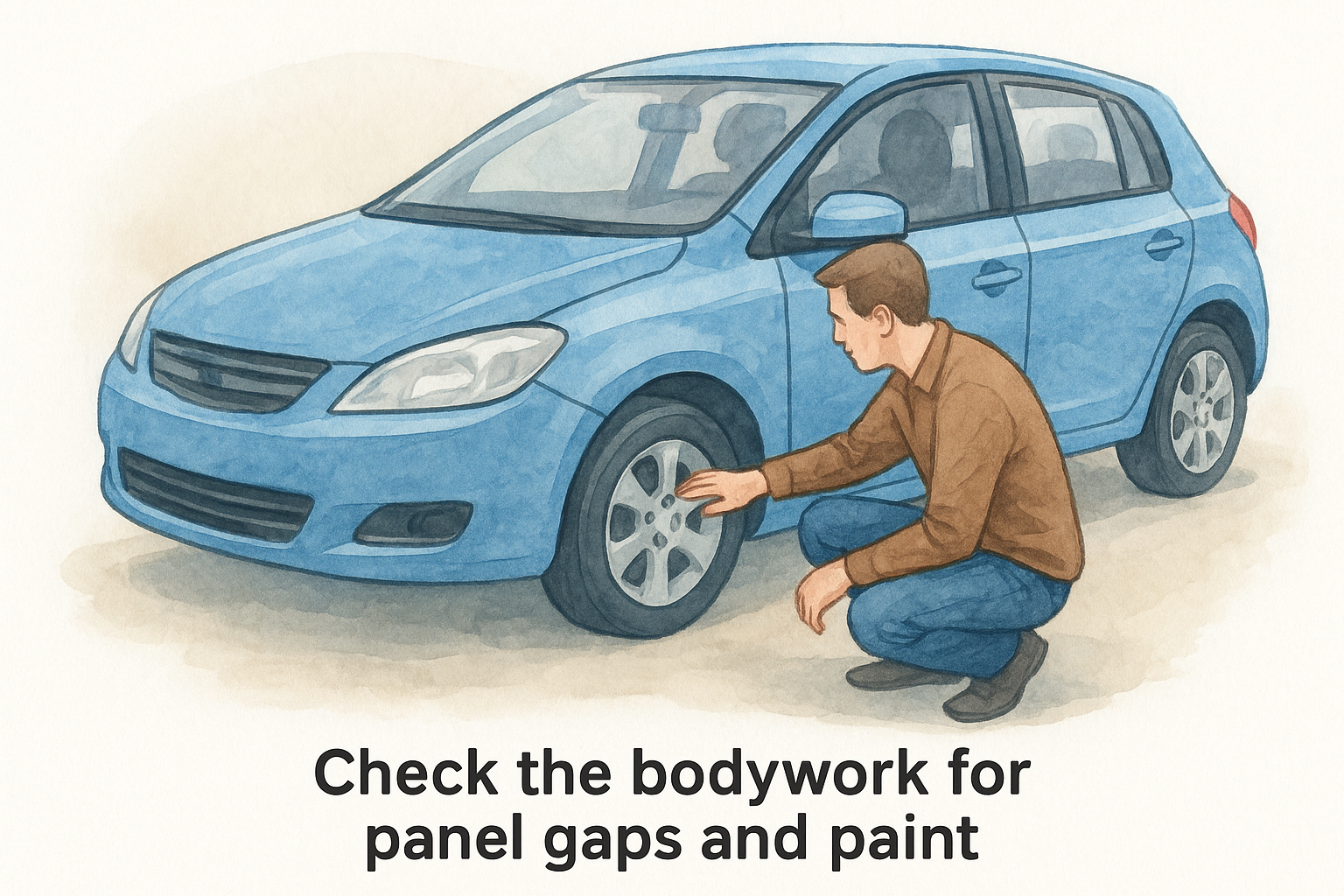
If you spot mismatched paint or inconsistent panel gaps, ask the seller directly whether the car has had bodywork repairs. A confident, clear answer is a good sign.
Also check the door sills, wheel arches, and the underside of the boot lid for rust or filler. Run your hand along the lower edges of the doors and along the sills, because rust often starts in areas that are easy to miss visually. Any soft or uneven texture under your fingers suggests filler rather than solid metal.
Inspect the tyres carefully
Check the tread depth on all four tyres, including the spare if one is present. The legal minimum in the UK is 1.6mm across the central three-quarters of the tyre, but anything below 3mm will need replacing soon. Uneven wear across a single tyre often signals a suspension or wheel alignment problem that goes beyond the tyre itself.
Look for the following on each tyre before moving inside:
- Cracks or bulges in the sidewall
- Uneven wear between the inner and outer edges
- Different tyre brands fitted on the same axle
- A brand or size that doesn't match the manufacturer's specification
Look over the interior for wear and hidden damage
Sit in each seat and check the fabric or leather for wear, staining, and damage that doesn't match the car's claimed mileage. A driver's seat that is heavily worn on a car with 30,000 miles recorded is worth questioning. Check that all electric windows, mirrors, and the air conditioning work before you leave the interior, because faults here are easy to miss and expensive to repair later.
Check the boot floor by lifting the carpet or load liner. Water ingress often leaves tide marks or a damp smell in the boot area, which can indicate a leaking seal or poorly repaired rear-end damage.
Check under the bonnet: fluids, leaks and belts
This inspection takes fewer than ten minutes, but it tells you a great deal about how well the previous owner maintained the car. Understanding what to check when buying a used car includes opening the bonnet and looking at the basics before any test drive. A car that's been properly serviced will have clean fluid levels and dry, oil-free surfaces throughout the engine bay.
Check the oil, coolant and brake fluid levels
Pull the oil dipstick out, wipe it clean, reinsert it fully, and pull it again. The oil level should sit between the two markers on the stick. Low oil suggests neglect or a possible leak. The colour matters too: fresh oil is amber to dark brown, but a milky or frothy appearance on the dipstick or the underside of the oil filler cap points to a head gasket problem, where coolant is mixing with the engine oil. That is a serious and expensive fault.
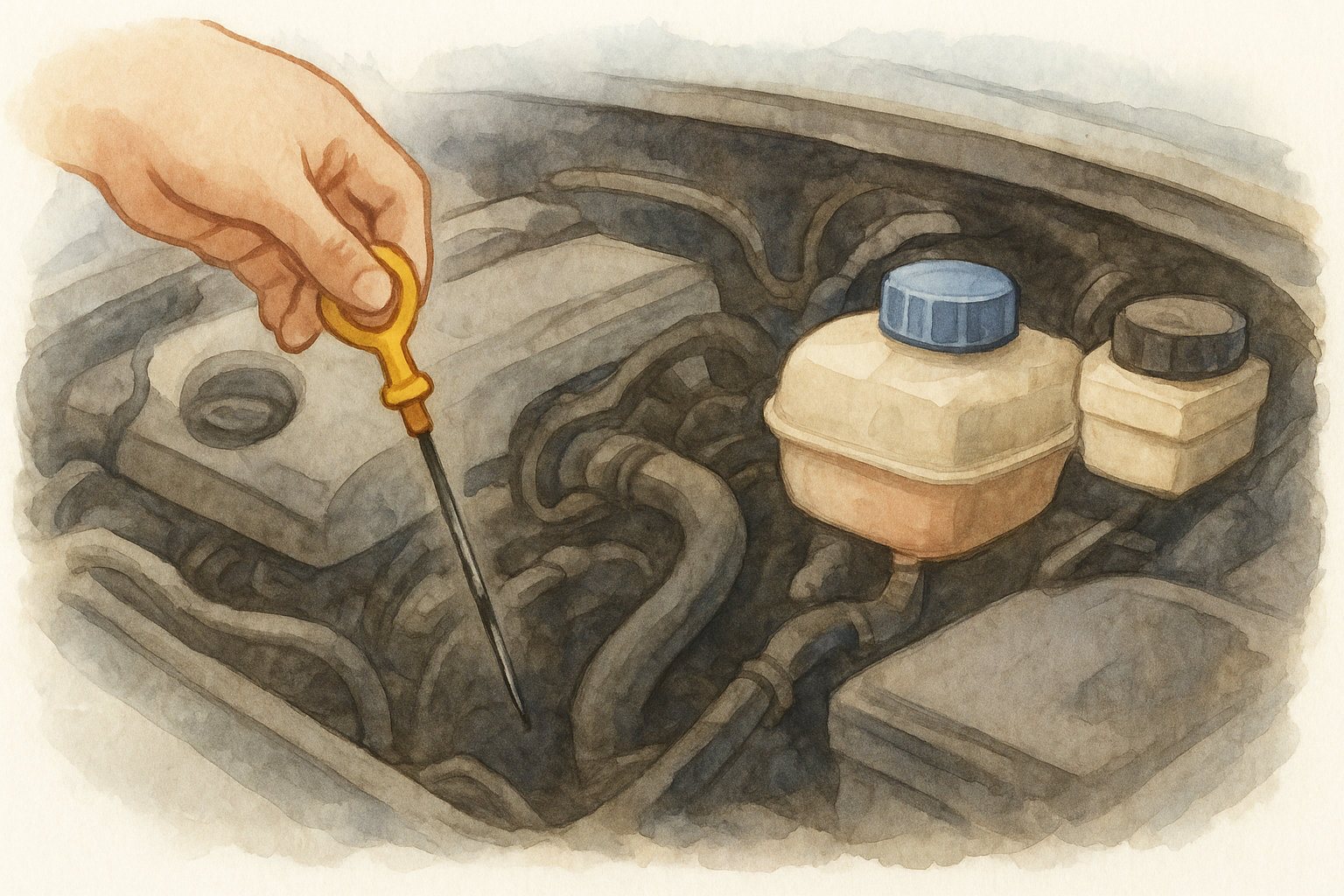
If you spot a milky residue on the oil filler cap, walk away unless you have a specialist's assessment confirming the extent of the damage.
Check the coolant reservoir and confirm the level sits between the minimum and maximum markers. Low coolant on a car that was supposedly serviced recently is worth querying. Also locate the brake fluid reservoir and check the level visually. Brake fluid darkens with age and moisture absorption, so very dark fluid suggests it hasn't been changed in a long time.
Look for leaks and inspect the cambelt
Run your eyes across the engine block, the base of the coolant hoses, and the area around the oil filter for any signs of staining, dried residue, or wet patches. Fresh oil on engine surfaces is a sign of an active leak, and staining on the underside of the car directly beneath the engine is equally telling. These may be minor seal issues, but they can also indicate deeper problems.
Check whether the car has a cambelt or a timing chain, because this matters significantly for your running costs. Ask the seller directly, and confirm against the manufacturer's maintenance schedule. A cambelt that is overdue for replacement is a real risk: if it snaps, the engine damage can cost more than the car is worth. Timing chains generally last the life of the engine, but they are not immune to wear. Look for any rattling noise from the engine on startup, which can indicate a stretched or worn chain.
Review the paperwork: V5C, VIN and service history
Paperwork is one of the most revealing parts of knowing what to check when buying a used car. A car with a convincing exterior and a smooth engine can still carry serious problems that only show up in the documents. Take your time with every piece of paper, and don't let a seller rush you through this stage.
Check the V5C logbook carefully
The V5C is the vehicle's registration document, and it must be present at any private sale. Check that the name and address on the V5C match the seller and the address where the car is kept. A seller who can't produce the V5C, or whose details don't match what's recorded, is a significant warning sign. The document should also show the number of previous registered keepers, which you can cross-reference against what the seller told you when you first made contact.
If the V5C is missing and the seller claims to have applied for a replacement, treat this with caution and do not hand over payment until the original document is confirmed.
Look for signs of tampering on the V5C itself. Check that the watermark is present when you hold the document up to light, and confirm that the vehicle colour, engine size, and registration number printed on the document match the car in front of you exactly.
Match the VIN across the car
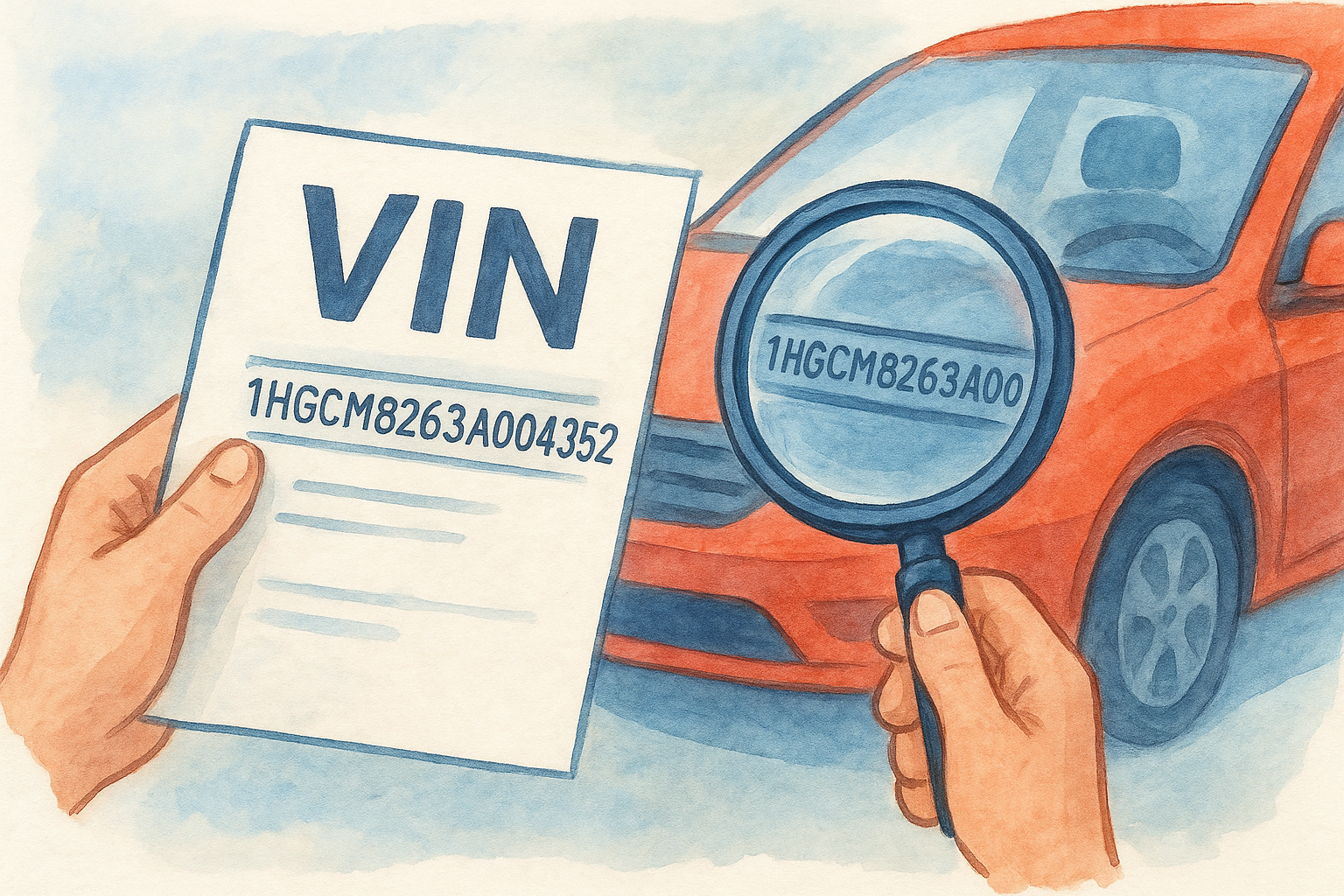
The Vehicle Identification Number is a 17-character code unique to each vehicle, and checking it is one of the most direct ways to confirm a car is exactly what it claims to be. You'll find the VIN stamped into the chassis in several locations, typically on a plate visible through the windscreen on the driver's side, inside the door jamb, and sometimes beneath the bonnet. All VIN locations must match each other and must match what is printed on the V5C. Any discrepancy suggests the car may have been rebuilt from multiple vehicles or that the plates have been changed.
Assess the service history
A full service history means receipts or dealer stamps for every scheduled service, ideally at the correct mileage intervals. Gaps in the history are worth querying directly, and a car with no history at all carries more risk of deferred maintenance. Look for receipts that show the type of work carried out, the mileage at the time, and the workshop details, rather than just a stamp with a date.
Check that the mileage recorded across each service entry increases progressively and logically. Any sudden drop in recorded mileage between service entries is a strong indicator of odometer tampering, which should end the viewing immediately.
Test drive checklist: engine, clutch, brakes, steering
The test drive is where everything you've checked on paper and in the driveway gets confirmed in real conditions. Never skip this step, and never feel pressured to keep it short. A proper test drive is a fundamental part of knowing what to check when buying a used car, and it should cover a range of speeds and road types, not just a single lap around the block.
Start the engine from cold
Arriving before the seller starts the car gives you the most useful information. A cold start reveals problems that disappear once the engine warms up, such as difficulty turning over, rough idling, or excessive smoke from the exhaust. Blue smoke on startup suggests oil burning in the engine; white smoke that persists after the first minute can indicate coolant burning, which points back to the head gasket concerns covered in the bonnet inspection.
If the engine is already warm when you arrive, ask the seller why and request time for it to cool before you test it yourself.
Listen for any knocking, rattling, or tapping sounds during the first few minutes of running. These often settle as oil circulates, but persistent noise after warm-up is a sign of worn internal components that will only get more expensive to address.
Test the gearbox and clutch
Work through every gear on the test drive, including reverse. A manual gearbox should shift cleanly without crunching or resistance. The clutch pedal should engage and release smoothly, with the biting point sitting in the middle of the pedal travel rather than right at the top. A high biting point usually means the clutch is close to the end of its life.
Use this quick checklist during the drive:
- Gear changes feel clean and positive in all ratios
- No crunching or grinding noise when selecting gears
- Clutch bites in the middle of the pedal travel
- No slipping sensation when you accelerate hard in a higher gear
- Automatic transmission shifts smoothly without hesitation or jolting
Check the brakes and steering at speed
Find a safe stretch of road where you can brake firmly from 40 mph to assess how the car pulls up. The car should stop in a straight line without pulling to one side. Any vibration through the brake pedal suggests warped discs; pulling under braking points to uneven pad wear or a brake fault that needs immediate investigation.
At motorway or dual carriageway speeds, hold the steering wheel lightly and check whether the car tracks straight. Wandering or a consistent pull to one side indicates wheel alignment or suspension wear that will affect both safety and tyre life.
Agree the deal: payment, V5C, tax and insurance
This is the final stage of knowing what to check when buying a used car, and it is where buyers sometimes rush and make mistakes they could have easily avoided. Getting the admin right before you drive away protects both your money and your legal position, so work through each step methodically rather than treating it as a formality.
Agree on price and pay safely
Never pay the full asking price without negotiating, particularly if the inspection or test drive revealed any issues. Any faults you identified during the physical check are legitimate grounds for reducing the price, and noting them clearly before you make an offer gives you a factual basis for the conversation rather than a vague request for a discount.
When it comes to payment, bank transfer is the safest method for private purchases because it creates a clear, dated record that links you to the transaction. Avoid paying by cash if possible, and never pay by wire transfer to an account you cannot verify. For dealer purchases, a credit card gives you additional protection under Section 75 of the Consumer Credit Act for purchases over £100.
Never hand over any payment before you have physically inspected the car, confirmed the V5C details, and run a full history check on the registration.
Transfer the V5C and notify the DVLA
The seller must complete the green V5C slip and hand it to you at the point of sale if you are buying privately. You keep the rest of the V5C logbook and must register yourself as the new keeper with the DVLA as soon as possible after the purchase. You can do this online through the official GOV.UK vehicle registration service. Failing to notify the DVLA promptly means you could receive fines or other correspondence intended for the previous owner.
Tax the car and sort insurance before you drive
Road tax does not transfer with the car when it changes hands. The previous owner receives a refund on their unused months automatically, and you are responsible for taxing the vehicle in your name before you use it on a public road. You can tax a car instantly through the GOV.UK vehicle tax service using the new keeper slip from the V5C.
Arrange insurance to start from the moment you collect the car, not from the following day. Driving without valid insurance, even for a short distance home from the seller's address, carries serious legal consequences including a fixed penalty, points on your licence, and potential seizure of the vehicle.
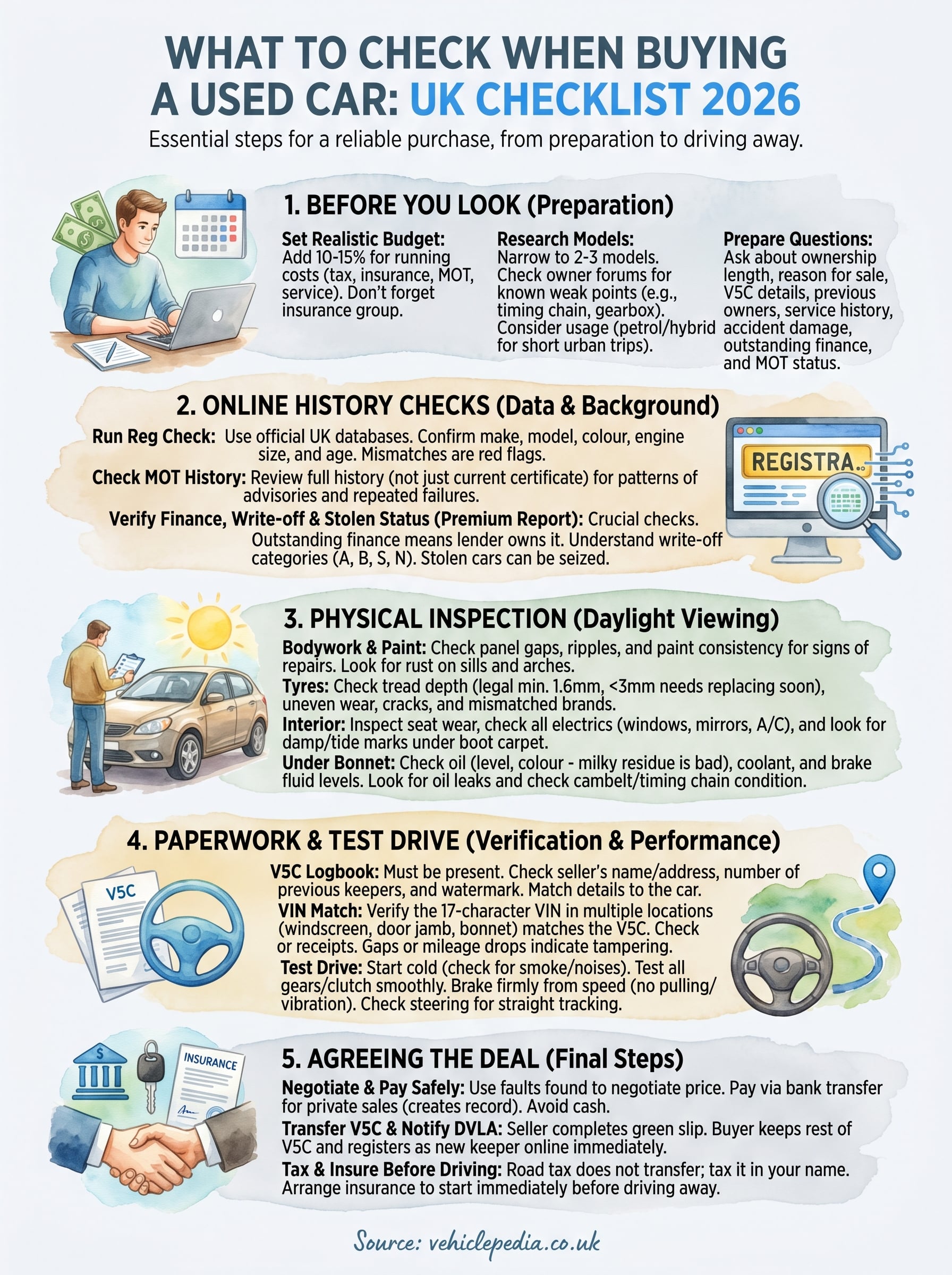
Quick recap and next step
You now have a complete picture of what to check when buying a used car, from setting your budget and running a history check right through to signing over the V5C and taxing the vehicle before you drive away. Each step in this guide exists because real buyers get caught out at exactly these points, and skipping any one of them increases your risk significantly.
Before you book a single viewing, run a free reg check to confirm the basics, then upgrade to a premium report before you commit any money. That report covers outstanding finance, write-off status, and the Police stolen vehicle database, which are the three issues that can cost you the car entirely after purchase. Vehiclepedia pulls all of this from official UK sources and backs it with a £30,000 data guarantee. Check a car's full history now and see exactly what a premium report shows before you buy.