How to Check Car Tax for Free by Registration Number
Check car tax for free by registration number with Vehiclepedia—see tax status, expiry, MOT and SORN details before buying a used car.
How to Check Car Tax for Free by Registration Number
Buying a used car without knowing its tax status is asking for trouble. You could drive it home only to find it's untaxed, then face a fine before you've even had it a week, or discover the road tax costs far more than you budgeted for once you check the actual rate. That's a rough way to start with a new car.
The good news is you can check car tax for free in under a minute, using nothing more than the vehicle's registration number. No account, no payment details, no waiting around. Just the reg plate and a couple of clicks gets you the current tax status, the expiry date, and whether SORN has been declared.
This guide walks you through exactly how to check car tax price by reg, where to find reliable data straight from the DVLA, and how to work out the actual road tax cost for the vehicle you're looking at based on its emissions and fuel type. You'll also learn what to do if the tax status looks wrong, and why this check matters just as much as an MOT check before you hand over any money.
What you need before checking your car tax
You don't need much to run a free car tax check. Forget about needing the seller's paperwork, a V5C logbook, or an account with the DVLA. All you actually need is the vehicle's registration number, and two minutes of your time. This makes it one of the easiest checks you can do before viewing a car in person, or even before you agree to a test drive.
Where to find the registration number
Grab the reg from the number plate itself, front or back, it's the same on both. If you're checking a car listed online rather than one you've seen in the flesh, most seller adverts on marketplaces show the registration plate in the photos, even when it's partially blurred for privacy. You can usually still make out enough of it, or ask the seller directly for the full reg before you commit to travelling to view the car.
You don't need the logbook, the seller present, or an account to check car tax, just the reg plate.
Know what the result will and won't tell you
Have a rough idea of what you're looking for before you search, because it saves confusion once the results appear. A car tax check by registration number tells you whether the vehicle is currently taxed, when that tax runs out, and whether a SORN (Statutory Off Road Notification) is in place. It won't tell you the car's full ownership history or outstanding finance, that's separate information covered by a premium vehicle history report.
A quick checklist before you start
- The full registration number, all characters, no guessing at similar-looking letters
- A note of the car's fuel type if you know it (petrol, diesel, electric, hybrid), since this affects the tax rate
- The first registration date, if available, since tax bands changed in April 2017 and again in 2025
- Five minutes and an internet connection, nothing else
Gathering this before you start means you'll understand the result the moment it appears, rather than needing to search again afterwards to work out what a road tax price checker by reg is actually telling you.
Step 1. Enter your vehicle's registration number
Open Vehiclepedia's free check tool and type the registration into the search box exactly as it appears on the plate, including any spaces. Skip the dashes some plates use for decoration, and don't add extra characters. Within seconds, the system pulls the record straight from the DVLA database, so there's no manual entry of make, model, or year required. This is the fastest route if you want to check car tax price from registration without digging through paperwork first.
Getting the reg exactly right
Mistyping a single character sends back the wrong vehicle, or no result at all. Before you hit search, run through this quick checklist:
- Double-check letters that look alike, such as 0 and O, or 1 and I
- Confirm you've got all seven characters, not six
- Leave out the country identifier badge (GB, UK) if the plate has one
- Copy the reg from a clear photo rather than typing from memory
Get the registration wrong by even one character and you'll check tax on a completely different car.
What happens after you submit
Submitting the reg triggers an instant lookup, not a queued request, so you won't be waiting on an email or a callback. The result page loads with the vehicle's basic details first, make, model, colour, and engine size, confirming you've searched the right car before you even look at the tax data. This matters more than it sounds, because sellers occasionally list the wrong reg by mistake, and catching that early saves you from acting on someone else's vehicle record entirely.
Step 2. Review the tax and MOT status shown
Once the result loads, focus on the tax status line before anything else. It shows one of a handful of clear labels, taxed, untaxed, or SORN, and the exact date the current tax runs out. Vehicle history checks like this pull the figure straight from DVLA records, so there's no guesswork involved, unlike asking a seller to just tell you.
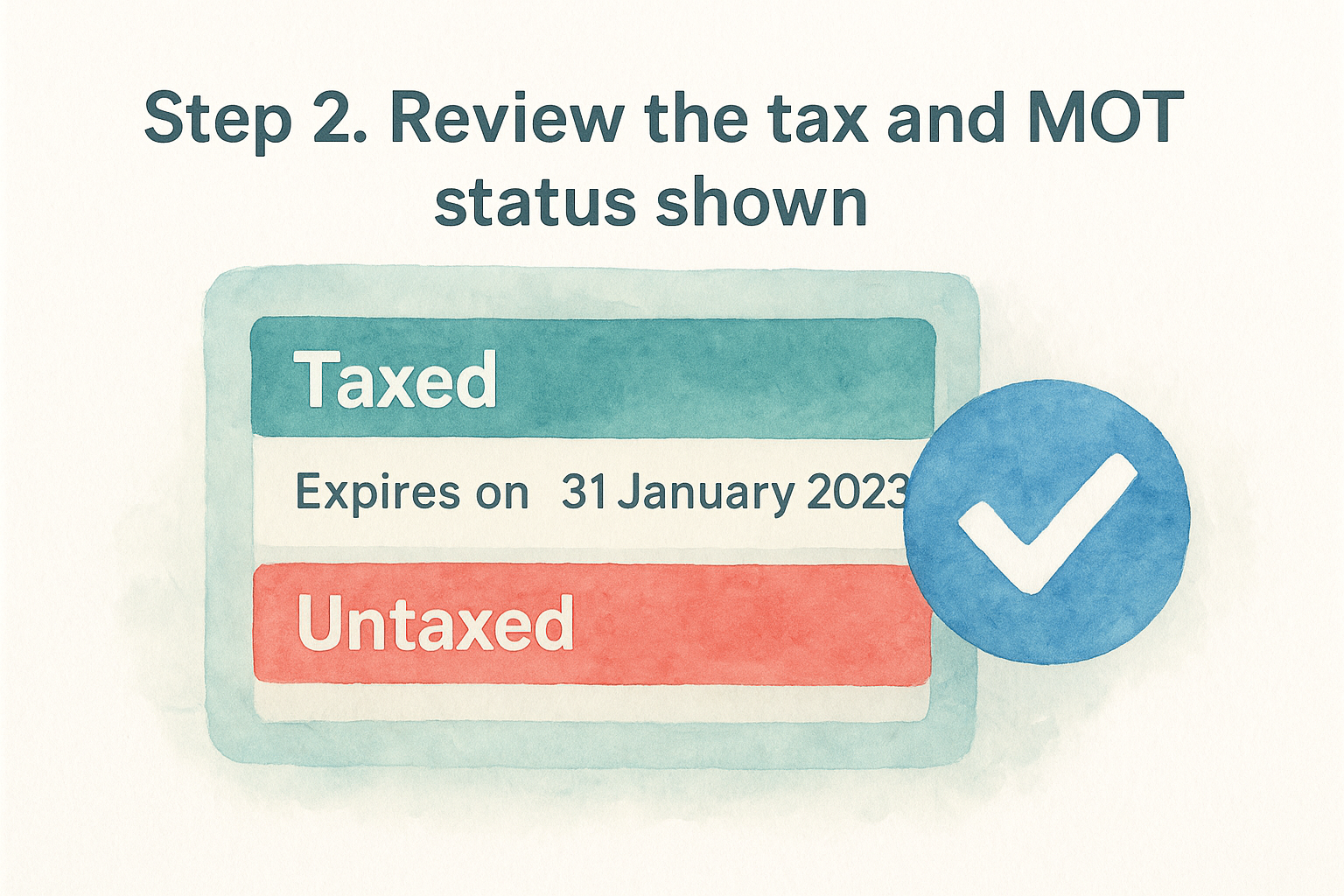
Reading the tax status field
Spot the difference between these statuses before you read any further into the report:
| Status shown | What it means |
|---|---|
| Taxed | Valid tax is in place, expiry date shown |
| SORN | Off the road legally, can't be driven or parked on public roads |
| Untaxed | No current tax, illegal to drive on public roads |
A car showing as untaxed or SORN can't legally be driven home, no matter what the seller tells you.
Cross-checking the MOT status
Next, glance at the MOT status sitting alongside the tax details. A valid MOT with months left gives you confidence the car has recently passed a legal roadworthiness check, while an expired or soon-to-expire MOT is a bargaining point, or a reason to walk away entirely. Pay attention to any advisories listed from the last test too, since they hint at repairs the seller might be glossing over. Together, the tax and MOT fields give you a snapshot of whether this car is even legal to drive today, which matters more than any cosmetic detail in the listing photos.
Step 3. Check the exact tax price and rate by reg
Once you've confirmed the tax status, the next question is what it actually costs to keep this car on the road. Vehiclepedia's report shows the road tax price checker by reg result directly beneath the status field, breaking down the current rate based on the car's CO2 emissions, fuel type, and first registration date. This is the figure that lets you check car tax amount by reg before you commit to a purchase, rather than discovering the real cost after the sale's gone through.
How the rate is worked out
Cars registered after April 2017 pay a first-year rate based on emissions, then a flat standard rate from year two onwards. Cars registered before that date fall under older CO2 bands, which is why the registration date matters so much when you check car tax price by registration number.
| Registration period | How rate is calculated |
|---|---|
| Before March 2001 | Flat rate by engine size |
| March 2001 to April 2017 | CO2 emissions band |
| After April 2017 | First-year CO2 rate, then flat standard rate |
The registration date changes the whole tax calculation, so never assume two similar-looking cars cost the same to tax.
Watch for the premium surcharge
Anything with a list price over £40,000 when new pays an extra surcharge for five years, on top of the standard rate, something many private sellers forget to mention when quoting a car's running costs.
Step 4. Know what to do if tax is due or missing
Finding out a car shows as untaxed doesn't mean the deal's dead, but it does change what happens next. You can't legally drive an untaxed vehicle away from the seller's address, even to get it home, so factor that into your plans before you agree a price. The good news is that taxing a car takes minutes once you own it, but only the registered keeper can do it, which means the seller needs to sort the sale paperwork first.
If tax has lapsed
Walk through this before you hand over any money:
- Ask the seller for the exact expiry date and whether they've already declared SORN
- Confirm the V5C logbook is ready to transfer on the day of sale
- Arrange transport (trailer, recovery, or trade plates) rather than driving an untaxed car
- Budget for the new tax cost using the rate shown in your car tax price check by reg, not the seller's estimate
Never drive an untaxed car home, arrange proper transport instead and tax it the moment you're the registered keeper.
If SORN is declared
A SORN status usually means the car's been sitting unused, which is worth asking about directly. Question why it's off the road, since a long SORN period sometimes hints at mechanical issues the seller's avoiding, or simply that it's been in storage. Either way, you'll need to tax it before driving, using the same car tax check by registration number process once ownership transfers into your name.
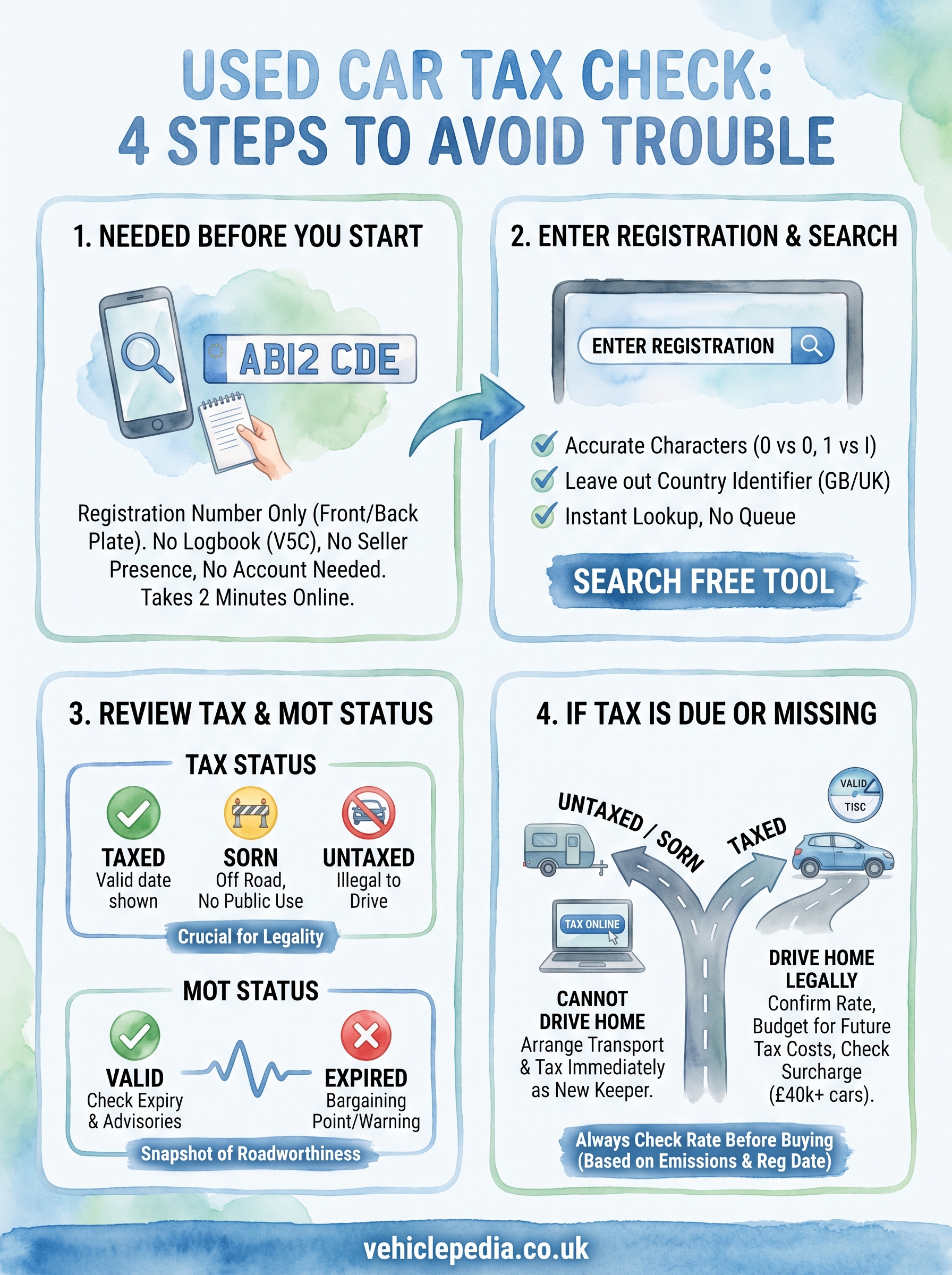
Staying on top of your car tax
Checking tax before you buy takes less time than making a cup of tea, and it protects you from driving away in a car you can't legally use. Run the reg through a free car tax check, confirm the MOT lines up, then work out the real road tax cost based on emissions and registration date before you agree a price. Skip this step and you risk a fine in your first week of ownership, or a tax bill far higher than you budgeted for.
Don't stop at tax status alone though. Finance owed, previous write-offs, and stolen markers won't show up in a free check, so once you're serious about a car, it's worth seeing what a full report covers. Take a look at a sample premium report to see exactly what extra protection you get before you hand over any money.