Does My Car Have Isofix? How to Check by Reg and by Hand
Does my car have Isofix reg check UK steps: identify your model by plate, then confirm with rear seat labels and the handbook.
Does My Car Have Isofix? How to Check by Reg and by Hand
If you are asking does my car have Isofix, the quickest route is a three-part check. Run your plate through an online reg check to confirm the exact make, model and year. Then look for the Isofix labels on the rear seats and confirm in the handbook. Official vehicle records do not list child seat anchor points, so the plate tells you which car you have and the seats and handbook tell you what is fitted.
The problem is that most advice stops at "it probably has it if it is from 2014". That is a guess, and a wrong guess matters. A child seat that cannot clamp onto anchor points gets fitted with the seat belt instead. That is acceptable when done well, but it is easy to get wrong. If you are buying a used car for a family, you want to know before you hand over the money.
This guide takes you through each check in order, from the plate lookup to the hands-on test and the handbook. It ends with how to make sure your child seat actually fits the points you find. Vehiclepedia runs plate lookups on UK cars, so you will also see where a reg check helps and where you need to put your hands on the car.
What Isofix is and which cars have it
Isofix is a standard fitting system that lets a child seat clip straight into metal anchor points built into the car, instead of relying on the seat belt. Whether your car has it depends mostly on when it was built and which trim you bought.
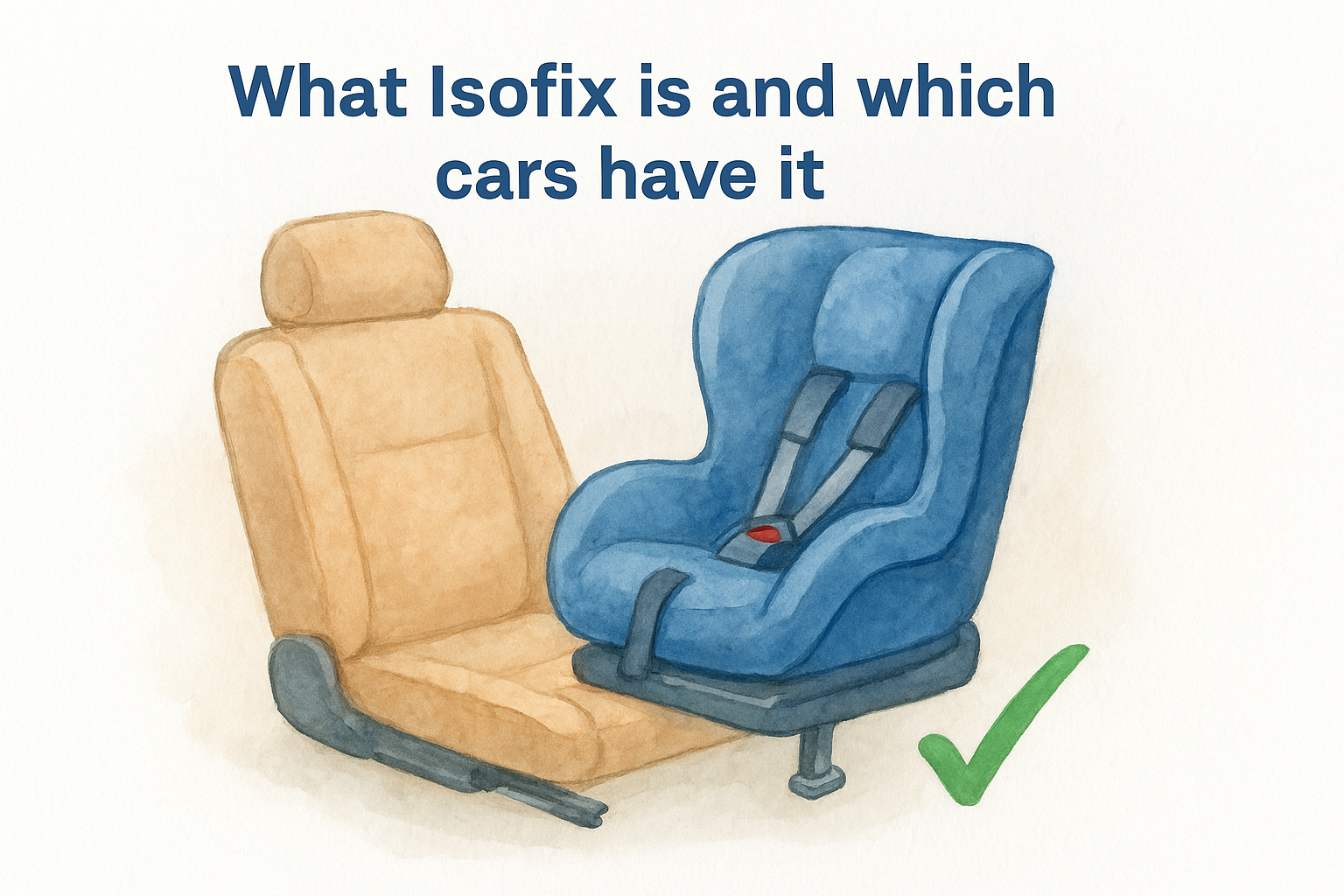
What Isofix does
An Isofix seat has two rigid connectors that push into two metal bars hidden at the base of the rear seat backrest. On many seats you hear a click, and a visible indicator turns from red to green. The seat is then locked to the car's structure, so there is no belt routing to get wrong.
Seats also need something to stop them tipping forward in a crash. That is either a top tether strap to an anchor behind the seat, or a support leg that braces against the floor. The anchor points themselves are not the whole system.
Isofix removes the guesswork of belt routing, but only if the car has the points and the seat is approved for that car.
Which cars have it, by age
Isofix has been required on new cars sold in the UK and EU since 2014, with the outer two rear seats as the minimum. Two-seater sports cars are the exception, though a few still include a point on the passenger seat. Many mainstream models had it years earlier. Use this table as a starting guess, not an answer.
| Year first registered | How likely | What to do next |
|---|---|---|
| 2014 onwards | Almost certain on both outer rear seats | Confirm the labels |
| 2010 to 2013 | Very likely, mostly on mid and upper trims | Check your trim, then the labels |
| 2006 to 2009 | Fitted to many models, often as an option | Check your exact variant |
| 2003 to 2005 | Some family and premium cars only | Verify before relying on it |
| Before 2003 | Rare | Assume belt fitting unless proven |
Most cars have two points. A third, in the middle rear seat, is uncommon and worth checking separately if you carry three children.
Step 1. Run your reg plate to identify the exact car
A reg check confirms which car you actually have, including its age, make, model, body type and doors. It will not show an Isofix tick, so treat it as the step that tells you which row of the table above applies.
What an online reg check can and cannot tell you
DVLA and DVSA records cover things like make, model, colour, year of registration, tax and MOT history. They do not list child seat anchorages. Some spec-based checkers use manufacturer data and may mention Isofix, but you should treat that as a pointer and still confirm it on the car.
What the plate gives you is the exact model and year to search against. That matters because the same model can have Isofix as standard in one year and as an option in another. It also stops you relying on a seller's description or your memory of when you bought the car.
How to run the check
- Find your registration number on the number plate, the V5C logbook or your insurance documents.
- Enter it into the free check on Vehiclepedia.
- Note the year, make, model, body type and number of doors.
- Compare the year with the age table above to see how likely Isofix is.
- Move on to the physical check in Step 2.
The free check also returns MOT history, tax and emissions, export status and recall information. The recall result is worth a glance, because it confirms you are looking at the right car.
A worked example
Say your plate returns a five-door hatchback first registered in March 2012. That falls in the 2010 to 2013 band, so Isofix is very likely, but mostly on mid and upper trims. If you own the car, you probably know your trim or can read it from the handbook. If you are viewing it as a buyer, ask the seller. Either way, you now know exactly what to look for on the rear seats and which handbook to find.
Use the plate to establish the car's age and model, then let the labels and handbook settle the Isofix question.
Step 2. Look for the labels and anchor points
The fastest hands-on check takes about two minutes. Look at the base of each rear backrest for an Isofix label, then feel in the gap for two metal bars.
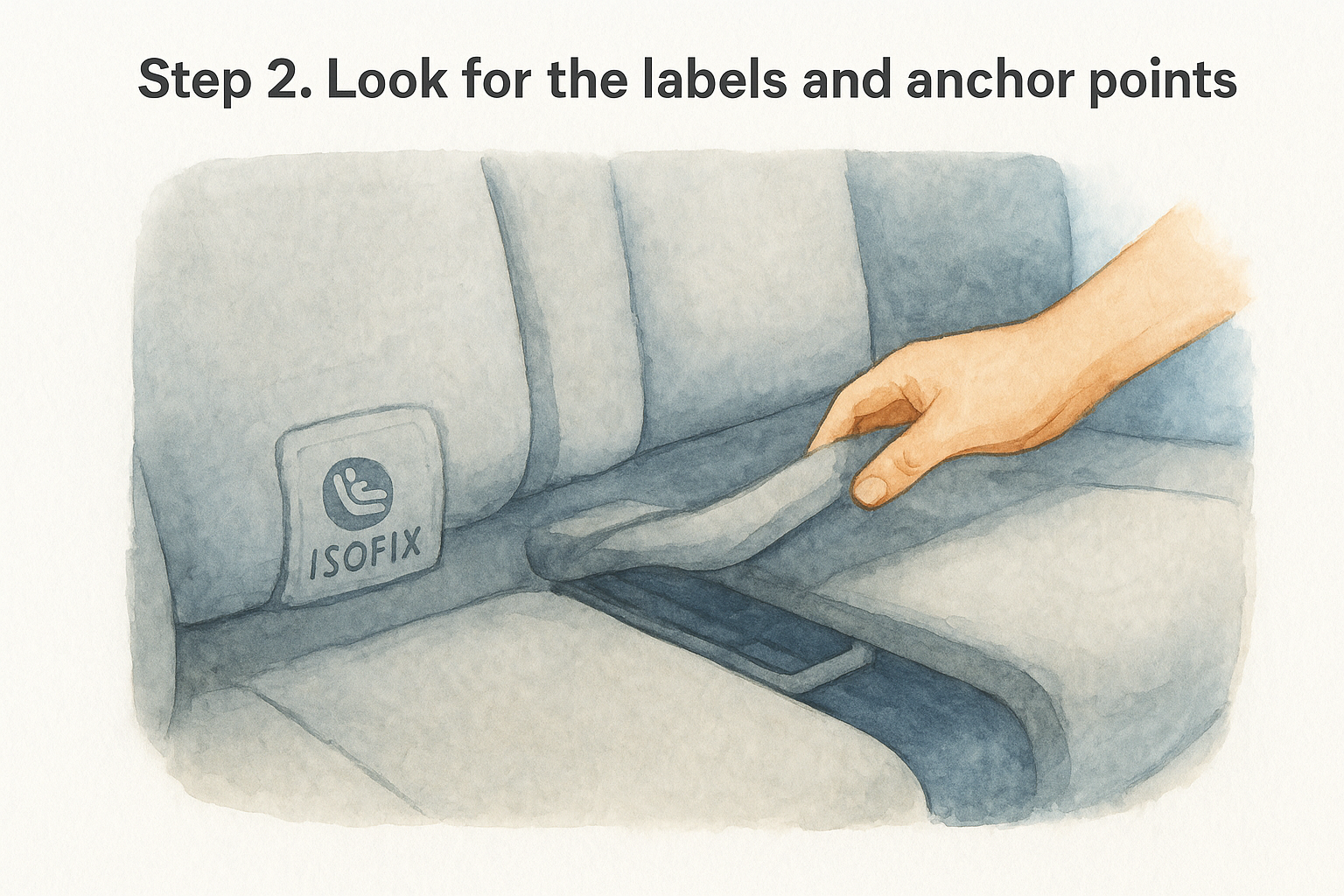
Find the labels
Isofix points are marked with a small tag, tab or plastic button on the outer rear seat backs, usually near the seat base. It often shows the word "Isofix" or a small diagram of a child seat. Check the left and right rear seats first.
If you cannot see a label, do not stop there. Some cars hide the label behind a flap or have it only in the handbook. Move to the next step and feel for the bars.
Feel for the anchor bars
- Open the rear door and look at the gap where the seat cushion meets the backrest.
- Push the fabric aside, or lift the small plastic flap if there is one.
- Run your fingers along the gap. You are looking for two horizontal metal bars or loops, about the width of a thick pencil, fixed to the car body.
- Check both outer seats. Each position should have its own pair.
- Make sure the bars are solid, not bent, and the cover is not missing.
A missing fabric cover is a minor fix. A missing or damaged bar is not, and you should not fit a seat to it.
Check the middle seat, front seat and tether
Look at the middle rear seat separately, because a third pair of points is the exception. If you plan to fit a seat in the front passenger position, look for a label there too. A rear-facing seat in the front is only allowed with the passenger airbag deactivated, so check the switch location in the handbook.
Then find the top tether anchor if your seat uses one. It is usually behind the rear seat on the parcel shelf, on the back of the seat, or in the boot floor. It is a dedicated anchor, not a luggage hook or headrest, and a seat strap must not be attached to either.
If you can feel two solid metal bars at the base of the backrest, the seat position has Isofix.
Step 3. Confirm in the handbook or with the maker
The handbook settles any doubt, and it also tells you which seat positions are approved for Isofix. If you cannot find it, the manufacturer or a dealer can confirm from your car's details.
Use the handbook
Look in the index under "child seats", "child restraints" or "Isofix". The relevant pages normally show a diagram marking each approved seat position, the top tether anchor locations and the airbag deactivation procedure. They also list which positions suit which seat types, which the labels alone will not tell you.
Take a photo of the page. It is useful when you buy a seat and when you check compatibility lists.
If the handbook is missing
You have three routes. First, most manufacturers publish handbooks as PDFs on their websites, searchable by model and year, which is exactly what your reg check gave you. Second, a franchised dealer can confirm from your registration or VIN. Third, the child seat maker's own vehicle list will show whether your model is approved for a given seat, which indirectly confirms the position is supported.
Buying a used car: confirm before you pay
If you are shopping, do not rely on a listing that says "family car". Ask the seller for the handbook or the spec sheet, and do the physical check in person. A car that has been repaired after a serious accident deserves a closer look at the anchors, so a history check that flags write-offs, outstanding finance and stolen status is a sensible companion to the Isofix check. Vehiclepedia's premium reports cover those, and its data guarantee of up to £30,000 applies to non-trade users.
Treat the handbook, not the listing or your memory, as the final word on what the car supports.
Step 4. Check your child seat fits your Isofix points
Having Isofix points does not mean every Isofix seat fits. Check approval for your car, fit the seat as the instructions say, and test it before every journey.
Match the seat to the car
Not every Isofix seat suits every Isofix car, because anchor positions, seat shapes and floor layouts vary. Check the seat maker's vehicle compatibility list, or ask your car manufacturer. If you can, take the car to the retailer and try the seat before buying.
The seat type also changes how Isofix is used.
| Seat type | Typical age | How Isofix is used |
|---|---|---|
| Infant carrier | Birth to about 12 to 15 months | Often a separate base on Isofix with a support leg |
| Toddler seat | About 9 months to 4 years | Connects directly, often with a top tether |
| Booster | About 4 to 12 years | Isofix stabilises the seat, the car belt holds the child |
| i-Size | Height-based standard from 2013 | Many are Isofix, rear-facing to at least 15 months |
Age ranges are approximate. Always follow the seat's own weight or height limits.
Fit it and test it
- Locate the Isofix bars and the connectors on the seat or base.
- Line up the connectors and push until you hear a click or the indicator turns green.
- Connect the top tether to its anchor, or extend the support leg until the indicator shows it is braced.
- Pull the seat firmly from side to side and forwards. It should barely move.
- Check the harness is tight and the indicators are still green.
Support leg and underfloor storage
A support leg must rest on solid floor. If your car has a hollow storage compartment under the rear footwell, the foot must not sit on the lid, because the lid may collapse in a collision. If you can see or hear a cavity, choose a seat with a top tether instead, or ask the seat maker.
A seat that clicks, shows green and barely moves is fitted correctly. Anything less, refit before driving.
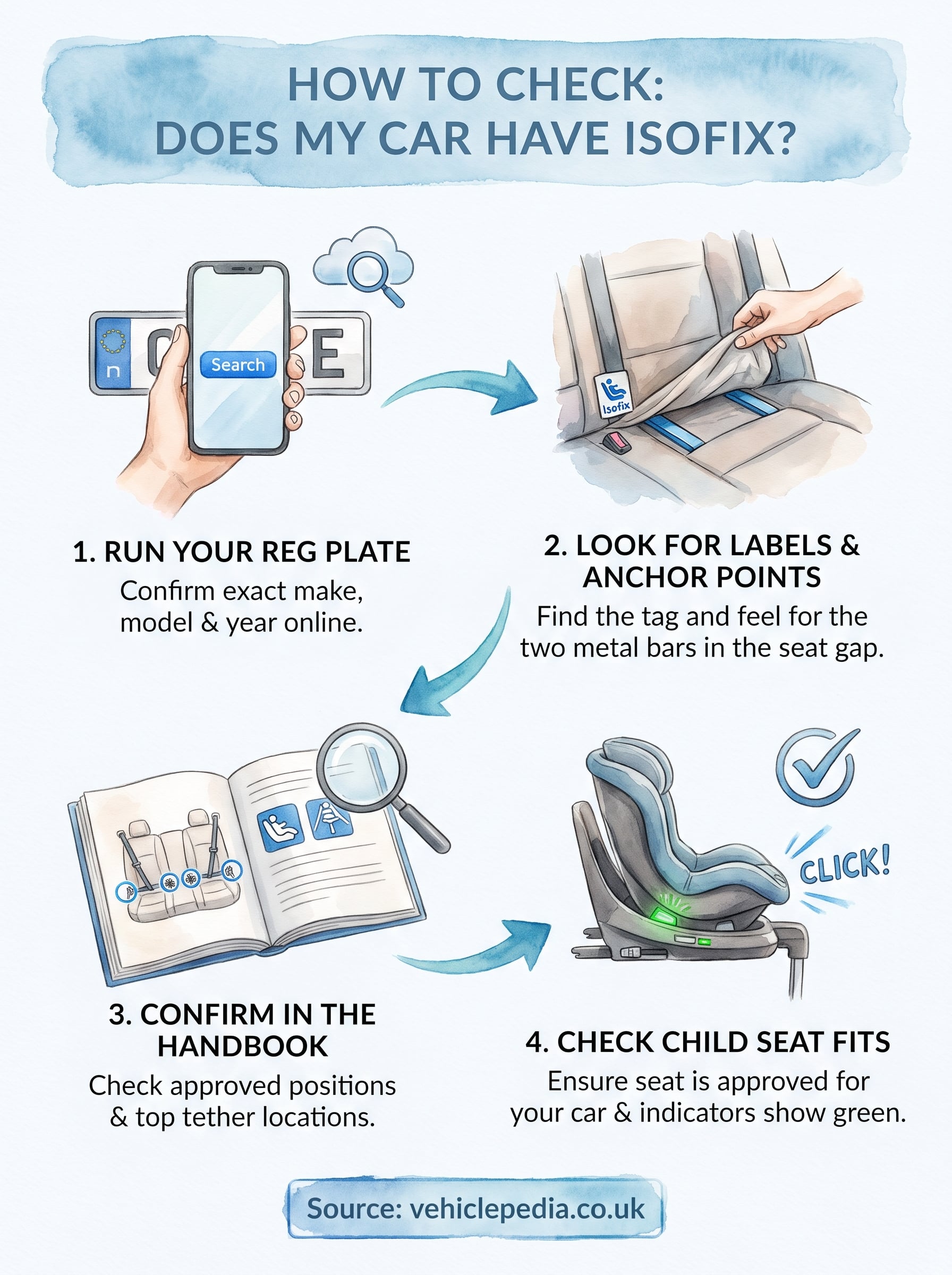
Get your answer, then fit with confidence
To find out whether your UK car has Isofix, start with the plate to confirm the year, model and body type. Then check the rear seats for labels and metal bars, and confirm in the handbook or with the manufacturer. Finally, make sure your child seat is approved for your car and passes the movement test.
If you are buying used, the same attention should go to the car's history. See what a full report covers in the Vehiclepedia sample report, then run the free check on the car you are considering before you visit.