What To Check Before Buying A Used Car: 16-Point UK List
Use our 16-point UK checklist to learn what to check before buying a used car. Verify MOT history, VINs, and finance to ensure you make a safe purchase.

What To Check Before Buying A Used Car: 16-Point UK List
Every year, millions of used cars change hands across the UK, and a significant number of them come with hidden problems. From outstanding finance and clocked mileage to dodgy MOT histories and structural damage, the risks are real. Knowing what to check before buying a used car can be the difference between driving away with a bargain and inheriting someone else's expensive mistake. The good news? Most of these issues are avoidable with the right checks.
This guide breaks down 16 essential things you need to inspect, verify, and confirm before handing over any money. We cover everything from bodywork and engine condition to V5C documents, MOT records, and HPI-style history checks, giving you a practical, step-by-step process you can follow whether you're buying privately or from a dealer.
At Vehiclepedia, we help UK car buyers make informed decisions by providing free and premium vehicle history checks sourced from official DVLA, police, and finance databases. Many of the checks on this list can be done, or at least started, right from our registration lookup tool before you even view the car in person.
Let's get into it.
1. Run a Vehiclepedia car history check
Before you step foot near the car, running a Vehiclepedia car history check is the single most important step in knowing what to check before buying a used car. It pulls data from official sources including the DVLA, UK police databases, and finance registers to give you a clear picture of the vehicle's past in seconds, all before you've even arranged a viewing.
What it covers
A Vehiclepedia check gives you a broad view of the car's recorded history across multiple databases in one place. The free check returns MOT status and history, road tax, vehicle age, registration details, fuel efficiency, performance figures, ownership history, colour change records, and import or export information. Upgrading to a premium report adds write-off markers, stolen vehicle status via the UK Police Database, and an outstanding finance check, all backed by a £30,000 data guarantee for private buyers.
Here is a breakdown of what each tier covers:
| Check | Free | Premium |
|---|---|---|
| MOT status and history | Yes | Yes |
| Road tax status | Yes | Yes |
| Vehicle registration details | Yes | Yes |
| Ownership history | Yes | Yes |
| Import/export records | Yes | Yes |
| Colour change history | Yes | Yes |
| Written-off vehicle detection | No | Yes |
| Stolen vehicle check (Police Database) | No | Yes |
| Outstanding finance check | No | Yes |
How to do it in the UK
Running a check on Vehiclepedia takes under a minute. Enter the vehicle registration plate into the lookup tool at vehiclepedia.co.uk and your free results appear instantly. If you want the complete picture before committing any money, upgrade to the premium report to cover the higher-risk areas like theft markers, finance, and write-offs.
You can run this check from your phone before you arrange a viewing. Doing it early means you can filter out obvious red flags without wasting a trip or, worse, falling for a car that photographs well but hides serious problems.
What to do if it flags a problem
If the report returns any concerns, take them seriously rather than assuming the seller has an explanation. A stolen vehicle marker means you should walk away immediately and report the listing to Action Fraud. If the check reveals outstanding finance, the debt legally follows the car rather than the seller, which puts your money and the vehicle itself at risk the moment you hand over payment.
If a car has outstanding finance, the debt stays with the vehicle. You could lose both the car and your money if you buy without checking first.
2. Confirm the vehicle exists on DVLA
The DVLA (Driver and Vehicle Licensing Agency) holds the official record for every registered vehicle in the UK. Before you go any further with a potential purchase, confirming that the car actually exists in the DVLA's database under the details you've been given is a basic but essential step.
What it covers
Checking the DVLA record tells you whether the vehicle's registration mark and listed details match what the government has on file. It confirms the make, model, colour, engine size, and year of manufacture. Discrepancies between what the seller tells you and what the DVLA holds can indicate a registration plate swap, cloned vehicle, or tampered documentation.
How to do it in the UK
You can check a vehicle's DVLA record for free through the GOV.UK vehicle enquiry service at gov.uk/check-vehicle-information. Enter the registration plate and you'll see the make, colour, and tax status instantly. This takes under a minute and is one of the quickest steps in knowing what to check before buying a used car.
Always run this check before arranging a viewing. If the basic details do not match the advert, do not proceed.
What to do if it flags a problem
If the DVLA record shows a different make, colour, or year from what the seller has described, treat it as a serious red flag. These mismatches often point to a cloned or ringed vehicle, where a stolen car has been given the identity of a legitimate one to disguise its origins. Walk away and report the listing to Action Fraud.
3. Check MOT status, history, and advisories
The MOT (Ministry of Transport) test is a mandatory annual safety and emissions check for most UK vehicles over three years old. Reviewing the MOT record is one of the most revealing steps in knowing what to check before buying a used car, because it gives you an independent, official account of the car's condition over time.
What it covers
Your MOT history shows every test result, failure reason, and advisory notice recorded against the vehicle since 2005. Advisories are items that passed but showed early signs of wear, giving you advance warning of components that may need attention soon. A car with repeated failures or a string of unresolved advisories on the same parts tells a clear story about how well the previous owner maintained it.
How to do it in the UK
You can check the full MOT history for free on the GOV.UK MOT history service at gov.uk/check-mot-history. Enter the registration plate and the results load instantly, showing pass and fail records, mileage at each test, and any advisory notices raised by the tester.
A gap in the MOT record often means the car was not being driven legally, which is worth raising directly with the seller before you go any further.
What to do if it flags a problem
If the history shows recent failures on major components such as brakes, suspension, or emissions, ask the seller for proof that a qualified mechanic completed the work. If advisories keep reappearing across multiple tests with no evidence of repair, factor the likely cost of that work into your offer or walk away entirely.
4. Verify road tax status and costs
Road tax, officially called Vehicle Excise Duty (VED), is a legal requirement for any car driven or parked on a public road in the UK. Checking the tax status is a quick but important part of what to check before buying a used car, since annual costs vary widely depending on the vehicle's emissions, fuel type, and registration year.
What it covers
The check confirms whether the vehicle holds a valid VED and shows the expiry date. It also flags the annual running cost, which matters for your budget. High-emission petrol and diesel models from certain registration years can cost several hundred pounds per year, while electric vehicles and low-emission cars often attract significantly lower rates. Knowing this figure upfront stops any surprises after you take ownership.
How to do it in the UK
You can check road tax status instantly using the GOV.UK vehicle enquiry service at gov.uk/check-vehicle-information. Enter the registration plate and the current tax status and expiry date appear straight away. Vehiclepedia's free check also returns road tax status and cost information as part of its standard registration lookup, so you can confirm this alongside other key details in a single search.
Road tax does not transfer when a car is sold. The seller can reclaim a refund on any unused full months, and you must tax the vehicle before driving it away.
What to do if it flags a problem
An untaxed vehicle means you cannot legally drive it until you tax it yourself. A car that has been untaxed for a prolonged period can also suggest the vehicle was off the road for reasons the seller has not mentioned, so ask them directly before you go any further.
5. Match the V5C details to the car
The V5C logbook is the official registration document for every vehicle in the UK, issued by the DVLA. Checking it carefully against the physical car is a critical part of what to check before buying a used car, because fraudsters can transfer details between vehicles or alter documents to hide a car's true identity.
What it covers
Each field on the V5C holds key information including the registered keeper's name and address, the vehicle's make, model, colour, engine size, VIN, and registration number. Matching each field to the car in front of you confirms the document belongs to that specific vehicle and that nothing has been altered or substituted.
A genuine V5C should also show the number of previous registered keepers, which gives you a rough indication of how many hands the vehicle has passed through and helps you cross-reference with MOT mileage records.
How to do it in the UK
Ask the seller to hand you the V5C before you inspect the car. Check that the registration number and VIN on the document match the plates and chassis markings on the vehicle. Confirm the colour, engine size, and number of previous keepers. The document should carry a DVLA watermark on official paper - if it looks printed on plain paper or the font appears inconsistent, treat it as suspicious.
A V5C in the seller's name does not prove they own the car. It only shows they are the registered keeper, which is not the same as legal ownership.
What to do if it flags a problem
If any detail on the V5C conflicts with the physical car, such as a different colour or mismatched VIN, do not proceed. Report the discrepancy to Action Fraud, as it strongly suggests the vehicle has been cloned or had its identity altered.
6. Confirm the VIN and look for tampering
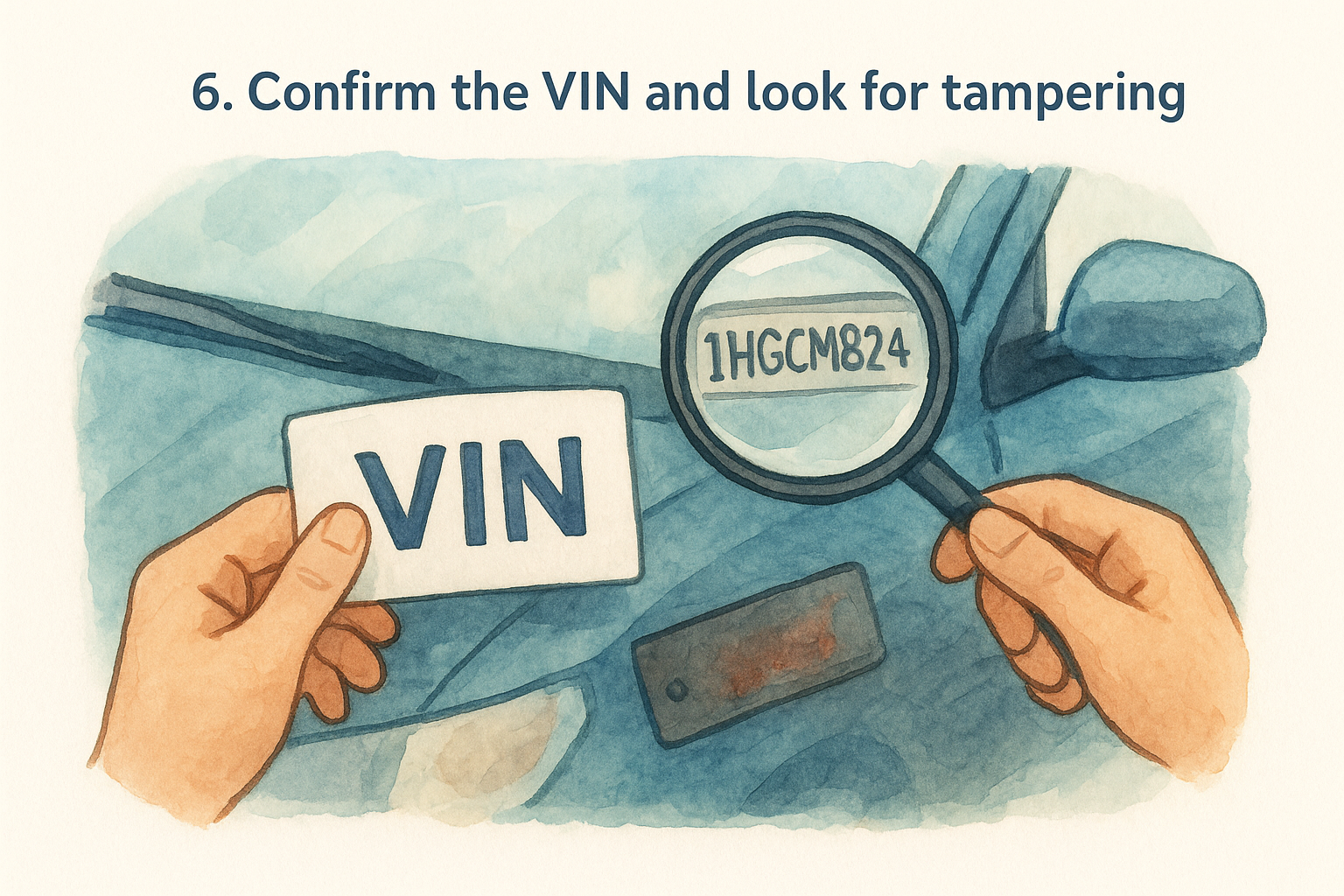
The Vehicle Identification Number (VIN) is a unique 17-character code assigned to every car at manufacture, and it appears in several places on the vehicle itself. Checking it carefully is a key part of what to check before buying a used car, because tampered or missing VIN plates are a strong indicator of criminal activity.
What it covers
The VIN links the physical car to its official registration records, including the DVLA database, MOT history, and any history check you run. On UK vehicles, the VIN typically appears on a plate on the dashboard visible through the windscreen, inside the door frame, and stamped into the chassis. All three locations should show an identical number, and that number should match the V5C logbook.
How to do it in the UK
Find the VIN on the dashboard plate (visible from outside the windscreen) and cross-check it against the V5C and the chassis stamp. The characters should be cleanly stamped or embossed with no signs of grinding, re-stamping, or welding around the area. You can also verify the VIN against the DVLA record using the government vehicle enquiry service.
If the VIN plate looks like it has been removed and refitted, or the area around the chassis stamp shows fresh welding, walk away immediately.
What to do if it flags a problem
If the VIN does not match across all three locations, or if the plate shows signs of tampering, the car has almost certainly been stolen or had its identity altered. Do not hand over any money, and report the vehicle to Action Fraud and your local police.
7. Check for outstanding finance and theft markers
Two of the most financially damaging problems you can encounter when researching what to check before buying a used car are hidden finance agreements and stolen vehicle markers. Neither issue is visible during a physical inspection, which is exactly why a dedicated history check is essential before you commit to anything.
What it covers
Outstanding finance means the previous owner took out a loan secured against the vehicle and has not paid it off. If you buy that car, the finance company retains a legal interest in it and can repossess it, even though you paid for it in good faith. A theft marker means the car has been reported stolen to UK police, making it illegal to buy or retain. Both checks pull data from official finance and police registers that are not accessible through a simple DVLA lookup.
If a car has outstanding finance, the debt stays with the vehicle, not the seller. You could lose both the car and your money.
How to do it in the UK
Both checks are included in a Vehiclepedia premium report, which queries the UK Police Database for theft markers and a national finance register for any secured loans against the vehicle. The report returns results in seconds and is backed by a £30,000 data guarantee for private buyers if the data turns out to be incorrect.
What to do if it flags a problem
Walk away from any car flagged as stolen, and report the listing to Action Fraud immediately. For outstanding finance, contact the finance company directly to confirm the situation before considering any further steps.
8. Spot insurance write-offs and repaired damage
A write-off does not always mean a car is undriveable. Insurers use four categories (A, B, S, and N) to classify damaged vehicles, and Category S and N write-offs can legally return to the road after repairs. That distinction matters when you are researching what to check before buying a used car, because a poorly repaired write-off can compromise structural safety and prove difficult to insure or resell later.
What it covers
Write-off checks search insurance industry registers to flag whether a car was ever declared a total loss and, if so, which category it falls into. Category A and B vehicles must be crushed and should never appear for sale. Category S and N cars can be sold, but only if the damage has been professionally repaired and the write-off status is disclosed upfront. Sellers who stay quiet about it are misrepresenting the vehicle.
A Category S write-off involves structural damage. Even after repair, it can affect how the car performs in a crash.
How to do it in the UK
This check is included in a Vehiclepedia premium report, which queries national insurance registers and returns any recorded write-off category against the vehicle's registration. It takes seconds and covers the full damage history.
What to do if it flags a problem
If the report shows a Category A or B marker, walk away. For Category S or N, ask the seller for a full repair invoice from a VAT-registered bodyshop and have an independent engineer assess the quality of the work before you commit.
9. Verify mileage and look for clocking
Clocking is the practice of winding back a vehicle's odometer to show a lower mileage than the car has actually covered. It is one of the most common forms of used car fraud in the UK, and it is almost invisible to the naked eye. Mileage verification is a step you cannot afford to skip when deciding what to check before buying a used car, because a clocked car will have worn components that simply do not match the mileage it appears to show on paper.
What it covers
Mileage verification cross-references the odometer reading against the mileage recorded at every MOT test and official checkpoint in the car's history. If the numbers drop between tests or show an inconsistent pattern, clocking is the most likely explanation. A genuine car with nothing to hide will show a steady, logical increase in recorded mileage across its full history with no unexplained jumps in either direction.
How to do it in the UK
Pull up the free MOT history on the GOV.UK service and read the mileage figure recorded at each test date. Then compare that figure directly to the current odometer reading when you view the car in person. Any drop or significant inconsistency between consecutive tests is a serious red flag that warrants an immediate conversation with the seller.
A car showing 40,000 miles on the clock but 80,000 miles on its last MOT record has been clocked. Walk away.
What to do if it flags a problem
If the mileage figures do not stack up, do not accept the seller's explanation without written evidence. A clocked car is misrepresented by definition, and you should report the seller to Trading Standards before walking away from the deal entirely.
10. Review service history and maintenance proof
A full service history shows the car has been maintained consistently throughout its life, and it is one of the most reliable indicators of how a previous owner treated the vehicle. Reviewing it is a straightforward but often overlooked part of what to check before buying a used car.
What it covers
Service history comes in two forms: a stamped physical booklet from a main dealer or independent garage, or a digital service record held against the vehicle's VIN. Both confirm that the car received routine work, such as oil changes, filter replacements, and safety checks, at the mileage or time intervals recommended by the manufacturer. A complete record also helps you anticipate upcoming scheduled work and gives you leverage when negotiating the price.
How to do it in the UK
Ask the seller for the original service booklet and check that each stamp carries a dated entry, a garage name, and a mileage figure that lines up with the MOT history. For manufacturer-backed digital records, contact the relevant dealer network or check the car's account on any digital service platform the manufacturer uses. Cross-reference every service interval against the MOT mileage to confirm the figures are consistent.
Gaps between services are not always a deal-breaker, but they are worth raising directly with the seller to understand why maintenance was skipped.
What to do if it flags a problem
If the service history is incomplete or missing entirely, adjust your offer to account for any maintenance work the car may need, and budget for a full inspection by a qualified mechanic before you finalise the purchase.
11. Inspect bodywork, glass, and underbody
A physical inspection of the car's exterior condition is one of the most revealing parts of knowing what to check before buying a used car. Rust, mismatched paint, and poorly fitted panels all point to past accident damage or neglect that the seller may not have disclosed.
What it covers
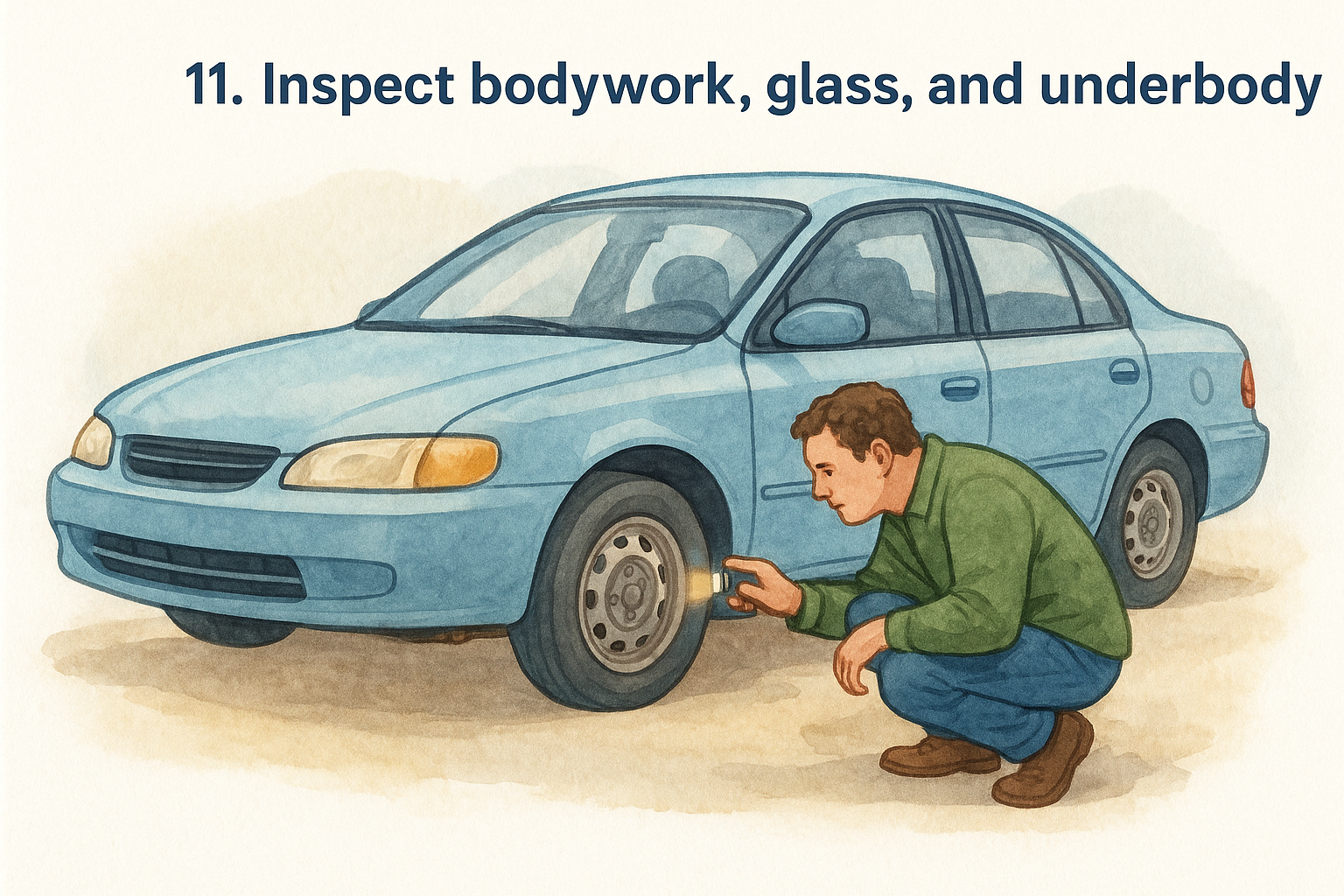
Bodywork inspection focuses on the paint finish, panel gaps, and overall structural alignment of the car's exterior. Uneven gaps between panels, rippling paint, or colour variations under different lighting suggest previous accident repairs. Glass carries its own concerns too, as chips and cracks in the windscreen can fail an MOT and cost several hundred pounds to replace. Underneath the car, you are looking for rust, corrosion on the sills and subframe, and any signs of structural repair work that was not declared.
How to do it in the UK
Walk around the car in daylight and crouch down at each corner to sight along the panels at a low angle. Doing this makes ripples and imperfections far easier to spot than standing upright. Check the door shuts, bonnet gaps, and boot alignment for consistency. Use a torch to look under the car at the sills, floor pan, and suspension mounting points for any rust or fresh underseal that may be hiding damage from view.
Fresh underseal applied in patches is often used to conceal corrosion rather than treat it properly.
What to do if it flags a problem
If you spot mismatched paint or poorly aligned panels, ask the seller directly about the repair history and request documentation from the bodyshop that completed the work. Significant rust on structural areas such as the sills or subframe is a safety concern and warrants an independent inspection by a qualified mechanic before you make any commitment.
12. Check tyres, wheels, and brakes
Tyres, wheels, and brakes are three of the most safety-critical components on any vehicle, and their condition tells you a great deal about how the car has been driven and maintained. Checking them carefully is a non-negotiable part of what to check before buying a used car.
What it covers
Tyres must have a minimum legal tread depth of 1.6mm across the central three-quarters of the tyre, though most mechanics recommend replacing them at 3mm. Uneven wear points to misaligned suspension or incorrect tyre pressures, both of which suggest the car has not been properly maintained. Alloy wheels should be free from significant kerbing or cracks, as damaged rims are expensive to repair or replace and can affect handling.
Brakes are harder to inspect visually, but you can check the disc thickness and pad wear through most wheel spokes without removing the wheel. Heavily scored or corroded discs, or pads worn down to the metal backing, indicate the car needs immediate brake work before it is safe to drive.
How to do it in the UK
Check each tyre with a tread depth gauge (available for a few pounds from most motor parts retailers) and look at the wear pattern across the full width. Inspect the sidewalls for cuts, bulges, or cracking, and check each alloy for damage while you are crouching down at each corner of the car.
A full set of new tyres can cost £300 to £600 or more depending on the vehicle, so factor this into your offer if the tread is low.
What to do if it flags a problem
If you spot worn tyres or badly scored brake discs, get a quote for replacement before committing to a price. Use the estimated repair cost as direct leverage in your negotiation, or ask the seller to replace the components before handover.
13. Inspect the engine bay and fluids
The engine bay is one of the most telling areas when deciding what to check before buying a used car. A well-maintained engine will look clean and consistent, while neglect, leaks, or poorly repaired damage usually leave clear evidence behind if you know what to look for.
What it covers
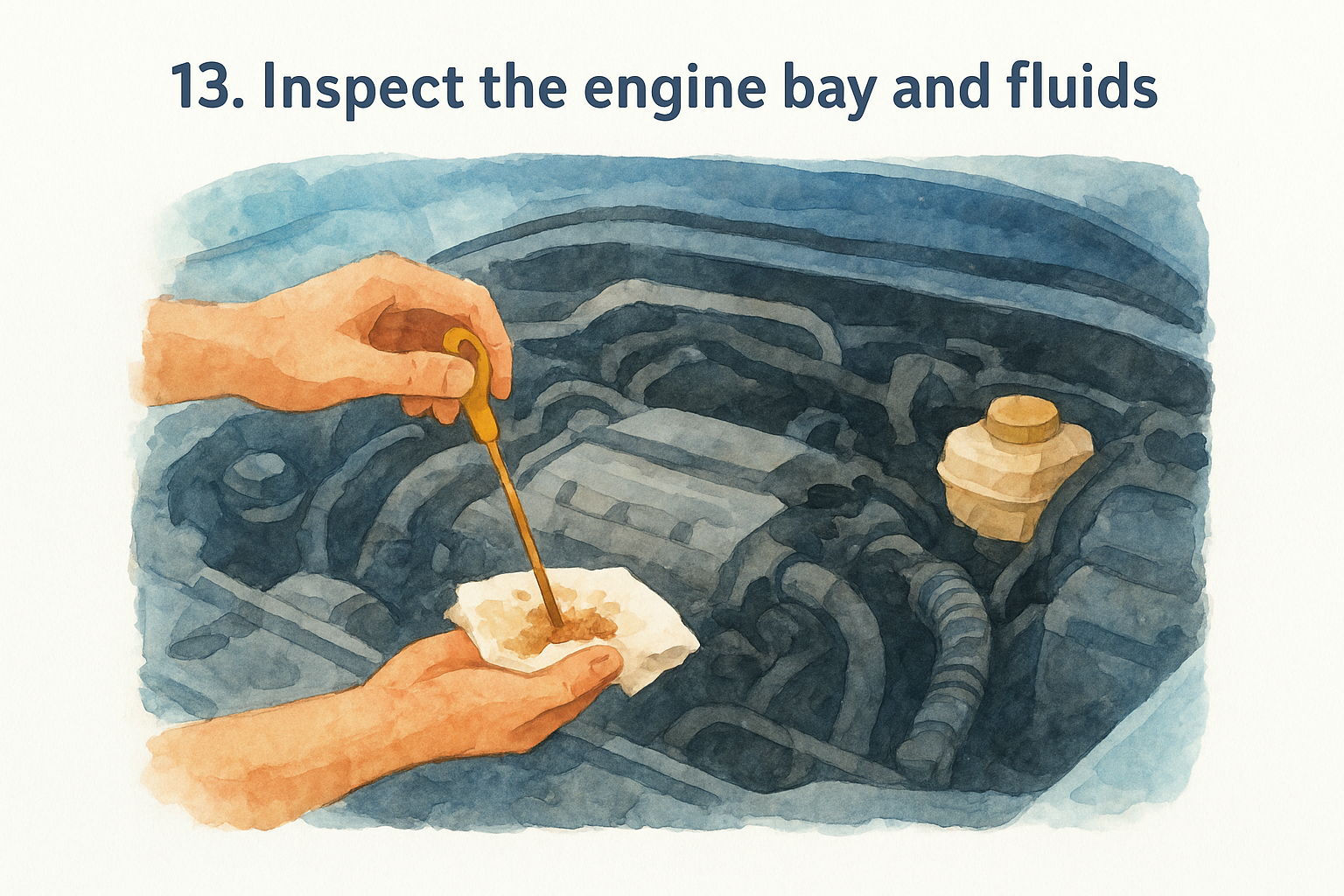
Inspecting the engine bay covers the condition of major components and fluid levels including oil, coolant, brake fluid, and power steering fluid. You are looking for signs of oil or coolant leaks around hoses, seals, and the engine block itself. Black or oily residue on surrounding components often points to a leak that has been present for some time. The colour and consistency of the oil on the dipstick also matters: clean oil runs amber, while thick black sludge or a milky appearance signals serious problems.
How to do it in the UK
Open the bonnet and allow the engine to cool before touching anything. Check each fluid reservoir against its minimum and maximum markers, and pull the oil dipstick to assess both level and condition. Look around the base of the engine, along the hoses, and at the cam cover for any signs of seepage or staining.
A milky or frothy appearance on the oil dipstick is a common indicator of a blown head gasket, which is an expensive repair.
What to do if it flags a problem
If you spot active leaks or discoloured fluid, ask the seller for a qualified mechanic's written assessment before committing. Factor any repair costs directly into your negotiation, or walk away if the seller cannot provide documentation of recent work.
14. Check interior wear, electrics, and safety kit
The interior tells you how the car has actually been used day to day. Excessive wear on the seat bolsters, a cracked dashboard, or a persistent warning light on the instrument cluster can all point to a vehicle that has been driven hard or poorly maintained. Knowing what to check before buying a used car includes going through the interior methodically so nothing gets missed in the excitement of a viewing.
What it covers
This part of the inspection covers seat condition, trim panels, carpet, headlining, and the instrument cluster, along with every electrical component in the cabin. You are checking the air conditioning, electric windows, central locking, heated seats, and the infotainment system to confirm they all work as they should. You are also looking for any warning lights that illuminate and stay on once the engine starts, which can indicate fault codes that need further investigation.
An airbag warning light that stays on after the engine starts means the supplemental restraint system may not deploy correctly in a collision.
How to do it in the UK
Work through every button and switch systematically from the driver's seat. Test each electric window individually, check that the air conditioning blows cold, and connect a phone via Bluetooth to confirm the infotainment works. Open the boot and check for a spare tyre or puncture repair kit, along with the jack and locking wheel nut key if the car has alloys.
What to do if it flags a problem
If you find inoperative electrics or missing safety equipment, get a repair quote before agreeing a price. Factor the cost of a replacement spare tyre or a diagnostic scan to clear fault codes directly into your offer.
15. Take a proper test drive and listen closely
A test drive is one of the most important steps in knowing what to check before buying a used car. No amount of visual inspection replaces time behind the wheel, where mechanical issues often announce themselves through noise, vibration, or unusual behaviour that you simply cannot detect while standing still.
What it covers
The test drive reveals how the engine, gearbox, clutch, steering, and brakes perform under real conditions. You are listening for clunks, knocking, grinding, or whining noises that point to worn components, and you are feeling for pulling to one side, vibrations through the steering wheel, or a clutch that bites too high or too low.
How to do it in the UK
Ask the seller to let you drive the car yourself rather than just riding as a passenger. Start the engine from cold if possible, as many faults only appear before the engine reaches operating temperature. Drive at a range of speeds, including a stretch of dual carriageway or faster road, to confirm the car holds a straight line and that the engine pulls cleanly through the rev range without hesitation or misfiring.
If the seller refuses to let you drive the car or insists on a very short route, treat that reluctance as a red flag worth questioning.
What to do if it flags a problem
Any unusual noise or handling issue you notice during the drive warrants a direct question to the seller. Ask for a written mechanic's assessment of the specific fault before you agree a final price, and factor the likely repair cost directly into your offer.
16. Confirm the seller, payment, and handover
The final step in knowing what to check before buying a used car is verifying the seller's identity and making sure the payment and handover process protects you legally. Rushing this stage after a positive test drive is one of the most common mistakes buyers make, and it can undo every check you have completed so far.
What it covers
This step confirms that the person selling the car is the registered keeper listed on the V5C, and that the sale follows a process that gives you legal protection. It also covers the method of payment and what documentation you should receive when the car changes hands.
How to do it in the UK
Ask the seller to show you photo ID that matches the name and address on the V5C. If you are buying privately, pay by bank transfer rather than cash so you have a clear transaction record. Never use an irreversible payment method such as cryptocurrency or a wire transfer to a party you have not verified. When you complete the sale, make sure the seller signs the V5C and you send the new keeper section to the DVLA on the same day.
Paying by bank transfer gives you a documented paper trail that cash cannot provide, which matters significantly if a dispute arises later.
What to do if it flags a problem
If the seller refuses to show ID or pushes back on bank transfer in favour of cash only, that resistance is a warning sign worth taking seriously. Walk away and report any suspicious listings to Action Fraud at actionfraud.police.uk.
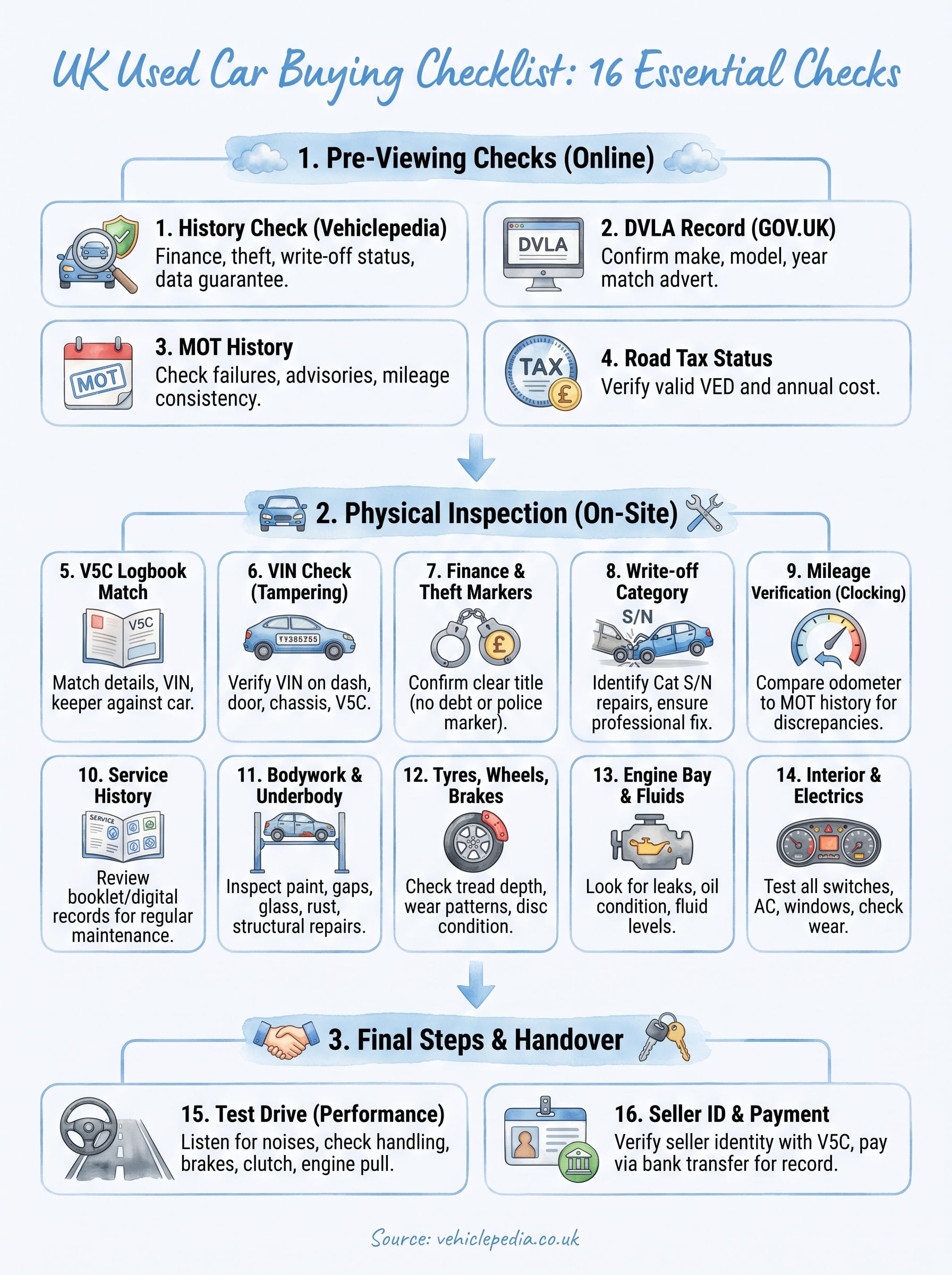
Make your final decision
You now have a complete picture of what to check before buying a used car, from the first history search to the final handover paperwork. Work through each of the 16 points methodically, and you significantly reduce your chances of purchasing a vehicle with hidden problems. No single check is more important than the others, but skipping even one leaves a gap that a dishonest seller can exploit.
If everything stacks up, the car passes your test drive, and the paperwork matches, you are in a strong position to complete the purchase with confidence. If anything feels wrong at any stage, walk away. There will always be another car.
Start your checks today with a free Vehiclepedia registration lookup before you arrange any viewing. If you want the full picture including finance, theft, and write-off data, view our premium report options and see exactly what each tier covers.