HPI Check: What It Is and Why You Need One
Learn what an HPI check reveals, how to run one, typical costs, and how to interpret results before buying a used car in the UK.
HPI Check: What It Is and Why You Need One
You've found a used car that looks perfect. The price is fair, the mileage checks out, the seller seems genuine. But looks can be deceiving, and thousands of buyers in the UK discover too late that their new car is stolen, still under finance, or a write-off in disguise. That's exactly the risk a hpi check is designed to catch before you hand over your money.
An HPI check pulls together official records to tell you whether a vehicle has outstanding finance, has been reported stolen, or carries a write-off history from an insurance claim. It cross-references data from the DVLA, police databases, and insurers, giving you a clear picture of what you're actually buying rather than what the seller tells you.
In this article, we'll explain exactly what an HPI check covers, how it differs from a basic registration lookup, and why skipping one can leave you legally and financially exposed. We'll also show you where free checks stop short and when it's worth paying for a full report, so you know precisely what protection you're getting before you commit.
Why an HPI check matters when buying a used car
Buying a used car without checking its background is a gamble most people wouldn't take with their eyes open. Every year, thousands of UK buyers unknowingly purchase vehicles with hidden finance, a hushed-up write-off status, or a stolen identity hiding behind a legitimate-looking number plate. An HPI check exists to close that gap, giving you hard data instead of a seller's word.
The three risks a check protects you from
Cars change hands fast, and sellers don't always disclose everything, sometimes because they don't know themselves. A vehicle history check flags the issues that matter most before you commit any money.
| Risk | What it means for you |
|---|---|
| Outstanding finance | You could be buying a car that still legally belongs to a finance company |
| Stolen vehicle | The car can be seized by police at any point, with no compensation |
| Write-off history | The car may be unsafe or worth far less than the asking price |
Buy a car with hidden finance, and you haven't bought a car at all, you've bought someone else's debt.
The legal reality if you buy a financed or stolen car
Here's the part most buyers don't realise: if a car still has outstanding finance attached, the finance company can repossess it from you, even if you paid the seller in full and in good faith. UK law protects innocent buyers in some cases, but proving you didn't know is stressful, slow, and not guaranteed to work in your favour. Repossession isn't a hypothetical risk either; it happens to private buyers every year who skipped a free outstanding finance check.
Similarly, a stolen vehicle can be seized the moment police identify it, regardless of how much you paid or how convincing the seller seemed, so it pays to check a car's stolen status before you buy. You'd be left chasing a refund from someone who's likely disappeared, rather than driving the car you thought you owned.
There's also the safety angle. A car marked as a write-off might have been structurally repaired to a poor standard, hidden behind fresh paint and a clean interior, which is why it's worth learning how to check a car's write-off status by reg. Without a check, you have no way of knowing whether the vehicle you're about to drive your family in has a compromised chassis.
Running a premium vehicle check before you buy costs a fraction of what a bad purchase could cost you. It's the difference between an informed decision and an expensive guess.
How to run an HPI check step by step
Running an HPI check takes less time than test-driving the car itself, and you don't need any special software to do it. All you're doing is checking a car by its number plate, feeding a vehicle registration plate into a system that queries official records and returns a report within seconds. Vehiclepedia's own lookup tool works the same way, pulling from DVLA data, police databases, and insurance registers so you get one consolidated answer rather than chasing separate sources yourself.
What you need before you start
Getting ready takes two minutes. Have these details on hand before you begin:
- The car's number plate, copied exactly as it appears, including spaces
- The vehicle's mileage, if the seller has quoted one, so you can compare it later
- A note of the make and model, so you can spot a mismatch straight away
Running the check and reading the first result
Start with a free car check before you buy, using the registration plate. This gives you the basics: MOT status, road tax, and registration details, enough to confirm the car is what the seller claims. If anything looks off here, stop and ask questions before spending another penny.
A free check tells you what the car looks like on paper; a full HPI check tells you what it's actually hiding.
Next, if the free results check out, upgrade to a full premium report for the deeper history: finance, theft, and write-off status. Review the report immediately, ideally while you're still with the seller, so you can raise any red flags on the spot rather than after you've paid a deposit.
What an HPI check does and doesn't reveal
Knowing the boundaries of an HPI check matters just as much as knowing what it covers. It's a data lookup, not a physical inspection, so it tells you what's on record rather than what's wrong with the car sitting in front of you. Treat it as one layer of due diligence, not the whole process.
What's included in a standard report
A full report pulls together several official data points into one document. Here's what you can expect to see:
| Included in an HPI check | Not included in an HPI check |
|---|---|
| Outstanding finance records | Engine or gearbox condition |
| Stolen vehicle status | Rust, leaks, or wear and tear |
| Write-off and insurance history | Accuracy of odometer beyond DVLA records |
| Number plate changes | Interior condition |
| Import/export records | Seller's honesty about usage |
An HPI check tells you the car's paper trail is clean; it can't tell you the clutch is on its last legs.
Where the gaps are and how to cover them
Spotting these gaps early saves you from a false sense of security. Because the vehicle history check relies on reported data, a car that's been in a minor accident but never had a claim filed won't show up as damaged, even if the repair was rushed. Odometer readings are cross-checked against DVLA and MOT records, but a clocked mileage can still slip through if it was never flagged during a service or test.
Running a check alongside inspecting the used car properly or an independent mechanic's report closes that gap. Think of the HPI check as confirming ownership and legal status, and the inspection as confirming the car itself is sound. Together, they cover both the paperwork and the metal.
How much an HPI check costs and what affects the price
Prices for a full HPI check in the UK typically sit between £3 and £20, depending on the provider and how much detail the report includes. That's a small outlay next to the average used car price, let alone the cost of discovering months later that you're paying off someone else's finance. Our report levels and prices sit at the affordable end of that range, with the premium report still covering finance, theft, and write-off status in full.
What drives the price up or down
Not every check costs the same, and the price usually reflects how much data the report pulls together. Here's what typically affects it:
| Factor | Effect on price |
|---|---|
| Depth of report (basic vs full history) | Fuller reports cost more |
| Provider and data sources used | Official DVLA-backed sources can command a premium |
| Bundled extras (mileage, valuation) | Extra features raise the price slightly |
| Trade vs private buyer accounts | Trade accounts often pay bulk rates |
Paying £15 for a full HPI check is cheaper than a single month's repayment on a car you don't actually own.
Free vs paid checks: what you actually get
Quite reasonably, buyers ask why they should pay at all when free checks exist. A free lookup gives you MOT status, tax details, and basic registration data, useful for a first pass, but it won't tell you if the car is stolen, financed, or written off. Reserving your money for a full report only after the free check passes muster is the sensible order to do things in. That way, you're not spending on a car that fails the basics anyway, and you're not risking a purchase on incomplete information when the stakes involve thousands of pounds and, potentially, the car itself being repossessed.
How to read and act on your HPI check results
Getting your report back is only half the job. What you do next determines whether the check actually protects you. A clean HPI check result means you can move forward with confidence, but a flagged result needs a clear response, not a shrug and a handshake with the seller.
Interpreting a clean report
If your report shows no outstanding finance, no theft markers, and no write-off history, you've confirmed the legal basics are sound. That doesn't mean skip the rest of your due diligence. Pair the clean result with a physical inspection or mechanic's check before you agree a final price, since the HPI check covers paperwork, not engine health.
What to do when a flag appears
Seeing a red flag on your report doesn't automatically mean walk away, but it does mean you need answers before you pay anything. Here's how to handle the most common flags:
- Outstanding finance: ask the seller to clear the finance before completion, or arrange for the settlement figure to come out of the sale price directly
- Write-off marker: request the insurance repair report and write-off categories explained (A, B, S, or N) to judge how serious the damage was
- Stolen marker: stop the transaction immediately and report the details to the police
- Mileage discrepancy: ask for service history and MOT records to verify the true figure
A flagged HPI check isn't a dead end, it's a negotiating tool or, in the worst cases, a warning to walk away.
Keep a copy of your premium report as evidence of what you knew at the point of purchase. If a dispute arises later, that paper trail protects you and supports any claim against the seller.
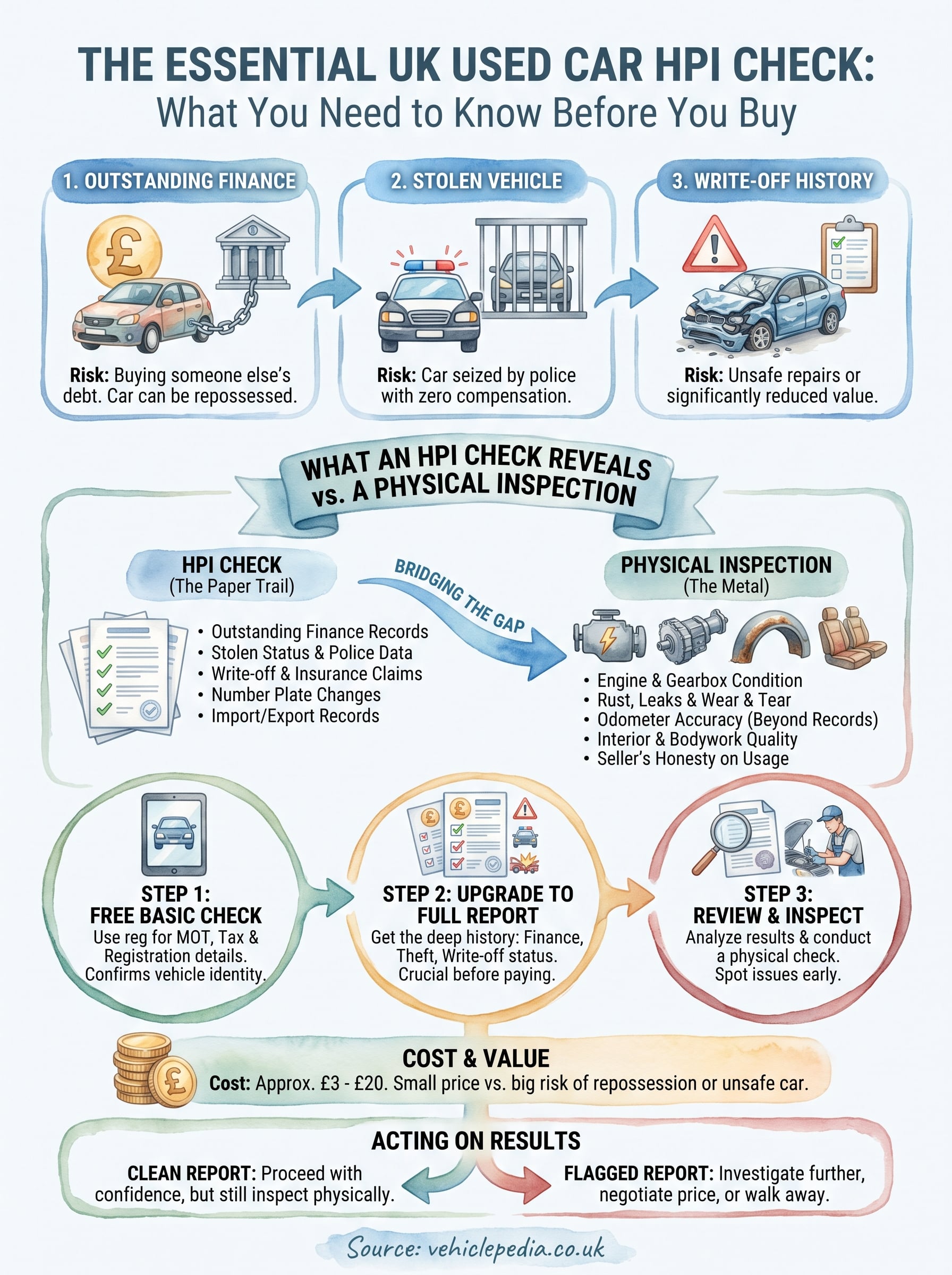
Buying with confidence
A used car purchase should never come down to trust alone. An HPI check turns guesswork into evidence, showing you exactly what you're paying for before the money changes hands. Skip it, and you're gambling with thousands of pounds on the strength of a seller's word.
Getting into the habit is simple: run the free basics first, then upgrade to a full report the moment finance, theft, or write-off history matters to you, which is every single time you're handing over serious cash. Pair that report with a physical inspection, and you've covered both the paperwork and the metal.
Before you commit to anything, see what a full premium report looks like so you know exactly what you're getting. It costs a few minutes and a small fee, against a purchase that could otherwise cost you the car itself.