What Is Vehicle Excise Duty in the UK? Rates, Bands and EVs
What is vehicle excise duty UK drivers pay? Learn who pays, how the bands work, current rates and how EVs are taxed from 2025.
What Is Vehicle Excise Duty in the UK? Rates, Bands and EVs
What is Vehicle Excise Duty in the UK? It is the annual tax that the registered keeper of a vehicle pays to drive it or keep it on a public road. Most people call it road tax or car tax, and the DVLA collects it. The amount depends on when the car was first registered, its CO2 emissions, its fuel type and, for some cars, its original list price. For most cars registered since April 2017, the standard rate is £200 a year.
This guide covers what the tax is for and who has to pay it. It then shows how the three rate systems work, with worked examples, and explains how electric and hybrid cars are taxed after the April 2025 change and the pay-per-mile charge planned for 2028. It finishes with how to check, pay and renew your tax, and what happens if you do not.
Vehiclepedia is a UK vehicle history check service, and tax status is one of the first things a registration lookup shows. That makes it a good place to learn how to read a car's tax band and expiry date before you buy.
Why Vehicle Excise Duty matters to every UK driver
VED matters because nearly every vehicle on a UK road must be taxed by law, and the amount you pay can differ by hundreds or even thousands of pounds from one car to the next. It also shapes the used car you choose, because the rules that apply to a car depend on a date printed in its logbook.
Who has to pay VED
The registered keeper is responsible for taxing a vehicle. The duty applies whether you drive daily or leave the car parked on the street. Even a car that qualifies for a £0 rate must still be taxed each year, and the same goes for exempt vehicles, which have to be renewed even though no money changes hands.
These categories are exempt from paying:
- Vehicles used by disabled people who qualify, through a full exemption or a 50% discount
- Disabled passenger vehicles
- Mobility scooters and powered wheelchairs
- Historic vehicles, which depend on when they were built
- Mowing machines and steam vehicles
- Vehicles used only for agriculture, horticulture and forestry
Why the cost varies so much
Despite the name, VED is not ring-fenced for roads. The money goes into general government revenue, so it is as likely to fund healthcare or education as road repairs. What you pay comes down to three things: the date of first registration, the car's CO2 emissions and fuel type, and its list price when new.
The registration date matters more than most buyers expect. A 2014 hatchback that emits 118 g/km sits in band C and costs £35 a year. A 2018 car with the same emissions pays the flat £200 standard rate. Two cars that look similar on a forecourt can therefore carry very different tax bills, so check the date on the V5C logbook before you compare running costs.
Your tax bill is set by the day the car was first registered, not by what it is worth today.
How to work out how much VED you pay
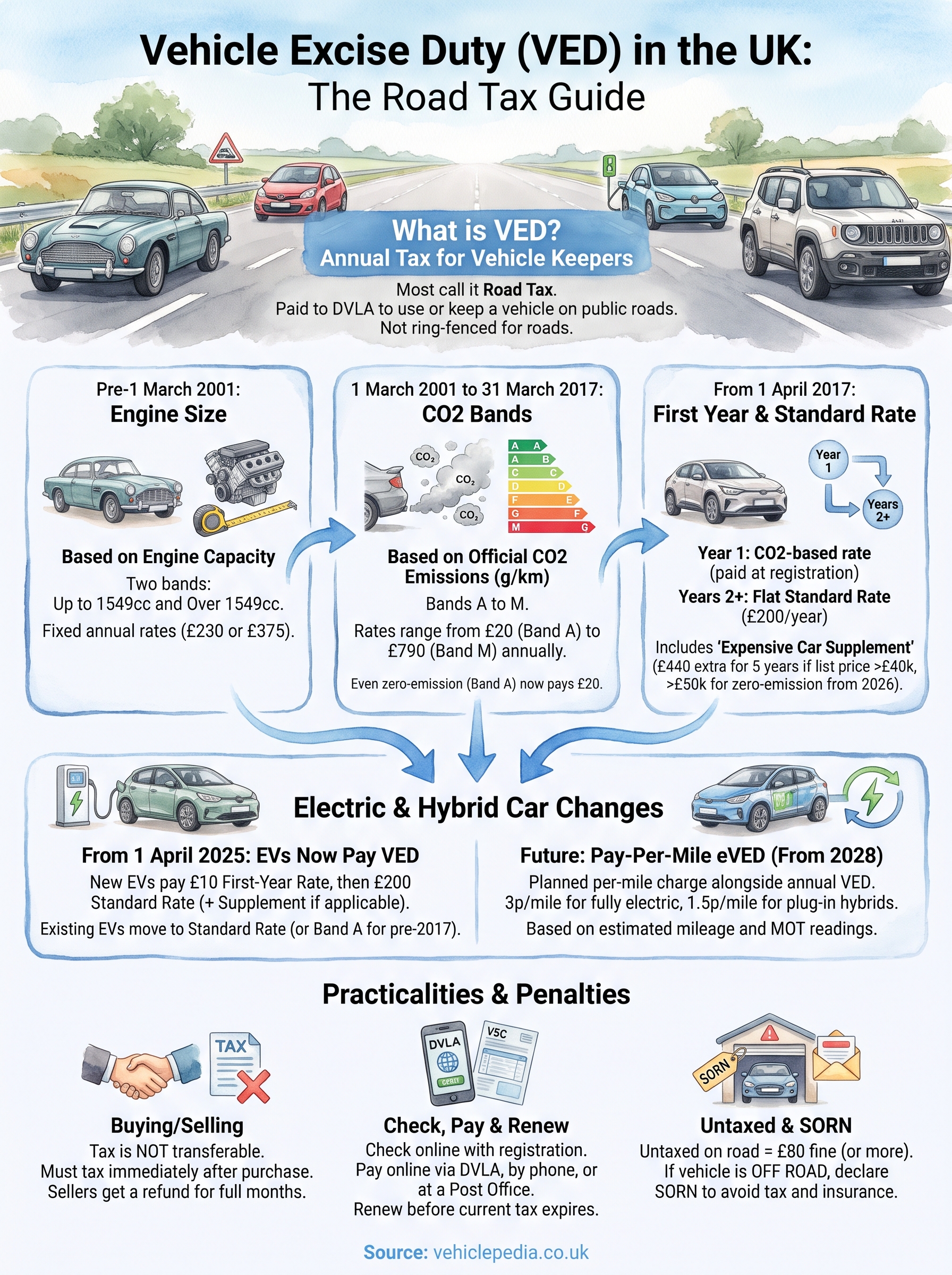
You work out your VED by finding the car's first registration date and applying the rules for that period. Engine size sets the rate before March 2001, CO2 bands set it from March 2001 to March 2017, and a first-year rate followed by a flat standard rate applies from April 2017.
Find your system first
You need three details: the first registration date (shown on the V5C logbook), the fuel type and the CO2 emissions. The table shows which system applies.
| First registered | What sets the rate | Annual cost |
|---|---|---|
| Before 1 March 2001 | Engine size, two bands | £230 or £375 |
| 1 March 2001 to 31 March 2017 | CO2 emissions, bands A to M | £20 to £790 |
| From 1 April 2017 | CO2-based first-year rate, then a flat rate | £200 standard, £640 with the supplement |
The 2017 reform happened because falling emissions had pushed many ordinary cars into zero or very low bands. That weakened the tax as a signal and left owners of older cars paying far more than owners of newer ones. A flat standard rate was the fix.
Cars registered from April 2017
A car first registered on or after 1 April 2017 pays a first-year rate based on CO2, then a flat standard rate of £200 from the second year. The first-year rate is paid at registration, and a dealer usually includes it in the on-the-road price.
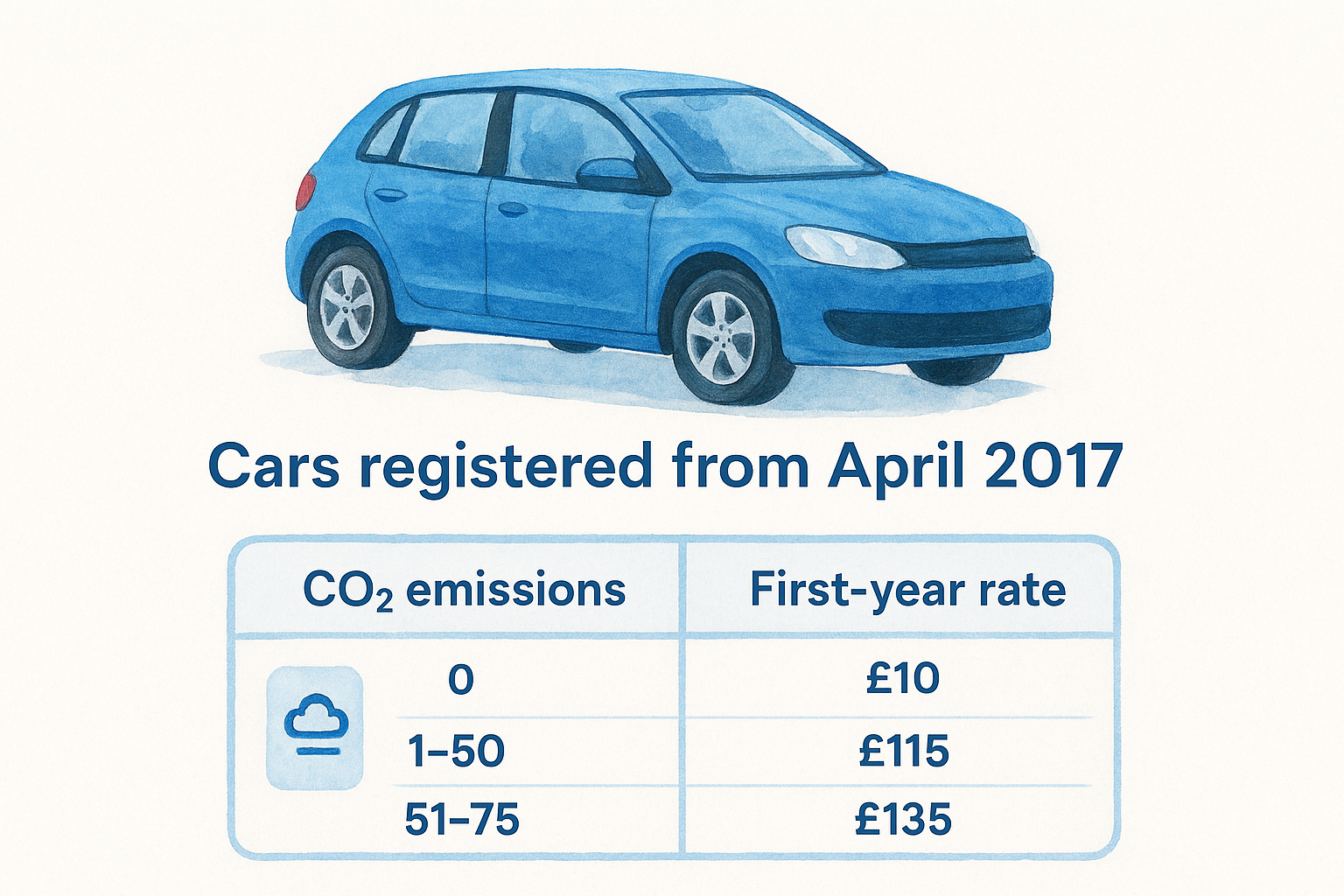
| CO2 emissions (g/km) | First-year rate | Standard rate |
|---|---|---|
| 0 | £10 | £200 |
| 1 to 50 | £115 | £200 |
| 51 to 75 | £135 | £200 |
| 76 to 90 | £280 | £200 |
| 91 to 100 | £365 | £200 |
| 101 to 110 | £405 | £200 |
| 111 to 130 | £455 | £200 |
| 131 to 150 | £560 | £200 |
| 151 to 170 | £1,410 | £200 |
| 171 to 190 | £2,270 | £200 |
| 191 to 225 | £3,420 | £200 |
| 226 to 255 | £4,850 | £200 |
| Over 255 | £5,690 | £200 |
Cars with a list price over £40,000 when new (£50,000 for zero-emission cars) also pay the expensive car supplement of £440 a year. It lasts for five years, starting from the second year. That takes the annual bill to £640. The supplement uses the original list price, not the car's value as a used car.
Two worked examples show the difference:
- A petrol car emitting 125 g/km with a £28,000 list price pays £455 in year one, then £200 in years two and three. That totals £855 over three years.
- A petrol car emitting 160 g/km with a £45,000 list price pays £1,410 in year one, then £640 a year for five years (£3,200). That totals £4,610 over six years, after which it drops to £200.
From April 2017, the first-year rate does the heavy lifting and the standard rate is the same for almost everyone.
Cars registered before April 2017
Cars registered between 1 March 2001 and 31 March 2017 pay by CO2 band, from A to M. The rate is the same whether the car runs on petrol or diesel.
| Band | CO2 emissions | Annual rate |
|---|---|---|
| A | Up to 100 g/km | £20 |
| B | 101 to 110 g/km | £20 |
| C | 111 to 120 g/km | £35 |
| D | 121 to 130 g/km | £170 |
| E | 131 to 140 g/km | £200 |
| F | 141 to 150 g/km | £225 |
| G | 151 to 165 g/km | £275 |
| H | 166 to 175 g/km | £325 |
| I | 176 to 185 g/km | £360 |
| J | 186 to 200 g/km | £410 |
| K | 201 to 225 g/km | £445 |
| L | 226 to 255 g/km | £760 |
| M | Over 255 g/km | £790 |
A car emitting 135 g/km sits in band E and costs £200 a year. Band A cars used to pay nothing, but since the 2025 changes they pay £20. Cars registered before 1 March 2001 are taxed by engine size instead. For 12 months that is £230 for engines up to 1549cc and £375 above that.
How electric and hybrid cars are taxed
Electric cars now pay VED like any other car. Since 1 April 2025, a new electric car pays a £10 first-year rate and then the £200 standard rate, or £640 where the expensive car supplement applies. Before that date, zero-emission cars paid nothing.
What changed in 2025 and 2026
Two dates matter for electric car owners. On 1 April 2025, electric cars joined the system. Newly registered ones pay the first-year rate for 0 g/km, and existing ones moved onto the standard rate. Cars registered before April 2017 that emit nothing fall into band A at £20.
On 1 April 2026, the supplement threshold for zero-emission cars rose from £40,000 to £50,000, reflecting higher electric car list prices. Petrol, diesel and hybrid cars stay at £40,000. A new electric car listed at £42,000 pays £10 in year one and £200 after that, which is £410 over the first two years. A £55,000 one pays £10, then £640 a year for five years.
Hybrids and plug-in hybrids
Hybrids follow the same CO2 table as petrol and diesel cars. A plug-in hybrid with official emissions of 1 to 50 g/km pays a £115 first-year rate, then £200 a year. A conventional hybrid at 111 to 130 g/km pays £455 in year one. The £40,000 supplement threshold applies to both.
Pay-per-mile eVED from 2028
From April 2028, the Government plans to add a pay-per-mile charge called eVED, paid alongside annual VED. Fully electric cars will pay 3p a mile and plug-in hybrids 1.5p a mile, with the rates rising with inflation from 2029. At 8,000 miles a year, that is £240 for an electric car or £120 for a plug-in hybrid.
To make this work, the Government plans a mileage verification system:
- You estimate your mileage for the year ahead when you renew
- If you drive more than you estimated, you top up. If you drive less, the unused miles carry forward as credit
- The DVLA compares your reported mileage with MOT readings
- There are no discounts for rural or high-mileage drivers, and no exemption for miles driven abroad
Electric cars no longer escape VED, and from 2028 their owners will also pay for the miles they drive.
How to check, pay and renew your vehicle tax
You can check any vehicle's tax status online using its registration number, and you can pay or renew online in a few minutes. Tax runs to the end of a month, so renew before the last day of the month in which it expires.
Check a car's tax status
The official route is the DVLA's check vehicle tax service on GOV.UK. Enter the registration and it shows whether the car is taxed. There is no paper tax disc to look for, because discs were abolished in 2014. Police cameras check tax automatically against the DVLA database.
A vehicle history check goes further. Vehiclepedia's free DVLA vehicle check shows tax status, emissions and MOT history from a registration number. The Car tax Check adds the tax expiry date, road tax band, outstanding tax, tax history and V5C details, taken from the DVLA. If you want to confirm which band a car falls into, the CO2 emissions check shows its emissions and tax band. This helps when a seller quotes a tax cost you cannot verify.
Pay or renew online
You will need a reference number from one of three documents: a recent V11 reminder letter from the DVLA, the V5C logbook in your name, or the green V5C/2 new keeper slip from a car you have just bought. Then follow these steps:
- Open the vehicle tax service on GOV.UK and enter the registration number.
- Enter the reference number from your V11, V5C or V5C/2.
- Choose a payment period: 12 months, six months or monthly by Direct Debit.
- Pay by debit card, credit card or Direct Debit. Direct Debit can carry extra charges.
- Check that the car has a valid MOT, because you generally cannot tax a car without one.
The MOT rule has two exceptions: vehicles under three years old and MOT-exempt vehicles. You can also tax a car by phone with the DVLA or at a Post Office that handles vehicle tax, though Direct Debit is not available by phone.
Buying and selling
Vehicle tax does not transfer to a new keeper. If you buy a car, you must tax it before you drive it away, even if the seller says the tax runs until the end of the month. If you sell, tell the DVLA. Any full months of remaining tax are refunded to you.
Tax belongs to the keeper, not the car, so every change of owner means a fresh tax payment.
What happens if you do not pay VED
Driving or keeping an untaxed vehicle on a public road triggers an automatic penalty, and it can escalate to court action, clamping and removal. The first step is usually an £80 Late Licensing Penalty letter, which falls to £40 if you pay within 33 days.
Fines and clamping
The penalties build up in stages:
| Stage | Penalty |
|---|---|
| Late Licensing Penalty letter | £80, or £40 if paid within 33 days |
| Out of Court Settlement (no SORN) | £30 plus 1.5 times the outstanding tax |
| Magistrates' court | £1,000 or five times the tax owed, whichever is greater |
| Untaxed on a public road with a SORN | Up to £2,500 |
| Clamp release | £100 within 24 hours |
| Removal to a pound | £200, plus £21 a day storage |
Unpaid Late Licensing Penalties can be passed to a debt collection agency. A car left abandoned and untaxed may be stored for 7 to 14 days and then auctioned, broken for spares or crushed.
When you need a SORN
A Statutory Off Road Notification (SORN) tells the DVLA that a vehicle is not being used or kept on a public road, so you can stop taxing and insuring it. It only works if the car stays off the road, for example in a garage or on a private drive. If you keep an untaxed car on the road without a SORN, you face the Out of Court Settlement. If you use a SORN vehicle on the road, you face the higher court penalty.
An untaxed car is only safe if it is off the public road and declared with a SORN.
Know your car's tax before you drive it
Vehicle Excise Duty is the annual tax on keeping or using a vehicle on UK roads. The first registration date decides how it is calculated, whether by engine size, CO2 band or the post-2017 first-year and standard rates. Electric cars now pay too, and a pay-per-mile charge is planned from April 2028. Tax does not transfer between owners, and driving untaxed costs at least £80.
Before you buy a used car, confirm its tax band, expiry date and registration details from the DVLA record rather than taking the seller's word for it. You can see what a full Vehiclepedia report includes and run a free check on any registration number.