14 Questions to Ask a Private Car Seller Before You Buy
14 essential questions to ask a private car seller, plus how a vehicle history check confirms mileage, MOT, write-off and finance status.
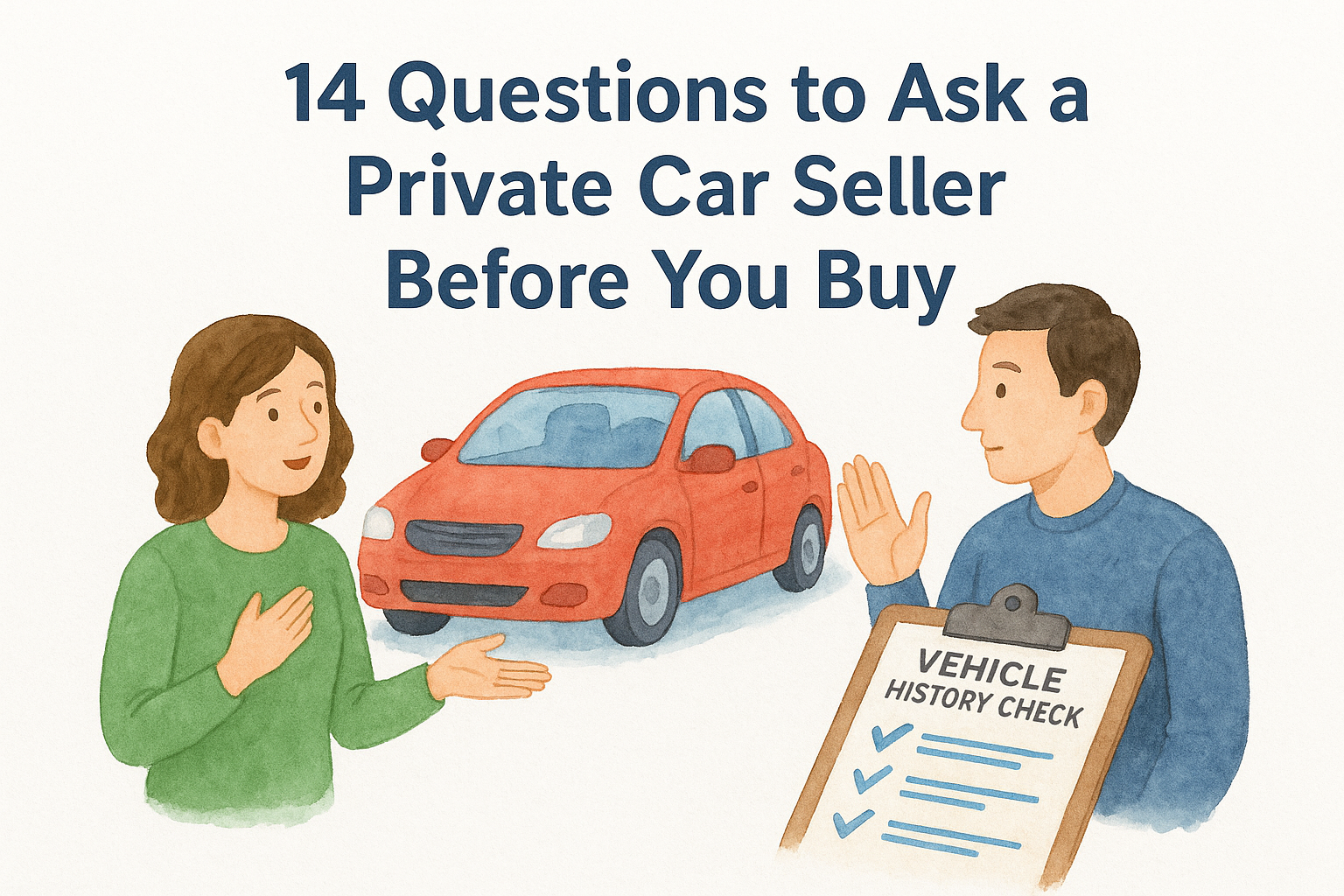
14 Questions to Ask a Private Car Seller Before You Buy
Buying a used car from a private seller can save you thousands compared to a dealership, but it also puts all the risk on your shoulders. There's no warranty, no consumer protection to fall back on, and no one double-checking the seller's story before you hand over cash. Knowing the right questions to ask private car seller contacts before you view the car, or hand over a deposit, is the difference between a smart purchase and an expensive mistake.
This guide gives you a direct answer to that problem: a practical list of questions covering ownership, service history, accident damage, outstanding finance, and the reason for selling. Asking these upfront helps you spot inconsistent answers and red flags that sellers hoping to offload a problem vehicle would rather you didn't notice.
Below, you'll find 14 questions worth asking every private seller, plus why each one matters and what a dodgy answer sounds like. We'll also point out where a vehicle history check backs up what the seller tells you, so you're not relying on their word alone. Pair these questions with a proper registration lookup and you'll walk into any viewing far better prepared than most buyers.
1. Can you show me a vehicle history check report?
Starting with this question sets the tone for everything else. Asking for a vehicle history check upfront tells the seller you've done your homework and aren't going to take their word for granted. It also gives you a factual baseline, mileage, MOT record, write-off status, and outstanding finance, before you even ask a single follow-up question.
Why it matters
A history check pulls data straight from official sources like the DVLA and insurance registers, so it's far harder to fake than a verbal claim. If the seller has nothing to hide, they'll usually have already run one themselves or won't mind you running one on the spot using nothing more than the registration plate. Vehiclepedia's free check covers MOT status, road tax, and basic registration details in seconds, which is enough to catch obvious inconsistencies before you waste a trip viewing the car.
A private seller who hesitates when you mention a vehicle history check is telling you something, even if they don't say a word.
What a good answer looks like
A seller with nothing to hide will happily let you run a check, and many will already have printed or screenshot results ready to show you. Look for answers such as:
- "Here's the report I ran last week, feel free to double-check it yourself."
- "I don't mind, the reg is on the windscreen, go ahead and look it up."
- "I've had a premium check done that covers write-off and finance status too."
A good seller treats this as a normal part of the sale, not an interrogation. If they offer to sit with you while you run the check on your phone, that's a strong signal of transparency, particularly for a premium report covering finance and write-off history rather than just the free basics.
Warning signs to watch for
Hesitation here is the biggest red flag on this entire list. Watch for sellers who:
- Change the subject or rush you towards the test drive instead
- Claim the reg plate is "new" or recently changed with no clear explanation
- Refuse to let you photograph the plate or VIN before you leave
- Insist verbal reassurance is "good enough" and a check isn't necessary
Any of these should make you pause. A genuine seller has nothing to lose by letting you verify their claims against official records, and a five-minute free lookup can save you from a stolen, written-off, or finance-encumbered car before you've even opened the driver's door.
2. Why are you selling the car?
This question sounds simple, but it does a lot of work. The answer tells you whether you're dealing with someone upgrading their family car or someone quietly trying to get rid of a problem vehicle before it costs them more money. It's also a useful way to gauge how honest a seller is generally, since a rehearsed or evasive answer here often predicts how they'll handle harder questions later.
Why it matters
Genuine reasons for selling are usually mundane: a new job, a growing family, a change in circumstances, or simply wanting a different model. Sellers offloading a car with hidden faults, an upcoming expensive repair, or a history they'd rather not discuss tend to give vaguer answers or avoid the question altogether. Cross-referencing this answer against what a vehicle history check shows can also confirm whether the story adds up, for instance if the car changed hands more recently than the seller implies.
If a seller can't give you a straight answer about why they're selling, ask yourself what they're not telling you.
What a good answer looks like
Honest sellers tend to give specific, unremarkable reasons without prompting:
- "We've had a second child and need something bigger."
- "I've moved closer to work and don't drive as much now."
- "I've already bought my next car and this one's just sitting on the drive."
These answers are consistent, low-drama, and easy to believe because they match ordinary life circumstances.
Warning signs to watch for
Be cautious if the seller:
- Gives a vague answer like "just fancied a change" with no further detail when pressed
- Contradicts themselves later, such as claiming they love the car but are selling in a rush
- Seems unusually keen to complete the sale quickly, especially with pressure to skip checks
- Avoids the question entirely and steers you back to the price
Any of these should push you towards a closer look at the car's paperwork and history before committing further.
3. How long have you owned it, and are you the registered keeper?
This question uncovers a detail many buyers forget to check: whether the person selling the car is actually the one legally entitled to sell it. A seller who isn't the registered keeper might be a trader posing as a private individual, or worse, someone selling a car that isn't theirs to sell.
Why it matters
Ownership length tells you a lot about the seller's relationship with the car and how much they actually know about it. Someone who's owned the car for years can usually answer detailed questions about its quirks, servicing, and history without hesitation. Someone who bought it two weeks ago and is already selling it should raise questions, especially if they can't explain why. Checking the V5C logbook against what the seller tells you, and against the keeper history shown in a vehicle history check, confirms whether their story matches official records.
A seller who can't explain how long they've owned the car is a seller you should be checking very carefully.
What a good answer looks like
A straightforward answer sounds like this:
- "I've had it since 2021, bought it from a dealer in Leeds."
- "Yes, I'm the registered keeper, it's been in my name the whole time."
- "I bought it from my brother two years ago and we did the logbook change together."
These answers are specific, consistent with the paperwork, and easy to verify against the V5C.
Warning signs to watch for
Treat these responses with caution:
- "It's not in my name yet, but that's fine, we'll sort it after the sale."
- Vague or shifting answers about how long they've had the car
- Reluctance to show the V5C or explain a recent change of keeper
Any mismatch between what the seller says and what the logbook or history check shows is worth walking away from.
4. What is the current mileage, and does it match the MOT history?
Mileage tells you how hard a car has worked, but only if it's genuine. Clocking, winding back the odometer to hide true wear, remains one of the most common tricks used to inflate a car's value. Asking this question directly, and checking the answer against official records, is one of the fastest ways to catch a dishonest seller before you go any further.
Why it matters
Every MOT test since 2005 records the mileage at the time, creating a public trail you can check independently of anything the seller tells you. A vehicle history check pulls this MOT mileage history automatically, letting you compare it against the number on the dashboard in seconds. If the mileage has dropped between tests, or jumped in a way that doesn't match normal use, that's a fact, not an accusation, and it's grounds to walk away or demand an explanation.
Odometer readings are only worth trusting once you've checked them against the MOT record yourself.
What a good answer looks like
A seller confident in their mileage will happily let you verify it:
- "It's just over 62,000, and that lines up with the MOT last month."
- "Here's the service book showing the mileage at each visit."
- "Go ahead and run the check, it'll show the same figure."
Consistency across the dashboard, service book, and MOT history is what you're looking for.
Warning signs to watch for
Be wary if you notice:
- A mileage figure lower than a previous MOT record shows
- Service stickers or documents with mileage that don't match the odometer
- A seller who gets defensive or vague when you mention checking MOT history
- Wear on pedals, seats, or steering wheel that looks inconsistent with a low reading
Any of these warrants a closer independent check before you commit.
5. Can I see the V5C logbook?
The V5C, often called the logbook, is the document the DVLA issues to register a car's keeper. It's not proof of ownership, but it's the single most useful piece of paper a seller can hand you, and asking to see it early tells you a lot about how organised and honest they are. If a seller can't produce it, or offers excuses instead of paperwork, that's reason enough to slow down.

Why it matters
The V5C carries the vehicle identification number (VIN), the registered keeper's name and address, and a watermark that's genuinely difficult to forge convincingly. Comparing the VIN on the document against the one stamped on the car itself, usually visible through the windscreen or under the bonnet, catches a surprising number of dodgy sales where the paperwork belongs to a different vehicle entirely. It's also worth checking the document has the DVLA watermark and hologram rather than looking photocopied or altered.
If the V5C doesn't match the car in front of you, walk away before you ask anything else.
What a good answer looks like
A seller with nothing to hide will produce the logbook without being asked twice:
- "Here it is, have a look, the VIN's on page two."
- "It's in my name, registered at this address since 2020."
- "Take a photo if you want to check it against the car."
A genuine document, a matching VIN, and an address that lines up with where you're viewing the car all build confidence.
Warning signs to watch for
Be cautious if the seller:
- Claims the logbook is "in the post" or lost with no DVLA replacement in progress
- Shows a V5C with a different name or address to the person selling
- Refuses to let you check the VIN against the vehicle
- Produces a document that looks photocopied, laminated oddly, or missing the watermark
Any of these should stop the sale until you've verified the paperwork properly.
6. Does the car have a full service history?
A full service history shows you whether the car has been looked after properly, not just driven until something broke. It's one of the clearest indicators of how the previous owner treated the vehicle, and it directly affects resale value and reliability going forward.
Why it matters
Regular servicing catches small problems before they become expensive ones, so a gap in the records often points to neglect rather than just missing paperwork. A service history also gives you a paper trail of who's worked on the car, which parts were replaced, and roughly when the next big job is due. Sellers who genuinely maintained the car well usually keep this documentation close at hand, because it's one of their strongest selling points.
A car with a full service history has usually been treated well; one without it has usually been neglected, or the truth is missing.
What a good answer looks like
Confident sellers produce evidence without hesitation:
- "Here's the stamped service book, every year at the same garage."
- "I've got digital invoices from the dealership for each service."
- "It's missed one interval, but here's why and what was checked instead."
Gaps explained honestly, alongside receipts, are far more reassuring than a spotless-looking book with no supporting invoices at all.
Warning signs to watch for
Treat these responses carefully:
- "It's been serviced, just not anywhere that keeps records"
- A stamped book with handwriting that looks inconsistent between entries
- No invoices, receipts, or garage names to back up the claimed history
- Long unexplained gaps between services, especially recent ones
Any of these should push you towards budgeting for an inspection, since missing history often hides underlying mechanical issues the seller would rather you didn't find.
7. Is any servicing or maintenance due soon?
Knowing what's coming up, not just what's already been done, helps you budget properly before you buy. A car might have a spotless service history behind it but still need a cambelt, brake fluid change, or set of tyres within weeks of you driving it home. Asking this question upfront stops those costs from becoming an unwelcome surprise a month into ownership.
Why it matters
Every car has a maintenance schedule, and manufacturers publish intervals for cambelts, timing chains, brake fluid, and other jobs that aren't always obvious from a visual inspection. A seller who's owned the car for years usually knows exactly what's due and when, because they've been managing that schedule themselves. This answer also tells you whether the asking price reflects the car's true running costs, since a car needing a £400 cambelt change soon should be priced accordingly.
A seller who doesn't know what's due soon either hasn't looked, or doesn't want you to know what it'll cost you.
What a good answer looks like
A seller who's on top of maintenance gives specifics rather than shrugging it off:
- "The cambelt's due next year, but it's not urgent."
- "Brake pads are getting low, budget for those within a couple of months."
- "Everything's been done recently, next service isn't due for another 8,000 miles."
Specific mileage or timeframes, backed by the service book, show a seller who genuinely understands the car's condition.
Warning signs to watch for
Be wary if the seller:
- Says "I'm not sure, never really looked into it" despite owning the car for years
- Dismisses obvious wear, like worn tyres or a warning light, as "nothing to worry about"
- Avoids giving a straight answer about upcoming costs
- Undersells how soon a major job like a cambelt or clutch is due
Any vagueness here means you should check the service book yourself and price in the worst case before agreeing a figure.
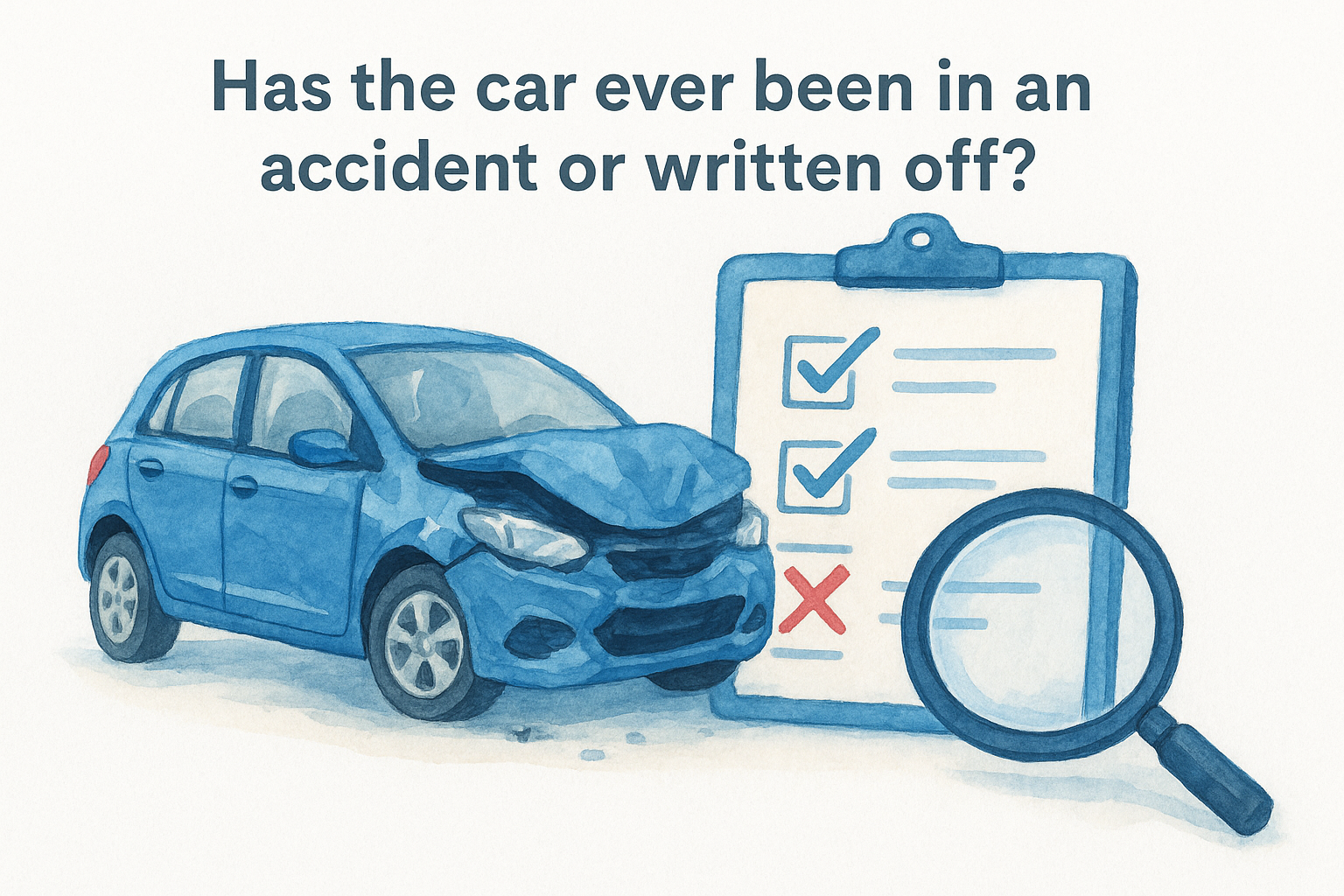
8. Has the car ever been in an accident or written off?
Crash damage doesn't always show on the surface, and a car repaired after a serious accident can hide structural problems that only surface months later. Asking directly whether the car has ever been in an accident, or worse, written off and repaired, forces the seller to address something a vehicle history check can confirm independently of their answer.
Why it matters
Insurers categorise write-offs from Cat A through to Cat N, and a car repaired after a Cat S or Cat C write-off can look perfectly normal while carrying hidden structural or electrical faults. A write-off check cross-references police and insurance databases to flag this history even when the seller genuinely doesn't know it themselves, which happens more often than you'd expect with cars that have changed hands several times.
A car that looks fine after an accident isn't the same as a car that's been fixed properly.
What a good answer looks like
Honest sellers who've had minor repair work done tend to explain it plainly:
- "It had a small bump on the rear bumper, repaired at a bodyshop, here's the invoice."
- "No accidents I'm aware of, and the history check backs that up."
- "The previous owner mentioned a scrape, nothing structural, I can show you where."
Documentation and a matching history check give you confidence the damage was minor and properly repaired.
Warning signs to watch for
Watch closely for sellers who:
- Insist "nothing's ever happened to it" while panel gaps or paint mismatches suggest otherwise
- Get defensive when you mention running a write-off check
- Claim ignorance about a previous owner's accident despite owning the car for years
- Avoid letting you inspect the underside or boot floor for repair signs
Any of these should send you straight to a premium history check before you go any further.
9. Is there any outstanding finance on the car?
Buying a car with outstanding finance attached is a genuine legal risk, not just an inconvenience. Under the terms most lenders use, the finance company technically owns the car until the loan is settled, which means they can repossess it from you even if you bought it in good faith and paid the seller in full.
Why it matters
Thousands of used cars change hands every year with finance still owed on them, sometimes because the seller genuinely forgot, and sometimes because they're deliberately hiding it. A finance check searches records held by lenders across the UK and flags any active agreement tied to the registration, giving you proof one way or the other rather than relying on a verbal promise. Vehiclepedia's premium report includes this check alongside write-off and stolen vehicle status, backed by a £30,000 data guarantee for non-trade buyers.
Paying a private seller in full doesn't protect you from a finance company reclaiming the car later.
What a good answer looks like
A seller with a clean title will usually confirm this without hesitation:
- "It's fully paid off, here's the settlement letter from the finance company."
- "I bought it outright, no finance ever taken out on it."
- "Run the check yourself, it'll come back clear."
Paperwork proving settlement, or a willingness to let you verify independently, gives you real confidence.
Warning signs to watch for
Treat these responses with real caution:
- "There might be a bit left, but it's not a problem"
- Pressure to pay in cash quickly before you can run a finance check
- Refusal to provide settlement figures or lender details
- Vague answers about how the car was originally bought
Any hesitation here should stop the sale until a proper check confirms the car is genuinely free of finance.
10. Are there any known mechanical or electrical problems?
No car is perfect, and a seller who admits to a minor fault is usually more trustworthy than one who insists everything is flawless. Asking directly about known faults gives the seller a chance to be upfront before you find the problem yourself, ideally after you've already paid.
Why it matters
Electrical gremlins and mechanical niggles rarely show up during a quick five-minute viewing, especially faults that only appear when the engine's warm or the car's been driven for a while. A seller who's owned the car for any length of time will know about that intermittent warning light or the window that sticks, because they've lived with it. Getting this admission before you buy means you can negotiate the price down or budget for the repair, rather than discovering it on the drive home.
Every honest seller has at least one small niggle to mention; it's the ones who claim perfection you should question.
What a good answer looks like
Sellers who are genuinely being straight with you tend to give specific, unprompted detail:
- "The air con's a bit weak, needs regas soon."
- "There's a slight rattle at idle, garage said it's just a heat shield."
- "Nothing major, but the infotainment screen freezes occasionally."
Specific, low-stakes admissions like these usually indicate honesty rather than a seller hiding something bigger.
Warning signs to watch for
Be suspicious if the seller:
- Insists "nothing at all, it's perfect" despite years of ownership
- Gets irritated or dismissive when you ask follow-up questions
- Mentions a fault only after you spot it yourself during the viewing
- Contradicts something the service history already documents
Any of these patterns suggests the seller is managing what you hear rather than telling you the full picture, which is exactly why this question belongs near the top of your list.
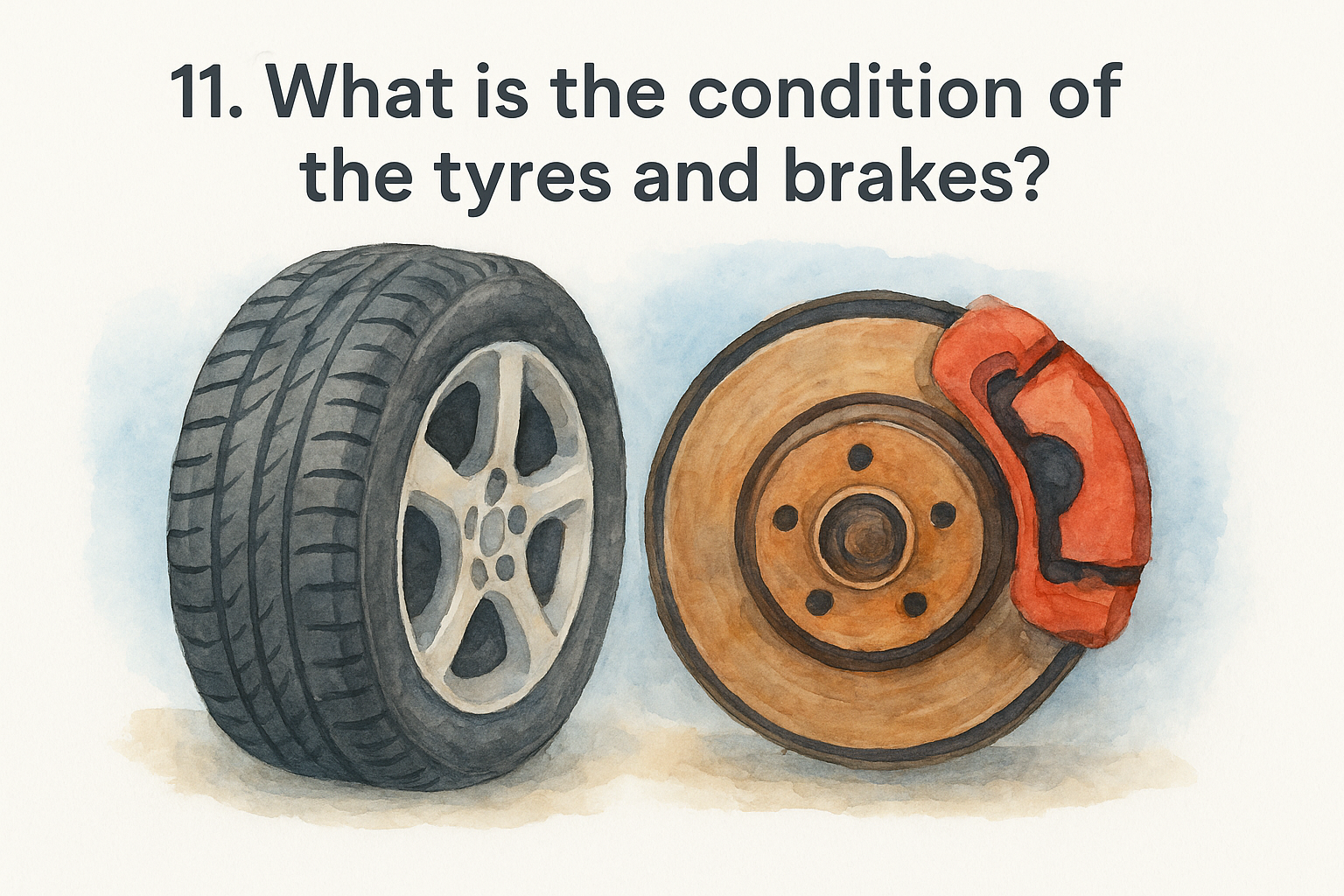
11. What is the condition of the tyres and brakes?
Tyres and brakes are the parts most likely to need immediate spending after you buy, yet they're also the easiest for a seller to gloss over during a quick viewing. Asking about their condition directly gives you a real figure to budget against, rather than discovering worn pads or bald tyres once you're already committed.
Why it matters
Legal tyre tread depth in the UK is 1.6mm, but anything close to that limit means you'll be paying for replacements within weeks. Tyre condition also reveals how the car's been driven, since uneven wear can point to alignment problems or suspension faults the seller hasn't mentioned. Brakes are similarly easy to overlook visually, so ask when the pads and discs were last changed rather than just glancing at them yourself.
Worn tyres and brakes aren't a dealbreaker on their own, but they're a cost you should be negotiating into the price, not discovering afterwards.
What a good answer looks like
A seller who maintains the car properly will usually know these details without checking:
- "Tyres were replaced last summer, still got plenty of tread."
- "Brake pads were done about six months ago, discs are fine."
- "Front tyres are getting low, I'd budget for those soon."
Specific answers backed by service records give you confidence the figures are genuine, not guessed at.
Warning signs to watch for
Be cautious if the seller:
- Says "they're fine" without ever having actually checked
- Downplays a visible bald patch or cracked sidewall
- Can't recall when brakes were last serviced despite years of ownership
- Rushes the viewing before you can inspect the wheels closely
Any of these should push you towards inspecting the tyres and brakes yourself before agreeing a final price.
12. Does the car have a valid MOT?
A car without a valid MOT can't legally be driven on public roads except to a pre-booked test appointment, so this question settles whether the car is even road-legal today. It also opens the door to checking the MOT history in detail, which is one of the richest free sources of information about a car's condition over time.
Why it matters
Beyond legality, the MOT history shows advisories from previous tests, the kind of notes that flag corrosion, worn suspension components, or emissions issues building up over several years. You can pull this directly from the government's own MOT history checker, which lists every test result, mileage recorded, and advisory given since 2005. A seller's answer should match what that record shows, and any gap between the two is worth questioning.
An MOT certificate tells you the car passed on the day, not that it's problem-free now.
What a good answer looks like
A seller confident in the car's condition will point you straight to the paperwork:
- "It's got eight months left, certificate's in the glovebox."
- "Passed last month with no advisories, here's the printout."
- "Due in three weeks, I'll get it retested before we complete if you want."
Specific dates and a willingness to show the certificate or let you check online both build confidence.
Warning signs to watch for
Treat these responses with suspicion:
- "It's expired, but it'll definitely pass, don't worry about it"
- Reluctance to give the exact expiry date or advisory details
- Advisories from the last test that clearly haven't been addressed
- Pressure to complete the sale before you've checked the MOT history yourself
Any of these should send you to the free government checker before you agree anything further.
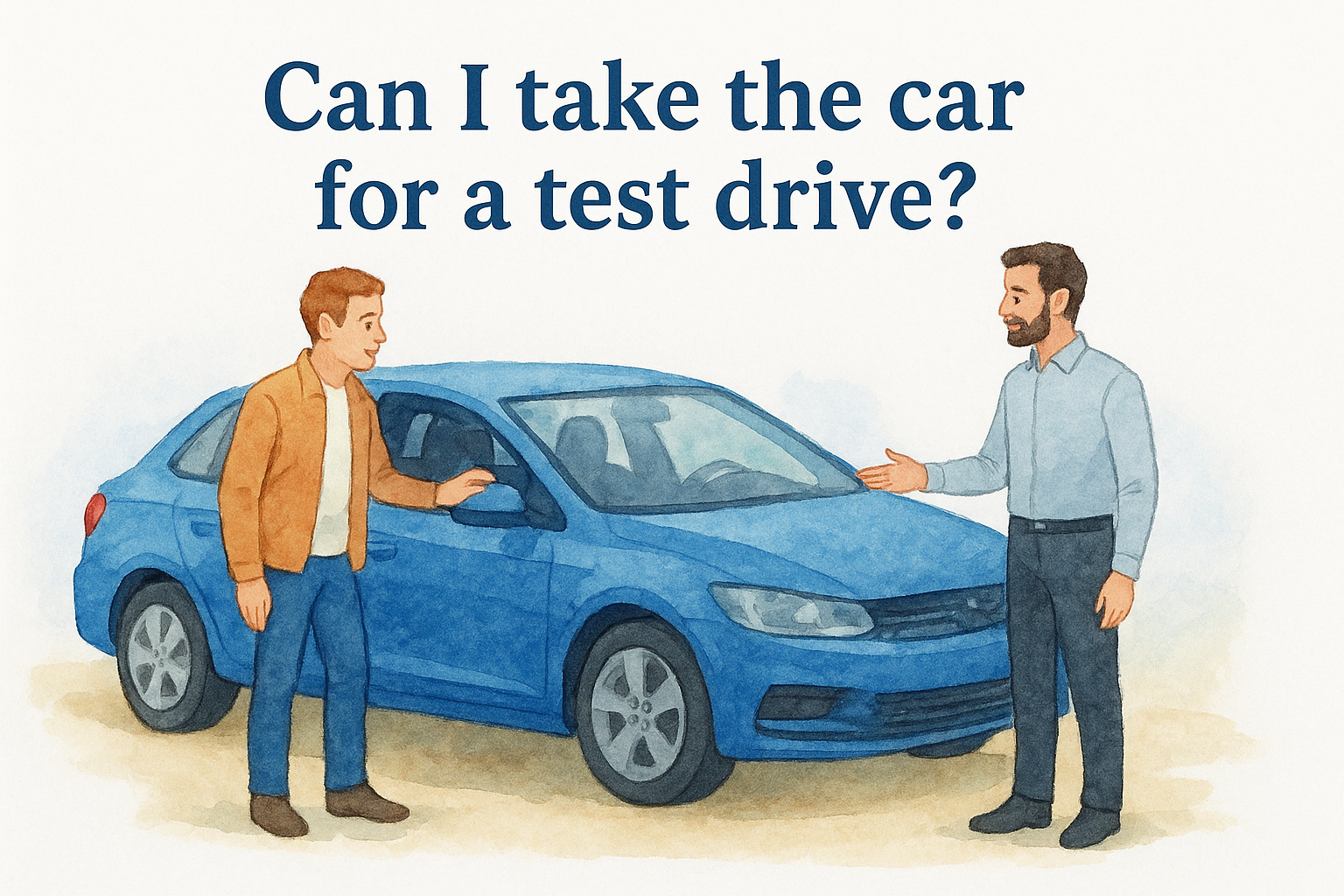
13. Can I take the car for a test drive?
Refusing a test drive is one of the clearest signs a seller has something to hide, yet it's astonishing how many buyers agree to purchase a car without ever driving it. A proper test drive tells you things no photo, video call, or verbal description ever can, from how the gearbox shifts to whether the steering pulls to one side.
Why it matters
A short drive around the block won't cut it. You need enough distance to bring the engine up to full temperature, test the brakes at speed, and hear any noises that only appear once the car's been running for ten minutes or more. A test drive also lets you check that the mileage on the dashboard climbs normally and that warning lights don't appear once the engine's warm, both of which back up what you learned from the vehicle history check earlier.
If a seller won't let you drive the car properly, assume there's a reason it won't survive the journey.
What a good answer looks like
Sellers confident in their car tend to encourage a thorough drive rather than limit it:
- "Take it on the dual carriageway, get it up to speed properly."
- "Drive it as long as you need, I'll come along if you'd like."
- "Bring your own insurance details, no rush on the route."
A relaxed attitude towards the route and duration usually reflects genuine confidence in the car's condition.
Warning signs to watch for
Be wary if the seller:
- Limits you to a few hundred metres on quiet residential roads
- Insists on driving themselves with you only as a passenger
- Claims the car "isn't insured" for you to drive it at all
- Rushes you back before the engine's properly warmed through
Any of these should delay the sale until you've driven the car properly yourself.
14. Can I have the car independently inspected?
An independent inspection is your last line of defence, and it's the one question that catches faults every other conversation might miss. A qualified mechanic or inspection service can put the car on a ramp, check the underside, and run diagnostics that reveal problems no test drive or history check will ever surface.
Why it matters
Sellers can answer every question on this list honestly and still not know about a slow coolant leak, worn suspension bushes, or a subframe repair hidden under fresh underseal. An independent inspection costs a small fraction of the car's price, typically £100 to £200, yet it can save you thousands if it flags a fault serious enough to walk away over. Organisations like the RAC and AA offer inspection services, and neither has any financial interest in whether you buy the car, unlike the seller.
Spending £150 on an inspection before you buy beats spending £1,500 fixing what it would have caught.
What a good answer looks like
A seller with genuine confidence in the car welcomes this suggestion outright:
- "No problem, just let me know when you'd like to bring someone round."
- "I've had it checked before, but feel free to get your own inspection done."
- "Take it to a garage of your choosing, I'll wait while it's done."
Flexibility around timing and location, rather than resistance, is what you want to see here.
Warning signs to watch for
Treat hesitation seriously if the seller:
- Refuses outright or claims it's "unnecessary" for a car in this condition
- Insists on using their own mechanic rather than one you choose
- Adds time pressure that conveniently rules out booking an inspection
- Becomes irritated or defensive the moment you raise the idea
Any of these should make you pause before parting with a deposit, regardless of how good the car looks on the day.
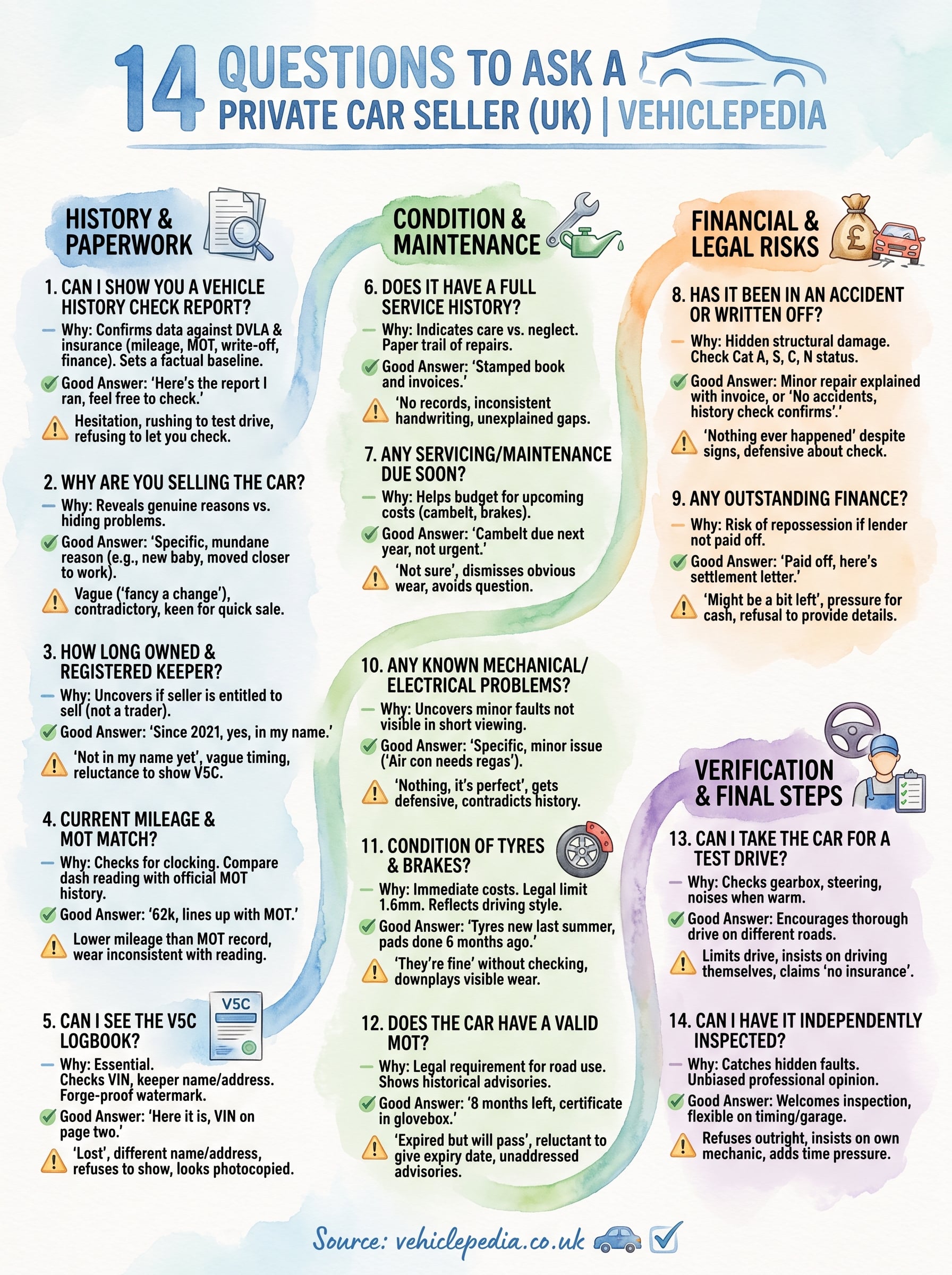
Putting these questions into practice
None of these 14 questions are complicated, but asking all of them takes discipline. Most buyers get swept up in how a car looks and drives, then forget to press the seller on finance, write-off status, or why the car's actually for sale. Write the list down, take it with you to the viewing, and don't feel awkward about working through it properly. A genuine seller expects careful buyers and won't mind the scrutiny.
What you can't verify by conversation alone, you can verify with data. A vehicle history check confirms mileage, MOT status, write-off history, and outstanding finance against official DVLA and insurance records, so you're never relying purely on the seller's word. Run a free check before you even book the viewing, then decide whether the full picture justifies a premium report.
Before you commit to anything, take a look at our sample report to see exactly what a premium check reveals.